Implementation of Biochar-Supported Fish Smoking Technology as A Green Technology Model for Sustainable Coastal Community Economy
DOI:
https://doi.org/10.12928/spekta.v7i1.16116Keywords:
Community empowerment, Fish smoking, Green technology biochar, Sustainable economyAbstract
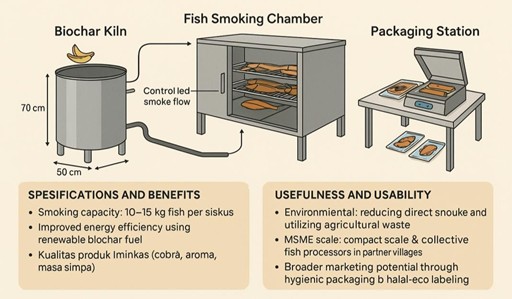
Background: Traditional fish smoking practices in coastal communities still rely heavily on firewood and conventional smoking systems, resulting in excessive smoke emissions, inefficient fuel consumption, and environmental pollution. This community service program introduced biochar-supported fish smoking technology as a green technology innovation to strengthen sustainable coastal community economies.
Contribution: This program contributes an integrative and replicable community empowerment model that combines biochar-based green technology, entrepreneurship strengthening, and digital marketing transformation within cross-country coastal communities.
Methods: The program was implemented in Bintang Meriah Village, Langkat Regency, North Sumatra, Indonesia, and Kuala Kedah, Malaysia, involving 28 participants from fish-smoking SMEs and coastal community groups. Activities were conducted through socialization, training, technology application, and mentoring.
Results: The implementation of biochar-supported fish smoking technology reduced firewood consumption by approximately 26%, decreased smoke emissions by around 30%, and improved production efficiency by approximately 24%. Approximately 68% of participants successfully adopted digital marketing platforms for product promotion and business expansion.
Conclusion: The integration of biochar-supported fish smoking technology and community empowerment successfully improved environmental sustainability, production efficiency, and local economic resilience.
References
C.-T. Pan and S.-J. Hsu, “Effects of a One-day Environmental Education Program on Sixth-Graders’ Environmental Literacy at a Nature Center in Eastern Taiwan,” Sustainability, vol. 12, no. 12, p. 5043, Jun. 2020, https://doi.org/10.3390/su12125043
S. P. Sohi, E. Krull, E. Lopez-Capel, and R. Bol, “A Review of Biochar and Its Use and Function in Soil,” 2010, pp. 47–82. https://doi.org/10.1016/S0065-2113(10)05002-9
A. Yüksel, M. Arıcı, M. Krajčík, M. Civan, and H. Karabay, “Energy consumption, thermal comfort, and indoor air quality in mosques: Impact of Covid-19 measures,” J. Clean. Prod., vol. 354, p. 131726, Jun. 2022, https://doi.org/10.1016/j.jclepro.2022.131726
W. Qiao, “Performance of Cu‐Ce / M‐Al (M = Mg, Ni, Co, Zn) hydrotalcite derived catalysts for hydrogen production from methanol steam reforming,” Int. J. Energy Res., vol. 45, no. 9, pp. 12773–12783, Jul. 2021, https://doi.org/10.1002/er.6610
P. Lacy, J. Long, and W. Spindler, The Circular Economy Handbook. London: Palgrave Macmillan UK, 2020.
J. Lehmann and S. Joseph, Eds., Biochar for Environmental Management. Routledge, 2015.
W. D. N. M. S. Tennakoon, M. P. N. Janadari, and I. D. Wattuhewa, “Environmental sustainability practices: A systematic literature review,” Eur. J. Sustain. Dev. Res., vol. 8, no. 3, p. em0259, Jul. 2024, https://doi.org/10.29333/ejosdr/14604
B. R. Moharana, B. C. Behera, and K. Muduli, Digital Technology Enabled Circular Economy. New York: CRC Press, 2024.
A. Patro, S. Dwivedi, A. Thakur, P. K. Sahoo, and J. K. Biswas, “Recent approaches and advancement in biochar-based environmental sustainability: Is biochar fulfilling the sustainable development goals?,” iScience, vol. 27, no. 9, p. 110812, Sep. 2024, https://doi.org/10.1016/j.isci.2024.110812
M. Afshar and S. Mofatteh, “Biochar for a sustainable future: Environmentally friendly production and diverse applications,” Results Eng., vol. 23, p. 102433, Sep. 2024, https://doi.org/10.1016/j.rineng.2024.102433
A. B. Duwiejuah, Z. Mutawakil, and E. O. Oyelude, “Eco-friendly banana peel biochar for adsorption of toxic metals from landfill treatment pond leachate,” Int. J. Phytoremediation, vol. 27, no. 5, pp. 596–605, Apr. 2025, https://doi.org/10.1080/15226514.2024.2428434
S. Suryanto, “The potential contribution of Indonesian fishing vessels in reducing Green House gas emission,” Aquac. Fish., vol. 10, no. 3, pp. 372–381, May 2025, https://doi.org/10.1016/j.aaf.2024.08.002
P. Warner, C. Kerry, A. Nuno, N. A. Miller, M. Rickwood, and K. Metcalfe, “A synthesis of research into marine small-scale fishers’ operational behaviour,” Mar. Policy, vol. 179, p. 106740, Sep. 2025, https://doi.org/10.1016/j.marpol.2025.106740
M. Rizwan, “Sustainable manufacture and application of biochar to improve soil properties and remediate soil contaminated with organic impurities: a systematic review,” Front. Environ. Sci., vol. 11, Nov. 2023, https://doi.org/10.3389/fenvs.2023.1277240
N. Rai, A. Kachore, J. M. Julka, and S. P. Das, “Biochar-based technologies for sustainable aquaculture: A review of synthesis, properties, and application in water quality improvement and nutrient management,” J. Water Process Eng., vol. 71, p. 107338, Mar. 2025, https://doi.org/10.1016/j.jwpe.2025.107338
O. Olagoke-Komolafe and J. Oyeboade, “Circular Economy in Fisheries: Transforming Aquatic Waste into Sustainable Resources for Agricultural and Industrial Use,” Int. J. Multidiscip. Futur. Dev., vol. 6, no. 2, pp. 45–58, 2025, https://doi.org/10.54660/IJMFD.2025.6.2.45-58
S. Akbar, R. P. Putra, I. M. N. Saragih, and N. Ranasti, “Circular economy transition through community-based ecopreneurship empowerment model: Reconstructing the environmental care community,” EcoProfit Sustain. Environ. Bus., vol. 3, no. 1, pp. 51–70, Jul. 2025, https://doi.org/10.61511/ecoprofit.v3i1.2025.2152
M. M. H. Mozumder and P. Schneider, “Advancing sustainability through the circular economy in small-scale fisheries: A global review of practices, challenges, and policy innovations,” Mar. Policy, vol. 185, p. 107001, Mar. 2026, https://doi.org/10.1016/j.marpol.2025.107001
S. A. Siddiqui, S. Singh, N. A. Bahmid, and A. Sasidharan, “Applying innovative technological interventions in the preservation and packaging of fresh seafood products to minimize spoilage - A systematic review and meta-analysis,” Heliyon, vol. 10, no. 8, p. e29066, Apr. 2024, https://doi.org/10.1016/j.heliyon.2024.e29066
A. Hassoun, “Use of industry 4.0 technologies to reduce and valorize seafood waste and by-products: A narrative review on current knowledge,” Curr. Res. Food Sci., vol. 6, p. 100505, 2023, https://doi.org/10.1016/j.crfs.2023.100505
A. Salim, H. Saediman, and Y. Yusnaini, “Profitability of Vannamei Shrimp Farming: Traditional vs. Intensive Systems in Kolaka District in Indonesia,” J. Glob. Innov. Agric. Sci., pp. 597–606, Apr. 2025, https://doi.org/10.22194/JGIAS/25.1595
D. Sarkity, A. Fernando, Y. Pratama, and B. Irawan, “Global warming’s effects on marine and coastal environments: Students’ knowledge, attitudes, and environmental behaviour,” J. Environ. Sustain. Educ., vol. 3, no. 2, pp. 250–261, Jun. 2025, https://doi.org/10.62672/joease.v3i2.81
I. Hossain, A. K. M. M. Haque, and A. Al Masud, “Mapping urban nature-based solutions and environmental sustainability in South Asia: A social–ecological–technological systems perspective on research trends, governance gaps and policy pathways,” Nature-Based Solut., vol. 9, p. 100326, Jun. 2026, https://doi.org/10.1016/j.nbsj.2026.100326
S. B. Kurniawan, “Tackling marine pollution in the blue economy: Synergies between wastewater treatment technologies and governmental policies,” Mar. Pollut. Bull., vol. 222, p. 118627, Jan. 2026, https://doi.org/10.1016/j.marpolbul.2025.118627
N. M. Suki, N. M. Suki, A. Sharif, S. Afshan, and K. Jermsittiparsert, “The role of technology innovation and renewable energy in reducing environmental degradation in Malaysia: A step towards sustainable environment,” Renew. Energy, vol. 182, pp. 245–253, Jan. 2022, https://doi.org/10.1016/j.renene.2021.10.007
J. Paul, I. Alhassan, N. Binsaif, and P. Singh, “Digital entrepreneurship research: A systematic review,” J. Bus. Res., vol. 156, p. 113507, Feb. 2023, https://doi.org/10.1016/j.jbusres.2022.113507
Y. Yu, Z. Wang, Q. Chen, and Q. Chen, “Innovative Approaches to Waste Management in Circular Economy: Technological Advancements and Policy Implications,” J. Fintech Bus. Anal., vol. 2, no. 1, pp. 11–15, Feb. 2025, https://doi.org/10.54254/3049-5768/2025.20858
M. Al-Emran and C. Griffy-Brown, “The role of technology adoption in sustainable development: Overview, opportunities, challenges, and future research agendas,” Technol. Soc., vol. 73, p. 102240, May 2023, https://doi.org/10.1016/j.techsoc.2023.102240
A. F. Rahman, “Community-Based Approaches to Environmental Sustainability: A Social Science Review,” Int. J. Soc. Sci. Appl. Technol., vol. 1, no. 1, pp. 12–21, Sep. 2025, https://doi.org/10.64391/ijssat.v1i1.002
S. S. Saraugi, F. Asare, R. Gazo, and W. Routray, “Advances in sustainable production of biochar and biochar-based nanocomposites: A critical review,” J. Clean. Prod., vol. 514, p. 145752, Jul. 2025, https://doi.org/10.1016/j.jclepro.2025.145752
M. Keiluweit, P. S. Nico, M. G. Johnson, and M. Kleber, “Dynamic Molecular Structure of Plant Biomass-Derived Black Carbon (Biochar),” Environ. Sci. Technol., vol. 44, no. 4, pp. 1247–1253, Feb. 2010, https://doi.org/10.1021/es9031419
M. Faishal, E. Mohamad, E. Utami, O. Adiyanto, H. M. Asih, and S. A. Kurnia, “Developing Marketing Strategies for MSMEs through SWOT Analysis and the Analytical Hierarchy Process (AHP),” Appl. Community Transformation and Sustainability, 2025, [Online]. Available: https://journal.ygtmi.org/acts/article/view/33
O. Adiyanto, F. Maruf, and A. Hopid, “The Predicting The Optimal Compressive Strength of Sustainable Brick Using Response Surface Method (RSM),” Eng. Access, 2025, [Online]. Available: https://ph02.tci-thaijo.org/index.php/mijet/article/view/253919.
I. Muis, “The State of Digital Transformation Among Indonesian SMEs: Insights from a Systematic Review,” J. Ilmu Multidisiplin, vol. 4, no. 3, pp. 1407–1419, Aug. 2025, https://doi.org/10.38035/jim.v4i3.1227
Z. Maulana, M. C. Hidayat, and I. Agustina, “Using digital marketing for small and medium enterprises (SMEs) in Bumdes Remboko Sumberrejo village Sleman regency,” SPEKTA (Jurnal Pengabdian Kepada Masyarakat Teknologi dan Aplikasi). 2022, https://doi.org/10.12928/spekta.v3i1.4563
M. P. Shah and P. Kaur, Biomass Energy for Sustainable Development. Boca Raton: CRC Press, 2024.
J. F. Saldarriaga and J. E. López, “Biochar as a Bridge Between Biomass Energy Technologies and Sustainable Agriculture: Opportunities, Challenges, and Future Directions,” Sustainability, vol. 17, no. 24, p. 11285, Dec. 2025, https://doi.org/10.3390/su172411285
P. Chowdhury, T. Chowdhury, H. Chowdhury, and E. Bontempi, “Food waste to biochar; a potential sustainable solution for Australia: a comprehensive review,” Carbon Res., vol. 4, no. 1, p. 41, May 2025, https://doi.org/10.1007/s44246-025-00207-7
Downloads
Published
How to Cite
Issue
Section
License
Copyright (c) 2026 Khairiah Khairiah

This work is licensed under a Creative Commons Attribution-ShareAlike 4.0 International License.
Authors who publish with SPEKTA (Jurnal Pengabdian Kepada Masyarakat: Teknologi dan Aplikasi) agree to the following terms:
- Authors retain copyright and grant the journal the right of first publication with the work simultaneously licensed under a Creative Commons Attribution License (CC BY-SA 4.0) that allows others to share the work with an acknowledgment of the work's authorship and initial publication in this journal.
- Authors are able to enter into separate, additional contractual arrangements for the non-exclusive distribution of the journal's published version of the work (e.g., post it to an institutional repository or publish it in a book), with an acknowledgment of its initial publication in this journal.
- Authors are permitted and encouraged to post their work online (e.g., in institutional repositories or on their website) prior to and during the submission process, as it can lead to productive exchanges, as well as earlier and greater citation of published work.

This work is licensed under a Creative Commons Attribution-ShareAlike 4.0 International License.