Strengthening Vocational High School Leadership through PAKEM SMK: A Project Action Plan–Based Change Project in Riau Province
DOI:
https://doi.org/10.12928/spekta.v7i1.16086Keywords:
Change project, Leadership capacity, Project action plan, SMK leaders, Vocational high schoolsAbstract
Background: Vocational High Schools (SMKs) play an important role in preparing graduates for employment, higher education, and entrepreneurship. In Riau Province, the role of SMKs has become increasingly strategic due to regional growth in the energy, plantation, and creative industry sectors.
Contribution: This study introduces a practice-oriented leadership development approach through the Project Action Plan framework, emphasizing direct implementation of school-based change projects.
Method: This study adopted a Participatory Action Research (PAR) approach involving 25 selected SMK leaders from June to September 2022. The program consisted of leadership training, PAP implementation, and project evaluation.
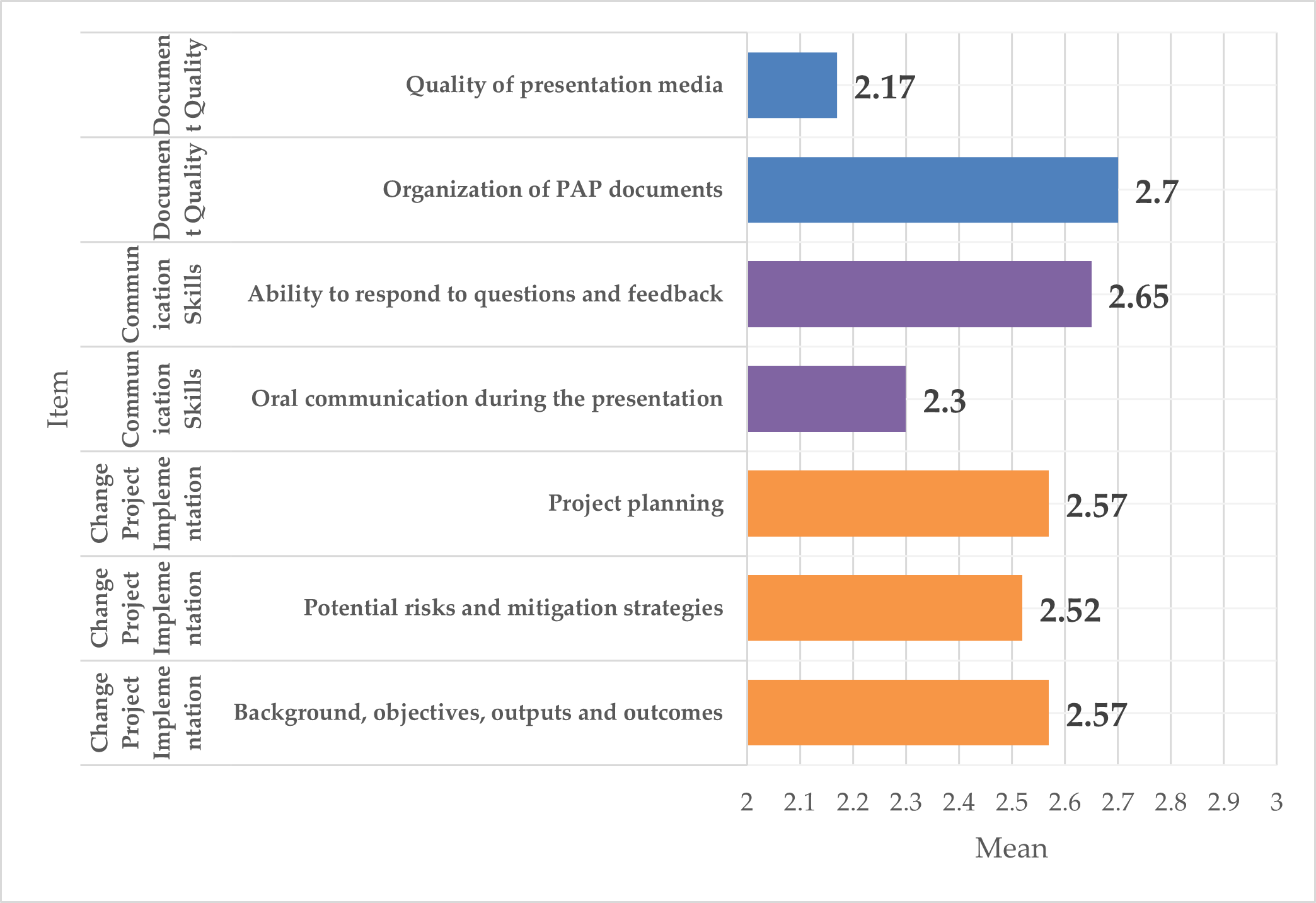
Results: The program achieved a high satisfaction level, with 96% of participants reporting being “very satisfied” and all participants recommending the program. Evaluation results showed high scores in project planning (M = 2.57), risk identification (M = 2.52), and PAP document organization (M = 2.70).
Conclusion: The PAKEM SMK program demonstrates that combining structured change projects through the PAP framework with continuous mentoring can strengthen leadership capacity and support institutional improvement within SMKs.
References
M. Wahid and D. Ratnasari, “Literature Review: Strategies to Increase the Hiring Rate and Shorten the Waiting Period of Vocational School Graduates in Workforce,” J. Ris. Ilmu Pendidik., 2024, https://doi.org/10.56495/jrip.v4i4.910
L. Stoll, “Professional Learning Community,” in International Encyclopedia of Education, Elsevier, 2010, pp. 151–157.
G. Redondo-Sama, S. Khaqan, T. Morlà-Folch, and A. Munté-Pascual, “Leading schools through dialogue: the role of principals in schools as Learning Communities,” J. New Approaches Educ. Res., vol. 14, no. 1, p. 12, Apr. 2025, https://doi.org/10.1007/s44322-025-00033-0
B. Bartanen, A. N. Husain, D. D. Liebowitz, and L. K. Rogers, “The Returns to Experience for School Principals,” Am. Educ. Res. J., vol. 61, no. 5, pp. 1030–1073, Oct. 2024, https://doi.org/10.3102/00028312241266216
S. D. Nabella, “The Influence of Leadership and Organizational Culture Mediated by Organizational Climate on Governance at Senior High School in Batam City,” J. Educ. Soc. Res., vol. 12, no. 5, p. 119, Sep. 2022, https://doi.org/10.36941/jesr-2022-0127
S. Sulpakar, R. Ridwan, S. Sudjarwo, H. Hariri, and H. Herdian, “Transformational Leadership Practices of Senior High School Principals in Indonesian Context by Gender,” WSEAS Trans. Adv. Eng. Educ., vol. 19, pp. 164–174, Jul. 2022, https://doi.org/10.37394/232010.2022.19.18
L. Langdon Warren, “The Importance of Teacher Leadership Skills in the Classroom,” Educ. J., vol. 10, no. 1, p. 8, 2021, https://doi.org/10.11648/j.edu.20211001.12
F. F. A. Marom, “Pengaruh Gaya Kepemimpinan Kepala Sekolah dan Budaya Organisasi Terhadap Kinerja Guru di SMKN 1 Jenangan.” etheses.iainponorogo.ac.id, 2025.
V. Virgana and M. Lapasau, “Elevating Teachers’ Performance through Locus of Control, Leadership Style, Environmental Factors, and Work Motivation.,” Knowl. Manag. E-Learning, 2024, https://doi.org/10.34105/j.kmel.2024.16.003
A. R. Bakri, U. Sulistiyo, and M. Hidayat, “Kompetensi Manajerial Kepala Sekolah Dalam Meningkatkan Kinerja Guru Smk Negeri 11 Muaro Jambi,” J. Educ. Dev., vol. 11, no. 3, pp. 280–286, Sep. 2023, https://doi.org/10.37081/ed.v11i3.5357
H. Hamka, “The Role of Principals on Teacher Performance Improvement in a Suburban School,” QALAMUNA J. Pendidikan, Sos. dan Agama, 2023, https://doi.org/10.37680/qalamuna.v15i1.2409
S. Kurniawati and M. I. Fitriani, “Principal’s Risk Management Strategy in Realizing Quality Continuity in Educational Institutions Case Study at SMK Negeri 1 Kopang,” J. Vision. Penelit. dan Pengemb. dibidang Adm. Pendidik., vol. 13, no. 1, p. 77, Apr. 2025, https://doi.org/10.33394/vis.v13i1.14919.
I. Gunawan, “Analisis statistik Pendidikan di Provinsi Riau Tahun 2023-2024,” ALPHA J. Stat. Demogr. and Engineering, 2025, [Online]. Available: https://jurnal.nawansa.com/index.php/ALPHA/article/view/536.
W. Windasari, S. Trihantoyo, A. Wulandari, and R. N. Fitria, “Transformational Leadership Training for Vocational School Principals in Ponorogo District : Strengthening Professional Learning Communities,” J. Pengabdi. UNDIKMA, vol. 5, no. 3, p. 388, Aug. 2024, https://doi.org/10.33394/jpu.v5i3.12224
A. Purnomo, S. Danim, and A. Khairi, “Management efficiency and school culture, and teacher performance in Indonesian vocational school during fiscal austerity,” J. Konseling dan Pendidik., vol. 14, no. 1, pp. 217–227, Mar. 2026, https://doi.org/10.29210/1202500
N. G. Ramadhan, Purnomo, Widiyanti, S. Suhartadi, and O. Purnawirawan, “Model of Education System in Indonesia Vocational High Schools Based on the Aspects School Cooperation with Industry Through Work-Based Learning to Improve Sustainable Development Goals (SDGs),” J. Lifestyle SDGs Rev., vol. 5, no. 3, p. e05013, Feb. 2025, https://doi.org/10.47172/2965-730X.SDGsReview.v5.n03.pe05013
A. N. F. Astuti, . Samsudi, I. M. Sudana, and . Hadromi, “Exploring Management Industrial Class at the Vocational High School in Indonesia,” J. Educ. Soc. Res., vol. 13, no. 3, p. 181, May 2023, https://doi.org/10.36941/jesr-2023-0068
E. M. Sangadji, S. Sopiah, and B. S. Narmaditya, “Does Leadership Effectiveness Matter for Indonesia Vocational Teacher Performance? The Mediating Role of Work Motivation,” Indones. Res. J. Educ. |IRJE|, vol. 5, no. 2, pp. 345–359, Aug. 2021, https://doi.org/10.22437/irje.v5i2.12541
I. P. Sari, W. R. Yasmin, R. Triyoga, I. Indri, W. G. Mulawarman, and A. Akhmad, “Strategic Leadership Practices in Fostering Innovation Culture in Vocational Education: A Case Study,” Nusant. J. Pendidik. Indones., vol. 6, no. 1, pp. 41–54, Jan. 2026, https://doi.org/10.62491/njpi.2026.v6i1-4
R. Prayuda, M. I. Rosyadi, R. Fikri, and M. F. Amrillah, “Integrating Environmental Sustainability and Borderland Development: A Tourism Model for Rupat Island, Indonesia.,” Int. J. of Sustainable Development and Planning, 2025, https://doi.org/10.18280/ijsdp.200730
T. Osawa, “Rethinking the local wisdom approach in peatland restoration through the case of Rantau Baru: A critical inquiry to the present-day concept of Kearifan Lokal,” Local governance of peatland restoration in Riau, Indonesia, 2023, https://doi.org/10.1007/978-981-99-0902-5_6.
R. T. Wahyuni, M. I. Zul, H. Azwar, and E. Susianti, “Program Penguatan Kapasitas Tendik SMK Sebagai Salah Satu Upaya Pendukung Penguatan Ekosistem Vokasi di Provinsi Riau,” Din. J. Pengabdi. Kpd. Masy., vol. 6, no. 5, pp. 1368–1378, Oct. 2022, doi: https://doi.org/10.31849/dinamisia.v6i5.11123
H. Adam and R. Rena, Polycrisis and economic development in the Global South. api.taylorfrancis.com, 2025.
W. Cahyadi, L. Cahyadi, C. C. Cen, and L. Candrasa, “Leadership, work motivation, and polytechnic culture impact on effective commitment and work ethics and its implications on the lecturer performance of Indonesia,” J. Mod. Project Management, 2024, [Online]. Available: https://journalmodernpm.com/manuscript/index.php/jmpm/article/view/727.
J. M. Chevalier, Participatory action research: Theory and methods for engaged inquiry. taylorfrancis.com, 2019.
X. Yang, “A Historical Review of Collaborative Learning and Cooperative Learning,” TechTrends, vol. 67, no. 4, pp. 718–728, Jul. 2023, https://doi.org/10.1007/s11528-022-00823-9
E. K. Appiah-Odame, “Authentic Assessment for Motivating Student Learning and Teaching Effectiveness in Rural, High-Need Secondary Schools in Manitoba, Canada,” Eur. J. Math. Sci. Educ., vol. volume-5-2, no. volume-5-issue-2-june-2024, pp. 93–104, Jun. 2024, https://doi.org/10.12973/ejmse.5.2.93
Y. Zhan, D. Boud, and Z. Du, “Designing for authentic assessment: a scoping review,” High. Educ., Nov. 2025, https://doi.org/10.1007/s10734-025-01588-9
J. T. M. Gulikers, T. J. Bastiaens, and P. A. Kirschner, “A five-dimensional framework for authentic assessment,” Educ. Technol. Res. Dev., vol. 52, no. 3, pp. 67–86, Sep. 2004, https://doi.org/10.1007/BF02504676
J. W. Creswell, Research design: Qualitative, quantitative, and mixed methods approaches. SAGE Publications, Incorporated. 2009.
Q. Roberson and J. L. Perry, “Inclusive Leadership in Thought and Action: A Thematic Analysis,” Gr. Organ. Manag., vol. 47, no. 4, pp. 755–778, Aug. 2022, https://doi.org/10.1177/10596011211013161
K. E. Prabowo, A. Sulistyahati, and Nurkolis, “Strengthening the instructional leadership capacity of school principals to improve the quality of learning,” Abdimas J. Pengabdian Masyarakat Universitas Merdeka Malang, 2026, https://doi.org/10.26905/abdimas.v11i1.16664
D. Nurdin, S. Suryadi, Uum Murfiah, and Arip Amin, “Training to Strengthen Competency of School Principals in the Implementation of the Independent Curriculum,” Din. J. Pengabdi. Kpd. Masy., vol. 9, no. 2, pp. 549–555, Apr. 2025, https://doi.org/10.31849/dinamisia.v9i2.23440
C. Rhodes and S. Fletcher, “Coaching and mentoring for self‐efficacious leadership in schools,” Int. J. Mentor. Coach. Educ., vol. 2, no. 1, pp. 47–63, May 2013, https://doi.org/10.1108/20466851311323087.
P. Hallinger, “Leading Educational Change: reflections on the practice of instructional and transformational leadership,” Cambridge J. Educ., vol. 33, no. 3, pp. 329–352, Nov. 2003, https://doi.org/10.1080/0305764032000122005
Downloads
Published
How to Cite
Issue
Section
License
Copyright (c) 2026 Muhammad Ihsan Zul, Dadang Syarif Sihabudin Sahid, Winda Damelia, Yoanda Alim Syahbana, Istianah Muslim, Tobi Arfan, Mona Elviyenti, Zainal Arifin Renaldo, Retno Tri Wahyuni, Hamid Azwar, Nabila Aulia Ramadhani

This work is licensed under a Creative Commons Attribution-ShareAlike 4.0 International License.
Authors who publish with SPEKTA (Jurnal Pengabdian Kepada Masyarakat: Teknologi dan Aplikasi) agree to the following terms:
- Authors retain copyright and grant the journal the right of first publication with the work simultaneously licensed under a Creative Commons Attribution License (CC BY-SA 4.0) that allows others to share the work with an acknowledgment of the work's authorship and initial publication in this journal.
- Authors are able to enter into separate, additional contractual arrangements for the non-exclusive distribution of the journal's published version of the work (e.g., post it to an institutional repository or publish it in a book), with an acknowledgment of its initial publication in this journal.
- Authors are permitted and encouraged to post their work online (e.g., in institutional repositories or on their website) prior to and during the submission process, as it can lead to productive exchanges, as well as earlier and greater citation of published work.

This work is licensed under a Creative Commons Attribution-ShareAlike 4.0 International License.