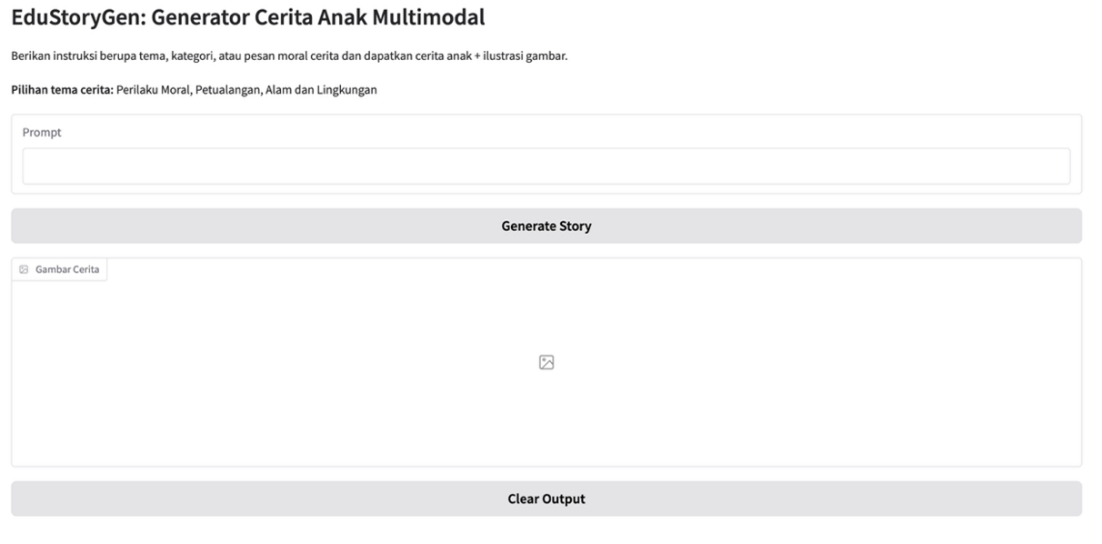
Training on the Use of EduStory-Gen for Developing Interactive Storytelling among Kindergarten and Early Childhood Education Teachers
DOI:
https://doi.org/10.12928/spekta.v7i1.15957Keywords:
Digital storytelling, Early childhood education, Teacher training, Artificial intelligence in education, EduStory-GenAbstract
Background: Early childhood education plays an important role in supporting children’s cognitive, social, and emotional development. However, many kindergartens and early childhood education teachers continue to rely on conventional storytelling approaches and have limited experience in utilizing digital and artificial intelligence (AI)-based technologies for learning activities.
Contribution: This community service program contributes to teacher professional development by introducing EduStory-Gen, an AI-assisted storytelling platform that integrates narrative generation and visual illustration creation.
Method: The program employed a participatory training approach involving 30 kindergarten and early childhood education teachers. The activities included needs analysis, training preparation, pre-assessment, hands-on training, mentoring, and post-training evaluation.
Results: The results showed substantial improvements in teachers’ competencies related to digital storytelling and AI-assisted educational tools. The average competency score increased from 2.9 in the pre-assessment to 4.4 in the post-assessment. The highest improvement was observed in teachers’ knowledge of AI-based tools (+1.7).
Conclusion: The EduStory-Gen training program effectively enhanced teachers’ digital storytelling competencies and AI literacy while fostering positive learning experiences. The findings highlight the potential of AI-assisted storytelling tools to support innovative teaching practices and strengthen technology integration in early childhood education.
References
H. Herman, S. Sultan, S. Suardi, A. S. Ahmar, and K. Khaeruddin, “Social emotional learning in pre-service early childhood teachers: the key role of academic achievement, ICT competence and socioeconomic status,” Cogent Educ., vol. 12, no. 1, Dec. 2025, https://doi.org/10.1080/2331186X.2025.2586315
D. J. Solang, M. Yunus, B. S. Rukmini, K. Kurnia, and K. Umam, “The Impact of Early Childhood Education on Long-Term Outcomes,” J. Acad. Sci., vol. 1, no. 4, pp. 350–361, Aug. 2024, https://doi.org/10.59613/7pvaa271
Y. Lin, M. A. A. Kadir, and D. Kaur, “Preschool Educators’ Perceptions on Values Education,” Educ. Sci., vol. 15, no. 2, p. 140, Jan. 2025, https://doi.org/10.3390/educsci15020140
M. S. Alotaibi, “Factors Influencing Early Childhood Educators’ Use of Digital Educational Aids: A Sequential Explanatory Study,” Sage Open, vol. 13, no. 4, Oct. 2023, https://doi.org/10.1177/21582440231217727
W. Astuti and E. Yafie, “A systematic literature review on language development strategies in early childhood education: Effective pedagogical approaches,” Mimb. Pendidik., 2025, https://doi.org/10.17509/mimbardik.v10i2.82960
S. Sadaruddin, C. Cahaya, S. Syamsuardi, M. A. Musi, and E. Sarimanah, “Development of Storytelling-based Learning in Stimulating Children’s Receptive and Expressive Language,” JPUD - J. Pendidik. Usia Dini, vol. 19, no. 2, pp. 263–273, Oct. 2025, https://doi.org/10.21009/jpud.v19i2.50620
O. Sitinjak, M. Pardede, J. J. Siahaan, and N. Manungkalit, “Enhancing Early Childhood Language Development through the Storytelling Method,” Int. Transformative Education, 2025, [Online]. Available: http://internationalleiden.com/itehj/article/view/277.
W. Wang, L. Zheng, and J. Zhang, “Effect of online digital storytelling on the comprehension of authentic listening materials and engagement of junior high school EFL learners,” Sci. Rep., vol. 16, no. 1, p. 6639, Jan. 2026, https://doi.org/10.1038/s41598-026-36913-4
K. I. Hossain, “Literature-based language learning: Challenges, and opportunities for English learners,” Ampersand, vol. 13, p. 100201, Dec. 2024, https://doi.org/10.1016/j.amper.2024.100201
A. F. Mena-Guacas, L. López-Catalán, C. Bernal-Bravo, and C. Ballesteros-Regaña, “Educational Transformation Through Emerging Technologies: Critical Review of Scientific Impact on Learning,” Educ. Sci., vol. 15, no. 3, p. 368, Mar. 2025, https://doi.org/10.3390/educsci15030368
S. Mhlongo, K. Mbatha, B. Ramatsetse, and R. Dlamini, “Challenges, opportunities, and prospects of adopting and using smart digital technologies in learning environments: An iterative review,” Heliyon, vol. 9, no. 6, p. e16348, Jun. 2023, https://doi.org/10.1016/j.heliyon.2023.e16348
P.-L. Chuang and X. Yan, “Language assessment in the era of generative artificial intelligence: Opportunities, challenges, and future directions,” System, vol. 134, p. 103846, Nov. 2025, https://doi.org/10.1016/j.system.2025.103846
C.-M. Mirea, R. Bologa, A. Toma, A. Clim, D.-D. Plăcintă, and A. Bobocea, “Transforming Learning with Generative AI: From Student Perceptions to the Design of an Educational Solution,” Appl. Sci., vol. 15, no. 10, p. 5785, May 2025, https://doi.org/10.3390/app15105785
N. Anantrasirichai, F. Zhang, and D. Bull, “Advances in artificial intelligence: a review for the creative industries,” Artif. Intell. Rev., vol. 59, no. 3, p. 89, Jan. 2026, https://doi.org/10.1007/s10462-026-11494-w
N. Kerimbayev, K. Adamova, R. Shadiev, and Z. Altinay, “Intelligent educational technologies in individual learning: a systematic literature review,” Smart Learn. Environ., vol. 12, no. 1, p. 1, Jan. 2025, https://doi.org/10.1186/s40561-024-00360-3
O. Filiz, M. H. Kaya, and T. Adiguzel, “Teachers and AI: Understanding the factors influencing AI integration in K-12 education,” Educ. Inf. Technol., vol. 30, no. 13, pp. 17931–17967, Aug. 2025, doi: https://doi.org/10.1007/s10639-025-13463-2
L. Kohnke, D. Zou, A. W. Ou, and M. M. Gu, “Preparing future educators for AI-enhanced classrooms: Insights into AI literacy and integration,” Comput. Educ. Artif. Intell., vol. 8, p. 100398, Jun. 2025, doi: https://doi.org/10.1016/j.caeai.2025.100398
Junadhi, S. Defit, and O. Okfalisa, “Grouped Query Attention for Dual-Output Generative Modeling: Narrative and Visual Prompt Generation in Educational Storytelling,” in 2025 1st International Conference on Emerging Trends in Information Systems and Informatics (ICETISI), Dec. 2025, pp. 1–7, doi: https://doi.org/10.1109/ICETISI67983.2025.11405876
A. Subarno, C. Dyah Sulistyaningrum Indrawati, P. Ninghardjanti, W. Winarno, and M. Choerul Umam, “Enhancing AI-Powered PowerPoint Skills: Training Impact on Vocational Teachers in Surakarta,” SPEKTA (Jurnal Pengabdi. Kpd. Masy. Teknol. dan Apl., vol. 6, no. 1, pp. 122–141, 2025, doi: https://doi.org/10.12928/spekta.v6i1.13056
G. T. Kayır and T. Akyol, “The Effect of Digital Story Tools Training on Teachers’ Competence in the Use of Digital Story Tools and Children’s Environmental Attitudes and Awareness,” Early Child. Educ. J., Dec. 2025, doi: https://doi.org/10.1007/s10643-025-02084-6
X. Tan, G. Cheng, and M. H. Ling, “Artificial intelligence in teaching and teacher professional development: A systematic review,” Comput. Educ. Artif. Intell., vol. 8, p. 100355, Jun. 2025, doi: https://doi.org/10.1016/j.caeai.2024.100355
Y. A. M. Abouelenein, A. F. A. Ghazala, E. M. M. Mahdy, and M. H. R. Khalaf, “The R5E pattern: can artificial intelligence enhance programming skills development?,” Educ. Inf. Technol., vol. 30, no. 15, pp. 22177–22205, Oct. 2025, doi: https://doi.org/10.1007/s10639-025-13616-3
X. Yao, Y. Zhong, and W. Cao, “The analysis of generative artificial intelligence technology for innovative thinking and strategies in animation teaching,” Sci. Rep., vol. 15, no. 1, p. 18618, May 2025, doi: https://doi.org/10.1038/s41598-025-03805-y
J. Chen, K. Li, Z. Zhang, K. Li, and P. S. Yu, “A Survey on Applications of Artificial Intelligence in Fighting against COVID-19,” ACM Computing Surveys, vol. 54, no. 8. 2022, doi: https://doi.org/10.1145/3465398
Y. Qian, “Prompt Engineering in Education: A Systematic Review of Approaches and Educational Applications,” J. Educ. Comput. Res., vol. 63, no. 7–8, pp. 1782–1818, Dec. 2025, doi: https://doi.org/10.1177/07356331251365189
D. T. K. Ng, W. Luo, H. M. Y. Chan, and S. K. W. Chu, “Using digital story writing as a pedagogy to develop AI literacy among primary students,” Comput. Educ. Artif. Intell., vol. 3, p. 100054, 2022, doi: https://doi.org/10.1016/j.caeai.2022.100054
H. D. Osorio Vanegas, Y. de M. Segovia Cifuentes, and A. Sobrino Morrás, “Educational Technology in Teacher Training: A Systematic Review of Competencies, Skills, Models, and Methods,” Educ. Sci., vol. 15, no. 8, p. 1036, Aug. 2025, doi: https://doi.org/10.3390/educsci15081036
Dea Amanda Ricita, Abdul Halim, and S. Sunarti, “Exploring Teachers’ and Students’ Perceptions of Deep Learning: Integrating Meaningful, Mindful, and Joyful Learning in ELT Classrooms,” Borneo Educ. J., vol. 7, no. 2, pp. 323–347, Jul. 2025, doi: https://doi.org/10.24903/bej.v7i2.2078
F. Feriyanto and D. Anjariyah, “Deep Learning Approach Through Meaningful, Mindful, and Joyful Learning: A Library Research,” Electron. J. Educ. Soc. Econ. Technol., vol. 5, no. 2, pp. 208–212, Oct. 2024, doi: https://doi.org/10.33122/ejeset.v5i2.321
D. Dumiyati, A. Wardhono, and D. Apriono, “Mindful, Meaningful, and Joyful Learning Based IPAS Learning Strategies and ICT-Based Interactive Multimedia to Increase Student Collaboration and Creativity,” Scaffolding J. Pendidik. Islam dan Multikulturalisme, vol. 7, no. 2, pp. 929–945, Sep. 2025, doi: https://doi.org/10.37680/scaffolding.v7i2.7788
Downloads
Published
How to Cite
Issue
Section
License
Copyright (c) 2026 Junadhi Junadhi, Sarjon Defit, Okfalisa Okfalisa

This work is licensed under a Creative Commons Attribution-ShareAlike 4.0 International License.
Authors who publish with SPEKTA (Jurnal Pengabdian Kepada Masyarakat: Teknologi dan Aplikasi) agree to the following terms:
- Authors retain copyright and grant the journal the right of first publication with the work simultaneously licensed under a Creative Commons Attribution License (CC BY-SA 4.0) that allows others to share the work with an acknowledgment of the work's authorship and initial publication in this journal.
- Authors are able to enter into separate, additional contractual arrangements for the non-exclusive distribution of the journal's published version of the work (e.g., post it to an institutional repository or publish it in a book), with an acknowledgment of its initial publication in this journal.
- Authors are permitted and encouraged to post their work online (e.g., in institutional repositories or on their website) prior to and during the submission process, as it can lead to productive exchanges, as well as earlier and greater citation of published work.

This work is licensed under a Creative Commons Attribution-ShareAlike 4.0 International License.