Human-Centered AI Literacy to Support Tolerance and Social Cohesion in a Diverse Community
DOI:
https://doi.org/10.12928/spekta.v7i1.15875Keywords:
AI literacy, Generative AI, ChatGPT, Tolerance, DiversityAbstract
Background: The growing use of generative AI in everyday learning and communication creates both opportunities and risks, including misinformation, bias, and unethical use, which may intensify social tension in diverse communities. This highlights the need for human-centered AI literacy that promotes not only technical use but also critical thinking, ethical awareness, and respect for differences.
Contribution: This community service program addresses the gap in community-based AI literacy initiatives by integrating responsible generative AI use with tolerance education for socially vulnerable children in a diverse social setting.
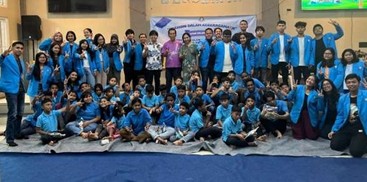
Method: A participatory one-day seminar and workshop were conducted on 14 June 2025 at Panti Asuhan Bersinar, East Jakarta. The program combined interactive instruction with guided hands-on practice using ChatGPT as a generative AI learning tool. Evaluation employed pretest-posttest assessment, Likert-scale questionnaires, facilitator observation, practice-based assessment, and short interviews.
Results: The mean score increased from 46 in the pretest to 82 in the posttest, with an average n-gain of 0.7061, indicating high effectiveness. These findings suggest that the program effectively strengthened responsible AI literacy and reinforced ethical awareness relevant to tolerance and social cohesion.
Conclusion: The integrated seminar-workshop model was effective in improving participants’ understanding of constructive, critical, and ethical AI use. This approach also shows potential as a replicable community-based strategy for promoting responsible AI literacy and social harmony in diverse settings.
References
H. J. Christanto, C. Dewi, S. A. Sutresno, and A. D. K. Silalahi, “Analyzing the Use of Chat Generative Pre-Trained Transformer and Artificial Intelligence,” Rev. d’Intelligence Artif., vol. 38, no. 4, pp. 1297–1304, Aug. 2024, https://doi.org/10.18280/ria.380423
L. Enqvist, “‘Human oversight’ in the EU artificial intelligence act: what, when and by whom?,” Law, Innov. Technol., vol. 15, no. 2, pp. 508–535, Jul. 2023, https://doi.org/10.1080/17579961.2023.2245683
D. E. van Norren, “The ethics of artificial intelligence, UNESCO and the African Ubuntu perspective,” J. Information, Commun. Ethics Soc., vol. 21, no. 1, pp. 112–128, Jan. 2023, https://doi.org/10.1108/JICES-04-2022-0037
E. Bean, C. Burleigh, C. Haskell, T. Burris‐Melville, J. Payne, and B. Pathak, “Eavesdropping on UNESCO AI Policy, Leadership, and Ethics,” J. Leadersh. Stud., vol. 18, no. 4, pp. 98–110, Dec. 2025, https://doi.org/10.1002/jls.70007
K. Yeung, “Recommendation of the Council on Artificial Intelligence (OECD),” Int. Leg. Mater., vol. 59, no. 1, pp. 27–34, Feb. 2020, https://doi.org/10.1017/ilm.2020.5
S. Kreps, R. M. McCain, and M. Brundage, “All the News That’s Fit to Fabricate: AI-Generated Text as a Tool of Media Misinformation,” J. Exp. Polit. Sci., vol. 9, no. 1, pp. 104–117, Nov. 2022, https://doi.org/10.1017/XPS.2020.37
S. Gehman, S. Gururangan, M. Sap, Y. Choi, and N. A. Smith, “RealToxicityPrompts: Evaluating Neural Toxic Degeneration in Language Models,” in Findings of the Association for Computational Linguistics: EMNLP 2020, 2020, pp. 3356–3369, https://doi.org/10.18653/v1/2020.findings-emnlp.301
A. Veldhuis, P. Y. Lo, S. Kenny, and A. N. Antle, “Critical Artificial Intelligence literacy: A scoping review and framework synthesis,” Int. J. Child-Computer Interact., vol. 43, p. 100708, Mar. 2025, https://doi.org/10.1016/j.ijcci.2024.100708
Y. Mochizuki, E. Bruillard, and A. Bryan, “The ethics of AI or techno-solutionism? UNESCO’s policy guidance on AI in education,” Br. J. Sociol. Educ., pp. 1–22, May 2025, https://doi.org/10.1080/01425692.2025.2502808
M. B. Ilmi, H. A. Siregar, and M. R. Chesio, “Implementation of pancasila values to improve tolerance between religions and tribes,” J. Pendidik. PKN (Pancasila Dan …, 2024, [Online]. Available: https://elibrary.ru/item.asp?id=74805930.
R. Rahmadini, Arifah, Amrullah, Jauharotul Maknunah, and Serly Arsita, “Penguatan Moderasi Beragama Melalui Literasi Digital dan Pemahaman Kritis atas Algoritma Media Sosial Bagi Para Santri di Pondok Pesantren Belitung,” J. Community Dev., vol. 6, no. 3, p. 12, Jan. 2026, https://doi.org/10.47134/comdev.v6i3.1862
M. Lim, “Freedom to hate: social media, algorithmic enclaves, and the rise of tribal nationalism in Indonesia,” Crit. Asian Stud., vol. 49, no. 3, pp. 411–427, Jul. 2017, doi: https://doi.org/10.1080/14672715.2017.1341188
D. Rahmawan, I. Garnesia, and R. Hartanto, “Content Analysis of MAFINDO’s Verified WhatsApp-Related Misinformation in Indonesia,” J. Kaji. Jurnalisme, vol. 8, no. 1, pp. 99–114, Jul. 2024, https://doi.org/10.24198/jkj.v8i1.54463
H. J. Christanto, S. A. Sutresno, Y. A. Singgalen, and C. Dewi, “Analyzing Benefits of Online Train Ticket Reservation App Using Technology Acceptance Model,” Ingénierie des systèmes d Inf., vol. 29, no. 1, pp. 107–115, Feb. 2024, https://doi.org/10.18280/isi.290112
D. Pramod, “Decoding responsible AI use: the influence of digital literacy and ethical awareness,” Cogent Educ., vol. 12, no. 1, Dec. 2025, https://doi.org/10.1080/2331186X.2025.2592371
W. Warlim, R. Effendi, R. Fitria, M. M. Ibrahim, and D. N. Hadiati, “Cross-faculty analysis of AI-enhanced civic character education on digital citizenship development,” Front. Educ., vol. 10, Jan. 2026, https://doi.org/10.3389/feduc.2025.1690799
H. J. Christanto, Julius Victor Manuel Bata, D. J. C. Sihombing, and Christine Dewi, “Workshop Google Mail, Google Drive, and Google Meet at HIMPAUDI Grobogan Regency,” MITRA J. Pemberdaya. Masy., vol. 7, no. 2, pp. 201–212, Nov. 2023, https://doi.org/10.25170/mitra.v7i2.4222
H. J. Christanto, S. A. Sutresno, J. V. M. Bata, D. J. C. Sihombing, P. K. Prihanto, and D. V. T. Linestyo, “Pelatihan Penggunaan Sistem Informasi Gereja Berbasis Android Pada Gia Purwodadi Kabupaten Grobogan,” RESWARA J. Pengabdi. Kpd. Masy., vol. 5, no. 1, pp. 119–127, Jan. 2024, https://doi.org/10.46576/rjpkm.v5i1.3707
K. Vasalampi, R.-L. Metsäpelto, J. Salminen, M.-K. Lerkkanen, M. Mäensivu, and A.-M. Poikkeus, “Promotion of school engagement through dialogic teaching practices in the context of a teacher professional development programme,” Learn. Cult. Soc. Interact., vol. 30, p. 100538, Sep. 2021, https://doi.org/10.1016/j.lcsi.2021.100538
F. Schou-Juul, S. S. Jensen, and C. Schaffalitzky de Muckadell, “Using dialogic teaching to promote student satisfaction and engagement in emergency remote teaching in primary school: a proof-of-concept study,” Technol. Pedagog. Educ., vol. 33, no. 1, pp. 87–101, Jan. 2024, https://doi.org/10.1080/1475939X.2023.2288005
J. Ren, W. Xu, and Z. Liu, “The Impact of Educational Games on Learning Outcomes,” Int. J. Game-Based Learn., vol. 14, no. 1, pp. 1–25, Jan. 2024, https://doi.org/10.4018/IJGBL.336478
R. Annapureddy, A. Fornaroli, and D. Gatica-Perez, “Generative AI Literacy: Twelve Defining Competencies,” Digit. Gov. Res. Pract., vol. 6, no. 1, pp. 1–21, Mar. 2025, https://doi.org/10.1145/3685680
S. Wineburg and S. McGrew, “Lateral Reading and the Nature of Expertise: Reading Less and Learning More When Evaluating Digital Information,” Teach. Coll. Rec. Voice Scholarsh. Educ., vol. 121, no. 11, pp. 1–40, Nov. 2019, https://doi.org/10.1177/016146811912101102
E. Almanasreh, R. Moles, and T. F. Chen, “Evaluation of methods used for estimating content validity,” Res. Soc. Adm. Pharm., vol. 15, no. 2, pp. 214–221, Feb. 2019, https://doi.org/10.1016/j.sapharm.2018.03.066
A. B. Rosen, J. Y. Choi, K. Anderson, L. E. Remski, and B. A. Knarr, “Development, validity, and test-retest reliability of a new neurocognitive functional performance test: The choice-reaction hop test,” Phys. Ther. Sport, vol. 59, pp. 80–84, Jan. 2023, https://doi.org/10.1016/j.ptsp.2022.12.003
L. L. Murray and D. R. Bellhouse, “W.F. Sheppard’s correspondence with Karl Pearson and the development of his tables and moment estimates,” Hist. Math., vol. 53, pp. 108–117, Nov. 2020, https://doi.org/10.1016/j.hm.2020.06.002
K. S. Taber, “The Use of Cronbach’s Alpha When Developing and Reporting Research Instruments in Science Education,” Res. Sci. Educ., vol. 48, no. 6, pp. 1273–1296, Dec. 2018, https://doi.org/10.1007/s11165-016-9602-2
F. Madadizadeh and S. Bahariniya, “Tutorial on internal consistency assessment by Cronbach’s alpha and McDonald’s omega,” Perioper. Care Oper. Room Manag., vol. 41, p. 100568, Dec. 2025, https://doi.org/10.1016/j.pcorm.2025.100568
D. M. Dimitrov, P. D. Rumrill, and Jr, “Pretest-posttest designs and measurement of change,” Work, 2003, https://doi.org/10.3233/WOR-2003-00285
R. R. Hake, “Interactive-engagement versus traditional methods: A six-thousand-student survey of mechanics test data for introductory physics courses,” Am. J. Phys., vol. 66, no. 1, pp. 64–74, Jan. 1998, https://doi.org/10.1119/1.18809
Downloads
Published
How to Cite
Issue
Section
License
Copyright (c) 2026 Henoch Juli Christanto, Gallen Cakra Adhi Wibowo , Dita Madonna Simanjuntak, Manatap Dolok Lauro , Manatap Dolok Lauro , Christine Dewi

This work is licensed under a Creative Commons Attribution-ShareAlike 4.0 International License.
Authors who publish with SPEKTA (Jurnal Pengabdian Kepada Masyarakat: Teknologi dan Aplikasi) agree to the following terms:
- Authors retain copyright and grant the journal the right of first publication with the work simultaneously licensed under a Creative Commons Attribution License (CC BY-SA 4.0) that allows others to share the work with an acknowledgment of the work's authorship and initial publication in this journal.
- Authors are able to enter into separate, additional contractual arrangements for the non-exclusive distribution of the journal's published version of the work (e.g., post it to an institutional repository or publish it in a book), with an acknowledgment of its initial publication in this journal.
- Authors are permitted and encouraged to post their work online (e.g., in institutional repositories or on their website) prior to and during the submission process, as it can lead to productive exchanges, as well as earlier and greater citation of published work.

This work is licensed under a Creative Commons Attribution-ShareAlike 4.0 International License.