Integration of Green Economy and Digital Marketing in the Empowerment of Coffee Farmers in Belatungan Village: Circular Economy Approach and Market Transformation
DOI:
https://doi.org/10.12928/spekta.v7i1.15762Keywords:
Biochar, Circular economy, Community empowerment, Digital marketing, Robusta coffeeAbstract
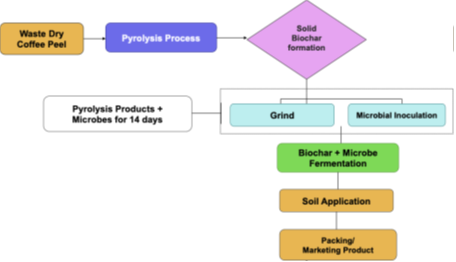
Background: Coffee farmers in Belatungan Village, Bali, face challenges, including low economic returns and environmental degradation due to inefficient waste management. The study aims to improve economic sustainability and environmental health by integrating the principles of circular economy and digital marketing. This intervention involves converting coffee husk waste into biochar and promoting digital marketing strategies to improve market access.
Contribution: This study expands the market reach and income potential of farmers through digital marketing. This study contributes to rural economic development and environmental sustainability by implementing a circular economy model in agriculture while integrating digital tools for empowerment.
Method: A Participatory Action Research (PAR) approach was used, involving farmers in the design, implementation, and evaluation of projects. The methodology includes technical training on biochar production, digital marketing, and ongoing mentoring.
Results: The intervention successfully converted 80% of coffee husk waste into biochar, leading to a 15% increase in land productivity and a 25% reduction in chemical fertilizer usage. Additionally, digital marketing efforts, including e-commerce activation and eco-friendly packaging, resulted in a 20% increase in online sales and a 15-20% increase in farmers' income.
Conclusion: The study successfully achieved its goal by integrating circular-economy practices with digital marketing, thereby improving economic and environmental outcomes for coffee farmers.
References
M. Imam Ma’ruf, Z. Bacsi, Z. Hollósy, C. Ayni Kamaruddin, and S. Astuty, “Yield Stability of Indonesian Coffee Production - Comparison Between Arabica and Robusta,” Coffee Sci., vol. 20, pp. 1–14, 2025, https://doi.org/10.25186/.v20i.2317
A. Anhar, “Comparing aboveground carbon stocks in coffee agroforestry and secondary and primary forests in Gayo Highlands, Indonesia,” Front. For. Glob. Chang., vol. 8, Apr. 2025, https://doi.org/10.3389/ffgc.2025.1541302
A. T. Suryana, Y. Saleh, T. G. Dewi, and H. S. P. Rahayu, “Global competitiveness of coffee products: A comparative study of Indonesia and Vietnam,” Coffee Sci., vol. 19, pp. 1–11, 2024, https://doi.org/10.25186/.v19i.2237
I. B. P. G. I. N. Sucipta, W. C. W. S. Putri, I. P. S. Wirawan, K. Suriasih, “Quality of Kintamani Arabica and Pupuan Robusta Green Bean Coffee Based on Defects of Fermentation Process with Full Washed Method,” Food Sci. Qual. Manag., Nov. 2023, https://doi.org/10.7176/FSQM/122-05
R. P. Ariani, G. A. Dellayanti, and N. W. Sukerti, “Added Value of Buleleng Typical Robusta Coffee in the Tourism Area of Sepang Kelod Village, Bali,” Int. J. Econ. Bus. Manag. Res., vol. 07, no. 12, pp. 179–190, 2023, https://doi.org/10.51505/IJEBMR.2023.71211
N. Nurasiah, T. Kusnafizal, A. Azis, S. Nur Amalina, Z. Zulfan, and S. Sakdiyah, “Registration of Geographic Indications of Alcohol Beverages from Abroad in Indonesia,” Humaniora, vol. 13, no. 2, pp. 145–152, May 2022, https://doi.org/10.21512/humaniora.v13i2.7718
S. Enjelia, “Income, Welfare, and Food Security of Coffee Farmer Households,” Indones. J. SMALL SCALE FARMING, vol. 1, no. 1, pp. 28–41, Aug. 2025, https://doi.org/10.24843/ijoss.2025.v01.i01.p03
Y. Sarvina, T. June, S. H. Sutjahjo, R. Nurmalina, and E. Surmaini, “Projection of Robusta Coffee’s Climate Suitability for Sustainable Indonesian Coffee Production,” Int. J. Sustain. Dev. Plan., vol. 18, no. 4, pp. 1069–1078, Apr. 2023, https://doi.org/10.18280/ijsdp.180409
A. B. T. Sari, “Chemical Composition and Sensory Profiles of Fermented Cocoa Beans Obtained from Various Regions of Indonesia,” Int. J. Food Sci., vol. 2023, pp. 1–13, Mar. 2023, https://doi.org/10.1155/2023/5639081
E. S. A. S. Agustin and A. Offermans, “Can Coffee Certification Reduce Poverty? Results from a Household Study of Smallholder Farmers in Indonesia,” Sustain. Sci. Resour., vol. 3, pp. 32–54, Dec. 2022, https://doi.org/10.55168/ssr2809-6029.2022.3003
A. Pingki, H. Hernawati, and R. Rahman, “Creative Economy as a Driver of Economic Growth in the Digitalization Era,” Journal of Multidisciplinary Sustainability Asean. 2025.
N. Afrianty, A. Sunarto, J. V. L. Chew, and N. Latifah, “Assessing Farmers’ Welfare in Bengkulu Province through Farmers’ Term of Trade and Zakat-Based Social Group Classification,” Asia Pacific J. Math., vol. 12, p. 82, 2025, https://doi.org/10.28924/APJM/12-82
N. Lubis, J. Nefri, H. F. Harahap, and R. M. Amir, “Determinants of Coffee Farmers’ Income: The Role of Land Area and Production Volume in Pargarutan Jae Village,” Andalasian Int. J. Agric. Nat. Sci., vol. 6, no. 1, pp. 16–25, Jun. 2025, https://doi.org/10.25077/aijans.v6.i1.16-25.2025
R. Azkar, “Sustainability of the Toraja Arabica coffee value chain in Indonesia: economic, cultural, environmental, and certification dimensions,” Front. Sustain., vol. 6, Dec. 2025, https://doi.org/10.3389/frsus.2025.1691977.
D. Damat, “Coffee Pulp Characterization and Utilization in Coffee Cherry Flour for Circular Economy Improvement,” Sarhad J. Agric., vol. 39, no. s1, 2024, https://doi.org/10.17582/journal.sja/2023/39/s1.71.83.
P. Fonseca i Casas and X. Pi i Palomes, “Building Society 5.0: a foundation for decision-making based on open models and digital twins,” Adv. Eng. Informatics, vol. 69, p. 103970, Jan. 2026, https://doi.org/10.1016/j.aei.2025.103970
V. Milanković, “Spent coffee grounds-derived carbon material as an effective adsorbent for removing multiple contaminants from wastewater: A comprehensive kinetic, isotherm, and thermodynamic study,” J. Water Process Eng., vol. 63, p. 105507, Jun. 2024, https://doi.org/10.1016/j.jwpe.2024.105507
M. Pagett, K. S. Teng, G. Sullivan, and W. Zhang, “Reusing Waste Coffee Grounds as Electrode Materials: Recent Advances and Future Opportunities,” Glob. Challenges, vol. 7, no. 1, Jan. 2023, https://doi.org/10.1002/gch2.202200093
T. C, “Effective reduction of carbon-containing pollutants in coffee cherry pulping wastewater using natural polysaccharide from Tamarindus indica L. seeds,” Environ. Res., vol. 259, p. 119527, Oct. 2024, https://doi.org/10.1016/j.envres.2024.119527
A. Merhi, R. Kordahi, and H. F. Hassan, “A review on the pesticides in coffee: Usage, health effects, detection, and mitigation,” Front. Public Heal., vol. 10, Nov. 2022, https://doi.org/10.3389/fpubh.2022.1004570
M. D. Ulsido, M.-Z. Geleto, and Y. S. Berego, “Waste Water Management in Wet Coffee Processing Mills and their Impact on the Water quality status of Gidabo River and its Tributaries, Southern Ethiopia,” Environ. Health Insights, vol. 18, Jan. 2024, https://doi.org/10.1177/11786302241260953
E. Singh, R. Mishra, A. Kumar, S. K. Shukla, S.-L. Lo, and S. Kumar, “Circular economy-based environmental management using biochar: Driving towards sustainability,” Process Saf. Environ. Prot., vol. 163, pp. 585–600, Jul. 2022, https://doi.org/10.1016/j.psep.2022.05.056
A. G. Alghamdi, A. Alomran, H. M. Ibrahim, A. Alkhasha, and M. A. Majrashi, “Spent coffee waste-derived biochar improves physical properties, water retention, and maize (Zea mays L.) growth in sandy soil,” Sci. Rep., vol. 14, no. 1, p. 19753, Aug. 2024, https://doi.org/10.1038/s41598-024-70504-5
S. Siddiqui, “Unlocking the environmental potential of biochar: production, applications, and limitations,” Front. Sustain. Food Syst., vol. 9, Jun. 2025, https://doi.org/10.3389/fsufs.2025.1569941
Y. Farida, N. Siswanto, and I. Vanany, “Reverse logistics toward a circular economy: Consumer behavioral intention toward polyethylene terephthalate (PET) recycling in Indonesia,” Case Stud. Chem. Environ. Eng., vol. 10, p. 100807, Dec. 2024, https://doi.org/10.1016/j.cscee.2024.100807
A. Y. Prasetyo, W. Yudhanto, N. Nurlina, H. Rosyidah, and L. L. Indrayati, “Adoption of Circular Economy in Sustainable Agriculture Practices in Magelang District: Influence on Productivity and Farmer Welfare,” Rev. Gestão Soc. e Ambient., vol. 18, no. 12, p. e010088, Dec. 2024, https://doi.org/10.24857/rgsa.v18n12-122
J. Suhariyanto, F. A Rizky, E. R. Rahmi, and I. Hosseini, “Determinants of Consumer Behavior Transformation from Traditional to Online Shopping: A Case Study of Central Java Community, Indonesia,” J. lslamic Econ. Bussines Ethics, vol. 2, no. 2, pp. 198–226, Jun. 2025, https://doi.org/10.24235/jiesbi.v2i2.201
H. Trang, T. Do, and H. Vo, “Adoption of E-Commerce in the Agricultural business sector in Vietnam,” J. Econ. Financ. Manag. Stud., vol. 07, no. 12, Dec. 2024, https://doi.org/10.47191/jefms/v7-i12-21
W. Li and W. He, “Revenue-increasing effect of rural e-commerce: A perspective of farmers’ market integration and employment growth,” Econ. Anal. Policy, vol. 81, pp. 482–493, Mar. 2024, https://doi.org/10.1016/j.eap.2023.12.015
U. M. Halida and C. Wilantini, “The Role of Digitalization in Expanding MSME Market Access,” Quant. Econ. Manag. Stud., vol. 3, no. 1, pp. 92–101, Feb. 2022, https://doi.org/10.35877/454RI.qems861
N. A. Khafsoh and N. Riani, “Implementation of Participatory Action Research (PAR) In Community Service Program,” J. Pengabdi. Masy., vol. 5, no. 1, pp. 237–253, Jun. 2024, https://doi.org/10.32815/jpm.v5i1.2034
C. Bešić, D. Ćoćkalo, M. Bakator, S. Stanisavljev, and S. Bogetić, “Society 5.0 And Its Impact On Agricultural Business And Innovation: A New Paradigm For Rural Development,” Ekon. Poljopr., vol. 71, no. 3, pp. 803–819, Oct. 2024, https://doi.org/10.59267/ekoPolj2403803B
K. D. Bissadu, S. Sonko, and G. Hossain, “Society 5.0 enabled agriculture: Drivers, enabling technologies, architectures, opportunities, and challenges,” Inf. Process. Agric., vol. 12, no. 1, pp. 112–124, Mar. 2025, https://doi.org/10.1016/j.inpa.2024.04.003
G. Singh, N. Kalra, N. Yadav, A. Sharma, and M. Saini, “Smart Agriculture: A Review,” Sib. J. Life Sci. Agric., vol. 14, no. 6, pp. 423–454, Dec. 2022, https://doi.org/10.12731/2658-6649-2022-14-6-423-454
J. Ensor and A. de Bruin, “The role of learning in farmer-led innovation,” Agric. Syst., vol. 197, p. 103356, Mar. 2022, https://doi.org/10.1016/j.agsy.2021.103356
Y. Kong and S. Suntrayuth, “The causal model of absorptive capacity, strategic flexibility and innovation performance on sustainable competitive advantage: An internationalization,” Thammasat Review. , 2021.
Y. Kong, “The Role of Experiential Learning on Students’ Motivation and Classroom Engagement,” Front. Psychol., vol. 12, Oct. 2021, https://doi.org/10.3389/fpsyg.2021.771272
A. Nasution, H. Risnafitri, and D. Andriani, “Empowering Communities of Coffee Farmers via Risk Management and Coffee Berry Borer Control,” SPEKTA (Jurnal Pengabdian Kepada Masyarakat Teknologi dan Aplikasi). 2024, https://doi.org/10.12928/spekta.v5i2.11585
N. Rahdiana, A. Hakim, A. Amalia, L. P. S. Marihot, and L. P. S. Marihot, “Implementation of Ergonomics and Local Wisdom in Designing ErJo (Ergonomic Jojodog) as a Solution to the Sustainability of Squatting Work,” SPEKTA (Jurnal Pengabdian Kepada Masyarakat Teknologi dan Aplikasi). 2025, https://doi.org/10.12928/spekta.v6i2.14704
G. Desipradani, A. Fais, M. Mochklas, M. Ali, L. Lihabi, and M. Ali, “Enhancing Digital Branding and Utilization of Meatball Printing Machines for MSMEs in Kampung Pentol, Surabaya,” SPEKTA (Jurnal Pengabdian Kepada Masyarakat Teknologi dan Aplikasi. 2024, https://doi.org/10.12928/spekta.v5i2.12133
Downloads
Published
How to Cite
Issue
Section
License
Copyright (c) 2026 I Dewa Gede Kresna Wirawan, I Wayan Suanda, Putu Siti Firmani

This work is licensed under a Creative Commons Attribution-ShareAlike 4.0 International License.
Authors who publish with SPEKTA (Jurnal Pengabdian Kepada Masyarakat: Teknologi dan Aplikasi) agree to the following terms:
- Authors retain copyright and grant the journal the right of first publication with the work simultaneously licensed under a Creative Commons Attribution License (CC BY-SA 4.0) that allows others to share the work with an acknowledgment of the work's authorship and initial publication in this journal.
- Authors are able to enter into separate, additional contractual arrangements for the non-exclusive distribution of the journal's published version of the work (e.g., post it to an institutional repository or publish it in a book), with an acknowledgment of its initial publication in this journal.
- Authors are permitted and encouraged to post their work online (e.g., in institutional repositories or on their website) prior to and during the submission process, as it can lead to productive exchanges, as well as earlier and greater citation of published work.

This work is licensed under a Creative Commons Attribution-ShareAlike 4.0 International License.