Mixed Reality–Based Solar System Learning Media for Enhancing Technological Literacy and Student Interaction in Elementary Education
DOI:
https://doi.org/10.12928/spekta.v7i1.15745Keywords:
Community service, Mixed reality, Solar system, Student interaction, Technology literacyAbstract
Background: The rapid advancement of digital technology has encouraged the development of learning approaches that support not only knowledge acquisition but also collaboration and interaction.
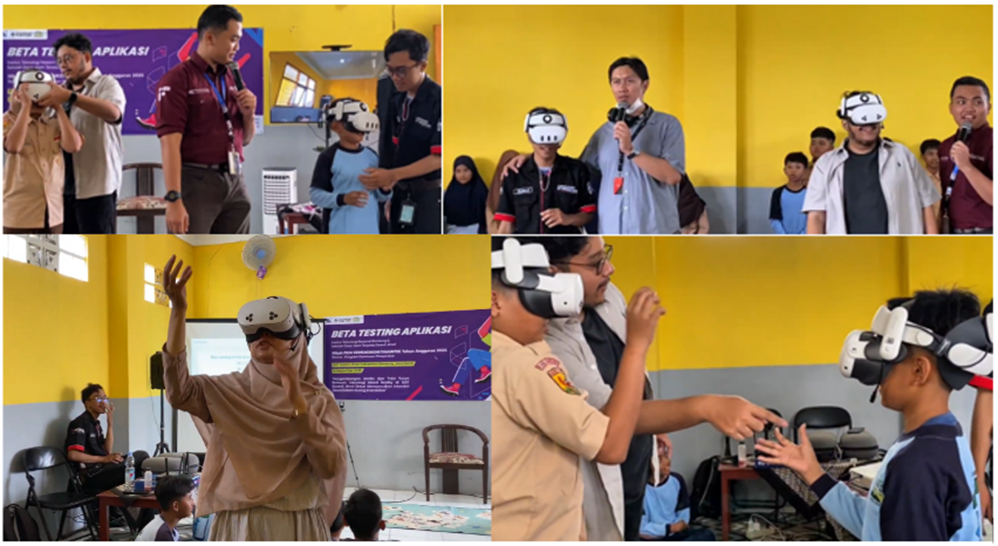
Contribution: This study proposes a Mixed Reality (MR)-based solar system learning media with multiplayer features to enhance technological literacy and student interaction in elementary education.
Methods: An evaluative mixed-method approach was employed involving 37 students and 8 teachers at SDIT Daarul Jihad. Data were collected through questionnaires, observations, and interviews, and analyzed using descriptive statistics and qualitative interpretation.
Results: The findings show that the MR-based learning media was positively perceived by both teachers and students. More than 88% of teachers reported improved student understanding and engagement, while over 90% of students experienced increased motivation and ease of use. In addition, 76.9% of students demonstrated high to very high confidence in explaining solar system concepts. The multiplayer feature also supported collaborative interaction and active discussion during learning activities.
Conclusions: The MR-based collaborative learning media demonstrates strong potential in enhancing both cognitive and social aspects of learning in elementary education and provides practical insights into the integration of immersive collaborative learning technologies in classroom settings.
References
Z. Ersozlu, S. Ledger, A. Ersozlu, F. Mayne, and H. Wildy, “Mixed-Reality Learning Environments in Teacher Education: An Analysis of TeachLivETM Research,” Sage Open, vol. 11, no. 3, Jul. 2021, https://doi.org/10.1177/21582440211032155
S. Budin, “Three Approaches to Using Mixed Reality Simulations for Teacher Preparation and Recruitment of Future Teachers,” Educ. Sci., vol. 14, no. 1, p. 75, Jan. 2024, https://doi.org/10.3390/educsci14010075
R. Rinda, “ Quizizz instructional strategies that consider learners’ emotional and cognitive conditions. In special education contexts, conventional teaching approaches often limit student with Special Needs,” JETS J. English Teach. Strateg., 2023, https://doi.org/10.47759/ejcgtm14
M. Nurcahyani and E. Sudarmilah, “Augmented reality solar system learning media applications based on Android for elementary school,” 2023, p. 040006, https://doi.org/10.1063/5.0141771
D. Nursyaidah, D. Rochintaniawati, N. Winarno, and R. A. Sihombing, “Bringing Space into the Classroom: An AR-Integrated E-Book on the Solar System for Students in Elementary School,” J. Penelit. Pendidik. IPA, vol. 11, no. 8, pp. 498–507, Aug. 2025, https://doi.org/10.29303/jppipa.v11i8.12562
C. Liu, S. Meng, W. Zheng, and Z. Zhou, “Research on the impact of immersive virtual reality classroom on student experience and concentration,” Virtual Real., vol. 29, no. 2, p. 82, May 2025, https://doi.org/10.1007/s10055-025-01153-w
J. Bailenson, Experience on demand: What virtual reality is, how it works, and what it can do. books.google.com, 2018.
A. Almufarreh, “Exploring the Potential of Mixed Reality in Enhancing Student Learning Experience and Academic Performance: An Empirical Study,” Systems, vol. 11, no. 6, p. 292, Jun. 2023, https://doi.org/10.3390/systems11060292
H. Tang, Y. Lin, and Y. Qian, “Understanding K‐12 teachers’ intention to adopt open educational resources: A mixed methods inquiry,” Br. J. Educ. Technol., vol. 51, no. 6, pp. 2558–2572, Nov. 2020, https://doi.org/10.1111/bjet.12937
N. van der Meer, V. van der Werf, W.-P. Brinkman, and M. Specht, “Virtual reality and collaborative learning: a systematic literature review,” Front. Virtual Real., vol. 4, May 2023, https://doi.org/10.3389/frvir.2023.1159905
S. Suryani, D. U. Daihani, T. Amran, and W. Septiani, “Systematic Literature Review of Sustainable Assessment Model in Vocational Higher Education,” Spektrum Industri. 2025, https://doi.org/10.12928/si.v23i2.459
S. S. Astutik and W. S. Jatiningrum, “Designing the Decision Support System to Determine the Major and Higher Education Institution based on Preferences of Prospective Students,” Spektrum Industri. 2023, https://doi.org/10.12928/si.v21i2.157
N. Huda, R. Adawiyah, and B. Budiman, “Integrating Environmental Character Education and Eco-Enzyme Innovation for Community-Based Waste Management,” SPEKTA (Jurnal Pengabdi. Kpd. Masy. Teknol. dan Apl., vol. 6, no. 2, pp. 230–245, Dec. 2025, https://doi.org/10.12928/spekta.v6i2.14387
A. Tuhkala, “A systematic literature review of participatory design studies involving teachers,” Eur. J. Educ., vol. 56, no. 4, pp. 641–659, Dec. 2021, https://doi.org/10.1111/ejed.12471
D. Hardianto and U. A. Wati, “Design of a participatory blended learning model in partnership with schools and parents of elementary school students,” J. Inov. Teknol. Pendidik., vol. 9, no. 3, pp. 355–366, Jan. 2023, https://doi.org/10.21831/jitp.v9i3.57615
M. Muslim, N. Y. Rustaman, P. Siahaan, W. Liliawati, and R. Efendi, “Implementation of Participatory Training Model to Develop Teachers’ Ability to Design Formative Assessment Instruments in Science Learning,” J. IPA Pembelajaran IPA, vol. 7, no. 1, pp. 97–107, Mar. 2023, https://doi.org/10.24815/jipi.v7i1.29657
F. Baradaran Rahimi and B. Kim, “The role of interest-driven participatory game design: considering design literacy within a technology classroom,” Int. J. Technol. Des. Educ., vol. 29, no. 2, pp. 387–404, Mar. 2019, https://doi.org/10.1007/s10798-018-9451-6
J. A. Bravo-Cedeño and F. M. Avila-Rosales, “School bullying and learning in high school students,” Int. Res. J. Manag. IT Soc. Sci., vol. 9, no. 4, pp. 631–638, 2022, doi: https://doi.org/10.21744/irjmis.v9n4.2130
W. Osman, J. P. K. Ninnoni, and M. T. Anim, “Use of the nursing process for patient care in a Ghanaian Teaching Hospital: A cross sectional study,” Int. J. Africa Nurs. Sci., vol. 14, 2021, https://doi.org/10.1016/j.ijans.2021.100281
J. Radianti, T. A. Majchrzak, J. Fromm, and I. Wohlgenannt, “A systematic review of immersive virtual reality applications for higher education: Design elements, lessons learned, and research agenda,” Comput. Educ., vol. 147, p. 103778, Apr. 2020, https://doi.org/10.1016/j.compedu.2019.103778
G. A. Rakhmat, “Aplikasi Android Mengenal Tata Surya Berbasis Augmented Reality Sebagai Media Belajar Interaktif Siswa Sekolah Dasar,” Build. Informatics, Technol. Sci., vol. 2, no. 2, pp. 151–158, Dec. 2020, https://doi.org/10.47065/bits.v2i2.590
G. Ashari et al., “Pengembangan Media Pembelajaran Tata Surya Berbasis Teknologi Immersive di SDIT Daarul Jihad,” J. SOLMA, vol. 14, no. 1, pp. 632–643, Apr. 2025, doi: https://doi.org/10.22236/solma.v14i1.16855
T. Guionnet, M. Raulet, and T. Burnichon, “Forward-looking content-aware encoding for next-generation UHD, HDR, WCG, and HFR,” SMPTE Motion Imaging J., vol. 129, no. 7, 2020, https://doi.org/10.5594/JMI.2020.3001797
J. E. A. Lôbo, W. F. M. Correia, J. M. Teixeira, J. E. de M. Siqueira, and R. A. Roberto, “WebAR as a Mediation Tool Focused on Reading and Understanding of Technical Drawings Regarding Tailor-Made Projects for the Scenographic Industry,” Appl. Sci., vol. 13, no. 22, p. 12295, Nov. 2023, doi: https://doi.org/10.3390/app132212295
J. I. Vallade, “Technology acceptance model: investigating students’ intentions toward adoption of immersive 360° videos for public speaking rehearsals,” Commun. Educ., pp. 1–19, 2020, doi: https://doi.org/10.1080/03634523.2020.1791351
S. Bhatia and A. S. Albarrak, “A Blockchain-Driven Food Supply Chain Management Using QR Code and XAI-Faster RCNN Architecture,” Sustainability, vol. 15, no. 3, p. 2579, Jan. 2023, doi: https://doi.org/10.3390/su15032579
S. Masdah, N. P. Mayarestya, N. Nuruniyah, and Budiman, “Education on Utilization of Online Queuing Application Based on Khanza Health Information System for Patients and Families,” SPEKTA (Jurnal Pengabdian Kepada Masyarakat Teknologi dan Aplikasi)," 2025, https://doi.org/10.12928/spekta.v6i2.14387
B. N. Lee, “Adapting history education for the 21st century: Integrating technology and critical thinking skills,” SPEKTA (Jurnal Pengabdian Kepada Masyarakat Teknologi dan Aplikasi), 2023. https://doi.org/10.12928/spekta.v4i2.8572
S. S. Y. Kim, K. M. Huang-Isherwood, W. Zheng, and D. Williams, “The art of being together: How group play can increase reciprocity, social capital, and social status in a multiplayer online game,” Comput. Human Behav., vol. 133, p. 107291, Aug. 2022, doi: https://doi.org/10.1016/j.chb.2022.107291
C. M. Stracke, P. Bothe, S. Adler, E. S. Heller, J. Deuchler, and M. Wolfel, “Immersive virtual reality in higher education: a systematic review of the scientific literature,” Virtual Reality. Springer, 2025, https://doi.org/10.1007/s10055-025-01136-x
N. Alalwan, L. Cheng, H. Al-Samarraie, R. Yousef, A. Ibrahim Alzahrani, and S. M. Sarsam, “Challenges and Prospects of Virtual Reality and Augmented Reality Utilization among Primary School Teachers: A Developing Country Perspective,” Stud. Educ. Eval., vol. 66, p. 100876, Sep. 2020, https://doi.org/10.1016/j.stueduc.2020.100876
Downloads
Published
How to Cite
Issue
Section
License
Copyright (c) 2026 Galih Ashari

This work is licensed under a Creative Commons Attribution-ShareAlike 4.0 International License.
Authors who publish with SPEKTA (Jurnal Pengabdian Kepada Masyarakat: Teknologi dan Aplikasi) agree to the following terms:
- Authors retain copyright and grant the journal the right of first publication with the work simultaneously licensed under a Creative Commons Attribution License (CC BY-SA 4.0) that allows others to share the work with an acknowledgment of the work's authorship and initial publication in this journal.
- Authors are able to enter into separate, additional contractual arrangements for the non-exclusive distribution of the journal's published version of the work (e.g., post it to an institutional repository or publish it in a book), with an acknowledgment of its initial publication in this journal.
- Authors are permitted and encouraged to post their work online (e.g., in institutional repositories or on their website) prior to and during the submission process, as it can lead to productive exchanges, as well as earlier and greater citation of published work.

This work is licensed under a Creative Commons Attribution-ShareAlike 4.0 International License.