Enhancing the Capacity of CLC Teachers in Tawau, Sabah, Malaysia to Innovate Game-Based Digital Assessment
DOI:
https://doi.org/10.12928/spekta.v7i1.15725Keywords:
Blooket, Community learning center, Community service program, Digital assessment, Teacher capacity buildingAbstract
Background: This community service program aimed to address gaps in digital assessment literacy among Community Learning Center (CLC) teachers in Tawau, Sabah, Malaysia, and to support more engaging assessment practices in low-resource educational settings.
Contribution: The program enhanced teachers’ practical capacity to design and implement game-based digital assessments and provided limited infrastructure support to improve the feasibility of sustained use in CLC classrooms.
Method: The program was designed using the Community Tool Box framework, emphasizing community needs assessment and an evaluation plan. It was delivered through two modes: an online training session and an in-person workshop.
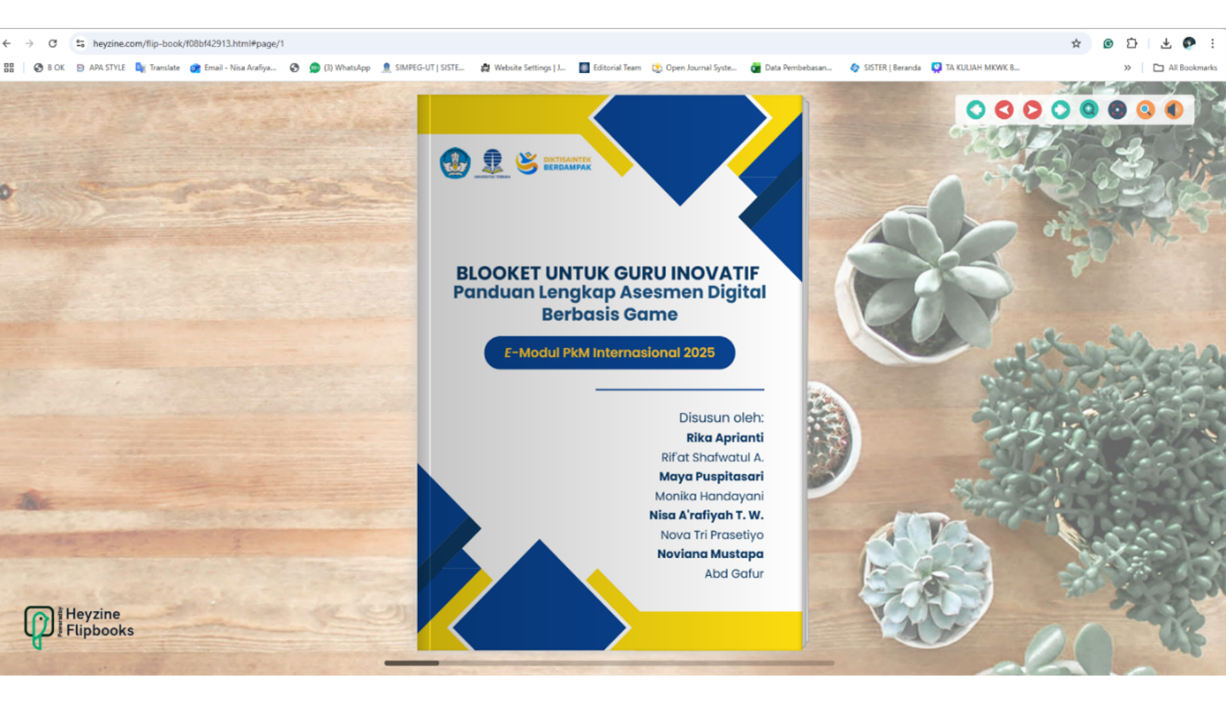
Results: The online training involved 117 educators from multiple CLCs across Sabah, followed by an in-person workshop with approximately 100 teachers in Tawau. Participants produced or designed game-based digital assessment activities using Blooket as a hands-on output, and post-program support included educational grants (projectors, laptops, and a Blooket Plus account) to strengthen implementation sustainability.
Conclusion: The two-mode training model produced concrete assessment outputs and strengthened readiness to integrate game-based digital assessment in CLC contexts. Future work should extend evaluation toward classroom-level impact and test replication across CLC districts with varying resource constraints.
References
Jatmika and M. Indrawan, “Indonesia-Malaysia Collaborative Policy to Address the Issue of Education for Indonesian Migrant Worker Family in Sabah Malaysia,” in Nusantara Science and Technology Proceedings, May 2023, pp. 22–28, https://doi.org/10.11594/nstp.2023.3404
A. Saefudin, Jumintono, and Rejokirono, “National Identity in Transnational Life: The Case of Dual Education of Indonesian Migrant Children in Sabah, East Malaysia,” Kaji. Malaysia, vol. 42, no. 1, pp. 117–138, 2024, https://doi.org/10.21315/km2024.42.1.6
M. Muslihudin, R. Hussin, T. Retno Wulan, and J. Santoso, “The Role of Non-Government Organizations in the Education of Migrant Workers’ Children in Sabah Malaysia,” KnE Soc. Sci., vol. 8, no. 3, pp. 363–373, Feb. 2023, https://doi.org/10.18502/kss.v8i3.12841
T. Loganathan, Z. L. Ong, F. Hassan, Z. X. Chan, and H. A. Majid, “Barriers and facilitators to education access for marginalised non-citizen children in Malaysia: A qualitative study,” PLoS One, vol. 18, no. 6, p. e0286793, 2023, https://doi.org/10.1371/journal.pone.0286793
A. Maksum, “Indonesian migrant workers’ multi-track diplomacy for education rights in Penang, Malaysia,” Diaspora, Indig. Minor. Educ., pp. 1–13, 2025, https://doi.org/10.1080/15595692.2025.2492549
O. F. Cingir, “Bridging Governance Gaps: The Role of Alternative Learning Centers in Sabah, Malaysia, as Repertoires of Migration Governance,” Int. Migr. Rev., pp. 1–26, 2025, https://doi.org/10.1177/01979183251359168
L. M. Black, The Impact of 21st Century Community Learning Center Programs On Middle School Achievement. search.proquest.com, 2018.
R. Y. Fus Han, A. S. Ambotang, G. Sulaiman, and D. N. B. Pantulusang, “Data-driven decisions making: Leveraging DELIMa 2.0 analytics for strategic digital leadership for underprivileged school in Sabah,” J. Pemikir Pendidik., vol. 13, no. 1, pp. 103–118, Nov. 2025, https://doi.org/10.51200/jpp.v13i1.6921
V. Abou-Khalil, S. Helou, E. Khalifé, M. A. Chen, R. Majumdar, and H. Ogata, “Emergency online learning in low-resource settings: Effective student engagement strategies,” Educ. Sci., 2021, https://doi.org/10.3390/educsci11010024
F. Goshtasbpour, B. Pitt, S. Cross, R. Ferguson, and D. Whitelock, “Challenges for Innovation and Educational Change in Digital Education in Low Resourced Settings: A Kenyan Example,” Ubiquity Proc., vol. 3, no. June, pp. 38–45, 2023, https://doi.org/10.5334/uproc.66
A. Ali, A. A. Raza, and I. A. Qazi, “Validated digital literacy measures for populations with low levels of internet experiences,” Dev. Eng., vol. 8, no. January, p. 100107, 2023, https://doi.org/10.1016/j.deveng.2023.100107
M. Estaji, Z. Banitalebi, and G. T. L. Brown, “The key competencies and components of teacher assessment literacy in digital environments: A scoping review,” Teach. Teach. Educ., vol. 141, p. 104497, 2024, https://doi.org/10.1016/j.tate.2024.104497
Z. Mirsanjari, “Enhancing assessment literacy in EAP instruction: the role of teacher development courses in overcoming systemic barriers,” Lang. Test. Asia, vol. 15, no. 30, 2025, https://doi.org/10.1186/s40468-025-00368-7
S. M. Al-Bahlani and P. Ecke, “Assessment competence and practices including digital assessment literacy of postsecondary {English} language teachers in {Oman},” Cogent Educ., vol. 10, no. 2, 2023, https://doi.org/10.1080/2331186x.2023.2239535
J. B. Napanoy and M. K. Peckley, “Assessment Literacy of Public Elementary School Teachers in the Indigenous Communities in Northern Philippines,” Univers. J. Educ. Res., vol. 8, no. 11B, pp. 5693–5703, 2020, https://doi.org/10.13189/ujer.2020.082203
K. Koh, L. E. C.-A. Burke, A. Luke, W. Gong, and C. Tan, “Developing the assessment literacy of teachers in Chinese language classrooms: A focus on assessment task design,” Lang. Teach. Res., vol. 22, no. 3, pp. 264–288, Jan. 2017, doi: https://doi.org/10.1177/1362168816684366
K. Vogt and D. Tsagari, “Assessment Literacy of Foreign Language Teachers: Findings of a European Study,” Lang. Assess. Q., vol. 11, no. 4, pp. 374–402, Oct. 2014, doi: https://doi.org/10.1080/15434303.2014.960046
F. Ogan-Bekiroglu and E. Suzuk, “Pre-service teachers’ assessment literacy and its implementation into practice,” Curric. J., vol. 25, no. 3, pp. 344–371, Jul. 2014, https://doi.org/10.1080/09585176.2014.899916
P. K. Hakim and R. S. Dewi, “Unlocking digital language assessment literacy: Vocational school English teachers’ perspectives,” BIS Educ., vol. 1, p. V125012, 2025, https://doi.org/10.31603/bised.159
A. Chasubuta and P. Ndibalema, “Barriers hindering Effective Engagement in Online Assessment for Teacher Education in Tanzania: Perspectives from two Teachers’ Colleges,” J. Issues Pract. Educ., vol. 16, no. Special Issue, pp. 31–48, 2024, https://doi.org/10.61538/jipe.v16i.1422
E. G. B. Decir and J. L. Paglinawan, “Hindrances of Adopting Technology in Assessment in Classrooms,” Int. J. Sci. Manag. Res., vol. 08, no. 10, pp. 413–423, 2025, https://doi.org/10.37502/ijsmr.2025.81033
S. Laher and K. Cockcroft, “Moving from culturally biased to culturally responsive assessment practices in low-resource, multicultural settings.,” Prof. Psychol. Res. Pract., vol. 48, no. 2, pp. 115–121, 2017, https://doi.org/10.1037/pro0000102
Evidence of innovative assessment: literature review and case studies. LU: Publications Office of the European Union, 2019.
S. Yaakub, W. Joko Pranoto, I. Safitri Windiarti, and R. Priyanti, “Transforming Rural Education With Digital Assessment Tools: a Case Study of Socrative in Sarolangun, Indonesia,” J. Abdimas UM Jambi, vol. 2, no. 1, pp. 27–33, 2025, https://doi.org/10.53978/jaum.v2i1.525
M. A. Herianto, A. Halim, A. A. Patak, and M. Tahir, “Navigating Digital Assessment: Teacher-Identified Challenges and Strategies in Using Wordwall in Efl Classrooms,” Klasikal J. Educ. Lang. Teach. Sci., vol. 7, no. 1, pp. 158–170, 2025, https://doi.org/10.52208/klasikal.v7i1.1270
E. Diana, L. A. Riswari, and E. Wijayanti, “Training and Mentoring for Elementary Teachers in Making STEM-Based Digital Assessment Instruments,” J. Community Serv. Empower., vol. 6, no. 2, pp. 122–129, 2025, https://doi.org/10.22219/jcse.v6i2.36445
F. Aziez, E. H. Sadeli, S. Anjarani, S. Hawanti, D. Setianti, and R. Rinjani, “A Teacher Training on Digital Assessment Strategies for Meaningful Learning Outcomes at Buranakarn Suksa Witya School, Thailand,” J. Pengabdi. Kpd. Masy. R., vol. 7, no. 4, pp. 692–700, Oct. 2024, https://doi.org/10.33330/jurdimas.v7i4.3389
S. Mohd Sukis, N. Muhamad, and A. H. Borham, “Implementation of Digital Alternative Assessment Among Islamic Education Teachers (IET) in Primary Schools,” Int. J. Educ. Psychol. Couns., vol. 7, no. 47, pp. 578–600, Sep. 2022, https://doi.org/10.35631/ijepc.747046
A. Subarno, C. Dyah Sulistyaningrum Indrawati, P. Ninghardjanti, W. Winarno, and M. Choerul Umam, “Enhancing AI-Powered PowerPoint Skills: Training Impact on Vocational Teachers in Surakarta,” SPEKTA (Jurnal Pengabdi. Kpd. Masy. Teknol. dan Apl., vol. 6, no. 1, pp. 122–141, 2025, https://doi.org/10.12928/spekta.v6i1.13056
P. E. K. Erlangga, “The Using Blooket Web as a Teaching Medium on Students’ Motivation to Learn English as a Second Language,” J. Technol. Educ. Teach., vol. 2, no. 1, pp. 152–157, May 2025, https://doi.org/10.62734/jtech.v2i1.460
O. S. Salsabila, M. Abidin, and P. R. Yurisa, “Enhancing Vocabulary Learning Through the Blooket Application: Effects on Motivation and Achievement Among Arabic Learners,” Abjadia Int. J. Educ., vol. 10, no. 2, 2025, https://doi.org/10.18860/abj.v10i2.32340
H. Christianto, A. C. Lalang, and D. M. W. Nay, “The Implementation of the Case Method with Blooket Media to Enhance Student Learning Outcomes in Radiochemical Material,” Orbital Electron. J. Chem., vol. 16, no. 1, pp. 62–67, May 2024, doi: https://doi.org/10.17807/orbital.v15i5.19375
U. Wahyudin, A. Hufad, and Purnomo, “Management of the Community Learning Center (CLC) program in Kinabalu Sabah Malaysia,” Advances in Social Science, Education and Humanities, 2020, https://doi.org/10.2991/assehr.k.210508.021
Center for Community Health and Development, “Section 1. Developing a Plan for Assessing Local Needs and Resources,” in Community Tool Box, University of Kansas, 2024.
Center for Community Health and Development, “Section 5. Developing an Evaluation Plan,” in Community Tool Box, University of Kansas, 2024
D. Mutiara and M. Koesmawan, “Strategic Management in Achieving Service Standards at the Center for Community Learning Activities (PKBM).,” Asian J. Contemp. Educ., 2020, https://doi.org/10.18488/journal.137.2020.41.57.68
O. I. Nasiru and E. O. Uyanne, “Usage and Impact of Teachers Self-Assessment Practices on Teaching of Upper Basic Social Studies in Kwara State,” SPEKTA (Jurnal Pengabdi. Kpd. Masy. Teknol. dan Apl., vol. 3, no. 2, pp. 137–146, 2022, doi: https://doi.org/10.12928/spekta.v3i2.4016
Downloads
Published
How to Cite
Issue
Section
License
Copyright (c) 2026 Nisa Arafiyah Tri Wulandari, Monika Handayani, Maya Puspitasari, Rika Aprianti, Nova Tri Prasetyo, Aiza Sunarto, Mad Noor Madjapuni

This work is licensed under a Creative Commons Attribution-ShareAlike 4.0 International License.
Authors who publish with SPEKTA (Jurnal Pengabdian Kepada Masyarakat: Teknologi dan Aplikasi) agree to the following terms:
- Authors retain copyright and grant the journal the right of first publication with the work simultaneously licensed under a Creative Commons Attribution License (CC BY-SA 4.0) that allows others to share the work with an acknowledgment of the work's authorship and initial publication in this journal.
- Authors are able to enter into separate, additional contractual arrangements for the non-exclusive distribution of the journal's published version of the work (e.g., post it to an institutional repository or publish it in a book), with an acknowledgment of its initial publication in this journal.
- Authors are permitted and encouraged to post their work online (e.g., in institutional repositories or on their website) prior to and during the submission process, as it can lead to productive exchanges, as well as earlier and greater citation of published work.

This work is licensed under a Creative Commons Attribution-ShareAlike 4.0 International License.