Improving Teachers’ and Students’ Understanding of Solar Energy Using an Interactive PV Learning Kit
DOI:
https://doi.org/10.12928/spekta.v7i1.15682Keywords:
Education, Electrical components, Renewable energy, Solar power, Trainer kitAbstract
Background: Solar energy utilization holds great potential to be introduced at an early age, especially for elementary school students in island regions such as Tidung Island, which receives high solar radiation throughout the year. However, the lack of hands-on, interactive learning media and limited teacher understanding of photovoltaic (PV) technology have become major obstacles in renewable energy education.
Contribution: This study proposes an interactive PV learning kit (SolarPuz-Kit) as a technology-enhanced educational intervention to enhance teachers’ and students’ competencies. It also contributes to the development of experiential learning approaches in renewable energy education.
Method: This study employed a pre-experimental one-group pretest–posttest design involving elementary school students. The implementation stages include the development of a portable PV trainer kit, and hands-on learning intervention sessions.
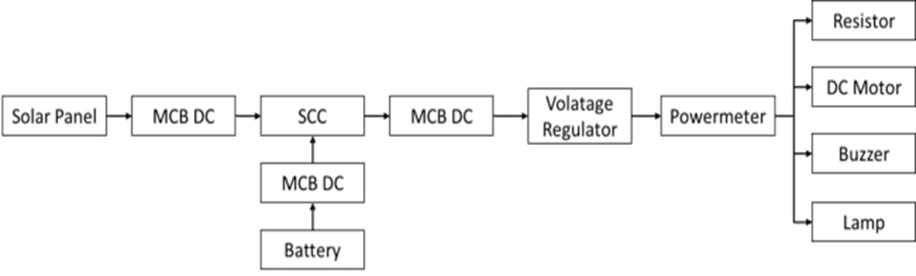
Results: The trainer kit consists of a 30 Wp solar panel and various electrical components for simulating DC energy distribution. Evaluation through pre- and post-tests revealed a significant improvement in student understanding—an 85% increase, from an average score of 36.47 to 67.64.
Conclusion: The results demonstrate that the interactive SolarPuz-Kit effectively enhances renewable energy literacy and technical problem-solving skills among students. This study highlights the effectiveness of hands-on, game-based learning in supporting conceptual understanding and provides a scalable instructional strategy for renewable energy education in remote island contexts.
References
D. Gayen, R. Chatterjee, and S. Roy, “A review on environmental impacts of renewable energy for sustainable development,” Int. J. Environ. Sci. Technol., vol. 21, no. 5, pp. 5285–5310, Mar. 2024, https://doi.org/10.1007/s13762-023-05380-z
N. A. Pambudi, “Renewable Energy in Indonesia: Current Status, Potential, and Future Development,” Sustainability, vol. 15, no. 3, p. 2342, Jan. 2023, https://doi.org/10.3390/su15032342
J. Bada, A. D. Vidal, Y. Komazawa, N. Ledanois, and H. Yaqoob, “Renewables 2023 Global Status Report,” Report REN21. 2023.
S. Twidale, “Renewables Provided Record 30% of Global Electricity in 2023, Ember Says.” Reuters, 2024.
F. Afif and A. Martin, “Review of Solar Energy Potential and Policy in Indonesia,” J. Engine Energy, Manufacturing, and Mater. 2022.
D. Aryani, S. Pranoto, F. Fajar, A. N. Intang, and F. X. Rhamadhan, “Artificial Neural Network Prediction to Identify Solar Energy Potential In Eastern Indonesia,” 2023 IEEE 3rd International Conference in Power Engineering Applications, 2023.
R. Mayer, Multimedia Learning. Cambridge University Press, 2020.
J. Hattie, Visible Learning. Routledge, 2008.
S. Asli, “Enhancing Wind Energy Awareness Among Fourth-Grade Students: The Impact of Comic-Based Learning on Environmental Education,” Sustainability, vol. 17, no. 10, p. 4636, May 2025, https://doi.org/10.3390/su17104636
A. K. Akella, R. P. Saini, and M. P. Sharma, “Social, economical and environmental impacts of renewable energy systems,” Renew. Energy, vol. 34, no. 2, pp. 390–396, Feb. 2009, https://doi.org/10.1016/j.renene.2008.05.002
D. A. Kolb, “Experiential learning: Experience as the source of learning and development.” Pearson Education Limited, 2015.
S. O. Bada and S. Olusegun, “Constructivism learning theory: A paradigm for teaching and learning,” Journal of Research &Method in Education. vulms.vu.edu.pk, 2015, https://doi.org/10.9790/7388-05616670
H. S. M. Honey, and G. Pearson, STEM Integration in K-12 Education. Washington, D.C.: National Academies Press, 2014.
P. Redmond, J. V. Lock, and V. Smart, “Pre-service teachers’ perspectives of cyberbullying,” Comput. Educ., vol. 119, pp. 1–13, Apr. 2018, https://doi.org/10.1016/j.compedu.2017.12.004
T. A. Mikropoulos and A. Natsis, “Educational virtual environments: A ten-year review of empirical research (1999–2009),” Comput. Educ., vol. 56, no. 3, pp. 769–780, Apr. 2011, https://doi.org/10.1016/j.compedu.2010.10.020
S. Papadakis, “The impact of coding apps to support young children in computational thinking and computational fluency. A literature review,” Frontiers in Education. frontiersin.org, 2021, https://doi.org/10.3389/feduc.2021.657895
H. S. M. Badr and A. A. H. Elgabry, “Evaluating the Effectiveness of Scratch Jr and Tynker Jr in Teaching Coding Skills for Kindergarten,” Int. J. Early Child., 2025, https://doi.org/10.1007/s13158-025-00442-4
J. L. Plass, B. D. Homer, and C. K. Kinzer, “Foundations of Game-Based Learning,” Educ. Psychol., vol. 50, no. 4, pp. 258–283, Oct. 2015, https://doi.org/10.1080/00461520.2015.1122533
S. E. Barrows, J. S. Homer, and A. C. Orrell, “Valuing wind as a distributed energy resource: A literature review,” Renew. Sustain. Energy Rev., vol. 152, p. 111678, Dec. 2021, https://doi.org/10.1016/j.rser.2021.111678
J. M. Zydney and Z. Warner, “Mobile apps for science learning: Review of research,” Comput. Educ., vol. 94, pp. 1–17, Mar. 2016, doi: https://doi.org/10.1016/j.compedu.2015.11.001
S. Rahayu, D. F. Treagust, and A. L. Chandrasegaran, “High school and preservice chemistry teacher education students’ understanding of voltaic and electrolytic cell concepts: evidence of consistent learning difficulties across Years,” Int. J. of Sci. and Mathema. Edu., 2022, https://doi.org/10.1007/s10763-021-10226-6
M. I. Simeon, M. A. Samsudin, and N. Yakob, “Effect of design thinking approach on students’ achievement in some selected physics concepts in the context of STEM learning,” Inter. J. Technol. Des. Edu., 2022, https://doi.org/10.1007/s10798-020-09601-1
Ü. Ormancı, “Effects of Simulation-Based Science Instruction on Fifth-Grade Students’ Systems Thinking and Problem-Solving Perceptions,” Systems. mdpi.com, 2026, https://doi.org/10.3390/systems14020222
M. Irmak, H. Inaltun, J. Ercan-Dursun, and N. Yuruk, “Development and application of a three-tier diagnostic test to assess pre-service science teachers’ understanding on work-power and energy concepts,” Int. J. of Sci. and Mathema. Edu., 2023, https://doi.org/10.1007/s10763-021-10242-6
E. A. Martinez-Ríos, P. Ponce-Cruz, and A. Molina, “A holistic educational platform for the study of the smart grid,” Inter. J. Interact. Des. and Manufact., 2022, https://doi.org/10.1007/s12008-022-00970-6
S. J. Osterlind, Constructing test items: Multiple-choice, constructed-response, performance, and other formats. Springer, 1998.
D. K. Singh, Dictionary of mechanical engineering. Springer, 2024.
M. Liserre, H. Beiranvand, Y. Leng, R. Zhu, and P. A. Hoeher, “Overview of talkative power conversion technologies,” IEEE Open J. Power Electronics, 2023, https://doi.org/10.1109/OJPEL.2023.3237709
F. R. Spellman, The science of wind power. api.taylorfrancis.com, 2022.
G. R. Kanagachidambaresan, Role of Single Board Computers (SBCs) in Rapid IoT Prototyping. Springer, 2021.
Downloads
Published
How to Cite
Issue
Section
License
Copyright (c) 2026 Nuha Nadhiroh, Murie Dwiyaniti, Arum Kusuma Wardhany, Nagib Muhammad, Jonathan Romulus Martius, Arjuna Muhammad Utomo, M. Wildan Mukholadun Saujana, Yuto Yamashiro

This work is licensed under a Creative Commons Attribution-ShareAlike 4.0 International License.
Authors who publish with SPEKTA (Jurnal Pengabdian Kepada Masyarakat: Teknologi dan Aplikasi) agree to the following terms:
- Authors retain copyright and grant the journal the right of first publication with the work simultaneously licensed under a Creative Commons Attribution License (CC BY-SA 4.0) that allows others to share the work with an acknowledgment of the work's authorship and initial publication in this journal.
- Authors are able to enter into separate, additional contractual arrangements for the non-exclusive distribution of the journal's published version of the work (e.g., post it to an institutional repository or publish it in a book), with an acknowledgment of its initial publication in this journal.
- Authors are permitted and encouraged to post their work online (e.g., in institutional repositories or on their website) prior to and during the submission process, as it can lead to productive exchanges, as well as earlier and greater citation of published work.

This work is licensed under a Creative Commons Attribution-ShareAlike 4.0 International License.