Enhancement increasing the productivity of the traditional herbal “Jamu Mak Lin” through a community partnership program
DOI:
https://doi.org/10.12928/spekta.v6i2.14742Keywords:
Jamu “Mak Lin” herbal, Medicine financial, Management training online, Marketing training increased, ProductivityAbstract
Background: The traditional home-based herbal medicine industry,” Jamu Mak Lin” faces challenges, including traditional herbal medicine production methods on traditional equipment. The packaging and labels of herbal medicine are not registered. There is a scarcity of effective door-to-door marketing strategies. A lack of good management and financial accountability systems.
Contribution: The main objective is to increase the productivity of “Jamu Mak Lin” traditional herbs through improvements in production processes and equipment, financial management, and marketing strategies.
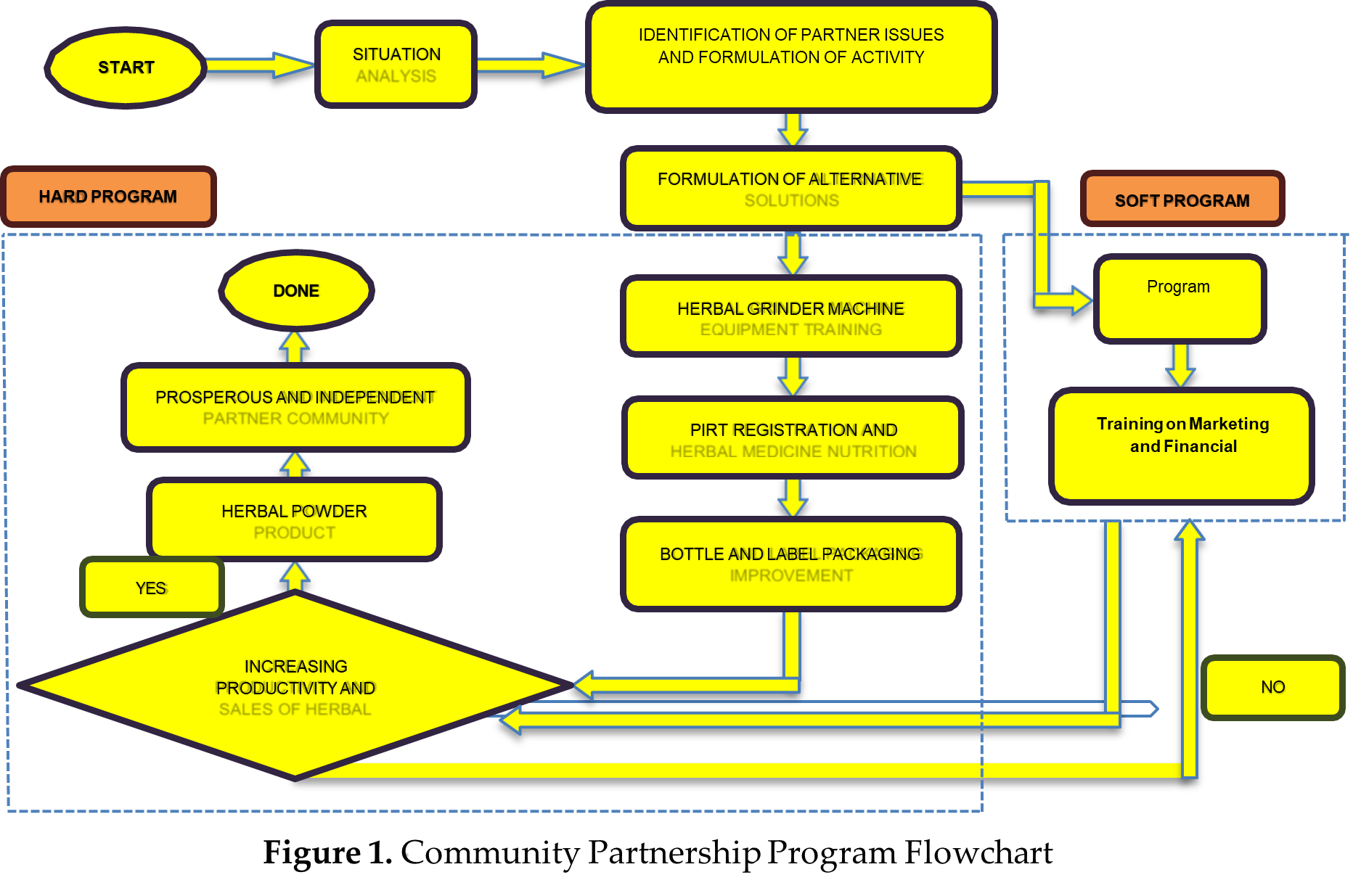
Method: The method applied is Participatory Action Research (PAR), consisting of both hard and soft programs.
Results: The results show a significant improvement in liquid herb production, reaching 150 bottles of 350 mL (approximately 52.5 liters), with an estimated increase in productivity and profit of up to 85% per day. In addition, “Jamu Mak Lin” traditional herbal products have been registered for halal certification, and the packaging design has been improved to be more elegant, hygienic, and readable.
Conclusion: Through this community partnership program, the productivity and income of “Jamu Mak Lin” traditional herbal products have significantly increased. The next program’s sustainability is achieved by diversifying herbal medicine dipping and herbal medicine cafes.
References
C. Liu, “Overview on development of ASEAN traditional and herbal medicines,” Chinese Herb. Med., vol. 13, no. 4, pp. 441–450, Oct. 2021, https://doi.org/10.1016/j.chmed.2021.09.002
M. H. Zulkifli, Z. L. Abdullah, N. I. S. Mohamed Yusof, and F. Mohd Fauzi, “In silico toxicity studies of traditional Chinese herbal medicine: A mini review,” Curr. Opin. Struct. Biol., vol. 80, p. 102588, Jun. 2023, https://doi.org/10.1016/j.sbi.2023.102588
M. F. Lubis, P. A. Zaitun Hasibuan, H. Syahputra, C. Surbakti, and R. Astyka, “Saurauia vulcani (Korth.) as herbal medicine potential from North Sumatera, Indonesia: A literature review,” Heliyon, vol. 8, no. 4, p. e09249, Apr. 2022, https://doi.org/10.1016/j.heliyon.2022.e09249
Z. S. Ulhaq, “The use of herbal medicine for cancer therapy in Indonesia: a prospective cohort study,” J. Herb. Med., vol. 51, p. 100991, Jun. 2025, https://doi.org/10.1016/j.hermed.2025.100991
E. Harfiani, R. Puspita, and I. R. S. Prabarini, “Herbal Medicine Usage During the COVID‐19 Pandemic in Indonesia: Trends and Determinants,” Sci. World J., vol. 2025, no. 1, Jan. 2025, https://doi.org/10.1155/tswj/1639500
T. E. Wahjono and W. D. Jusniarti, “Buku Saku Tanaman Obat: Warisan tradisi nusantara untuk kesejahteraan rakyat,” Bogor: Pusat Penelitian dan Pengembangan Perkebunan. 2021.
Elfahmi, H. J. Woerdenbag, and O. Kayser, “Jamu: Indonesian traditional herbal medicine towards rational phytopharmacological use,” J. Herb. Med., vol. 4, no. 2, pp. 51–73, Jun. 2014, https://doi.org/10.1016/j.hermed.2014.01.002
R. Indonesia, “Rencana Pembangunan Jangka Menengah Nasional 2015-2019,” Rencana Pembang Jangka Menengah Nas. 2015.
G. Prayitno, “Community-powered environmental pathways to reduce stunting: Food security, social capital, and open innovation in semi-urban Indonesia,” Environ. Challenges, vol. 21, p. 101350, Dec. 2025, https://doi.org/10.1016/j.envc.2025.101350
H. Husnani and W. Puspita, “Kegiatan Pengabdian Masyarakat Dengan Tema Sosialisasi Jamu Instan Dalam Rangka Milad Akfar Yarsi Pontianak Yang Ke-23,” J. Pengabdi. Indones., 2023, [Online]. Available: https://jkfn.akfaryarsiptk.ac.id/index.php/japin/article/view/95
M. Yuliana, S. S. Tauri, N. Utami, C. Kartika, and D. Arisandi, “Pelatihan Pembuatan Jamu Herbal Jahe Pada Komunitas Ibu PKH Di Desa Sungai Pinang,” J. Pengabdi. Masy. Bangsa, vol. 1, no. 7, pp. 1044–1050, Sep. 2023, https://doi.org/10.59837/jpmba.v1i7.302
A. D. Yulianto, R. N. Hariza, R. P. Adelia, and A. U. Sofyandi, “Strategi Digital Marketing Umkm Jamu Tradisional Melalui Media Soisal Untuk Meingkatkan Jangkauan Pasar,” J. Abdimas Sosek, 2025, [Online]. Available: https://journalpdmi.org/index.php/jas/article/view/104
F. Faramayuda and A. S. Windyaswari, “Pelatihan Pembuatan Serbuk Jamu Instan sebagai Model Pemberdayaan UMKM di Kota Cimahi,” Room Civ. Soc. Dev., vol. 4, no. 4, pp. 725–733, Aug. 2025, https://doi.org/10.59110/rcsd.734
D. Cahyani, M. Ridha, K. Huda, and A. Mubarok, “Peningkatan ekonomi keluarga melalui pelatihan bisnis jamu tradisional dengan pendekatan PAR dan capacity building di Mojogebang,” J. Pengabdi. Masyarakat, 2025, [Online]. Available: https://jurnal.penerbitwidina.com/index.php/JPMWidina/article/view/1254
A. Zunaidi, Metodologi Pengabdian Kepada Masyarakat: Pendekatan Praktis untuk Memberdayakan Komunitas, vol. 3, no. 1. Yogyakarta: Yayasan Putra Adi Dharma, 2024.
Rif’an Luthfi, Naily Qurota A’yuni, Setiorini Rahma Safitri, Ahmad Satriya, Rahmawati Febriyantika, and Agung Prasetyo Putra, “Program Pengabdian Kepada Masyarakat: Metode Fun-Counseling Dan Outbound Sebagai Media Pembelajaran Dan Pembentukan Karakter Anak Di Desa Rowoboni Tahun 2024,” Varia Humanika, vol. 5, no. 2, pp. 1–7, Nov. 2024, https://doi.org/10.15294/vh.v5i2.15749
B. W. Budiarto, S. Karyadi, W. Wasiran, and R. Pratiwi, “Improving Digital Literacy of Village Communities in Indonesia through Information Technology-Based Community Service Programs,” Unram Community Service, 2024, [Online]. Available: https://jurnalpasca.unram.ac.id/index.php/UJCS/article/view/716
I. I. Hidayat, S. Nurhayati, and G. Boriboon, “Vocational high school community service as innovative community empowerment program: A case study of garut vocational high school,” J. Paedagogy, 2024, [Online]. Available: https://ojspanel.undikma.ac.id/index.php/pedagogy/article/view/8806
A. A. K. Jayawarsa, K. A. K. Saputra, and N. M. Narindra, “Strengthening Ecotourism to Improve Quality of Life in Ubung Kaja Village through Creativity, Order, and Cultural Values,” Community Serv.: Sustainability Development, 2024, [Online]. Available: https://www.swastikajournal.com/index.php/cssdev/article/view/81
L. Oktaviani, Y. Fernando, R. Romadhoni, and N. Noviana, “Developing a web-based application for school councelling and guidance during COVID-19 Pandemic,” Community Serv., 2021, [Online]. Available: https://ejournal.umm.ac.id/index.php/jcse/article/view/17630
A. D. Tuhuteru and M. Iqbal, “Readiness of micro, small, and medium enterprises (MSMEs) in the food and beverage sector for halal certification implementation: A case study in Magelang, Indonesia,” J. Islam. Econ. Lariba, 2024, [Online]. Available: https://journal.uii.ac.id/JIELariba/article/view/38031
K. T. Fahira and R. M. Yasin, “Peningkatan Nilai Produk Melalui Perijinan PIRT, Sertifikasi Halal dan Digital Marketing Pada UMKM Sirup Parijoto,” SEMAR (Jurnal Ilmu Pengetahuan, Teknologi, dan Seni bagi Masyarakat, 2022, [Online]. Available: https://jurnal.uns.ac.id/jurnal-semar/article/view/64034
M. I. N. Susiang, I. Siswanti, D. Permana, and M. W. Wibowo, “Effects of competitive intelligence and halal integrity on Halalan Tayyiban implementation strategy in Indonesian MSMEs: the mediating role of halal orientation Strategy,” J. Islam. Marketing, 2024, https://doi.org/10.1108/JIMA-10-2023-0344
S. F. Aini, N. Hendrsato, and A. Haidar, “Assessing the Impact of Marketing Mix and Halal Awareness on Consumer Purchase Behavior: A Case in Indonesia,” Halal Tour. and Pilgrimage, 2024, [Online]. Available: http://journals.smartinsight.id/index.php/HTP/article/view/567
S. Astutik, J. Pretzsch, J. N. Kimengsi, and G. Kapp, “Medicinal plants production systems in rural Indonesia: Management practices and performance insights,” For. Policy Econ., vol. 153, p. 102972, Aug. 2023, https://doi.org/10.1016/j.forpol.2023.102972
C. Kong, H. Lee, and H. Park, “Design and manufacturing of automobile hood using natural composite structure,” Compos. Part B Eng., vol. 91, pp. 18–26, Apr. 2016, https://doi.org/10.1016/j.compositesb.2015.12.033
I. Santosa, G. R. Wilis, and U. Mulyadi, “Soy milk filter design using DFMA method,” IOP Conf. Ser. Earth and Environmental Science, 2021, https://doi.org/10.1088/1755-1315/755/1/012047
S. T. Kismanti and M. F. Nurdin, “Rancang Bangun Mesin Penepung Tipe Disc Mill FFC-15 pada Biji Jagung,” J. Bear. Borneo Mech. Eng. Sci., vol. 2, no. 2, pp. 69–76, Dec. 2023, https://doi.org/10.35334/bearings.v2i2.4721
I. Santosa, A. Firdaus, R. Hidayat, R. Rusnoto, A. Wibowo, and F. Mubina Dewadi, “The Optimization of Vapor Compression Type for Desalination of Seawater Using the DFMA Method,” J. Tek. Mesin Mech. Xplore, vol. 3, no. 1, pp. 1–8, Jul. 2022, https://doi.org/10.36805/jtmmx.v3i1.2378
A. N. Swaraj, J. A. Moses, and L. Manickam, “Sustainable food upcycling: perspectives on manufacturing challenges and certification requirements for large-scale commercialization,” Sustainable Food Technology. pubs.rsc.org, 2025, [Online]. Available: https://pubs.rsc.org/en/content/articlehtml/2025/fb/d4fb00254g
H. H. Adinugraha, M. Shulthoni, and L. Syakirunni, “Halal Supply Chain Management from Theory to Application: Case Studies in Indonesia,” J. Islam, 2025, [Online]. Available: http://publications.waim.org.my/index.php/jims/article/view/132
A. Rahmat and M. Mirnawati, “Model Participation Action Research Dalam Pemberdayaan Masyarakat,” Aksara J. Ilmu Pendidik. Nonform., vol. 6, no. 1, p. 62, Jan. 2020, https://doi.org/10.37905/aksara.6.1.62-71.2020
G. S. Putro, A. Arfiany, and Y. Yasni, “Analisis dampak sosial dari implementasi program pengabdian berbasis teknologi di pedesaan,” ABDI DAYA J. Pengabdi. dan Pemberdayaan Masyarakat, 2024, [Online]. Available: http://ejournal.stiejb.ac.id/index.php/abdidaya/article/view/555
Downloads
Published
How to Cite
Issue
Section
License
Copyright (c) 2025 IRFAN SANTOSA, Ira Maya Hapsari, Rizki Prasetyo Tulodo, Amin Nur aKHMADI

This work is licensed under a Creative Commons Attribution-ShareAlike 4.0 International License.
Authors who publish with SPEKTA (Jurnal Pengabdian Kepada Masyarakat: Teknologi dan Aplikasi) agree to the following terms:
- Authors retain copyright and grant the journal the right of first publication with the work simultaneously licensed under a Creative Commons Attribution License (CC BY-SA 4.0) that allows others to share the work with an acknowledgment of the work's authorship and initial publication in this journal.
- Authors are able to enter into separate, additional contractual arrangements for the non-exclusive distribution of the journal's published version of the work (e.g., post it to an institutional repository or publish it in a book), with an acknowledgment of its initial publication in this journal.
- Authors are permitted and encouraged to post their work online (e.g., in institutional repositories or on their website) prior to and during the submission process, as it can lead to productive exchanges, as well as earlier and greater citation of published work.

This work is licensed under a Creative Commons Attribution-ShareAlike 4.0 International License.