Implementation of Ergonomics and Local Wisdom in Designing ErJo (Ergonomic Jojodog) as a Solution to the Sustainability of Squatting Work
DOI:
https://doi.org/10.12928/spekta.v6i2.14704Keywords:
Ergonomic jojodog, Local wisdom, Musculoskeletal, Sustainable development goalsAbstract
Background: This community service program was implemented to address musculoskeletal complaints among production workers who frequently adopted squatting postures, which imposed static loads on the lower back, knees, and calves, resulting in discomfort and reduced productivity.
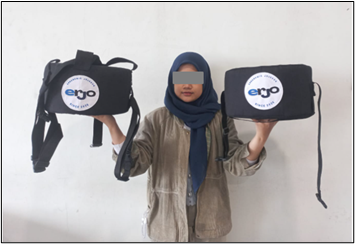
Contribution: This study introduces ErJo (Ergonomic Jojodog), a culturally adaptive ergonomic innovation that integrates traditional sitting design with modern ergonomic principles to enhance worker comfort and foster cultural acceptance.
Method: A participatory ergonomics approach involving ten production workers was employed through design, testing, and evaluation stages. Musculoskeletal complaints were assessed using the Indonesian National Standard (SNI 9011:2021), complemented by field observations and semi-structured interviews.
Results: After two weeks of ErJo implementation, musculoskeletal complaints in the knees and calves decreased from 67% to 20%, while lower-back discomfort declined to 40%. Participants reported greater comfort, stability, and ease of movement, with the belt-equipped model achieving the highest usability score. This study demonstrates that integrating ergonomics with local wisdom enhances worker well-being and promotes sustainable occupational practices.
Conclusion: ErJo effectively reduced musculoskeletal complaints and improved work comfort in squatting tasks. This innovation supports SDG 3 (good health and well-being) and SDG 8 (decent work and economic growth), with potential for broader application across similar manual occupations.
References
A. Widyanti, “Ergonomic Checkpoint in Agriculture, Postural Analysis, and Prevalence of Work Musculoskeletal Symptoms among Indonesian Farmers: Road to Safety and Health in Agriculture,” J. Tek. Ind., vol. 20, no. 1, pp. 1–10, 2018, https://doi.org/10.9744/jti.20.1.1-10.
S. Norouzi, S. S. Tavafian, R. Cousins, and H. Mokarami, “Evaluation of postural stress and risk factors for developing work‑related musculoskeletal disorders among full‑time women homemakers,” Sport Sci. Health, vol. 21, no. 1, pp. 173–180, 2025, https://doi.org/10.1007/s11332-024-01242-4
S. Hakim, H. Prastawa, and N. Susanto, “Ergonomic evaluation of mechanical workshop activities to reduce musculoskeletal disorders,” Adv. Sustain. Sci. Eng. Technol., vol. 5, no. 1, pp. 1–8, 2023, https://doi.org/10.26877/asset.v5i1.15036
M. M. Rahman, M. M. Mofachel Hossain, M. Islam, and R. I. Avi, “Optimizing Welders’ Posture: A Study on Ergonomic Solutions to Mitigate MSDs,” in International Conference on Mechanical, Industrial and Materials Engineering, 2024, vol. 1, no. December, pp. 1–6.
N. Rahdiana, B. Suhardi, and R. Rahmadiyani, “Identifikasi keluhan muskuloskeletal pekerja berdasarkan standar nasional indonesia,” in Bunga Rampai Teknik Industri, vol. III, no. 2025, Semarang: UNDIP Press, 2025, pp. 287–307.
L. Punnett and D. H. Wegman, “Work-related musculoskeletal disorders: The epidemiologic evidence and the debate,” J. Electromyogr. Kinesiol., vol. 14, no. 1, pp. 13–23, 2004, https://doi.org/10.1016/j.jelekin.2003.09.015
X. Jin, “Prevalence and associated factors of lower extremity musculoskeletal disorders among manufacturing workers : a cross-sectional study in China,” BMJ Open, pp. 1–9, 2022, https://doi.org/10.1136/bmjopen-2021-054969
D. M. Ditchen, R. P. Ellegast, T. Gawliczek, B. Hartmann, and M. A. Rieger, “Occupational kneeling and squatting: development and validation of an assessment method combining measurements and diaries,” Int. Arch. Occup. Environ. Health, vol. 88, no. 2, pp. 153–165, 2015, https://doi.org/10.1007/s00420-014-0946-5
Siswiyanti, Rusnoto, S. Luthfianto, Nurjanah, and A. Zainudin, “The Work Posture Assessment Towards Musculoskeletal Disorders in Coloring Activities of Indonesian Hand Drawn Batik,” J. Phys. Conf. Ser. - 2nd Int. Conf. Adv. Sci. Innov., vol. 1424, no. 1, pp. 1–13, 2019, https://doi.org/10.1088/1742-6596/1424/1/012048
I. G. S. Pandit and P. A. N. K. Permatananda, “Ergonomic approach decrease musculoskeletal complaints and increases productivity of pindang producers in Kusamba, Bali,” IOP Conf. Ser. Mater. Sci. Eng. - 3rd Annu. Appl. Sci. Eng. Conf. (AASEC 2018), vol. 434, no. 1, pp. 1–5, 2018, https://doi.org/10.1088/1757-899X/434/1/012318
K. T. Palmer, “Occupational activities and osteoarthritis of the knee,” Br. Med. Bull., vol. 102, no. 1, pp. 147–170, 2012, https://doi.org/10.1093/bmb/lds012
A. Choobineh, R. Tosian, Z. Alhamdi, and M. Davarzanie, “Ergonomic intervention in carpet mending operation,” Appl. Ergon., vol. 35, no. 5, pp. 493–496, 2004, https://doi.org/10.1016/j.apergo.2004.01.008
J. Hutabarat, J. A. Pradana, I. Ruwana, D. W. L. Basuki, S. A. Sari, and R. Septiari, “Ergonomic Chair Design as a Solution to Musculoskeletal Disorders among Traditional Cobblers: An Anthropometric Study,” J. Eur. des Syst. Autom., vol. 56, no. 4, pp. 697–701, 2023, https://doi.org/10.18280/jesa.560419.
A. Realyvásquez-Vargas, K. C. Arredondo-Soto, J. Blanco-Fernandez, J. D. Sandoval-Quintanilla, E. Jiménez-Macías, and J. L. García-Alcaraz, “Work standardization and anthropometric workstation design as an integrated approach to sustainableworkplaces in the manufacturing industry,” Sustain., vol. 12, no. 9, pp. 1–22, 2020, https://doi.org/10.3390/su12093728.
K. Lukiyanto, A. R. F. Pratama, and I. K. Ningrum, “The Challenges of Applying Ergonomics to Small Medium Enterprises,” E3S Web Conf. 4th Int. Conf. Biosph. Harmon. Adv. Res. (ICOBAR 2022), vol. 388, pp. 1–6, 2023, https://doi.org/10.1051/e3sconf/202338801012.
S. C. Heath, “Navigating psychosocial dimensions: understanding the intersections of adaptation strategies and well-being outcomes in the context of climate change,” Current Opinion in Environmental Sustainability. Elsevier, 2025, [Online]. Available: https://www.sciencedirect.com/science/article/pii/S1877343524000800.
M. Khan, K. Behrendt, D. Papadas, and L. Arnold, “From inequalities to inclusion: Sustainable development for smallholders,” Sustain. Development, 2025, https://doi.org/10.1002/sd.70073
J. E. Akahome and M. L. Matsoso, “Claiming Power and Resilience: Decolonizing Women’s Entrepreneurship in Nigeria’s Socio-Cultural Contexts,” Palgrave Handb. Decolonising Enterpreneurship, 2025, 10.1007/978-3-031-92310-4_8
A. S. Imada and M. M. Robertson, “Cultural Perspectives in Participatory Ergonomics,” Proc. Hum. Factors Soc. Annu. Meet., vol. 31, no. 9, pp. 1019–1022, 1987, https://doi.org/10.1177/154193128703100920
D. Samsudin, “Pengetahuan Generasi Milenial Sunda Perkotaan terhadap Peralatan Dapur Tradisional Sunda,” Suar Betang, vol. 16, no. 2, pp. 179–197, 2021, https://doi.org/10.26499/surbet.v16i2.242
A. D. Monterroza-Rios, M. S. Prada-Molina, L. G. Sañudo-Velez, and C. M. Cano-Ramirez, “Community-based design through the enactive concept of participatory sense-making: the case of water care in the Moravia neighbourhood of Medellín, Colombia,” CoDesign Int. J. CoCreation Des. Arts, vol. 20, no. 4, pp. 1–16, 2024, https://doi.org/10.1080/15710882.2024.2357781
P. Sukapto, H. Djojosubroto, and K. Audiandra, “Penerapan Participatory Ergonomics dalam Perbaikan Sistem K3 di Bagian Laminating dan Cutting (studi Kasus di PT Primarindo Asia Infrastructure Tbk),” JEMIS (Journal Eng. Manag. Ind. Syst., vol. 4, no. 1, pp. 77–85, 2016, https://doi.org/10.21776/ub.jemis.2016.004.01.9
I. Berlianty, R. A. Aziza, T. Wibawa, and G. M. Putro, “Pendampingan UMKM dalam Implementasi Ergonomi untuk Meningkatkan Produktivitas Pekerja Sandal Kulit,” JURPIKAT (Jurnal Pengabdi. Kpd. Masyarakat), vol. 5, no. 4, pp. 1530–1541, 2024, https://doi.org/10.37339/jurpikat.v5i4.2065
I. M. Sutajaya, “Community Empowerment Through Ergonomics Training With Local Wisdom Oriented to Improve Quality of Sculptor Health in the Peliatan Village, Ubud, Gianyar, Bali-Indonesia,” Bali Med. J. (Bali Med. J.), vol. 3, no. 3, pp. 157–160, 2014, https://doi.org/10.15562/bmj.v3i3.96.
Badan Standardisasi Nasional, “Keputusan Kepala Badan Standarisasi Nasional Nomor 590/Kep/BSN/12/2021, tentang: Penetapan SNI 9011:2021 Pengukuran dan Evaluasi Potensi Bahaya Ergonomi di Tempat Kerja,” Jakarta, 2021.
B. Das, S. Gangopadhyay, and G. Tirthankar, “The effects of using an ergonomic aid on the physical workload and body discomfort reported by pre-adolescent farmers in West Bengal, India,” Work, vol. 70, no. 2, pp. 571–582, 2021, https://doi.org/10.3233/WOR-213593.
P. Sukapto, S. Susanto, and F. Rohman, “Application of Participatory Ergonomic Method to Reduce Musculoskeletal Disorders With Rapid Whole Body Assessment (REBA) at PT. Adyawinsa Stamping Industries,” J. Eng. Sci., vol. 2, no. 1, pp. 60–73, 2024, https://doi.org/10.62885/improsci.v2i1.471.
M. Helander, A Guide to Human Factors and Ergonomics, 2nd Edition. Boca Raton: CRC Press, 2006.
E. K. Joseph, “Planning sustainable futures: critical drivers of success in the global context,” Discover Sustainability. Springer, 2025, https://link.springer.com/article/10.1007/s43621-025-01126-8
M. S. M. Sapawi and N. Yusoff, “Integrating technology into the Arabic language curriculum: A systematic review of trends, strategies and cultural dimensions,” Social Sciences &Humanities Open. Elsevier, 2025, [Online]. Available: https://www.sciencedirect.com/science/article/pii/S2590291125007028.
United Nations, “The 17 Sustainable Development Goals,” Department of Economic and Social Affairs, 2015.
Downloads
Published
How to Cite
Issue
Section
License
Copyright (c) 2025 Nana Rahdiana

This work is licensed under a Creative Commons Attribution-ShareAlike 4.0 International License.
Authors who publish with SPEKTA (Jurnal Pengabdian Kepada Masyarakat: Teknologi dan Aplikasi) agree to the following terms:
- Authors retain copyright and grant the journal the right of first publication with the work simultaneously licensed under a Creative Commons Attribution License (CC BY-SA 4.0) that allows others to share the work with an acknowledgment of the work's authorship and initial publication in this journal.
- Authors are able to enter into separate, additional contractual arrangements for the non-exclusive distribution of the journal's published version of the work (e.g., post it to an institutional repository or publish it in a book), with an acknowledgment of its initial publication in this journal.
- Authors are permitted and encouraged to post their work online (e.g., in institutional repositories or on their website) prior to and during the submission process, as it can lead to productive exchanges, as well as earlier and greater citation of published work.

This work is licensed under a Creative Commons Attribution-ShareAlike 4.0 International License.