Development and Implementation of Smart Eco-STEAM Technology to Reduce Defects and Improve Efficiency in Ecoprint MSMEs
DOI:
https://doi.org/10.12928/spekta.v6i2.14481Keywords:
Ecoprint MSMEs, Participatory Action Research, Smart Eco-STEAM, Sustainable Fashion, Technological InnovationAbstract
Background: Ecoprint micro, small, and medium-sized enterprises (MSMEs) face persistent challenges, including production inefficiencies, high defect rates, and limited market adaptability due to reliance on manual processes. This study aims to develop and implement a holistic framework that enhances sustainability and competitiveness through technological innovation, skill enhancement, and stakeholder collaboration.
Contribution: The study contributes to a replicable innovation model that empowers artisans, strengthens ecological sustainability, and improves operational efficiency.
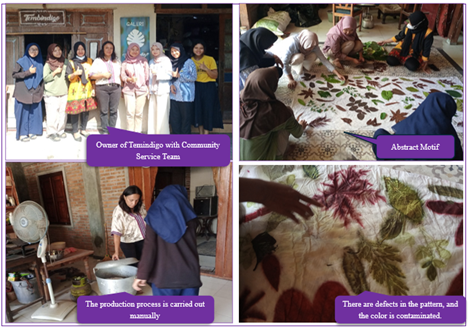
Method: Using a Participatory Action Research (PAR) approach, 12 purposively selected ecoprint artisans from Tembindigo MSME in Yogyakarta participated in the co-design and testing of Smart Eco-STEAM technology. Data was collected through observation, interviews, questionnaires, and production records, and analyzed using descriptive and comparative statistics.
Results: The implementation of Smart Eco-STEAM reduced defective products from 35% to 12%, achieved energy savings of 37%, and shortened steaming time by 45 minutes per cycle, enabling a twofold increase in daily output. Artisans reported greater ease of use, improved motif quality, and increased confidence in handling larger orders.
Conclusion: The findings confirm that Smart Eco-STEAM effectively addresses key production barriers while aligning ecological sustainability with operational efficiency.
References
J. Gao, “Polyphenol metabolomics reveals the applications and prospects of polyphenol-rich plants in natural dyes,” For. Res., vol. 4, no. 1, 2024, https://doi.org/10.48130/forres-0024-0035
A. Yadav and R. Pandey, “Comparative study of unbleached and bleached cotton knitted fabric dyed with chickpea husk agro-waste,” Int. J. Res. Agron., vol. 7, no. 3, pp. 26–28, 2024, https://doi.org/10.33545/2618060x.2024.v7.i3a.376
R. Putra, P. Nerisafitra, and A. Abidin, “Implementation of SDG 9: Innovation in the Indonesian Batik Industry Through Business Digitalisation,” J. Lifestyle SDGs Rev., vol. 5, no. 2, p. e03433, 2024, https://doi.org/10.47172/2965-730x.sdgsreview.v5.n02.pe03433
S. E. Wahyuningsih, A. Kusumastuti, M. Krisnawati, O. Paramita, M. Yuniar, and M. R. Furi, “Quality of motif, colors and fastness of Sekar Ayu ecoprint products in terms of mordant type, natural dyes, and types of leaves on silk fabrics,” in IOP Conference Series: Earth and Environmental Science, 2022, vol. 969, no. 1, pp. 1–11. https://doi.org/10.1088/1755-1315/969/1/012043
J. S. Kiurski, B. B. Marić, I. B. Oros, and V. S. Kecić, “The ecodesign practice in Serbian printing industry,” J. Clean. Prod., vol. 149, pp. 1200–1209, 2017, https://doi.org/10.1016/j.jclepro.2017.02.193
T. H. Bokhari, “Eco-Friendly Sustainable Dyeing of Cotton Fabric Using Reactive Violet 05 and Direct Violet 09 Dyes,” Coatings, vol. 13, no. 4. pp. 1–13, 2023. https://doi.org/10.3390/coatings13040677
Y. P. Sari, “Assistance in Determining the Selling Price of Ecoprint Batik (HR. Ambar Batik Bayat, Wedi, Klaten),” Asian J. Community Serv., vol. 1, no. 4, pp. 131–142, 2022, https://doi.org/10.55927/ajcs.v1i4.1440
R. Mia, “Ultrasonic Assisted Environmentally Friendly Extraction of Natural Dyes From Beta vulgaris for the Coloration of Silk Fabric Using Different Mordants,” Energy Sci. Eng., vol. 13, no. 1, pp. 323–334, 2025, https://doi.org/10.1002/ese3.2001
S. Wahyuningsih, A. Kusumastuti, M. Krisnawati, O. Paramita, M. Yuniar, and M. R. Furi, “Quality of Motif, Colors and Fastness of Sekar Ayu Ecoprint Products in Terms of Mordant Type, Natural Dyes, and Types of Leaves on Silk Fabrics,” Iop Conf. Ser. Earth Environ. Sci., vol. 969, no. 1, p. 12043, 2022, https://doi.org/10.1088/1755-1315/969/1/012043
Y. Tang, Y. Xue, J. Yuan, and J. Xu, “Research and Application of Bacterial Cellulose as a Fashionable Biomaterial in Dyeing and Printing,” Sustaina, vol. 17, no. 7631, pp. 1–20, 2025. https://doi.org/10.3390/su17177631
P. Charoensit, F. Sawasdipol, N. Tibkawin, N. Suphrom, and N. Khorana, “Development of natural pigments from Tectona grandis (teak) leaves: Agricultural waste material from teak plantations,” Sustain. Chem. Pharm., vol. 19, p. 100365, 2021, https://doi.org/10.1016/j.scp.2020.100365.
V. Ponnusami and S. N. Srivastava, “Studies on application of teak leaf powders for the removal of color from synthetic and industrial effluents,” J. Hazard. Mater., vol. 169, no. 1, pp. 1159–1162, 2009, https://doi.org/10.1016/j.jhazmat.2009.03.142.
H. N. Sari, R. Mahmud, N. A. Susanti, I. A. T. Rahayu, S. T. Umaroh, and A. P. Budijono, “Design and analysis of heat transfer on a customized eco-print batik steamer with automatic temperature and time control using Computer Fluid Dynamic (CFD),” in E3S Web of Conferences, 2023, vol. 450, pp. 1–10. https://doi.org/10.1051/e3sconf/202345002002
H. N. Sari, Nurhayati, I. A. Tri, A. P. Budijono, and S. T. Umaroh, “Manufacturing and Electrical Design of the Ecoprint Batik Steamer Machine with Automatic Temperature and Timer Control,” in IOP Conference Series: Earth and Environmental Science, 2025, vol. 1439, no. 1. https://doi.org/10.1088/1755-1315/1439/1/012031
N. Kholifah and J. Puspito, “QR Code-Based Ecoprint Catalog Digitalization as a Strategic Innovation for Sustainable MSME Development at Tembindigo Digitalización del Catálogo de Ecoprint Basado en Código QR como Innovación Estratégica para el Desarrollo Sostenible de las MIPYMES en,” eVitroKhem, vol. 4, no. 290, pp. 1–10, 2025, https://doi.org/10.56294/evk2025290
N. Kholifah, C. Mahanani, D. P. Sagita, and F. Oktariani, “Website-Based Digital Marketing and Digital Branding as a Strategy to Increase Ecoprint Product Sales at Tembindigo MSME,” J. Med. Med., vol. 4, no. 3, pp. 483–494, 2025. https://doi.org/10.31004/77fngm94
H. H. Salo, J. Suikkanen, and A. Nissinen, “Eco-innovation motivations and ecodesign tool implementation in companies in the Nordic textile and information technology sectors,” Bus. Strateg. Environ., vol. 29, no. 6, pp. 2654–2667, 2020, https://doi.org/10.1002/bse.2527
M. Aftab, T. Ahmad, S. Adeel, M. Javed, and R. Mia, “Ecofriendly Process for Extraction and Application of Natural Dye from Hulela Zard plant through Advanced Statistical Approach,” Nat. Prod. Commun., vol. 20, no. 6, pp. 1–12, Jun. 2025, https://doi.org/10.1177/1934578X251349338
F. Cornish, “Participatory action research,” Nat. Rev. Methods Prim., vol. 3, no. 1, 2023, https://doi.org/10.1038/s43586-023-00214-1
J. Mackenzie, P.-L. Tan, S. Hoverman, and C. Baldwin, “The value and limitations of Participatory Action Research methodology,” J. Hydrol., vol. 474, pp. 11–21, 2012, https://doi.org/10.1016/j.jhydrol.2012.09.008
A. Aziz, M. Shams, and K. S. Khan, “Participatory action research as the approach for women’s empowerment,” Action Res., vol. 9, no. 3, pp. 303–323, Apr. 2011, https://doi.org/10.1177/1476750310396952
C. MacDonald, “Understanding Participatory Action Research: A Qualitative Research Methodology Option,” Can. J. Action Res., vol. 13, no. 2, pp. 34–50, 2012, https://doi.org/10.33524/cjar.v13i2.37
S. Brown, A. Dennis, and V. Venkatesh, “Predicting Collaboration Technology Use: Integrating Technology Adoption and Collaboration Research,” J. Manag. Inf. Syst., vol. 27, no. 2, pp. 9–54, Oct. 2010, https://doi.org/10.2753/MIS0742-1222270201
I. Khodijah, R. I. Afriani, Y. Yuliah, and Y. Octavitri, “Creative Economic Empowerment Through Ecoprint Training for Pkk Cadres As a Driver of Family Economy in Sayar Subdistrict Taktakan Serang,” Int. J. Engagem. Empower., vol. 1, no. 1, pp. 35–43, 2021, https://doi.org/10.53067/ije2.v1i1.10
S. E. Bibri, “Data-driven smart eco-cities and sustainable integrated districts: A best-evidence synthesis approach to an extensive literature review,” Eur. J. Futur. Res., vol. 9, no. 1, pp. 1–43, 2021, https://doi.org/10.1186/s40309-021-00181-4
J. Yu, L. Cao, H. Fu, and J. Guo, “A Method for Optimizing Stencil Cleaning Time in Solder Paste Printing Process,” Solder. Surf. Mt. Technol., vol. 31, no. 4, pp. 233–239, 2019, https://doi.org/10.1108/ssmt-10-2018-0037
J. Höffken and A. Limmer, “Smart and Eco-Cities in India and China,” Local Environ., vol. 24, no. 7, pp. 646–661, 2019, https://doi.org/10.1080/13549839.2019.1628730
J.-C. Sagot, V. Gouin, and S. Gomes, “Ergonomics in product design: safety factor,” Saf. Sci., vol. 41, no. 2, pp. 137–154, 2003, https://doi.org/10.1016/S0925-7535(02)00038-3.
T. T. Kiong, N. S. M. Rusly, R. I. A. Hamid, C. K. S. Singh, and Z. Hanapi, “Inventive Problem-Solving in Project-Based Learning on Design and Technology: A Needs Analysis for Module Development,” Asian J. Univ. Educ., vol. 18, no. 1, pp. 271–278, 2022, https://doi.org/10.24191/ajue.v18i1.17196
Y. Ni, Y. Ou, Y. Li, and N. Zhang, “Improve the product structural robustness based on network motifs in product development,” Sci. Rep., vol. 12, no. 1, p. 10916, 2022, https://doi.org/10.1038/s41598-022-15056-2
A. Hussein, “The use of Triangulation in Social Sciences Research: Can qualitative and quantitative methods be combined?,” J. Comp. Soc. Work, vol. 1, pp. 1–12, 2009. https://doi.org/10.31265/jcsw.v4i1.48
J. A. Norton and F. M. Bass, “A Diffusion Theory Model of Adoption and Substitution for Successive Generations of High-Technology Products,” Manage. Sci., vol. 33, no. 9, pp. 1069–1086, Sep. 1987, https://doi.org/10.1287/mnsc.33.9.1069
A. A. Kutty, G. M. Abdella, M. Küçükvar, N. C. Onat, and M. Bulu, “A System Thinking Approach for Harmonizing Smart and Sustainable City Initiatives With United Nations Sustainable Development Goals,” Sustain. Dev., vol. 28, no. 5, pp. 1347–1365, 2020, https://doi.org/10.1002/sd.2088
B. Nithyashree, B. Vaishnavi, K. M. Pachiyappan, R. D. Sathyam, and T. Kanimozhi, “Review on Sustainable Fashion: Innovations and Challenges,” Int. J. Multidiscip. Res., vol. 6, no. 5, pp. 1–8, 2024, https://doi.org/10.36948/ijfmr.2024.v06i05.28297
C. Eifler and K. Diekamp, “Consumer Acceptance of Sustainable Fashion in Germany,” Res. J. Text. Appar., vol. 17, no. 1, pp. 70–77, 2013, https://doi.org/10.1108/rjta-17-01-2013-b007
S. Scaturro, “Eco-Tech Fashion: Rationalizing Technology in Sustainable Fashion,” Fash. Theory, vol. 12, no. 4, pp. 469–488, 2008, https://doi.org/10.2752/175174108x346940
S. Sanu, M. F. Ahmad, and S. Anjum, “A Comparative Analysis of Women and Men-Owned MSMEs With Special Emphasis on Women Entrepreneurship: A Case Study of Cachar District, Assam,” Sedme (Small Enterp. Dev. Manag. Ext. Journal) a Worldw. Wind. Msme Stud., vol. 47, no. 4, pp. 314–328, 2020, https://doi.org/10.1177/09708464211044227
Downloads
Published
How to Cite
Issue
Section
License
Copyright (c) 2025 Nur Kholifah, Jarwo Puspito, Sunarta Sunarta, G. Nancy Elizabeth

This work is licensed under a Creative Commons Attribution-ShareAlike 4.0 International License.
Authors who publish with SPEKTA (Jurnal Pengabdian Kepada Masyarakat: Teknologi dan Aplikasi) agree to the following terms:
- Authors retain copyright and grant the journal the right of first publication with the work simultaneously licensed under a Creative Commons Attribution License (CC BY-SA 4.0) that allows others to share the work with an acknowledgment of the work's authorship and initial publication in this journal.
- Authors are able to enter into separate, additional contractual arrangements for the non-exclusive distribution of the journal's published version of the work (e.g., post it to an institutional repository or publish it in a book), with an acknowledgment of its initial publication in this journal.
- Authors are permitted and encouraged to post their work online (e.g., in institutional repositories or on their website) prior to and during the submission process, as it can lead to productive exchanges, as well as earlier and greater citation of published work.

This work is licensed under a Creative Commons Attribution-ShareAlike 4.0 International License.