Enhancing Community-Based Rural Tourism through Master planning, Business Models, and Branding in Curug Luhur, Ambarjaya, Sukabumi
DOI:
https://doi.org/10.12928/spekta.v6i2.14474Keywords:
Branding, Business Model, Curug Luhur, Masterplan, Rural TourismAbstract
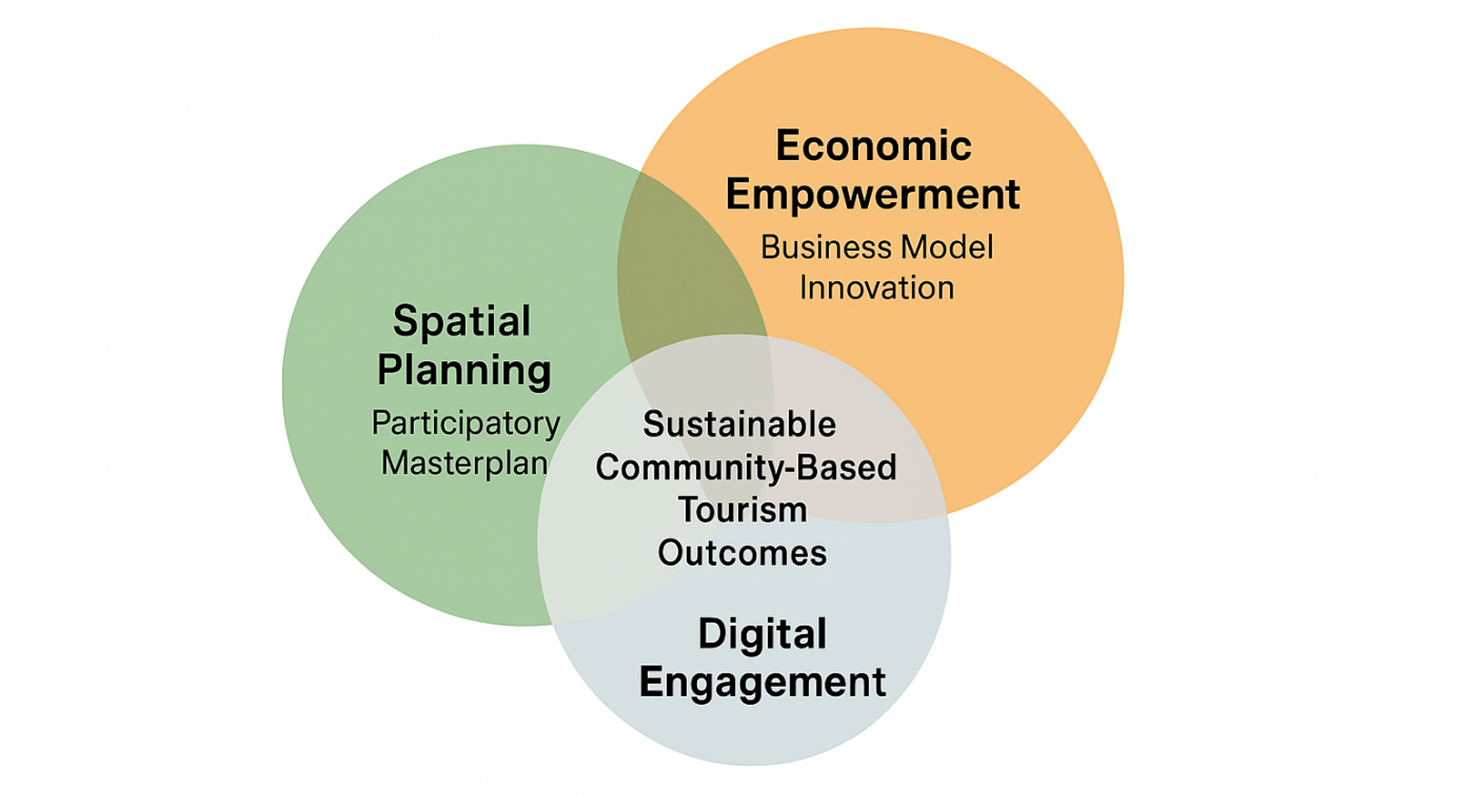
Background: This community service program aimed to develop Curug Luhur as a sustainable rural tourism destination in Desa Ambarjaya by strengthening local capacity in participatory spatial planning, business model development, and digital destination branding. The objective was to integrate these components into a community-based tourism framework that supports environmental sustainability, economic viability, and local governance.
Contribution: The program empowered 20 local stakeholders, including village officials, community organizations, and the youth group Bina Muda Group, as well as 11 micro, small, and medium enterprises (MSMEs) from culinary, handicraft, and service sectors. It fostered cross-sector collaboration, enhanced community ownership, and supported MSME integration into the local tourism value chain.
Method: A participatory action approach was applied, combining Participatory Rural Appraisal (PRA), site surveys and spatial mapping, focus group discussions (FGDs) for master planning and architectural design, business management training using SWOT analysis and the Business Model Canvas (BMC), MSME empowerment activities, and digital branding and social media workshops.
Results: The program produced a community-endorsed tourism master plan, participatory architectural design proposals, strategic business models for tourism activities, and a locally grounded destination brand supported by digital promotion tools. Participant evaluation showed high overall satisfaction (average score: 4.6/5), improved entrepreneurial skills, and stronger community commitment to tourism development.
Conclusion: The integration of participatory master planning, business model innovation, and digital promotion effectively strengthened the institutional, economic, and promotional foundations of Curug Luhur. This approach demonstrates a replicable model for sustainable, community-driven rural tourism development in Indonesia.
References
Y.-L. Liu, J.-T. Chiang, and P.-F. Ko, “The benefits of tourism for rural community development,” Humanit. Soc. Sci. Commun., vol. 10, no. 1, p. 137, 2023, https://doi.org/10.1057/s41599-023-01610-4
J. M. López-Sanz, A. Penelas-Leguía, P. Gutiérrez-Rodríguez, and P. Cuesta-Valiño, “Sustainable Development and Rural Tourism in Depopulated Areas,” Land, vol. 10, no. 9. 2021. https://doi.org/10.3390/land10090985
World Tourism Organization, Tourism and Rural Development. UNWTO, 2024. https://doi.org/10.18111/9789284424306
X. Ming, “Rural Tourism and Rural Economic Development,” Int. J. Bus. Anthropol., vol. 14, no. 2, p. 51, 2024, https://doi.org/10.33423/ijba.v14i2.7477
T. Ramukumba, “Rural tourism in South Africa: A local economic development strategy,” Interdiscip. J. Rural Community Stud., vol. 6, pp. 1–16, 2024, https://doi.org/10.38140/ijrcs-2024.vol6.03
L. Abdul Kadir, I., & Ni Chew, “Assessing tourism potential for rural tourism development: Promoting SDGs and economic opportunities to the B40 community-A mixed method approach,” J. Smart Tour., vol. 5, p. 2477, Jan. 2024, https://doi.org/10.54517/st.v5i1.2477
A. Halder and S. Kumar, “Rural tourism-an opportunity to achieve sustainable development goals: A study in Indian context,” Natl. Geogr. J. India, vol. 69, no. 4, pp. 301–318., 2023, [Online]. Available: https://ngji.in/index.php/ngji/article/view/848
Smriti Thakur, Sagar Sood, Rakesh Kumar Singh, and Ranjeet Singh, “Status of homestay tourism in Indian Himalayan region: Analysis of customer review and policy support for sustainable tourism,” Tour. Hosp. Res., vol. 24, no. 4, pp. 588–601, May 2023, https://doi.org/10.1177/14673584231170578
N. Ariyani and A. Fauzi, “Unlocking Sustainable Rural Tourism to Support Rural Development: A Bayesian Approach to Managing Water-Based Destinations in Indonesia,” Sustainability, vol. 16, no. 13. 2024. https://doi.org/10.3390/su16135506
N. Ghassani, “Development of facilities and services of the Way Kalam Waterfall natural tourism destination, South Lampung based on visitor perceptions.,” J. People, For. Environ., vol. 3, no. 2, pp. 40–50, 2023, https://doi.org/10.23960/jopfe.v3i2.8204
I. N. Sari, “Realizing sustainable rural tourism through community-based tourism (CBT): A swot analysis of Curug Dhuwur Waterfall,” J. Bisnis Kehutan. dan Lingkung., vol. 2, no. 1, pp. 17–30, 2024, https://doi.org/10.61511/jbkl.v2i1.2024.929
R. M. K. Rasyid, “Local Concept For Tourism Development of The Ngabatata Waterfall,” Des. Ideals J., vol. 4, no. 2, pp. 20–26, 2022, [Online]. Available: https://journals.iium.edu.my/kaed/index.php/dij/article/view/750/576
Feriyadin, Anisa, N. Kausar, and M. A. Wahyudin, “Development of River Tubing as A Special Interset Tourism in Kawinda To’i Tourism Village: A Youth Perspective,” Sadar Wisata J. Pariwisata, vol. 7, no. 2, pp. 112–125, 2024, https://doi.org/10.32528/sw.v7i2.2500
A. K. Jama, Y. Yulianti, W. Prihatmadji, A. Caniago, and N. Izzah, “The Impact of Tourism Infrastructure and Marketing Strategies on Tourist Arrivals and Local Economic Growth in Bali,” Es Econ. Entrep., vol. 3, no. 01, pp. 12–24, 2024, https://doi.org/10.58812/esee.v3i01.319
J. R. Saragih, “Assessing Tourism Object Management Towards Sustainable Tourism Development Strategy: A SWOT Analysis,” Int. J. Sustain. Dev. Plan., vol. 19, no. 8, pp. 3235–3245, 2024, https://doi.org/10.18280/ijsdp.190835
W. Resdiawan, M. Hidayat, B. Jatmika, W. Siadari, and Z. Nikolay Ivanovich, “Studi Kelayakan Rencana Ruas Jalan Parungkuda Ciambar Cibadak,” J. Teslink Tek. Sipil dan Lingkung., vol. 4, no. 4, p. 1, 2022, https://doi.org/10.52005/teslink.v4i1.110
M. Winandari, M. I. R., Karista, A. J., Saskia, C. S., Kridarso, E. R., Faisal, U. F., Sejati, W., Fauzi, R., Hartanti, N. B., Ischak, M., Rezandi, F., Aziiz, A. D., Putra, G. B., Wijayanto, P., Rinanti, A., & Burhannudinnur, Membingkai Ciambar, Sukabumi, Jawa Barat: Integrasi pertanian, industri, dan pariwisata. Jakarta: PT Lontar Digital Asia; LPPM Universitas Trisakti., 2025.
R. Chambers, Whose reality counts?: putting the first last. Intermediate Technology Publications., 1997.
D. Nurhaida, I. Busnetty, D. Octaviani, F. N. Amalia, and A. Prasetya, “Pemberdayaan Potensi Desa Nelayan Sidamukti di Kabupaten Pandeglang melalui Pembuatan Kafe Kontainer,” J. Pengabdi. Pada Masy., vol. 8, no. 1, pp. 10–18, 2023, https://doi.org/10.30653/jppm.v8i1.307
S. M. Budijati, F. H. Astuti, W. S. Jatiningrum, and A. Ichwanudin, “Determining the Priority of Business Development Strategy for Kunir Jalak Business Unit, SMK Muhammadiyah 1 Moyudan, Sleman,” SPEKTA (Jurnal Pengabdi. Kpd. Masy. Teknol. dan Apl., vol. 3, no. 1, pp. 81–90, 2022, https://doi.org/10.12928/spekta.v3i1.6099
O. Adiyanto, M. Faishal, and S. Supriyanto, “Transfer Teknologi Melalui Program Kemitraan Masyarakat untuk UKM Kayu Tunas Karya Gumawang,” E-Dimas J. Pengabdi. Kpd. Masy., vol. 11, no. 4, pp. 455–459, 2020, https://doi.org/10.26877/e-dimas.v11i4.4086
Z. Maulana, M. Chanif Hidayat, and I. Agustina, “Using Digital Marketing for Small and Medium Enterprises (SMEs) in Bumdes Remboko Sumberrejo Village Sleman Regency,” SPEKTA (Jurnal Pengabdi. Kpd. Masy. Teknol. dan Apl., vol. 3, no. 1, pp. 31–38, 2022, https://doi.org/10.12928/spekta.v3i1.4563
G. Desipradani, “Enhancing Digital Branding and Utilization of Meatball Printing Machines for MSMEs in Kampung Pentol, Surabaya,” SPEKTA (Jurnal Pengabdi. Kpd. Masy. Teknol. dan Apl., vol. 5, no. 2, pp. 244–256, 2024, https://doi.org/10.12928/spekta.v5i2.12133
P. Panagiotopoulou and S. Skoultsos, “Stakeholders’ Involvement in Sustainable Destination Management: A Systematic Literature Review of Existing Multi-Stakeholder Frameworks and Approaches,” Tourism and Hospitality, vol. 6, no. 5. p. 250, 2025. https://doi.org/10.3390/tourhosp6050250
B. Bramwell and B. Lane, “Critical research on the governance of tourism and sustainability,” J. Sustain. Tour., vol. 19, no. 4–5, pp. 411–421, May 2011, https://doi.org/10.1080/09669582.2011.580586
A. Siswanto, N. Widyawati, and I. Rahayu, “Tourism Carrying Capacity Revisited : A Mixed-Methods Study for Sustainable Heritage Site Management of Baluran National Park in Indonesia,” JMBI J. Manaj. Bisnis dan Inform., vol. 6, no. 1, pp. 57–66, 2025, https://doi.org/10.31967/prodimanajemen.v6i1.1615
A. S. Suhandi, E. Novianti, D. Oktavia, and A. M. A. Khan, “Community Participation Process in Community-Based Tourism Development in Waerebo Traditional Village, Manggarai,” ASEAN J. Hosp. Tour., vol. 20, no. 2, pp. 67–82, 2022, https://doi.org/10.5614/ajht.2022.20.2.05
J. Samodra, “Sustainable Tourism Development Based on Local Wisdom in Sutojayan Village , Malang Regency : A Participatory Approach in Masterplan Planning,” Abdimas Pedagog. J. Ilm. Pengabdi. Kpd. Masyaraka, vol. 8, no. 2, pp. 117–125, 2025, https://doi.org/10.17977/um050v8i22025p117-125
D. Satyanegara and M. J. Widikusyanto, “The Development of Tourism Village Business Model ( Case in Tourism Village of Kampung Bambu Banyuresmi ),” Int. J. Bus. Stud., vol. 7, no. 1, pp. 38–47, 2023, https://doi.org/10.32924/ijbs.v7i1.253
M. Z. Ukhrowi, “Strategic development of rural halal tourism using the Business Model Canvas framework : A case study from East Java , Indonesia,” J. Islam. Econ. Manag. Bus., vol. 5, no. 2, pp. 187–202, 2023, https://doi.org/10.21580/jiemb.2023.5.2.20943
N. Al-sakina, Y. Yustiana, and A. Furqan, “Business Model Canvas ( BMC ) Approach for Ecotourism Development Based on Islamic Boarding School Community ( Case : Cipeujeuh Valley , Darul Arqam Muhammadiyah Islamic Boarding School ),” 3Bio J. Biol. Sci. Technol. Manag., vol. 6, no. 2, pp. 235–245, 2024, https://doi.org/10.5614/3bio.2024.6.2.1
H. Kusdiyanti, I. Febrianto, R. Wijaya, and N. I. Agustina, “The innovation of sustainable business model in eco-edutourism: a way for creating society 5.0,” BISMA (Bisnis Dan Manajemen), vol. 14, no. 2, pp. 177–191, 2022, https://doi.org/10.26740/bisma.v14n2.p177-191
K. Pande and F. Shi, “Managing visitor experience at religious heritage sites,” J. Destin. Mark. Manag., vol. 29, p. 100800, 2023, https://doi.org/10.1016/j.jdmm.2023.100800.
B. Susanto, Y. K. Wardhani, and M. Agus, “The role and use of social media as a medium for marketing tourist attractions and increasing tourist visits,” J. Commer. Manag. Tour. Stud., vol. 2, no. 1, pp. 48–56, 2023, https://doi.org/10.58881/jcmts.v2i1.93
T. Waluyo, “Digital marketing communication strategy in the post-pandemic of the Indonesian tourism,” JPPI (Jurnal Penelit. Pendidik. Indones., vol. 9, no. 4, pp. 178–184, 2023, https://doi.org/10.29210/020232226
E. Sumarna, A. Geohansa, and F. Fauzi, “Youth Engagement and Digital Media in Promoting Rural Cultural Tourism : Evidence from Cibunar Village,” in Proceeding International Conference On Sustainable Environment And Innovation (ICOSEI), 2025. https://doi.org/10.53675/icosei.v1i1.1506
Downloads
Published
How to Cite
Issue
Section
License
Copyright (c) 2025 Dida Nurhaida, Fajar Rezandi, Harris Effendi, Alif Alfiansyah, Ariel Aryaseta, Muhammad Fathir Abdullah, Erin Valencia

This work is licensed under a Creative Commons Attribution-ShareAlike 4.0 International License.
Authors who publish with SPEKTA (Jurnal Pengabdian Kepada Masyarakat: Teknologi dan Aplikasi) agree to the following terms:
- Authors retain copyright and grant the journal the right of first publication with the work simultaneously licensed under a Creative Commons Attribution License (CC BY-SA 4.0) that allows others to share the work with an acknowledgment of the work's authorship and initial publication in this journal.
- Authors are able to enter into separate, additional contractual arrangements for the non-exclusive distribution of the journal's published version of the work (e.g., post it to an institutional repository or publish it in a book), with an acknowledgment of its initial publication in this journal.
- Authors are permitted and encouraged to post their work online (e.g., in institutional repositories or on their website) prior to and during the submission process, as it can lead to productive exchanges, as well as earlier and greater citation of published work.

This work is licensed under a Creative Commons Attribution-ShareAlike 4.0 International License.