Empowering Rural Housewives Through Creative Packaging Design: The Case of Beneng Taro Products in Juhut Village, Banten
DOI:
https://doi.org/10.12928/spekta.v6i2.14467Keywords:
Beneng taro, Creative packaging , Community service , Rural entrepreneurship , Women empowermentAbstract
Background: This community service program was conducted in Juhut Village, Pandeglang, Banten, to address limited market access of Beneng taro-based food products produced by local housewives. Despite abundant raw materials, product competitiveness remains low due to unsafe processing practices and poor packaging design.
Contribution: This program bridges the gap between product quality and consumer trust by integrating food safety education with creative packaging innovation. It offers a participatory model that strengthens visual identity, labeling compliance, and branding for rural microenterprises.
Method: The program applied a participatory approach involving 20 local women from the Sendaloka group. Activities included technical training on oxalate reduction techniques, visual communication in packaging, and safe food processing.
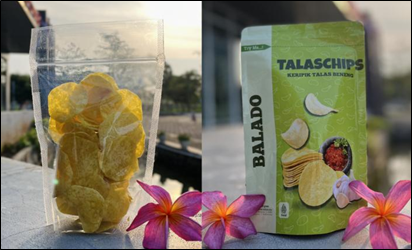
Results: The initiative led to the development of Talaschips, a branded Beneng taro chip product with complete labelling, health claims, and consumer-oriented design. Evaluation showed a 65% increase in knowledge based on post-training interviews, and more than 30% of participants expressed intent to register their products for food certification.
Conclusion: The program effectively empowered rural women by improving their technical and design capabilities. It fostered self-recognition as legitimate entrepreneurs and improved market access for local food products. The model is scalable and can be adapted to other rural settings for inclusive economic development and gender-equitable entrepreneurship.
References
F. D. Wahyuni, F. R. Eris, N. A. Putri, and R. A. Riyanto, “Physical and Sensory Characteristics of Food Bar Based on Beneng Taro (Xanthosoma undipes K. Koch) and Soy Protein Isolate,” Food Sci. J., vol. 4, no. 2, p. 175, Dec. 2022, https://doi.org/10.33512/fsj.v4i2.17148
H. Herawati, W. Haliza, M. Rahmadhani, and F. R. Eris, “Production Process Technology and Physic-Chemical Characterization of Beneng Taro Flour,” IOP Conference Ser. Earth and Environmental Science, 2023, https://doi.org/10.1088/1755-1315/1172/1/012048
Z. Yursak, I. Hidayah, A. Saryoko, and P. N. Susilawati, “Morphological characterization and development potential of beneng variety (Xanthosoma undipes K. Koch) Pandeglang-Banten,” IOP Ser. Earth and Environmental Science, 2021, https://doi.org/10.1088/1755-1315/715/1/012022
V. A. Nurhidayati, A. Rizkiriani, A. Nuraeni, and A. Safitri, “Development and evaluation of beneng taro (Xanthosoma undipes K. Koch) flour sable cookies,” E3S Web Conf, 2024, [Online]. Available: https://www.e3s-conferences.org/articles/e3sconf/abs/2024/107/e3sconf_icas2024_02021/e3sconf_icas2024_02021.html.
G. Windarsih, “Pragmatical utilization of beneng taro (Xanthosoma undipes) based on local knowledge of the community of Mount Karang, Pandeglang, Indonesia,” Biodiversitas J. Biol. Divers., vol. 24, no. 12, Dec. 2023, https://doi.org/10.13057/biodiv/d241202
L. A. G. Pieter, M. M. B. Utomo, A. Sudomo, and C. M. Siagian, “Geophytes cultivation dilemma in Indonesia: Climate change disaster mitigation, investment, and impact on the environment,” IOP Conf. Ser. Earcth and Environmental Science, 2022, https://doi.org/10.1088/1755-1315/1109/1/012028
S. Agustina, A. T. Anjani, E. Indriani, and R. P. Altisa, “Synthesis of starch nanoparticles as functional food materials via nanoprecipitation technique in moderate temperature,” AIP Conf. Proceedings, 2024, https://doi.org/10.1063/5.0201127/19843344/040009_1_5.0201127
S. Agustina, Z. H. Kenvisyah, M. H. Revianto, and F. Azhari, “Preparation of Modified Starch Nanoparticles from Beneng Taro (Xanthosoma undipes K. Koch) as Active Packaging Materials via Nanoprecipitation Method,” Mater. Sci. Forum, 2022, [Online]. Available: https://www.scientific.net/MSF.1057.19
A. Maghfirah, K. Brahmana, D. A. Pratiwi, and S. Ramadina, “Utilization of taro beneng (xantoshoma undipes k. koch) starch in the manufacture of bioplastics with sorbitol plasticizer and its characterization,” J. Phys. Conference Series, 2024, https://doi.org/10.1088/1742-6596/2733/1/012010
A. Sulastri, Y. Maryani, and S. Agustina, “Reviu Artikel: Potensi Talas Beneng (Xantoshoma Undipes K. Koch) Sebagai Bahan Pembuatan Beras Analog Untuk Diversifikasi Pangan Di Indonesia,” J. Integr. PROSES, vol. 12, no. 2, p. 88, Dec. 2023, https://doi.org/10.36055/jip.v12i2.22216
S. Agustina, R. P. Altisa, N. Rahadatul’aisy, A. S. N. Fithri, and E. A. Rahma, “Enhancement of Functional Characteristics of Beneng Taro Noodles by Incorporating Garlic Nanoparticles as Bioactive Compounds,” J. Rekayasa Kim. Lingkung., vol. 20, no. 1, pp. 57–67, May 2025, https://doi.org/10.23955/rkl.v20i1.41818
P. B. Fitridewi, A. Sulaeman, and Eny, “High Fibre Instant Noodles Made from Beneng Taro Flour (Xanthosoma undipes).,” Malaysian J. of Medicine & Health Science, 2023, [Online].
W. Nurtiana, Z. Najah, and M. A. Syabana, “The Effect of Beneng Taro Flour (Xanthosoma undipes K. Koch) and Rice Bran (Oryza sativa L.) Substitution on the Physical and Sensory Characteristics of Bread,” Journal of Nutrition Science. 2023. https://doi.org/10.35308/jns.v4i2.7593
D. Fajriaty, B. Setiawan, T. Sinaga, and A. Sulaeman, “High-fibre analog rice made from beneng taro flour,” J. Gizi dan Diet. Indones. (Indonesian J. Nutr. Diet., vol. 10, no. 3, p. 125, Dec. 2022, https://doi.org/10.21927/ijnd.2022.10(3).125-131
R. P. Aditia, S. Haryati, A. M. Muhede, and D. F. E. Nuryadin, “Physicochemical characteristics and dietary fiber of analog rice from seaweed (Sargassum sp.) and Beneng Taro combination,” Food Processing and Manufacture, 2023, [Online]. Available: https://doi.org/10.33512/fsj.v5i2.22312
F. R. Eris, D. Riziani, V. Y. Pamela, and M. R. Febriansah, “A review of the potential of beneng taro as material for inulin making and its application to yogurt,” International Conference for Smart Agric. Food, and Environment, 2022, [Online]. Available: https://doi.org/10.2991/978-94-6463-090-9_5
Y. B. Pramono, D. R. Tiarsono, and A. Rofifah, “Quality of synbiotic yogurt drink based on beneng taro flour and honey pineapple juice,” Futur. Food, 2023, [Online]. Available: https://thefutureoffoodjournal.com/manuscript/index.php/FOFJ/article/view/709.
W. Nurtiana, “The Effect of Beneng Taro (Xanthosoma undipes K.Koch) Flour Substitution on Physical and Sensory Characteristics of Muffins,” Food Sci. J., vol. 4, no. 2, p. 129, Dec. 2022, https://doi.org/10.33512/fsj.v4i2.17413
S. Kusumasari, T. B. Rusbana, and K. Nurrohmah, “Utilization of Extrusion Techniques in Pasta Processing from Beneng Taro Flour and Durian Rind Flour,” IOP Conf. Ser. Earth and Environmental Science, 2025, https://doi.org/10.1088/1755-1315/1508/1/012006
A. S. Pranowo, H. Herdiyana, and H. Muharram, “Packaging Innovation and Selling Performance in Microenterprises: Role of Digital Marketing Training,” Indonesian Interdisciolinary J. Sharia Economics, 2024, [Online]. Available: https://www.e-journal.uac.ac.id/index.php/iijse/article/view/5285.
M. A. Y. Alvar, “Beyond the Box: Packaging and Branding as Tools for Differentiation in a Competitive Retail Market,” Int. J. Multidiscip. Res., vol. 6, no. 3, May 2024, https://doi.org/10.36948/ijfmr.2024.v06i03.20589
A. Mardani and Y. Prihastomo, “Recent Trends in Packaging Based on Industrial Design Application,” Prod. J. Desain Prod. (Pengetahuan dan Peranc. Produk), vol. 8, no. 1, pp. 53–62, Jun. 2025, https://doi.org/10.24821/productum.v8i1.14628
I. Iranita, “Analisis Faktor-Faktor Kemasan (Packaging) Dalam Mempengaruhi Keputusan Pembelian Oleh-Oleh Makanan Khas Tanjungpinang,” Bahtera Inov., vol. 3, no. 2, pp. 182–193, May 2021, https://doi.org/10.31629/bi.v3i2.3334
P. H. Purba and R. Lestari, “The Influence of Product Packaging, Product Innovation and Distribution Channels on Increasing Sales Among Food SMEs Through Digital Marketing,” IDEAS Initiat. Sustain. Futur, 2024, [Online]. Available: http://conference.um.ac.id/index.php/ideas/article/view/9916.
M. Retamosa, I. Aliagas, and A. Millán, “Displaying ingredients on healthy snack packaging: A study on visual attention, choice, and purchase intention,” J. Sens. Stud., vol. 39, no. 4, Aug. 2024, https://doi.org/10.1111/joss.12944
D. E. and M. Medhat, “Creativity in Packaging Design as a Competitive promotional Tool,” Inf. Sci. Lett., vol. 11, no. 1, pp. 135–148, Jan. 2022, https://doi.org/10.18576/isl/110115
M. Kelly, J. R. McCann, C. I. Chapple, J. Woods, and C. G. Russell, “Visual communication design: a neglected factor in nutrition promotion via packaged food labels,” Front. Public Heal., vol. 12, Feb. 2024, https://doi.org/10.3389/fpubh.2024.1296704
M. Ghorbani and A. Westermann, “Exploring the role of packaging in the formation of brand images: a mixed methods investigation of consumer perspectives,” J. Prod. Brand Manag., vol. 34, no. 2, pp. 186–202, Feb. 2025, https://doi.org/10.1108/JPBM-09-2023-4738
Raafid Ghariy Ramadhan and Dian Septiana Sari, “Pengaruh Good Looking dan Pengemasan Produk Terhadap Peningkatan Penjualan Toko Bakery MilaMila di Kota Medan,” EKOMA J. Ekon. Manajemen, Akunt., vol. 4, no. 1, pp. 1687–1700, Nov. 2024, https://doi.org/10.56799/ekoma.v4i1.6063
C. Bou-Mitri, M. Abdessater, H. Zgheib, and Z. Akiki, “Food packaging design and consumer perception of the product quality, safety, healthiness and preference,” Nutr. Food Sci., vol. 51, no. 1, pp. 71–86, Jan. 2021, https://doi.org/10.1108/NFS-02-2020-0039
H. Wang, M. A. A. Ab Gani, and C. Liu, “Impact of Snack Food Packaging Design Characteristics on Consumer Purchase Decisions,” Sage Open, vol. 13, no. 2, Apr. 2023, https://doi.org/10.1177/21582440231167109
S. Baidoun and M. Salem, “The Role of Visual and Verbal Packaging Design on Consumers’ Purchase Decisions,” AI Business, Innov. Res. Understanding the Potential and Risks of AI for Modern Enterprises, 2023, https://doi.org/10.1007/978-3-031-42085-6_50
Downloads
Published
How to Cite
Issue
Section
License
Copyright (c) 2025 Sri Agustina, Nurul Ummi, Arief Rahman, Marta Pramudita, Muhammad Daffa Al Aziz, Aufa Irsyad Priyatna

This work is licensed under a Creative Commons Attribution-ShareAlike 4.0 International License.
Authors who publish with SPEKTA (Jurnal Pengabdian Kepada Masyarakat: Teknologi dan Aplikasi) agree to the following terms:
- Authors retain copyright and grant the journal the right of first publication with the work simultaneously licensed under a Creative Commons Attribution License (CC BY-SA 4.0) that allows others to share the work with an acknowledgment of the work's authorship and initial publication in this journal.
- Authors are able to enter into separate, additional contractual arrangements for the non-exclusive distribution of the journal's published version of the work (e.g., post it to an institutional repository or publish it in a book), with an acknowledgment of its initial publication in this journal.
- Authors are permitted and encouraged to post their work online (e.g., in institutional repositories or on their website) prior to and during the submission process, as it can lead to productive exchanges, as well as earlier and greater citation of published work.

This work is licensed under a Creative Commons Attribution-ShareAlike 4.0 International License.