Integrating Environmental Character Education and Eco-Enzyme Innovation for Community-Based Waste Management
DOI:
https://doi.org/10.12928/spekta.v6i2.14387Keywords:
Character Education, Circular Economy, Community Empowerment, Eco-Enzyme, Waste ManagementAbstract
Background: Household organic waste in Indonesia, which accounts for over 40% of total solid waste, creates major environmental, economic, and health challenges, especially in semi-urban areas with limited waste management systems and low community participation. This study explores the potential of eco-enzymes as a community-based innovation to reduce organic waste while promoting ecological literacy and environmental citizenship.
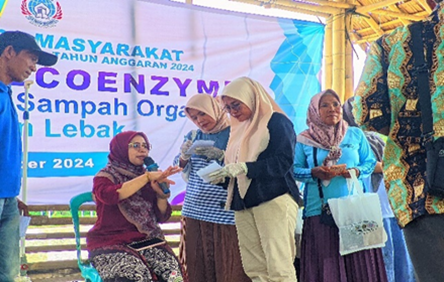
Methods: A qualitative case study was conducted in Lebak Regency (September 2024–January 2025) involving households, schools, women’s groups, youth organizations, farmers, and the local environmental agency. Data were collected through observation, interviews, focus group discussions, and document analysis, and were analysed thematically following the Miles and Huberman framework.
Results: The findings show that eco-enzyme training led to high adoption among participants, resulting in a noticeable reduction of household organic waste and methane emissions, while also strengthening community networks. Schools demonstrated higher levels of participation compared to households, indicating a gap between institutional practices and daily behaviour.
Contribution: This study contributes an integrative and replicable model that combines technical innovation with community empowerment.
Conclusion: Eco-enzyme interventions enhanced ecological literacy, encouraged pro-environmental behaviour, and supported local socio-economic activities, aligning with SDG 11.6 and 12.3. These findings highlight the importance of cross-sector collaboration linking schools, households, and communities for sustainable waste management.
References
U. and I. S. W. Association, Global Waste Management Outlook 2024 - Beyond an age of waste: Turning rubbish into a resource. United Nations Environment Programme, 2024.
S. Kaza, L. Yao, P. Bhada-Tata, and F. Van Woerden, What a waste 2.0: a global snapshot of solid waste management to 2050. books.google.com, 2018.
K. Calvin, “IPCC, 2023: Climate Change 2023: Synthesis Report. Contribution of Working Groups I, II and III to the Sixth Assessment Report of the Intergovernmental Panel on Climate Change [Core Writing Team, H. Lee and J. Romero (eds.)]. IPCC, Geneva, Switzerland.,” Jul. 2023. https://doi.org/10.59327/IPCC/AR6-9789291691647
V. Derosya and T. Ihsan, “The Role of Packaging in Food Loss and Waste Reduction: A Mini Review from Indonesia,” J. Serambi Eng., 2025, [Online]. Available: https://jse.serambimekkah.id/index.php/jse/article/view/1002.
Y. Nurhayati and E. Triharyati, “The Interaction of Digital Lifestyle and Food Waste on Household Food Security among Urban Millennials: Evidence from Palembang City, Indonesia,” Equity J. Ekon., 2025, [Online]. Available: https://equity.ubb.ac.id/index.php/equity/article/view/582.
R. Permatasari, I. Pratiwi, F. Hadinata, and M. I. Ammrullah, “Assessment of greenhouse gas (GHG) emissions in Indonesia using the first order decay (FOD) model: implications of waste bioavailability, biodegradability, and bioactivity,” Environ. Pollutants and Bioavailability, 2025, https://doi.org/10.1080/26395940.2025.2539875
K. L. Hidup, “Kehutanan.(2022). Sistem Informasi Pengelolaan Sampah Nasional (SIPSN).” 2024.
A. S. Alqahtani, “Improve the QoS using multi-path routing protocol for Wireless Multimedia Sensor Network,” Environ. Technol. Innov., vol. 24, p. 101850, Nov. 2021, https://doi.org/10.1016/j.eti.2021.101850
P. A. Jayasinghe, H. Jalilzadeh, and P. Hettiaratchi, “The Impact of COVID-19 on Waste Infrastructure: Lessons Learned and Opportunities for a Sustainable Future,” Int. J. Environ. Res. Public Health, vol. 20, no. 5, p. 4310, Feb. 2023, https://doi.org/10.3390/ijerph20054310
T. F. Ojo, O. A. Akpor, Y. J. Talabi, and A. S. Afolalu, “AI-Powered Platforms for Interactive Nutrition Education Based on WHO (World Health Organization) Guidelines–An Overview,” ABUAD J. of Engineering Research and Development, 2025, https://doi.org/10.53982/ajerd.2025.0801.17-j
H. H. Wicaksana, C. Parmanto, and M. Fauzi, “The Context of the Collaborative Governance Systems in Organic Waste Management is a Public Service in the Urban Area of Lebak Regency,” J. Manaj. Pelayanan Publik, vol. 9, no. 2, pp. 327–352, Jun. 2025, https://doi.org/10.24198/jmpp.v9i2.61963
G. Trancone, “Treatment of concrete waste from construction and demolition activities: Application of organic acids from continuous dark fermentation in moving bed biofilm reactors,” Chem. Eng. J., vol. 505, p. 159536, Feb. 2025, https://doi.org/10.1016/j.cej.2025.159536
F. Lestari, “Spatiotemporal Trend of Hazardous Waste Sites and Risks in Urban Jakarta, Indonesia,” Sustainability, vol. 17, no. 12, p. 5548, Jun. 2025, https://doi.org/10.3390/su17125548
B. Moeini, “Effect of Household Interventions on Promoting Waste Segregation Behavior at Source: A Systematic Review,” Sustainability, vol. 15, no. 24, p. 16546, Dec. 2023, https://doi.org/10.3390/su152416546
S. Rahayu and S. Evanita, “Environmental Communication Strategy For Sustainable Waste Management Through Community Empowerment,” J. Bus. Stud. MANGEMENT Rev., vol. 7, no. 2, pp. 125–130, Jun. 2024, https://doi.org/10.22437/jbsmr.v7i2.33500
Utami, Titis Istiqomah, and Lieza Corsita, “Implementation of Community-Based Waste Management to Improve Environmental Health in Villages,” Sustain. Appl. Modif. Evid. Community, vol. 1, no. 2, pp. 1–8, Dec. 2024, https://gpijournal.com/index.php/samec/article/view/90
S. C. Das, “Evaluating the biocatalytic potential of fruit peel-derived eco-enzymes for sustainable textile wastewater treatment,” Results Eng., vol. 21, p. 101898, Mar. 2024, https://doi.org/10.1016/j.rineng.2024.101898
F. N. Arifah and E. C. Prima, “Testing the Antimicrobial Efficacy of Eco-Enzymes on Staphylococcus aureus and Escherichia coli as a Participatory Student Activity in Biotechnology Material for Food Waste Management,” Symbiotic J. Biol. Educ. Sci., vol. 6, no. 1, pp. 1–10, Apr. 2025, https://doi.org/10.32939/symbiotic.v6i1.156
and F. S. R. Halim, M. Jaya Arma, “Chemical Characteristics of Eco-enzymes as Liquid Organic Fertilizer from Vegetable Waste and Its Impact to Improve the Growth of Red Onion (Allium ascalonicum L.) on Marginal Dry Land,” Int. J. Agric. Biosci., 2025, https://doi.org/10.47278/journal.ijab/2025.050
R. Rachman, S. A. Yanti, and N. O. Abdullah, “Innovative Eco-Enzyme from Fruit and Vegetable Waste for Pollution Control,” Gema Lingkung. Kesehat., vol. 23, no. 1, pp. 14–19, Jan. 2025, https://doi.org/10.36568/gelinkes.v23i1.142
C. Vidalia, E. Angelina, J. Hans, L. H. Field, N. C. Santo, and E. Rukmini, “Eco-enzyme as disinfectant: a systematic literature review,” Int. J. Public Heal. Sci., vol. 12, no. 3, p. 1171, Sep. 2023, http://doi.org/10.11591/ijphs.v12i3.22131
H. Maulida, W. Herwina, and A. Hamdan, “Pelatihan Eco Enzyme Sebagai Alternatif Pengolahan Sampah,” JENTRE, vol. 4, no. 2, pp. 85–93, Dec. 2023, https://doi.org/10.38075/jen.v4i2.465
A. Sarminingsih, “Study of the Effect of Adding Eco-Enzyme to the Process of Decomposing Organic Waste on the Quality of Compost, Leachate, and Methane Gas Production,” J. Presipitasi Media Komun. dan Pengemb. Tek. Lingkung., vol. 20, no. 3, pp. 655–668, Dec. 2023, https://doi.org/10.14710/presipitasi.v20i3.655-668
H. Kriswantoro, “Utilization of Eco-Enzyme from Household Organic Waste to Maintain Soil Fertility and Plant Pest Control,” Altifani J. Int. J. Community Engagem., vol. 3, no. 1, p. 7, Dec. 2022, https://doi.org/10.32502/altifani.v3i1.5355
S. S. Sawant, H.-Y. Park, E.-Y. Sim, H.-S. Kim, and H.-S. Choi, “Microbial Fermentation in Food: Impact on Functional Properties and Nutritional Enhancement - A Review of Recent Developments,” Fermentation, vol. 11, no. 1, p. 15, Jan. 2025, https://doi.org/10.3390/fermentation11010015
I Nengah Muliarta, Desak Ketut Tristiana Sukmadewi, Gede Agus Surya Pratama, I Nyoman Yoga Parawangsa, and Ni Luh Putu Putri Setianingsih, “Youth Involvement in Processing Kitchen Waste into Eco-Enzyme as Air Freshener in Sanur Kauh Village -Denpasar City,” Asian J. Community Serv., vol. 2, no. 9, pp. 759–776, Sep. 2023, https://doi.org/10.55927/ajcs.v2i9.6145
A. T. Nguyen, N. Nguyen, P. Phung, and N. Yến-Khanh, “Residents’ waste management practices in a developing country: A social practice theory analysis,” Environ. Challenges, vol. 13, p. 100770, Dec. 2023, https://doi.org/10.1016/j.envc.2023.100770
W. Yao and X. Zhou, “Acceptance of pay-as-you-throw solid waste charging methods among urban residents in China,” Front. Environ. Sci., vol. 11, Aug. 2023, https://doi.org/10.3389/fenvs.2023.1263565
N. Benny, R. Shams, K. K. Dash, V. K. Pandey, and O. Bashir, “Recent trends in utilization of citrus fruits in production of eco-enzyme,” J. Agric. Food Res., vol. 13, p. 100657, Sep. 2023, https://doi.org/10.1016/j.jafr.2023.100657
V. Braun and V. Clarke, “Reflecting on reflexive thematic analysis,” Qual. Res. Sport. Exerc. Heal., vol. 11, no. 4, pp. 589–597, Aug. 2019, https://doi.org/10.1080/2159676X.2019.1628806
M. B. Miles, A. M. Huberman, and J. Saldana, “Qualitative data analysis, A methods sourcebook (fourth),” Arizona State University. 2019.
G. Guest, E. Namey, and M. Chen, “A simple method to assess and report thematic saturation in qualitative research,” PLoS One, vol. 15, no. 5, p. e0232076, May 2020, https://doi.org/10.1371/journal.pone.0232076.s001
H. Kallio, A. Pietilä, M. Johnson, and M. Kangasniemi, “Systematic methodological review: developing a framework for a qualitative semi‐structured interview guide,” J. Adv. Nurs., vol. 72, no. 12, pp. 2954–2965, Dec. 2016, https://doi.org/10.1111/jan.13031
M. S. Alam, A. Asmawi, and S. Fatema, “Focus Group Discussions (FGDs) for Qualitative and Mixed-Method Approaches: Principles, Applications, and Key Considerations,” Integr. J. Res. Arts Humanit., vol. 5, no. 4, pp. 51–56, Jul. 2025, https://doi.org/10.55544/ijrah.5.4.8
N. K. Bachtiar, M. Fariz, and M. S. Arif, “Conducting a Focus Group Discussion in Qualitative Research,” Innov. Technol. Entrep. J., vol. 1, no. 2, pp. 94–101, Aug. 2024, https://doi.org/10.31603/itej.11466
I. Korstjens and A. Moser, “Series: Practical guidance to qualitative research. Part 4: Trustworthiness and publishing,” Eur. J. Gen. Pract., vol. 24, no. 1, pp. 120–124, Jan. 2018, https://doi.org/10.1080/13814788.2017.1375092
D. Deviona, “Grounding Eco-Enzyme to The Community Of Air Putih Urban Village Through Education and Socialization Of Household Organic Waste Processing,” J. Community Engagem. Res. Sustain., vol. 3, no. 1, pp. 55–62, Jan. 2023, https://doi.org/10.31258/cers.3.1.55-62
A. Hidayat, “Community Empowerment and Environmental Management through Eco Enzyme Production Training in Kismoyoso Village, Boyolali – Central Java,” Prospect J. Pemberdaya. Masy., vol. 2, no. 2, pp. 114–120, Jul. 2023, https://doi.org/10.55381/jpm.v2i2.147
R. T. Wahyuni, D. A. Putri, M. L. Al-Ghozi, and Fatmawati, “Pengelolaan Sampah Di Lingkungan Pasar Arengka Dan Pengaruhnya Terhadap Lingkungan Sekitar,” J. Pendidik. Sos. dan Humaniora, 2025, [Online]. Available: https://publisherqu.com/index.php/pediaqu/article/view/3074.
N. O. Abdullah, A. Zubair, N. A. P. Mangarengi, R. M. Rachman, M. Tumpu, and D. Djamaluddin, “Identification of eco enzyme characteristics from organic waste,” IOP Conf. Ser. Earth Environ. Sci., vol. 1268, no. 1, p. 012015, Dec. 2023, https://doi.org/10.1088/1755-1315/1268/1/012015
and M. F. F. G. G. Gumilar, A. Kadarohman, “Characterization and Enzymatic Evaluation of Ecoenzyme Derived from Fruit and Vegetable Waste: An Effort to Achieve Zero Waste Concept,” Baghdad Sci. J., 2024, https://doi.org/10.21123/bsj.2024.10707
B. Varshini and V. Gayathri, “Role of Eco-Enzymes in Sustainable Development,” Nat. Environ. Pollut. Technol., vol. 22, no. 3, pp. 1299–1310, Sep. 2023, https://doi.org/10.46488/NEPT.2023.v22i03.017
I. A. M. Herawati, I. B. K. Sindu Putra, and I. W. Suyanta, “Meningkatkan Literasi Lingkungan Anak Usia 5-6 Tahun Melalui Projek Eco Enzyme,” Kumara Cendekia, vol. 11, no. 3, p. 251, Oct. 2023, https://doi.org/10.20961/kc.v11i3.76862
F. A. Kitole, T. O. Ojo, C. U. Emenike, N. Z. Khumalo, K. M. Elhindi, and H. S. Kassem, “The Impact of Poor Waste Management on Public Health Initiatives in Shanty Towns in Tanzania,” Sustainability, vol. 16, no. 24, p. 10873, Dec. 2024, https://doi.org/10.3390/su162410873
U. K. Priya and R. Senthil, “Framework for Enhancing Urban Living Through Sustainable Plant Selection in Residential Green Spaces,” Urban Sci., vol. 8, no. 4, p. 235, Dec. 2024, https://doi.org/10.3390/urbansci8040235
Downloads
Published
How to Cite
Issue
Section
License
Copyright (c) 2025 Nurul Huda, Robiatul Adawiyah, Budiman

This work is licensed under a Creative Commons Attribution-ShareAlike 4.0 International License.
Authors who publish with SPEKTA (Jurnal Pengabdian Kepada Masyarakat: Teknologi dan Aplikasi) agree to the following terms:
- Authors retain copyright and grant the journal the right of first publication with the work simultaneously licensed under a Creative Commons Attribution License (CC BY-SA 4.0) that allows others to share the work with an acknowledgment of the work's authorship and initial publication in this journal.
- Authors are able to enter into separate, additional contractual arrangements for the non-exclusive distribution of the journal's published version of the work (e.g., post it to an institutional repository or publish it in a book), with an acknowledgment of its initial publication in this journal.
- Authors are permitted and encouraged to post their work online (e.g., in institutional repositories or on their website) prior to and during the submission process, as it can lead to productive exchanges, as well as earlier and greater citation of published work.

This work is licensed under a Creative Commons Attribution-ShareAlike 4.0 International License.