Urban Farming-Based Learning: A Community Engagement Model for Agricultural Vocational Schools
DOI:
https://doi.org/10.12928/spekta.v6i2.14318Keywords:
Agriculture, Aquaponic, Biochar, Vocational School, Urban FarmingAbstract
Background: Agriculture in the modern era faces increasingly complex challenges that require innovative and sustainable solutions.
Contribution: Students on SMK Negeri 2 Rantauprapat lacked comprehensive understanding and hands-on exposure to modern methods such as aquaponics, hydroponics, and integrated urban farming systems.
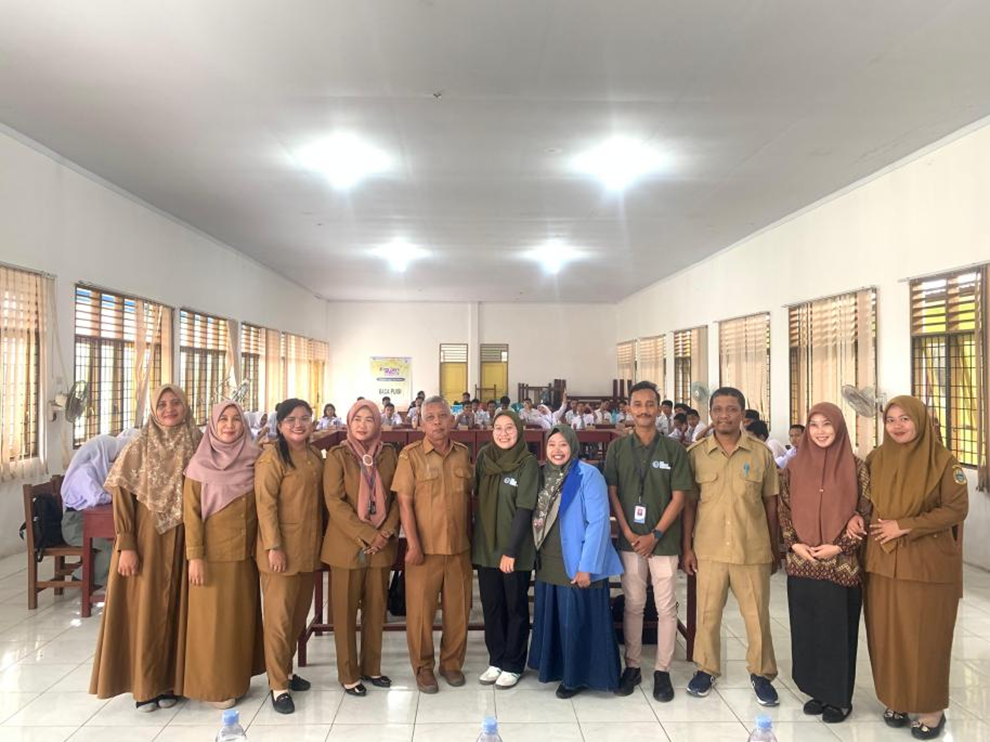
Method: This study applied a participatory action research approach designed to evaluate students baseline understanding, measure knowledge improvement, and enhance practical skills in sustainable agriculture through an urban farming-based community engagement program at the Vocational School of Agriculture Labuhanbatu (SMK Negeri 2 Rantauprapat).
Results: Through training and community activities including collaborative pond construction, establishment of a hydroponic house, and development of a biofilter system students acquired both theoretical and practical skills. The initiative also fostered teamwork and a sense of ownership. Evaluation confirmed its effectiveness, as knowledge levels surged from pre-test benchmarks to over 70%, and even exceeded 90% in some areas.
Conclusion: The evaluation results directly reflect the study's novelty. The survey on student interest revealed a very positive response, with more than 80% expressing strong interest in integrating urban farming and aquaponics into the curriculum, building facilities, and pursuing entrepreneurship. This high level of engagement underscores the effectiveness of the program's novel approach in bridging theory, practice, and community implementation.
References
L. Kumar, “Climate change and future of agri-food production,” in Future Foods, Elsevier, 2022, pp. 49–79. https://doi.org/10.1016/B978-0-323-91001-9.00009-8
D. Tilman, C. Balzer, J. Hill, and B. L. Befort, “Global food demand and the sustainable intensification of agriculture,” Proc. Natl. Acad. Sci., vol. 108, no. 50, pp. 20260–20264, Dec. 2011, doi: 10.1073/pnas.1116437108.
A. V Dwivedi, “Live Sustainably Now: A Low-Carbon Vision of the Good Life,” Electronic Green Journal, 2024, [Online]. Available: https://doi.org/10.7312/copl19090
J. Pretty, The low-carbon good life. taylorfrancis.com, 2022.
M. P. J. Tabe-Ojong, G. B. D. Aihounton, and J. C. Lokossou, “‘Climate-smart agriculture and food security: Cross-country evidence from West Africa,’” Glob. Environ. Chang., vol. 81, p. 102697, Jul. 2023, https://doi.org/10.1016/j.gloenvcha.2023.102697
Y. Haryanto and Z. Helmi, “Pokok-Pokok Pikiran Pendidikan Pertanian Di Era Teknologi Informasi,” Jurnal Kommunity Online. 2020, [Online]. Available: https://doi.org/10.15408/jko.v1i1.17706
N. Alkhaja, K. Alawadi, K. Almemari, and G. Alshehhi, “How is urban agriculture practiced, institutionalized, implemented, and sustained? A literature review,” Prog. Plann., vol. 192, p. 100917, Feb. 2025, https://doi.org/10.1016/j.progress.2024.100917
R. Evizal and F. E. Prasmatiwi, “Biochar: Pemanfaatan dan Aplikasi Praktis,” J. AGROTROPIKA, vol. 22, no. 1, p. 1, Jun. 2023, https://doi.org/10.23960/ja.v22i1.7151
H. Singh, B. K. Northup, C. W. Rice, and P. V. V. Prasad, “Biochar applications influence soil physical and chemical properties, microbial diversity, and crop productivity: a meta-analysis,” Biochar, vol. 4, no. 1, p. 8, Dec. 2022, https://doi.org/10.1007/s42773-022-00138-1
E. Calys-Tagoe, A. Sadick, E. Yeboah, and B. Amoah, “Biochar Effect on Maize Yield in Selected Farmers Fields in the Northern and Upper East Regions of Ghana,” J. Exp. Agric. Int., vol. 30, no. 6, pp. 1–9, Feb. 2019, https://doi.org/10.9734/JEAI/2019/44168
M. Cong, “Long-term effects of biochar application on the growth and physiological characteristics of maize,” Front. Plant Sci., vol. 14, Jun. 2023, doi: https://doi.org/10.3389/fpls.2023.1172425
R. Gunapala, “Urban agriculture: A strategic pathway to building resilience and ensuring sustainable food security in cities,” Farming Syst., vol. 3, no. 3, p. 100150, Jul. 2025, https://doi.org/10.1016/j.farsys.2025.100150
E. Dorr, B. Goldstein, A. Horvath, C. Aubry, and B. Gabrielle, “Environmental impacts and resource use of urban agriculture: a systematic review and meta-analysis,” Environ. Res. Lett., vol. 16, no. 9, p. 093002, Sep. 2021, https://doi.org/10.1088/1748-9326/ac1a39
S. Supriyadi, B. W. Widjajani, and E. Murniyanto, “The Effect of Rice Husk Biochar and Cow Manure on Some Soil Characteristics, N and P Uptake and Plant Growth of Soybean in Alfisol. 27 (2), 59–66.” 2022. https://doi.org/10.5400/jts.2022.v27i2.59-66
R. Ghamkhar, C. Hartleb, F. Wu, and A. Hicks, “Life cycle assessment of a cold weather aquaponic food production system,” J. Clean. Prod., vol. 244, p. 118767, Jan. 2020, https://doi.org/10.1016/j.jclepro.2019.118767
M. Rieckmann, Education for sustainable development goals: Learning objectives. books.google.com, 2017.
H. Schmidt., “Biochar in agriculture – A systematic review of 26 global meta‐analyses,” GCB Bioenergy, vol. 13, no. 11, pp. 1708–1730, Nov. 2021, https://doi.org/10.1111/gcbb.12889
R. P. Premalatha, “A review on biochar’s effect on soil properties and crop growth,” Front. Energy Res., vol. 11, Jun. 2023, https://doi.org/10.3389/fenrg.2023.1092637
D. Aller, S. Archontoulis, and D. Laird, “Soil Organic Matter and Biochar Effects on Soil Water: Measurements, Pedotransfer Functions and APSIM Simulations,” Eur. J. Soil Sci., vol. 76, no. 2, Mar. 2025, https://doi.org/10.1111/ejss.70083
A. Jia, “Biochar enhances soil hydrological function by improving the pore structure of saline soil,” Agric. Water Manag., vol. 306, p. 109170, Dec. 2024, https://doi.org/10.1016/j.agwat.2024.109170
T. Suna, A. Kumari, P. K. Paramaguru, and N. L. Kushwaha, “Enhancing agricultural water productivity using deficit irrigation practices in water-scarce regions,” Enhancing Resil. of Dry. Agri. Under Changing Climate, 2023, https://doi.org/10.1007/978-981-19-9159-2_11
S. K. Ambast, “Managing Land and Water Resources in Sundarbans India for Enhancing Agricultural Productivity,” Sundarbans A Disaster-Prone Eco-Region, 2019, https://doi.org/10.1007/978-3-030-00680-8_7
X. Gao, “Shallow groundwater plays an important role in enhancing irrigation water productivity in an arid area: The perspective from a regional agricultural hydrology simulation,” Agric. water Management, 2018, https://doi.org/10.1016/j.agwat.2018.06.009
H. Morgan, S. Sohi, and S. Shackley, “Biochar: An Emerging carbon abatement and soil management strategy,” Oxford Res. Encycl. Environmental Science, 2020, doi: 10.1093/acrefore/9780199389414.001.0001/acrefore-9780199389414-e-550.
P. Rc and J. S. Rawal, “Integrating Aquaculture and Hydroponics: A Review of Aquaponics Systems and Their Sustainability,” Engineering Heritage Journal (GWK). enggheritage.com, 2024, [Online]. Available: https://enggheritage.com/archives/2gwk2024/2gwk2024-79-87.pdf.
M. T. Haraz, L. Bowtell, and R. A. Al-Juboori, “Biochar Effects on Nutrients Retention and Release of Hydroponics Growth Media,” J. Agric. Sci., vol. 12, no. 8, p. 1, Jul. 2020, https://doi.org/10.5539/jas.v12n8p1
N. Lestari, Nurdian, Rezky, S. Putri, and Samsuar, “Edukasi Urban Farming, Budidaya Sistem Hidroponik, dan Konsep 3R untuk Siswa-Siswa Sekolah Dasar,” Abdi Techno, pp. 80–88, Jul. 2024, https://doi.org/10.70124/abditechno.v4i2.1352
R. Yunita, J. Jamsari, W. P. Sari, M. Erona, L. Syukriani, F. N. Rosadi, J. Venora, and H. A. Huda, “Pengenalan Teknologi Urban Farming Dengan Metode Budidaya Microgreen Di Smp Baiturrosyid School Kecamatan Koto,” Jurnal Hilirisasi IPTEKS. researchgate.net, 2023, [Online]. Available: https://doi.org/10.25077/jhi.v6i3.692
L.-A. Sutherland, “Inclusivity of on-farm demonstration: gender, age, and geographic location,” J. Agric. Educ. Ext., vol. 27, no. 5, pp. 591–613, Oct. 2021, https://doi.org/10.1080/1389224X.2020.1828115
D. Wicklow and S. Shortall, “Power positions in the farm family, marrying in, and negative peer pressure: the social relations that impact agricultural practice,” Agric. Human Values, vol. 42, no. 2, pp. 749–763, Jun. 2025, https://doi.org/10.1007/s10460-024-10620-0
M. S. S. Danish, “A Forefront Framework for Sustainable Aquaponics Modeling and Design,” Sustainability, vol. 13, no. 16, p. 9313, Aug. 2021, https://doi.org/10.3390/su13169313
L. A. Ibrahim, H. Shaghaleh, G. M. El-Kassar, M. Abu-Hashim, E. A. Elsadek, and Y. Alhaj Hamoud, “Aquaponics: A Sustainable Path to Food Sovereignty and Enhanced Water Use Efficiency,” Water, vol. 15, no. 24, p. 4310, Dec. 2023, https://doi.org/10.3390/w15244310
Z. Abdullah, A. S. Mohd Zahari, and M. binti Mohamed Anuar, “Determinants of Urban Farming Intention among Graduates: A Conceptual Paper,” Int. J. Acad. Res. Bus. Soc. Sci., vol. 12, no. 7, Jul. 2022, https://doi.org/10.6007/IJARBSS/v12-i7/14239
E. A. Papadopoulou, V. Tsiantos, E. Hatzikraniotis, D. Karampatzakis, and M. Maragakis, “Combining Hydroponics and Three-Dimensional Printing to Foster 21st Century Skills in Elementary Students,” Sustainability, vol. 17, no. 7, p. 2876, Mar. 2025, https://doi.org/10.3390/su17072876
P. Padath, “Hands-on harvest: Participatory organic farming education on campus,” World Sci. Res., vol. 12, no. 1, pp. 8–15, Mar. 2025, https://doi.org/10.20448/wsr.v12i1.6515
A. Chitamba, V. Yearwood, M. Swanepoel, and G. Myeza, “Project-Based Learning and The Development of Entrepreneurial Skills in Higher Education: An Integrative Approach,” Int. J. Bus. Manag. Stud., vol. 06, no. 04, pp. 113–123, Apr. 2025, https://doi.org/10.56734/ijbms.v6n4a12
U. K. Priya and R. Senthil, “Framework for Enhancing Urban Living Through Sustainable Plant Selection in Residential Green Spaces,” Urban Sci., vol. 8, no. 4, p. 235, Dec. 2024, https://doi.org/10.3390/urbansci8040235
N. Rai, A. Kachore, J. M. Julka, and S. P. Das, “Biochar-based technologies for sustainable aquaculture: A review of synthesis, properties, and application in water quality improvement and nutrient management,” J. Water Process Eng., vol. 71, p. 107338, Mar. 2025, https://doi.org/10.1016/j.jwpe.2025.107338
Downloads
Published
How to Cite
Issue
Section
License
Copyright (c) 2025 Ika Ayu Putri Septyani, Lutfi Fadilah Zamzami, Novi Fitriandika Sari

This work is licensed under a Creative Commons Attribution-ShareAlike 4.0 International License.
Authors who publish with SPEKTA (Jurnal Pengabdian Kepada Masyarakat: Teknologi dan Aplikasi) agree to the following terms:
- Authors retain copyright and grant the journal the right of first publication with the work simultaneously licensed under a Creative Commons Attribution License (CC BY-SA 4.0) that allows others to share the work with an acknowledgment of the work's authorship and initial publication in this journal.
- Authors are able to enter into separate, additional contractual arrangements for the non-exclusive distribution of the journal's published version of the work (e.g., post it to an institutional repository or publish it in a book), with an acknowledgment of its initial publication in this journal.
- Authors are permitted and encouraged to post their work online (e.g., in institutional repositories or on their website) prior to and during the submission process, as it can lead to productive exchanges, as well as earlier and greater citation of published work.

This work is licensed under a Creative Commons Attribution-ShareAlike 4.0 International License.