Utilization of Renewable Emission Neutral Garbage Solution Equipment (RENGSE) as Waste Management Technology in Mekar Jaya Village
DOI:
https://doi.org/10.12928/spekta.v6i2.14113Keywords:
Community service, Eco-Friendly technology , Incinerator , RENGSE , Waste managementAbstract
Background: This article presents the application of environmentally friendly renewable waste technology called RENGSE in Mekar Jaya Village, Tangerang Regency as part of a technology-based community service program.
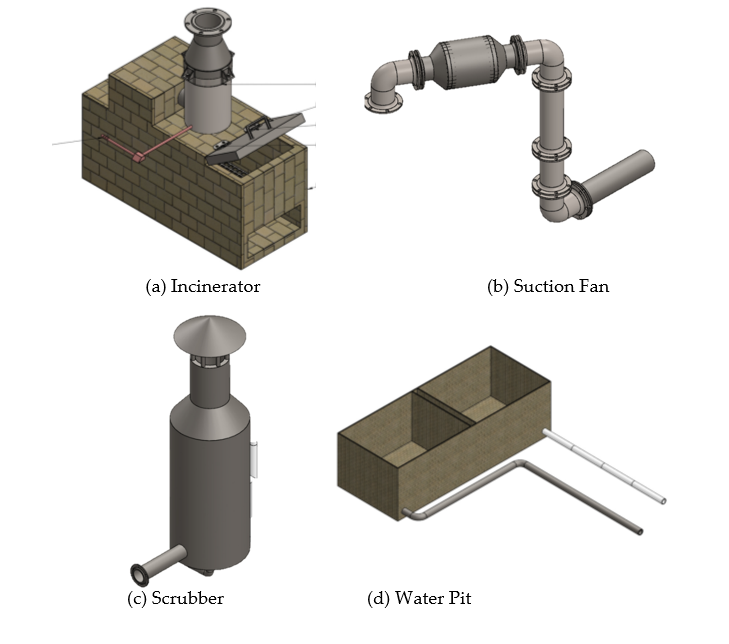
Contribution: The initiative to create and operate RENGSE for the management of various types of waste (organic and non-organic) based on thermal combustion that is specifically designed so as not to produce harmful emissions.
Method: The methodology used is Participatory Action Research (PAR) with stages including counseling, technology operation training, mentoring and direct practice, as well as monitoring and evaluation.
Results: The results obtained from this service activity are that the use of RENGSE equipment in Mekar Jaya Village shows good technical performance, with an average combustion capacity of 95-100 kg/hour and an operational time of around 8 hours/day. For 30 days, this tool is able to process about 24 tons of waste. From the social side, there has been a significant change in people's behavior patterns, where households that sort waste have increased from 10% to 68%.
Conclusion: RENGSE utilization activities have succeeded in increasing the effectiveness of waste management in Mekar Jaya Village technically and socially with 87% positive responses. The application of this technology can be said to be efficient in reducing the volume of waste because it is able to reduce up to 70% of waste to landfills, as well as encourage changes in community behavior towards more responsible, independent, and sustainable waste management.
References
SIPSN, “Capaian Kinerja Pengelolaan Sampah,” SIPSN Kementerian Lingkungan Hidup dan Kehutanan, 2024.
SIPSN, “Komposisi Sampah,” SIPSN Kementerian Lingkungan Hidup dan Kehutanan, 2024.
D. N. Marpaung, Y. Iriyanti, and D. Prayoga, “Analisis Faktor Penyebab Perilaku Buang Sampah Sembarangan Pada Masyarakat Desa Kluncing, Banyuwangi,” Prev. J. Kesehat. Masy., vol. 13, no. 1, pp. 47–57, 2022, https://doi.org/10.22487/preventif.v13i1.240
A. S. Ma’arif, “Volume sampah di Kabupaten Tangerang capai 3.000 ton per hari,” Antara Banten, Tangerang, Apr. 2024.
D. Ramadhan, “Hidup Berdampingan Antara Sampah Dan Masyarakat Kabupaten Tangerang,” Kumparan, Tangerang, Apr. 2024.
BPS Kabupaten Tangerang, “Kabupaten Tangerang Dalam Angka 2024; Tangerang Regency in Figures,” 2024.
S. J. Lesmana, H. Latuconsina, A. Suseno, A. A. Yumna, and C. A. Herawati, “Pemberdayaan Masyarakat Melalui Teknologi Pengelolaan Sampah Menggunakan Rocket Eco Stove Incinerator (REST-I) di Kelurahan,” Solma, vol. 13, no. 3, pp. 2789–2799, 2024, https://journal.uhamka.ac.id/index.php/solma/article/view/16389
C. F. Sari, L. Salsabila, K. T. Lodan, and T. Dompak, “Tantangan Pertumbuhan Sampah Melalui Tata Kelola Kota yang Kolaboratif di Kota Batam,” Dialogue J. Ilmu Adm. Publik, vol. 6, no. 2, pp. 761–773, 2024, https://doi.org/10.14710/dialogue.v6i2.23809
R. Ferdian, “TPA Jatiwaringin Tangerang Seluas 31 Hektare Nyaris Over Kapasitas, Ketinggian Sampah Capai 7 Meter,” Disway.id, 2022.
Joniansyah, “KLH Tutup TPA Jatiwaringin Tangerang Setelah Beri Sanksi,” TEMPO, 2025.
Admin Web Terpadu, “Tinjau TPA Jatiwaringin, Bupati Tangerang Siapkan Pengelolaan Sampah Berkelanjutan,” Kabupaten Tangerang Gemilang, 2025. .
I. S. Latif, H. Latuconsina, and S. J. Lesmana, “Digitalisasi UMKM di Kelurahan Selapajang Jaya: Strategi Social Media Marketing Dalam Menyongsong Era Modern (Digitalization of MSMEs in Selapajang Jaya Village: Social Media Marketing Strategy in Welcoming the Modern Era),” Yumary J. Pengabdi. Kpd. Masy., vol. 5, no. 1, pp. 45–55, 2024, https://doi.org/10.35912/yumary.v5i1.2939
L. J. Lingga, M. Yuana, N. A. Sari, H. N. Syahida, and C. S. Shahron, “Sampah di Indonesia: Tantangan dan Solusi Menuju Perubahan Positif,” Innov. J. Soc. Sci. Res., vol. 4, no. 4, pp. 12235–12247, 2024, https://doi.org/10.31004/innovative.v4i4.14542
I. G. A. P. S. I. Svari and I. W. Sutama, “Meningkatkan Kesadaran Masyarakat Dalam Mengelola Sampah Rumah Tangga Melalui Lembaga Bank Sampah Jaya Lestari Desa Pemogan,” J. PENGABDI, vol. 5, no. 1, pp. 10–18, 2022, https://doi.org/10.26418/jplp2km.v5i1.48701
N. T. Fernanda, I. N. Rohmah, E. A. Hanafi, F. Meliana, F. Fasya, and R. Khairiyakh, “Peningkatan Kesadaran terhadap Lingkungan Melalui Edukasi Manajemen Sampah di Sekolah Dasar Desa Ngrombo, Sukoharjo,” in “Penguatan Ketahanan Pangan Berbasis Sumber Daya Lokal Sebagai Antisipasi Menanggulangi El Nino,” 2023, no. 2019, pp. 1–9. https://proceeding.uns.ac.id/pengabdianfp/article/view/361
F. J. Khan, A. Sutar, P. Wagh, S. Raut, and N. Yadav, “Incinerator For Household Waste,” Int. J. Disaster Recover. Bus. Contin., vol. 11, no. 3, pp. 2020–2030, 2020.
A. F. Oktava, M. I. Arisandi, F. Rohman, and L. Akmal, “Design of a Micro Scale Incinerator as a Solution for Handling Waste in Cisolok Village,” in BIO Web of Conferences: International Conference of Biological, Environment, Agriculture, and Food (ICoBEAF 2024), 2025, vol. 148, pp. 1–7, https://doi.org/10.1051/bioconf/202414802029
A. Bhikuning, B. Setiawan, S. A. Setiawan, and H. E. Potto, “A review of combustion in waste incinerator and its emissions,” in The 6th BIS-STE 2024 in conjunction with The 2nd INTERCONNECTS 2024, 2025, vol. 2, pp. 1–8, https://doi.org/10.31603/biseeng.221
B. Wahyudi, M. I. Maulana, and M. Rofi, “Simple Medical Waste Incinerator Design and Construction,” J. Eng. Electr. Informatics, vol. 5, no. 2, pp. 67–75, 2025, https://doi.org/10.55606/jeei.v5i2.4359
D. W. Utomo, A. I. Syahputra, M. S. Alim, C. Amalia, and E. J. Sidik, “Pengolahan Limbah Padat Menggunakan Teknologi Incinerator di Desa Pulo Ampel Kabupaten Serang Banten,” J. Ilm. Pengabdhi, vol. 10, no. 1, pp. 8–12, 2024, https://doi.org/10.21107/pangabdhi.v10i1.11428
A. M. Vele, F. C. Galisteo, E. Atanes-Sánchez, A. Nieto-Márquez, and M. J. Martín de Vidales, “Sustainable management of municipal solid waste incineration fly ash: A life cycle assessment based review of treatment and valorization pathways,” J. Hazard. Mater. Adv., vol. 19, pp. 1–13, 2025, https://doi.org/10.1016/j.hazadv.2025.100817
K. R. Mattson, J. B. Pettersen, and H. Brattebø, “Incineration economy: Waste management policy failing the circular economy transition in Norway,” Resour. Conserv. Recycl., vol. 210, pp. 1–11, 2024, https://doi.org/10.1016/j.resconrec.2024.107838
N. Gusdini, N. Mediana, and R. Pratiwi, “Jurnal Teknologi Lingkungan Uji Kinerja Insinerator dan Alat Pengendali Pencemaran Udara Performance Testing of Incinerator and Air Pollution Control Tools to Minimize the Impact of Hazardous Waste,” J. Tek. Lingkung., vol. 24, no. 1, pp. 1–9, 2023, https://doi.org/10.55981/jtl.2023.248
P. W. Tait, “The health impacts of waste incineration: a systematic review,” Aust. N. Z. J. Public Health, vol. 44, no. 1, pp. 40–48, 2020, https://doi.org/10.1111/1753-6405.12939
M. Idris, M. Setyawan, and Z. Mufrodi, “Teknologi Insinerasi Sebagai Solusi Pengolahan Sampah Perkotaan dan Pemulihan Energi: A Review,” in Seminar Nasional Sains dan Teknologi 2024: Aplikasi & Teknologi Maju Untuk Membangun Kemandirian Bangsa, 2024, no. April, pp. 1–8. https://jurnal.umj.ac.id/index.php/semnastek/article/view/22490
A. Zunaidi, Metodologi Pengabdian Kepada Masyarakat: Pendekatan Praktis untuk Memberdayakan Komunitas, vol. 3, no. 1. Yogyakarta: Yayasan Putra Adi Dharma, 2024.
I. S. Latif, “Business Identification Number (NIB) Registration Assistance through PAR Approach for MSME Development,” Raje Riau J. Empower., vol. 6, no. 2, pp. 86–97, 2023, https://doi.org/10.31258/raje.6.2.86-97
D. Indraswati, M. Sobri, A. N. Rahmatih, A. Fauzi, and L. W. Z. Amrullah, “Optimalisasi Pembelajaran Melalui Pelatihan Pembuatan Media Classpoint bagi Guru Sekolah Dasar,” Dedik. J. Pengabdi. Kpd. Masy., vol. 4, no. 01, pp. 10–15, 2024, https://doi.org/10.70004/dedikasi.v4i01.81
B. Suhardi, R. Dwi Astuti, A. Aisyah Arifna Putri, I. Iftadi, E. Liquiddanu, and W. Suletra, “Transforming Food Packaging Labels in Food MSMEs through Community Counseling: A Case from Purwodiningratan, Surakarta,” SPEKTA (Jurnal Pengabdi. Kpd. Masy. Teknol. dan Apl., vol. 6, no. 1, pp. 94–107, 2025, https://doi.org/10.12928/spekta.v6i1.12163
Amuddin, S. Antesty, I. A. Widhiantari, I. Puspitasari, and R. Ridho, “Design and Constructions an Environmentally Friendly Waste Destruction Incinerator Machine for Environmental Cleanliness of The University of Mataram Campus,” Int. J. Curr. Sci. Res. Rev., vol. 08, no. 03, pp. 1376–1383, 2025, https://doi.org/10.47191/ijcsrr/V8-i3-44
Y. Kwon, “Evaluation of Incinerator Performance and Policy Framework for Effective Waste Management and Energy Recovery: A Case Study of South Korea,” Sustain., vol. 16, no. 448, pp. 1–14, 2024, https://doi.org/10.3390/su16010448
S. A. Glazyrin, E. E. Kopishev, M. G. Zhumagulov, Z. A. Bimurzina, and Y. K. Aibuldinov, “Analysis of the Efficiency and Environmental Impact of Municipal Solid Waste Incineration as a Tool for Sustainability Development in Kazakhstan,” Sustainability, vol. 17, no. 8696, pp. 1–21, 2025, https://doi.org/10.3390/su17198696
P. W. Tait, J. Salmona, M. Sandhu, T. Guscott, J. King, and V. Williamson, “Economic, Environmental, and Sociopolitical Aspects of Waste Incineration: A Scoping Review,” Sustain., vol. 17, no. 12, pp. 1–14, 2025, https://doi.org/10.3390/su17125528
R. Nurjaman, “Penguatan Peran Administrasi dalam Mendorong Partisipasi Masyarakat pada Kegiatan Kerja Bakti di Kampung Nendali Strengthening the Role of Administration in Encouraging Community Participation in Community Service Activities in Nendali Village,” Pemberdaya. Masy. J. Aksi Sos., vol. 2, no. 2, pp. 20–30, 2025, https://doi.org/10.62383/aksisosial.v2i2.1511
I. S. Latif, R. N. Fauzyah, I. A. Pangestu, and D. Yulviani, “Joint Industrial Expansion: G20 Solutions in Alleviating Poverty in Developing Countries,” IJSW Indones. J. Soc. Work, vol. 7, no. 1, pp. 35–42, 2023, doi: https://doi.org/10.31595/ijsw.v7i1.731
Downloads
Published
How to Cite
Issue
Section
License
Copyright (c) 2025 Hudaya Latuconsina, Inas Sofia Latif

This work is licensed under a Creative Commons Attribution-ShareAlike 4.0 International License.
Authors who publish with SPEKTA (Jurnal Pengabdian Kepada Masyarakat: Teknologi dan Aplikasi) agree to the following terms:
- Authors retain copyright and grant the journal the right of first publication with the work simultaneously licensed under a Creative Commons Attribution License (CC BY-SA 4.0) that allows others to share the work with an acknowledgment of the work's authorship and initial publication in this journal.
- Authors are able to enter into separate, additional contractual arrangements for the non-exclusive distribution of the journal's published version of the work (e.g., post it to an institutional repository or publish it in a book), with an acknowledgment of its initial publication in this journal.
- Authors are permitted and encouraged to post their work online (e.g., in institutional repositories or on their website) prior to and during the submission process, as it can lead to productive exchanges, as well as earlier and greater citation of published work.

This work is licensed under a Creative Commons Attribution-ShareAlike 4.0 International License.