Application of Natural Dyeing Technology through Eco-print for Eco-Friendly Textile Production in the Bantul Region
DOI:
https://doi.org/10.12928/spekta.v6i1.13688Keywords:
Eco-print, Natural dye, Community empowerment, Sustainable textile, Green productAbstract
Background: Bantul Regency in Indonesia has strong potential to develop a sustainable creative economy through local crafts. However, many MSMEs still use synthetic dyes that harm the environment. This program aimed to introduce Eco-print, a natural dyeing technique using local leaves and flowers.
Contribution: The initiative raised awareness about sustainable production, built technical skills, and encouraged home-based creative enterprises. It supported the community in adopting local resource-based innovations while promoting environmental responsibility and cultural expression.
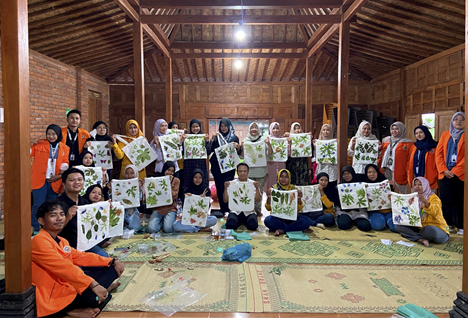
Method: This program using a Community Development approach, with six stages: needs assessment, collaborative planning, Eco-print training, mentoring, and evaluation. Training activities included plant identification, motif design, and natural dye fixation, conducted with the KSS Berkah Bersama community.
Results: Post-training assessments showed a significant improvement in knowledge and skill, with test scores increasing from 40–50 to 80–90. Participants produced eco-friendly tote bags and expressed interest in continuing independent production and marketing efforts.
Conclusion: The program effectively built sustainable textile skills, empowered community members through practical innovation, and supported inclusive local economic development rooted in environmental values and cultural identity.
Author Biographies
Okka Adiyanto, Department of Industrial Engineering, Faculty of Industrial Technology, Universitas Ahmad Dahlan, Indonesia
 Scopus ID: 57193336194
Endah Utami, Department of Industrial Engineering, Faculty of Industrial Technology, Universitas Ahmad Dahlan, Indonesia
Industrial Engineering Department
Choirul Bariyah, Department of Industrial Engineering, Faculty of Industrial Technology, Universitas Ahmad Dahlan, Indonesia
Industrial Engineering Department
Muhammad Faishal, Department of Industrial Engineering, Faculty of Industrial Technology, Universitas Ahmad Dahlan, Indonesia
Industrial Engineering Department
Effendi Mohamad, Faculty of Industrial and Manufacturing Technology and Engineering, Universiti Teknikal Malaysia Melaka, Malaysia
References
N. L. Ramadhani and P. Pandansari, “Utilization of Eco-print Techniques as an Environmentally Friendly Fashion Business Opportunity,” J. Teknol. Busana, 2024, [Online]. Available: https://journal.unnes.ac.id/journals/teknobuga/article/view/6474.
U. Laili, R. Rohmawati, S. N. Hasina, Y. Septianingrum, and E. P. Rahayu, “Eco Printing as an Environmentally Friendly Effort in Malaysia,” Amalee Indones. J. Community Res. Engagem., vol. 5, no. 1, pp. 493–501, Jun. 2024, doi: 10.37680/amalee.v5i1.3986.
A. D. Pranta and M. T. Rahaman, “Extraction of eco-friendly natural dyes and biomordants for textile coloration: A critical review,” Nano-Structures & Nano-Objects, vol. 39, p. 101243, Sep. 2024, doi: 10.1016/j.nanoso.2024.101243.
Y. P. Sari, “Ecoprint Batik Opportunity as an Environmentally Friendly Business (Case study: HR. Ambar Batik. Bayat, Wedi, Klaten),” Enrich. J. Manag., 2022, [Online]. Available: http://www.enrichment.iocspublisher.org/index.php/enrichment/article/view/733.
O. Adiyanto, M. Faishal, and E. Utami, “Pengolahan sampah plastik menjadi ecobrick sebagai upaya pemanfaatan kembali sampah plastik,” J. Pembelajaran Pemberdayaan Masyarakat, 2024, doi: 10.33474/jp2m.v5i2.21793.
B. B. Ahire, S. M. Kasabe, A. B. Mali, and V. R. Jadhav, “Development of a Sustainable Dyeing Process for Cotton fabric Utilizing Natural Dyes from Punica granatum L. and Curcuma Longa,” Current World Environment. researchgate.net, 2024, doi: 10.12944/CWE.19.1.12.
R. A. Oetopo, R. Despriliani, and F. Al Hazmi, “The application of natural dyes from rambutan skin for eco-printing on tanned leather,” J. Bhs. dan Seni, 2024, doi: 10.17977/um015v51i12023p107.
W. Fatihah and A. A. K. Astuti, “Ecoprint: Alternatif Pendidikan Karakter Pada Pokok Bahasan Kimia Hijau Dan Pembangunan Yang Berkelanjutan,” LENSA (Lentera Sains) J. Pendidikan IPA, 2025, [Online]. Available: https://www.jurnallensa.web.id/index.php/lensa/article/view/567.
R. N. Firdaus, and N. Andrianto, “Pola Komunikasi Guru Terhadap Metode Pembelajaran Anak Tuna Grahita Di Sma Kertajaya Surabaya,” Pros. Seminar Nasional Mahasiswa Komunikasi, 2025, [Online]. Available: https://conference.untag-sby.ac.id/index.php/semakom/article/view/5291/2924.
P. S. Sinaga, L. S. Marimpan, M. M. E. Purnama, and R. H. Sipayung, “Pelatihan Pembuatan Ecoprint Untuk Mendorong Kreativitas Berwirausaha Bagi Pemuda Gereja Ebenhaezer Matani,” J. Hum. and Education (JAHE), 2025, doi: 10.31004/jh.v5i2.2299.
G. E. Fauziah and M. M. Asna, “Pelatihan Edukasi Kreatif Melalui Teknik Ecoprint Pada Siswa Siswi Mi Dwi Dasa Warsa Sebagai Upaya Peningkatan Keterampilan,” JIK-PkM J. Inov. dan Kreat. Has. Pengabdian kepada Masyarakat, 2025, [Online]. Available: http://jurnal.iaih.ac.id/index.php/JIK-PKM/article/view/1293.
I. Saukani, S. Sulistyono, Z. Irfin, A. Zaini, and D. E. Poernawati, “Efisiensi energi produksi ecoprint untuk meningkatkan produktifitas hasil usaha,” SELAPARANG: J. Pengabdian Masyarakat Berkemajuan, 2025, [Online]. Available: https://journal.ummat.ac.id/index.php/jpmb/article/view/28729.
E. Erwantiningsih, P. M. Dewi, and E. E. Febrianti, “Pelatihan Batik Eco Print Sebagai Upaya Menuju Kemandirian Masyarakat Pesisir Di Kelurahan Panggungrejo Pasuruan,” Panrita Abdi-Jurnal, 2025, [Online]. Available: http://journal.unhas.ac.id/index.php/panritaabdi/article/view/34214.
O. Adiyanto, F. M. Farid, and A. Hopid, “Assessing the optimal compressive strength of eco-friendly bricks using full factorial design,” Sustain. Eng. and Innovation, 2024, doi: 10.37868/sei.v6i1.id286.
O. Adiyanto, E. Mohamad, Irianto, R. Jaafar, and M. Faishal, “Optimization of PET Particle-Reinforced epoxy resin composite for Eco-Brick application using the Response Surface methodology,” Sustainability. mdpi.com, 2023, doi: 10.3390/su15054271.
N. Purnasari, A. F. Dardiri, and J. R. Prasetiyo, “PkM Pengolahan Produk Susu dengan Pendekatan Asset-Based Community Development (ABCD) di Kawasan Penghasil Susu Boyolali Jawa Tengah,” GUYUB: Journal of Community. core.ac.uk, 2023, [Online]. Available: https://core.ac.uk/download/pdf/578411167.pdf.
S. I. P. Yuwana, “Pemberdayaan dan Peningkatan Kualitas SDM Masyarakat dengan Menggunakan Metode Asset Bassed Community Development (ABCD) di Desa Pecalongan Kec. Sukosari Bondowoso,” Sasambo J. Abdimas (Journal Community Serv., vol. 4, no. 3, pp. 330–338, Aug. 2022, doi: 10.36312/sasambo.v4i3.735.
F. Faizal, “Diskursus pemberdayaan masyarakat,” Ijtimaiyya: Jurnal Pengembangan Masyarakat. ejournal.radenintan.ac.id, 2015, [Online]. Available: https://ejournal.radenintan.ac.id/index.php/ijtimaiyya/article/download/861/740.
J. Sawant, R. Guru, D. Grewal, S. C. Talekar, and S. P. Kulkarni, “Sustainability In Textiles: A Critical Review Of Eco – Friendly Practices And Materials,” ShodhKosh J. Vis. Perform. Arts, vol. 5, no. 2, Jul. 2024, doi: 10.29121/shodhkosh.v5.i2.2024.891.
R. Kant, “Textile dyeing industry an environmental hazard,” Nat. Sci., vol. 04, no. 01, pp. 22–26, 2012, doi: 10.4236/ns.2012.41004.
L. D. Ardila-Leal, R. A. Poutou-Piñales, A. M. Pedroza-Rodríguez, and B. E. Quevedo-Hidalgo, “A Brief History of Colour, the Environmental Impact of Synthetic Dyes and Removal by Using Laccases,” Molecules, vol. 26, no. 13, p. 3813, Jun. 2021, doi: 10.3390/molecules26133813.
C. C. Okafor, C. N. Madu, C. C. Ajaero, and J. C. Ibekwe, “Sustainable management of textile and clothing,” Clean Technol. academia.edu, 2021, [Online]. Available: https://www.academia.edu/download/109073169/ctr-01-01-004.pdf.
M. V. Eitzel, “Sustainable development as successful technology transfer: Empowerment through teaching, learning, and using digital participatory mapping techniques in Mazvihwa, Zimbabwe,” Dev. Eng., vol. 3, pp. 196–208, 2018, doi: 10.1016/j.deveng.2018.07.001.
K. Yılmaz, I. O. Aksu, M. Gocken, and T. Demirdelen, “Sustainable Textile Manufacturing with Revolutionizing Textile Dyeing: Deep Learning-Based, for Energy Efficiency and Environmental-Impact Reduction, Pioneering Green Practices for a Sustainable Future,” Sustainability, vol. 16, no. 18, p. 8152, Sep. 2024, doi: 10.3390/su16188152.
N. Kangana, N. Kankanamge, C. De Silva, A. Goonetilleke, R. Mahamood, and D. Ranasinghe, “Bridging Community Engagement and Technological Innovation for Creating Smart and Resilient Cities: A Systematic Literature Review,” Smart Cities, vol. 7, no. 6, pp. 3823–3852, Dec. 2024, doi: 10.3390/smartcities7060147.
E. Sulaiman, “Go Green Products Using Ecoprint Techniques,” Indones. J. Community Serv. Cel, vol. 1, no. 1, pp. 56–62, Jun. 2022, doi: 10.70110/ijcsc.v1i1.8.
M. T. An, “Present status of the natural resource of camellias in Guizhou Province,” Guizhou For. Sci. Technol. 2005.
N. K. Putri and M. Mustakimah, “Pemanfaatan Bahan Alam untuk Meningkatkan Kreativitas Anak melalui Kegiatan Ecoprint,” Aulad J. Early Child., vol. 8, no. 1, pp. 31–40, Jan. 2025, doi: 10.31004/aulad.v8i1.893.
A. P. M. Sholikhah and W. Widowati, “Kualitas Hasil Ecoprint Motif Daun Jenitri dengan ZWA Daun Ketapang menggunakan Mordan Tawas, Tunjung dan Kapur Tohor,” Fash. Fash. Educ., 2024, doi: 10.15294/ffej.v13i1.76046.
B. Mushtaq, Y. Nawab, S. Ahmad, and F. Ahmad, “An eco-friendly enzymatic treatment to prepare spinnable banana fibers as an alternative to cotton for textile applications,” Int. J. Biol. Macromol., vol. 278, p. 134630, Oct. 2024, doi: 10.1016/j.ijbiomac.2024.134630.
Downloads
Published
How to Cite
Issue
Section
License
Copyright (c) 2025 Okka Adiyanto, Endah Utami, Choirul Bariyah, Muhammad Faishal, Effendi Mohamad, Ali Maksum

This work is licensed under a Creative Commons Attribution-ShareAlike 4.0 International License.
Authors who publish with SPEKTA (Jurnal Pengabdian Kepada Masyarakat: Teknologi dan Aplikasi) agree to the following terms:
- Authors retain copyright and grant the journal the right of first publication with the work simultaneously licensed under a Creative Commons Attribution License (CC BY-SA 4.0) that allows others to share the work with an acknowledgment of the work's authorship and initial publication in this journal.
- Authors are able to enter into separate, additional contractual arrangements for the non-exclusive distribution of the journal's published version of the work (e.g., post it to an institutional repository or publish it in a book), with an acknowledgment of its initial publication in this journal.
- Authors are permitted and encouraged to post their work online (e.g., in institutional repositories or on their website) prior to and during the submission process, as it can lead to productive exchanges, as well as earlier and greater citation of published work.

This work is licensed under a Creative Commons Attribution-ShareAlike 4.0 International License.