Technology-Based Fish Health Service Innovation for Sustainable Aquaculture Practices in Indonesia
DOI:
https://doi.org/10.12928/spekta.v6i2.13492Keywords:
Aquaculture, Artificial Intelligence, Expert System, Fish Disease Diagnosis, Progressive Web AppAbstract
Background: Indonesia’s aquaculture sector holds vast potential, yet many fish farmers, especially those in remote areas like offshore cages, face limited access to timely fish health services, leading to undetected disease outbreaks, mass fish mortality, and significant economic losses.
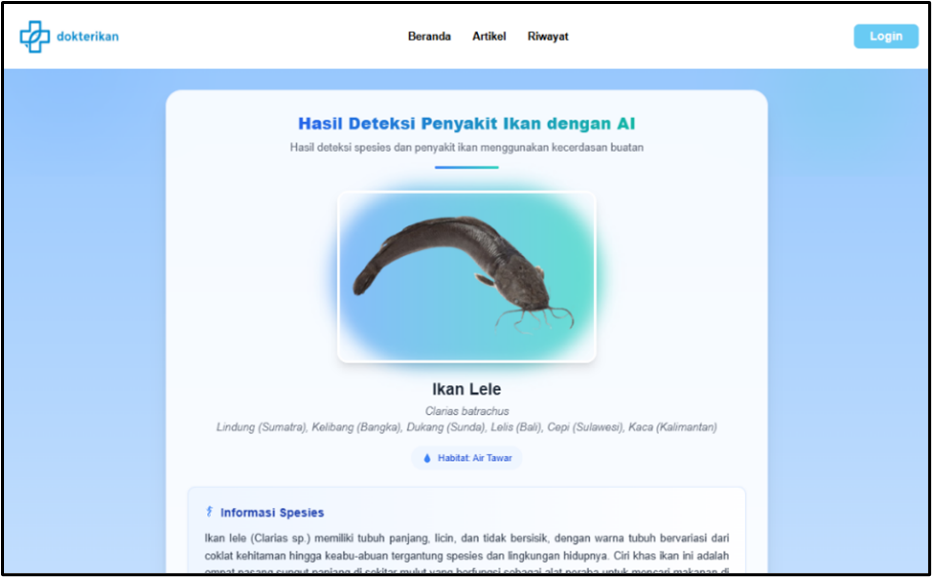
Contribution: This study introduces Fish Doctor, a scalable platform integrating fish species detection, disease diagnosis, and expert consultation. It bridges the gap between AI-based detection and practical aquaculture needs in developing countries, supporting sustainable practices aligned with SDG 2 (Zero Hunger) and SDG 12 (Responsible Consumption and Production).
Method: The application was built using Next.js, Express.js, MySQL, and integrates computer vision and expert systems. Its core features include image-based fish species detection using YOLOv11, rule-based disease diagnosis through forward chaining, and an online expert consultation module. Designed as a Progressive Web App (PWA), the system offers offline-first capabilities, enabling its use in low-connectivity environments.
Results: The system was evaluated using test datasets of five fish species, achieving an average diagnostic accuracy above 80% and response times of less than 2 seconds per case.
Conclusion: The developed platform demonstrates potential for improving early disease detection and reducing reliance on chemical treatments in aquaculture. Future research will involve usability testing with more than 100 fish farmers across multiple provinces to assess scalability and generalizability.
References
J. Ling and Y. Jin, “Balancing Industrialization with Pollution: Evidence from the Marine Ecological Civilization Demonstration Zone Program in China,” Sustainability. mdpi.com, 2025, [Online]. Available: https://www.mdpi.com/2071-1050/17/14/6352
R. E. Caraka, K. Supardi, P. U. Gio, V. Isnaniawardhani, and B. Djatmiko, “Using Kolmogorov–Arnold network and ResNet for marine protein mapping in support of the Prabowo–Gibran MBG program,” Discover Sustainability. Springer, 2025, https://link.springer.com/article/10.1007/s43621-025-01880-9
M. L. Faishol, M. A. Yogia, R. Prayuda, and Khotami, “Evaluating Conservation Assistance Program In The Anambas Islands Marine Protected Area Using The CIPP Model,” Int. Information and Engineering Technology Association, 2024, [Online]. Available: https://doi.org/10.18280/ijsdp.190429
FAO, “FAO Report: Global Fisheries and Aquaculture Production Reaches a New Record High,” Newsroom. 2024.
R. Rusindiyanto, Y. C. Winursito, and I. Nugraha, “Strategi dalam Meningkatkan Hasil Panen Ikan Lele Melalui Inovasi Teknologi Alat Pemberi Pakan Otomatis di Kecamatan Wiyung,” E-Dimas: Jurnal Pengabdian Kepada Masyarakat, 2024. https://journal.upgris.ac.id/index.php/e-dimas/article/view/16589
N. Nabi, I. Ahmed, M. Qadir, and Q. M. Reshi, “Global Aquaculture: Scenarios and Nutritional Implications,” Aquac. Enhancing Food Security and Nutrition, 2025, https://doi.org/10.1007/978-3-031-92858-1_6
K. Srikulnath, T. Budi, T. Panthum, and C. Sinthuvanich, “Sustainable Aquaculture in Thailand: Balancing Economic Growth and Ecological Integrity with North African Catfish Integration,” Aquac. Fish and Fisheries, 2025, https://doi.org/10.1155/are/2688051
A. Singh, K. Chatterjee, and S. C. Satapathy, “An edge based hybrid intrusion detection framework for mobile edge computing,” Complex &Intelligent Systems. Springer, 2022, https://link.springer.com/article/10.1007/s40747-021-00498-4
N. Koroniotis, N. Moustafa, and J. Slay, “A new intelligent satellite deep learning network forensic framework for smart satellite networks,” Comput. Electr. Eng., 2022, [Online]. Available:.
L. Zhao, F. Montanari, H. Heberle, and S. Schmidt, “Modeling bioconcentration factors in fish with explainable deep learning,” Artificial Intelligence in the Life Sciences. Elsevier, 2022, [Online]. Available: https://doi.org/10.1016/j.compeleceng.2022.107745
A. Rico, “Use of veterinary medicines, feed additives and probiotics in four major internationally traded aquaculture species farmed in Asia,” Aquaculture, vol. 412–413, pp. 231–243, Nov. 2013, https://doi.org/10.1016/j.aquaculture.2013.07.028
R. Mukaila, I. C. Ukwuaba, and I. I. Umaru, “Economic impact of disease on small-scale catfish farms in Nigeria,” Aquaculture, 2023, [Online]. Available: https://doi.org/10.1016/j.aquaculture.2023.739773
G. Kumar, C. Engle, S. Aarattuthodi, and J. V. Senten, “Economic impact of Edwardsiellosis on the US catfish industry,” Aquac. Economics & Management, 2024, https://doi.org/10.1080/13657305.2024.2319083
S. Anand and M. K. Barua, “Modeling the key factors leading to post-harvest loss and waste of fruits and vegetables in the agri-fresh produce supply chain,” Comput. Electron. Agric., vol. 198, p. 106936, Jul. 2022, https://doi.org/10.1016/j.compag.2022.106936
S. Fernandes and A. DMello, “Artificial intelligence in the aquaculture industry: Current state, challenges and future directions,” Aquaculture, vol. 598, p. 742048, Mar. 2025, https://doi.org/10.1016/j.aquaculture.2024.742048
B. Omarov and Z. Zhumanov, “Bidirectional Long-Short-Term Memory with Attention Mechanism for Emotion Analysis in Textual Content,” Int. J. Adv. Comput. Sci. Appl., vol. 14, no. 6, 2023, https://doi.org/10.14569/IJACSA.2023.0140615
S. Zhang, Y. Yuan, Z. Wang, S. Wei, X. Zhang, and T. Zhang, “A novel deep learning model for spectral analysis: Lightweight ResNet-CNN with adaptive feature compression for oil spill type identification,” Spectrochimica Acta Part A Mol. and Biomolecular Spectroscopy, 2025, [Online]. Available: https://www.sciencedirect.com/science/article/pii/S138614252401792X
E. J. Weissberger and P. M. Glibert, “Diet of the eastern oyster, Crassostrea virginica, growing in a eutrophic tributary of Chesapeake Bay, Maryland, USA,” Aquac. Reports, vol. 20, p. 100655, Jul. 2021, https://doi.org/10.1016/j.aqrep.2021.100655
S. Aripin and S. Somantri, “Implementasi Progressive Web Apps (PWA) pada Repository E-Portofolio Mahasiswa,” J. Eksplora Inform., vol. 10, no. 2, pp. 148–158, Mar. 2021, https://doi.org/10.30864/eksplora.v10i2.486
D. Hindarto, “Exploring YOLOv8 Pretrain for Real-Time Detection of Indonesian Native Fish Species,” Sinkron, vol. 8, no. 4, pp. 2776–2785, Oct. 2023, https://doi.org/10.33395/sinkron.v8i4.13100
W. N. Hadi and T. Suhartini, “Sistem Pakar Diagnosa Penyakit Akibat Virus Pada Manusia Menggunakan Metode Teorema Bayes,” Briliant J. Ris. dan Konseptual, vol. 9, no. 2, pp. 488–498, May 2024, https://doi.org/10.28926/briliant.v9i2.1676
L. P. Wanti and S. Romadhon, “Implementasi Forward Chaining Method Pada Sistem Pakar Untuk Deteksi Dini Penyakit Ikan,” Infotekmesin, vol. 11, no. 2, pp. 74–79, Aug. 2020, https://doi.org/10.35970/infotekmesin.v11i2.248
H. D. Lin, J. L. Chen, and C. H. Lin, “A Deep Learning-Based Sensing System for Identifying Salmon and Rainbow Trout Meat and Grading Freshness for Consumer Protection,” Sensors. mdpi.com, 2025, [Online]. Available: https://www.mdpi.com/1424-8220/25/20/6299
Z. Y. A. Chen, C. C. Lin, H. C. Huang, W. C. Su, and C. Y. Cheng, “Anomaly Detection for Semiconductor Wafer Multi-wire Sawing Machines Using Statistical and Deep Learning Methods,” Mobile Networks and Applications. Springer, 2025, https://doi.org/10.1007/s11036-025-02477-2
T. Boroukhian, K. Supyen, J. B. Samson, A. Bashyal, and H. Wicaksono, “Integrating 3D object detection with ontologies for accurate digital twin creation in manufacturing systems,” The International Journal of Advanced Manufacturing Technology. Springer, 2025, https://doi.org/10.1007/s00170-025-16548-x
P. Moriano, S. C. Hespeler, M. Li, and M. Mahbub, “Adaptive anomaly detection for identifying attacks in cyber-physical systems: A systematic literature review,” Artificial Intelligence Review. Springer, 2025, https://doi.org/10.1007/s10462-025-11292-w
R. Abbasi, P. Martinez, and R. Ahmad, “An ontology model to represent aquaponics 4.0 system’s knowledge,” Information Processing in Agriculture. Elsevier, 2022, [Online]. Available: https://www.sciencedirect.com/science/article/pii/S2214317321000937
M. T. Ahad, S. Bin Mamun, S. Chowdhury, B. Song, and Y. Li, “End User Interface Design of Mobile-Based Fish Disease Detection to Assist Fish Farmers.” 2024, https://doi.org/10.2139/ssrn.4980536
R. Irwansyah, Y. Maulita, and S. Syahputra, “Sistem Pakar Diagnosis Penyakit Leukosit Menggunakan Metode Certainty Factor,” Syntax J. Softw. Eng. Comput. Sci. Inf. Technol., vol. 3, no. 1, pp. 190–195, Jul. 2022, https://doi.org/10.46576/syntax.v3i1.2088
Downloads
Published
How to Cite
Issue
Section
License
Copyright (c) 2025 Fadlil Ferdiansyah, Irawan Habib Yulianto, Muhammad Zamrol Imada, Patricia Evericho Mountaines, Erwin Adriono, Yudi Eko Windarto, Arseto Satriyo Nugroho

This work is licensed under a Creative Commons Attribution-ShareAlike 4.0 International License.
Authors who publish with SPEKTA (Jurnal Pengabdian Kepada Masyarakat: Teknologi dan Aplikasi) agree to the following terms:
- Authors retain copyright and grant the journal the right of first publication with the work simultaneously licensed under a Creative Commons Attribution License (CC BY-SA 4.0) that allows others to share the work with an acknowledgment of the work's authorship and initial publication in this journal.
- Authors are able to enter into separate, additional contractual arrangements for the non-exclusive distribution of the journal's published version of the work (e.g., post it to an institutional repository or publish it in a book), with an acknowledgment of its initial publication in this journal.
- Authors are permitted and encouraged to post their work online (e.g., in institutional repositories or on their website) prior to and during the submission process, as it can lead to productive exchanges, as well as earlier and greater citation of published work.

This work is licensed under a Creative Commons Attribution-ShareAlike 4.0 International License.