EduHealth Time Application for Enhancing Nutrition and Health Knowledge and Skills among Junior High School Students
DOI:
https://doi.org/10.12928/spekta.v6i2.13243Keywords:
Adolescent health education, Multimedia learning, mHealth , School health units , Self-monitoringAbstract
Background: Adolescents often acquire health knowledge through traditional education but frequently face challenges in sustaining healthy behaviors due to a range of social, environmental, psychological, and developmental factors.
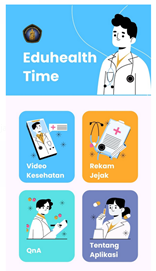
Contribution: We developed "EduHealth Time," an Android application co-designed with educators and health personnel to deliver on-demand health education videos and integrated screening modules (anthropometry, anaemia risk, illness monitoring), with built-in functionality for exporting data to support School Health Unit documentation.
Method: A one-group pretest-posttest design was implemented during a community-service pilot at SMPIT As-Salam Malang (October–November 2024), involving 65 junior high school students. The app development followed the Plan–Act–Observe–Reflect cycle. Usability and feasibility were evaluated through a seven-item structured survey.
Results: EduHealth Time was made publicly available on Google Play. Usability outcomes were highly positive: 92% of participants reported ease of data entry, 100% experienced no system errors, and 100% completed screening tasks without difficulty. The educational and screening functions were rated feasible by 92% of users. Significant improvements were observed in knowledge scores: +5.2 points for balanced diet, +21.4 points for physical activity, and +7.4 points for reproductive health.
Conclusion: The EduHealth Time application is a scalable and contextually relevant mHealth platform that enhances adolescent health knowledge and supports self-monitoring. Its integration of multimedia learning and screening features provides a model for continuous school-based health education.
References
J. P. Allen and E. L. Loeb, “The Autonomy‐Connection Challenge in Adolescent–Peer Relationships,” Child Dev. Perspect., vol. 9, no. 2, pp. 101–105, Jun. 2015, https://doi.org/10.1111/cdep.12111
F. Fithria, M. Adlim, S. R. Jannah, and T. Tahlil, “Indonesian adolescents’ perspectives on smoking habits: a qualitative study,” BMC Public Health, vol. 21, no. 1, p. 82, Dec. 2021, https://doi.org/10.1186/s12889-020-10090-z
T. Baig, G. S. Ganesan, H. Ibrahim, W. Yousuf, and Z. R. Mahfoud, “The association of parental involvement with adolescents’ well-being in Oman: evidence from the 2015 Global School Health Survey,” BMC Psychol., vol. 9, no. 1, p. 175, Dec. 2021, https://doi.org/10.1186/s40359-021-00677-5
V. B. Facina, R. da R. Fonseca, M. E. P. da Conceição-Machado, R. de C. Ribeiro-Silva, S. M. C. dos Santos, and M. L. P. de Santana, “Association between Socioeconomic Factors, Food Insecurity, and Dietary Patterns of Adolescents: A Latent Class Analysis,” Nutrients, vol. 15, no. 20, p. 4344, Oct. 2023, https://doi.org/10.3390/nu15204344
W. Setyaningsih, I. Yudianti, and H. Mansur, “Perceived susceptibility, barriers, and cues to action as determinant factors of reproductive health behavior,” Int. J. Public Heal. Sci., vol. 11, no. 3, p. 884, Sep. 2022, http://doi.org/10.11591/ijphs.v11i3.21576
T. J. Dekkers, E. de Water, and A. Scheres, “Impulsive and risky decision-making in adolescents with attention-deficit/hyperactivity disorder (ADHD): The need for a developmental perspective,” Curr. Opin. Psychol., vol. 44, pp. 330–336, Apr. 2022, https://doi.org/10.1016/j.copsyc.2021.11.002
P. Macharia, A. Pérez-Navarro, I. Inwani, R. Nduati, and C. Carrion, “Developing an Unstructured Supplementary Service Data-based mobile phone app to provide adolescents with sexual reproductive health information: a human-centered design approach,” BMC Med. Res. Methodol., vol. 22, no. 1, p. 213, Dec. 2022, https://doi.org/10.1186/s12874-022-01689-4
I. D. Saragih, S. Imanuel Tonapa, C. M. Porta, and B.-O. Lee, “Effects of telehealth interventions for adolescent sexual health: A systematic review and meta-analysis of randomized controlled studies,” J. Telemed. Telecare, vol. 30, no. 2, pp. 201–214, Feb. 2024, https://doi.org/10.1177/1357633x211047762
C. Lu, W. Chu, S. Madden, B. Parmanto, and J. S. Silk, “Adolescent perspectives on how an adjunctive mobile app for social anxiety treatment impacts treatment engagement in telehealth group therapy,” Social Sciences. mdpi.com, 2021, [Online]. Available: https://www.mdpi.com/2076-0760/10/10/397
S. Kaiser, M. Rye, R. Jakobsen, M. Martinussen, H. Hogdal, and H. Kyrrestad, “A Universal Mental Health–Promoting Mobile App for Adolescents: Protocol for a Cluster Randomized Controlled Trial,” JMIR Research Protocols. researchprotocols.org, 2023, [Online]. Available: https://www.researchprotocols.org/2023/1/e42119/
C. S. E. Chew, C. Davis, J. K. E. Lim, C. M. M. Lim, Y. Z. H. Tan, J. Y. Oh, K. Rajasegaran, Y. H. M. Chia, and E. A. Finkelstein, “Use of a mobile lifestyle intervention app as an early intervention for adolescents with obesity: single-cohort study,” Journal of medical Internet Research. jmir.org, 2021, [Online]. Available: https://www.jmir.org/2021/9/e20520/
H. L. Tong, J. C. Quiroz, A. B. Kocaballi, K. Ijaz, and E. Coiera, “A personalized mobile app for physical activity: An experimental mixed-methods study,” Digit. Health, 2022, https://doi.org/10.1177/20552076221115017
W. A. Nisman, I. Parmawati, L. Lailatussa’adah, and W. Krismonita, “The effect of the commander application (gender equality-based adolescent reproductive health education) on knowledge, attitudes, and self-efficacy of high School Students in Yogyakarta City,” Open Access Macedonian Journal of Med Sci. oamjms.eu, 2022, [Online]. Available: https://oamjms.eu/index.php/mjms/article/view/10041.
L. P. C. Brewer, A. Kumbamu, C. Smith, and C. A Patten, “A cardiovascular health and wellness mobile health intervention among church-going African Americans: formative evaluation of the FAITH! app,” JMIR formative Res. formative.jmir.org, 2020, [Online]. Available: https://formative.jmir.org/2020/11/e21450.
H. N. Fageeh, “‘Teledentistry’ using a mobile app (Telesmile) to improve oral health among the visually impaired and hearing-impaired populations in Saudi Arabia: a randomized controlled study,” Front. Oral Heal., vol. 5, Dec. 2024, https://doi.org/10.3389/froh.2024.1496222
C. Benavides, J. A. Benítez-Andrades, and N. Arias, “eHealth intervention to improve health habits in the adolescent population: mixed methods study,” JMIR mHealth and Uhealth. mhealth.jmir.org, 2021, [Online]. Available: https://mhealth.jmir.org/2021/2/e20217.
S. Mancone, S. Corrado, B. Tosti, G. Spica, and P. Diotaiuti, “Integrating digital and interactive approaches in adolescent health literacy: a comprehensive review,” Front. Public Heal., vol. 12, Oct. 2024, https://doi.org/10.3389/fpubh.2024.1387874
R. Harini and F. L. Andini, “The Effectiveness of Health Education Through Video Learning Multimedia On The Knowledge Of Youth About Menarche at SDN I Pakisaji,” J. Dedik., 2021, [Online]. Available: https://ejournal.umm.ac.id/index.php/dedikasi/article/view/18933
U. Müssener, P. Henriksson, and K. A. Agren, “Promoting healthy behaviors among adolescents and young adults with intellectual disability: Protocol for developing a digital intervention with co-design Workshops,” JMIR Research Publications Advancing Digital Health & Open Science researchprotocols.org, 2023, [Online]. Available: https://www.researchprotocols.org/2023/1/e47877/
C. I. Reis, “Development of an mHealth Platform for Adolescent Obesity Prevention: User-Centered Design Approach,” Int. J. Environ. Res. Public Health, vol. 19, no. 19, p. 12568, Oct. 2022, https://doi.org/10.3390/ijerph191912568
D. N. Aisyah, “Knowledge, Attitudes, and Behaviors on Utilizing Mobile Health Technology for TB in Indonesia: A Qualitative Pilot Study,” Front. Public Heal., vol. 8, Oct. 2020, https://doi.org/10.3389/fpubh.2020.531514
S. Zagade, “Constructivism And Multimedia: Tools Of Innovative Teaching,” Journal Of Higher Education And Research Society: A Media Design. academia.edu, 2017, [Online]. Available: https://www.academia.edu/download/54232613/2017_April_JHERSO_Vol_5_.pdf.
S. Rahayu, S. M. Said, and T. B. Sansuwito, “The effect of mhealth on preventing anemia in adolescent girls: a literature review,” Int J Health Sci. 2024.
R. T. Nabavi and M. S. Bijandi, “Bandura’s social learning theory &social cognitive learning theory,” Theory of Developmental Psychology, 2012.
N. Caliston, “Evaluating the Effectiveness of Mobile Game-Based Learning for Raising Adolescent Health Awareness: The Case of ‘AHlam Na 2.0,’” IJOEM Indones. J. E-learning Multimed., vol. 4, no. 1, pp. 11–20, Jan. 2025, https://doi.org/10.58723/ijoem.v4i1.349
A. Collishaw, A. Snider, P. McNamara, S. Nuvaga, and A.-F. Bilame, “Impact of a video-based nutrition education program on the nutrition knowledge of students and parents: evidence from the North Region of Cameroon,” Glob. Health Promot., vol. 31, no. 3, pp. 60–69, Sep. 2024, https://doi.org/10.1177/17579759231206795
J. A. Benítez-Andrades, N. Arias, M. T. García-Ordás, M. Martínez-Martínez, and I. García-Rodríguez, “Feasibility of Social-Network-Based eHealth Intervention on the Improvement of Healthy Habits among Children,” Sensors, vol. 20, no. 5, p. 1404, Mar. 2020, https://doi.org/10.3390/s20051404
Y. Anggriani, S. Rahayu, and S. Sukarni, “The Use of Video Media Against Adolescent Knowledge Level of Breast Self Examination (BSE),” J. Aisyah J. Ilmu Kesehat., vol. 7, no. S1, Jun. 2022, https://dx.doi.org/10.30604/jika.v7iS1.1198
P. W. Handayani, D. A. Meigasari, A. A. Pinem, and D. Ayuningtyas, “Critical success factors for mobile health implementation in Indonesia,” Heliyon. cell.com, 2018, [Online]. Available: https://doi.org/10.1016/j.heliyon.2018.e00981
Downloads
Published
How to Cite
Issue
Section
License
Copyright (c) 2025 Fajar Ari Nugroho, Inggita Kusumastuty, Anggun Rindang Cempaka

This work is licensed under a Creative Commons Attribution-ShareAlike 4.0 International License.
Authors who publish with SPEKTA (Jurnal Pengabdian Kepada Masyarakat: Teknologi dan Aplikasi) agree to the following terms:
- Authors retain copyright and grant the journal the right of first publication with the work simultaneously licensed under a Creative Commons Attribution License (CC BY-SA 4.0) that allows others to share the work with an acknowledgment of the work's authorship and initial publication in this journal.
- Authors are able to enter into separate, additional contractual arrangements for the non-exclusive distribution of the journal's published version of the work (e.g., post it to an institutional repository or publish it in a book), with an acknowledgment of its initial publication in this journal.
- Authors are permitted and encouraged to post their work online (e.g., in institutional repositories or on their website) prior to and during the submission process, as it can lead to productive exchanges, as well as earlier and greater citation of published work.

This work is licensed under a Creative Commons Attribution-ShareAlike 4.0 International License.