Improving the Quality of Coffee Beans and Branding of Coffee Products of Sekar Adji MSMEs Malang Through Inovokasi Program Grants
DOI:
https://doi.org/10.12928/spekta.v6i2.13119Keywords:
Coffee Bean, Digital Marketing, MSMEs , Rotary dryerAbstract
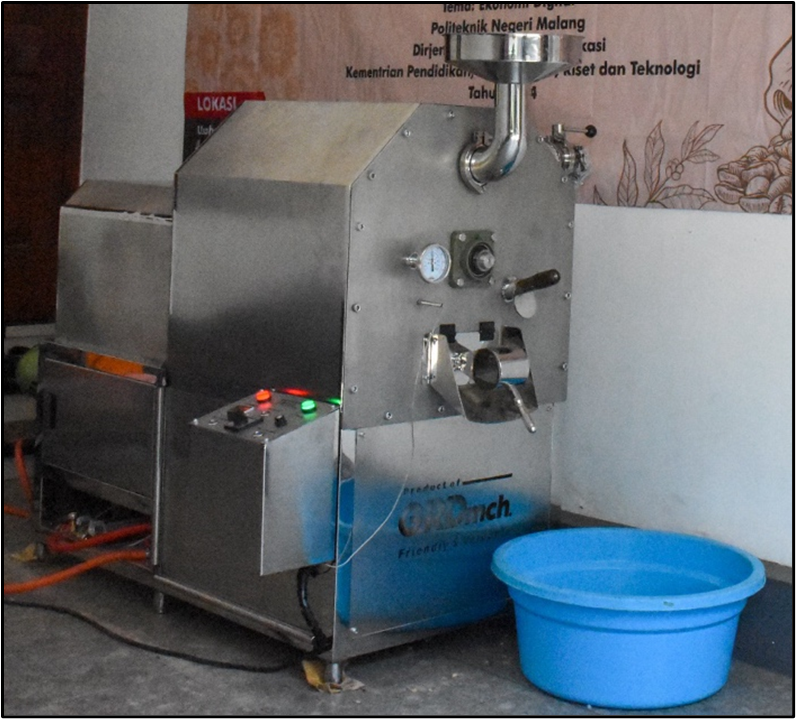
Background: Coffee is a key plantation commodity in Indonesia, with Gunung Kawi producing Robusta, Arabica, and Excelsa varieties. However, local farmers still rely on traditional drying methods and outdated marketing, affecting bean quality and sales. This community service program seeks to address these issues by introducing a 30 kg-capacity rotary dryer to meet the SNI 01-2907-2008 standard and by providing digital marketing training to enhance competitiveness.
Contribution: This program significantly supports Sekar Adji MSMEs by introducing a rotary dryer that enables coffee drying to meet national quality standards. Combined with digital marketing training and improved packaging, it enhances product promotion and competitiveness in the digital market, ultimately boosting MSME revenue.
Method: The program involves four main activities: manufacturing and training on the use of a 30 kg-capacity rotary dryer, providing digital marketing training to enhance social media and e-commerce use, redesigning coffee packaging for better appeal, and restructuring the MSME organization to improve adaptability and management efficiency.
Results: The program introduced a 30 kg-capacity rotary dryer and digital marketing training. The dryer reduced moisture content to 11.5%, and product packaging was improved with five new designs. The program significantly increased marketing reach and MSME revenue. Digital platforms such as Instagram, Tokopedia, and TikTok Shop were utilized to expand online presence, and a new organizational structure enhanced business operation.
Conclusion: Analysis of the results shows that the program positively impacted product quality and sales at Sekar Adji MSMEs, primarily by improving drying processes and enhancing digital marketing through targeted training.
References
Sub Direktorat Statistik Tanaman Perkebunan, Statistik Kopi Indonesia 2022, Volume 7. Jakarta: Badan Pusat Statistik, 2023.
A. Prayoga and Z. Zumaira, “Comparison Study of Caffeine Levels of Coffee Bean (Coffea Sp.) and Brands of Coffee Powder Circulate in Banda Aceh City,” Indones. J. Pharm. Educ., vol. 3, no. 1, pp. 96–102, 2023, https://doi.org/10.37311/ijpe.v3i1.18913
E. Firdissa, A. Mohammed, G. Berecha, and W. Garedew, “Coffee Drying and Processing Method Influence Quality of Arabica Coffee Varieties (Coffee arabica L.) at Gomma I and Limmu Kossa, Southwest Ethiopia,” J. Food Qual., vol. 2022, pp. 1–8, 2022, https://doi.org/10.1155/2022/9184374
A. Tawakal, “Development of Coffee Production in Kepahiang,” J. Fokus Manaj., vol. 2, no. 2, pp. 143–152, 2022, https://doi.org/10.37676/jfm.v2i2.3377
A. Kwangsawad, P. Nusawat, and A. Jattamart, “Conceptual model of innovation decision process and hesitation to adopt augmented reality in tourism industry,” Int. J. of Human-Computer Interaction, 2025, https://doi.org/10.1080/10447318.2024.2434963
L. Lady, S. Shevia, and L. Nurjanah, “Optimizing customer engagement: Employing triangulation methodology to improve social media content strategy for MSME,” J. Bus. &Applied Management, 2024, http://dx.doi.org/10.30813/jbam.v17i1.5252
S. R. Raysyah, Veri Arinal, and Dadang Iskandar Mulyana, “Klasifikasi Tingkat Kematangan Buah Kopi Berdasarkan Deteksi Warna Menggunakan Metode Knn Dan Pca,” JSiI (Jurnal Sist. Informasi), vol. 8, no. 2, pp. 88–95, 2021, https://doi.org/10.30656/jsii.v8i2.3638
N. F. Huang, “Smart agriculture: real-time classification of green coffee beans by using a convolutional neural network,” IET Smart Cities, vol. 2, no. 4, pp. 167–172, 2020, https://doi.org/10.1049/iet-smc.2020.0068
I. Dhamayanthie, “Analisis Metode Pengurangan Kadar Air pada Biji Kopi,” J. Pendidik. Tambusai, vol. 6, pp. 12056–12065, 2022. https://doi.org/10.31004/jptam.v6i2.4366
N. F. Suaib, D. N. Faridah, D. R. Adawiyah, and N. Andarwulan, “Authentication of volatile and non-volatile compounds in Robusta Java Bogor as a differentiator in post-harvest processes,” BIO Web Conf., vol. 123, 2024, https://doi.org/10.1051/bioconf/202412301002
D. Radianto and F. Ali Ega Wardana, “Pengaturan Suhu dan Kecepatan Motor pada Pengering Padi Menggunakan Metode Fuzzylogic,” J. Multidisiplin Saintek, vol. 2, no. 2, pp. 11–25, 2024. https://ejournal.warunayama.org/index.php/kohesi/article/view/1724
S. Suherman, H. Widuri, S. Patricia, E. E. Susanto, and R. J. Sutrisna, “Energy analysis of a hybrid solar dryer for drying coffee beans,” Int. J. Renew. Energy Dev., vol. 9, no. 1, pp. 131–139, 2020, https://doi.org/10.14710/ijred.9.1.131-139
Badan Standar Nasional, “Standar Nasioanal Indonesia Biji Kopi,” Sni 01-2907-2008, p. 4, 2008.
J. Tétreault, “Green Bean Coffee Moisture For Roasting,” Nucleus, 2024.
International Coffee Organization, “Coffee Report and Outlook,” Int. Coffee Organ. ICO, vol. 1, no. 1, pp. 1–39, 2023.
C. Sundaygara and M. Kurniawati, “Bubuk Asli Gunung Kawi Berbasis Teknologi Tepat Guna,” J. PARAHITA ABDIMAS, vol. 4, no. 2, pp. 1–6, 2023. https://ejournal.unma.ac.id/index.php/parahita/article/view/4570
M. Hernawan, “Jarang Diketahui! Ini Perbedaan Kopi Robusta dan Arabika Yang Sebenarnya,” COFFINDO, 2024.
G. Abebe and A. Awoke, “Sustainable ecosystem services in the coffee value chain,” Discover Sustainability. Springer, 2025, https://doi.org/10.1007/s43621-025-02128-2
A. Petrillo, M. Rehman, and F. De Felice, “Optimizing coffee supply chain transparency and traceability through mobile application,” European Journal of Innovation. emerald.com, 2025, [Online]. Available: https://www.emerald.com/ejim/article/28/11/267/1270922.
C. M. R. Peralta and J. S. Gómez, “Innovation in coffee production and distribution of economic benefits among value chain actors,” Leadersh. Organ. Sustainability, 2023.
I. G. Bawa Susana, I. B. Alit, and I. D. K. Okariawan, “Rice husk energy rotary dryer experiment for improved solar drying thermal performance on cherry coffee,” Case Stud. Therm. Eng., vol. 41, p. 102616, Jan. 2023, https://doi.org/10.1016/j.csite.2022.102616
Kavin Klinsman Konsil, Norazlianie Sazali, Kumaran Kadirgama, Wan Sharuzi Wan Harun, and Norazwina Zainol, “Analysis on the Performance of Designed Fluidized Bed Dryer for Drying Coffee Beans,” J. Adv. Res. Appl. Sci. Eng. Technol., vol. 31, no. 1, pp. 99–109, Jun. 2023, https://doi.org/10.37934/araset.31.1.99109
P. M. M. Martins, N. N. Batista, M. G. da C. P. Miguel, J. B. P. Simão, J. R. Soares, and R. F. Schwan, “Coffee growing altitude influences the microbiota, chemical compounds and the quality of fermented coffees,” Food Res. Int., vol. 129, p. 108872, 2020, https://doi.org/10.1016/j.foodres.2019.108872
N. Nafisah, I. N. Syamsiana, R. I. Putri, W. Kusuma, and A. D. W. Sumari, “Implementation of fuzzy logic control algorithm for temperature control in robusta rotary dryer coffee bean dryer,” MethodsX, vol. 12, p. 102580, Jun. 2024, https://doi.org/10.1016/j.mex.2024.102580
Y. K. Dwivedi, “Setting the future of digital and social media marketing research: Perspectives and research propositions,” Int. J. Inf. Manage., vol. 59, no. July 2020, p. 102168, 2021, https://doi.org/10.1016/j.ijinfomgt.2020.102168
R. S. Ali, R. K. Hasoun, I. F. Jaleel, and Abdul-Majeed, G, “Proposal for providing secure Zoom meeting through Corona pandemic,” Journal of Engineering Research. Elsevier, 2024, [Online]. Available: https://www.sciencedirect.com/science/article/pii/S2307187723002754.
L. E. Knox, S. R. Berzenski, and S. A. Drew, “Measuring Zoom fatigue in college students: development and validation of the Meeting Fatigue Scale for Videoconferencing (MFS-V) and the Meeting Fatigue Scale for In-Person (MFS-I),” Media Psychol., 2023, https://doi.org/10.1080/15213269.2023.2204529
F. Saputra, D. Ryana Suchendra, and M. Ikhsan Sani, “Implementasi Sistem Sensor Dht22 Untuk Menstabilkan Suhu Dan Kelembapan Berbasis Mikrokontroller Nodemcu Esp8266 Pada Ruangan Implementation of Dht22 Sensor System To Stabilize Temperature and Humidity Based on Microcontroller Nodemcu Esp8266 in Space,” Proceeding Appl. Sci., vol. 6, no. 2, p. 1977, 2020. https://openlibrarypublications.telkomuniversity.ac.id/index.php/appliedscience/article/view/12457
K. Kusnandar, “Perbaikan Kemasan Sebagai Upaya Meningkatkan Daya Saing Produk Ukm Murni Snack,” Kumawula J. Pengabdi. Kpd. Masy., vol. 4, no. 2, p. 320, 2021, https://doi.org/10.24198/kumawula.v4i2.34958
I. J. Akinrinde, O. J. Adelakun, K. C. Okogor, and Jerome-Ukaoke, I, “SME Prospects for Nigeria’s Economic Growth and Unemployment Reduction,” Palgrave Handb. of Decolonising Enterpereneurship, 2025, https://doi.org/10.1007/978-3-031-92310-4_19
K. R. Radhika and A. A. Mishra, “Decoding celebrity-owned brand coolness: exploring its impact on brand experience through tight and loose cultural contexts: KR Radhika and AA Mishra,” J. Brand Manag., 2025, https://doi.org/10.1057/s41262-025-00414-y
Downloads
Published
How to Cite
Issue
Section
License
Copyright (c) 2025 Ika Noer Syamsiana, Arwin Datumaya Wahyudi Sumari, Nilawati Fiernaningsih, Wahyu Aulia Nurwicaksana, Nihayatun Nafisah, Putri Findi, Annisa Anggraini Ningrum, Ammar Ibrohim Farros, Mohammad Wildan Fikri

This work is licensed under a Creative Commons Attribution-ShareAlike 4.0 International License.
Authors who publish with SPEKTA (Jurnal Pengabdian Kepada Masyarakat: Teknologi dan Aplikasi) agree to the following terms:
- Authors retain copyright and grant the journal the right of first publication with the work simultaneously licensed under a Creative Commons Attribution License (CC BY-SA 4.0) that allows others to share the work with an acknowledgment of the work's authorship and initial publication in this journal.
- Authors are able to enter into separate, additional contractual arrangements for the non-exclusive distribution of the journal's published version of the work (e.g., post it to an institutional repository or publish it in a book), with an acknowledgment of its initial publication in this journal.
- Authors are permitted and encouraged to post their work online (e.g., in institutional repositories or on their website) prior to and during the submission process, as it can lead to productive exchanges, as well as earlier and greater citation of published work.

This work is licensed under a Creative Commons Attribution-ShareAlike 4.0 International License.