Enhancing AI-Powered PowerPoint Skills: Training Impact on Vocational Teachers in Surakarta
DOI:
https://doi.org/10.12928/spekta.v6i1.13056Keywords:
AI-powered PowerPoint, Vocational education, Teacher training, Technological integration, Quasi-experimental studyAbstract
Background: The integration of AI-powered PowerPoint in education offers promising opportunities for enhancing teaching effectiveness, yet many vocational teachers face challenges in implementing this technology due to limited training and technical support.
Contribution: This study contributes to the educational community by providing a practical framework for integrating AI-powered tools in vocational education, thereby enhancing teachers' technical skills and supporting sustainable technological adoption.
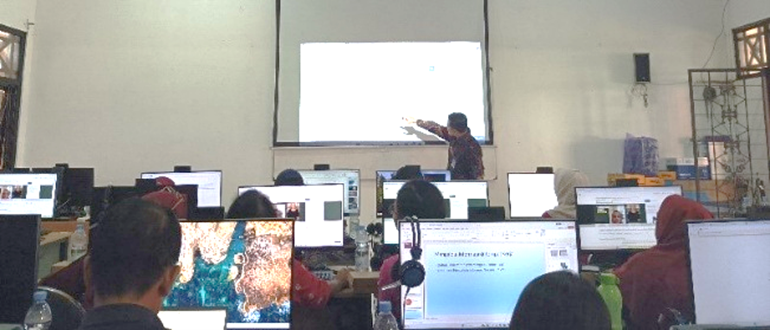
Method: Using a quasi-experimental design with a one-group pretest-posttest approach, twenty office administration teachers participated in an 8-hour training program. Data were collected through validated instruments measuring three indicators: training reaction, training facilities and materials, and expected behavioral changes.
Results: Paired-sample t-tests revealed highly significant improvements in expected behavioral changes (t (19) = -4.501, p < 0.001) and training facilities perception (t (19) = -2.594, p = 0.018), although training reaction showed no significant change (t (19) = -1.628, p = 0.120).
Conclusion: These findings suggest that intensive, well-structured training programs can effectively promote AI-powered PowerPoint adoption in vocational education, particularly in developing technical skills and implementation intentions. Educational institutions should consider implementing similar training programs while maintaining long-term support structures to reinforce learning and facilitate sustained technological integration.
References
O. Hamal, N.-E. El Faddouli, M. H. A. Harouni, and J. Lu, “Artificial Intelligent in Education,” Sustainability, vol. 14, no. 5, p. 2862, Mar. 2022, doi: 10.3390/su14052862.
J. Sweller, “Cognitive load theory and educational technology,” Educ. Technol. Res. Dev., vol. 68, no. 1, pp. 1–16, Feb. 2020, doi: 10.1007/s11423-019-09701-3.
J. Randi, “Adaptive Teaching,” in Adaptive Teaching, Routledge, 2022. doi: 10.4324/9781138609877-REE125-1.
N. A. Dahri, “Extended TAM based acceptance of AI-Powered ChatGPT for supporting metacognitive self-regulated learning in education: A mixed-methods study,” Heliyon, vol. 10, no. 8, p. e29317, Apr. 2024, doi: 10.1016/j.heliyon.2024.e29317.
H.-C. Yeh, “The synergy of generative AI and inquiry-based learning: transforming the landscape of English teaching and learning,” Interact. Learn. Environ., vol. 33, no. 1, pp. 88–102, Jan. 2025, doi: 10.1080/10494820.2024.2335491.
S. Aruna, S. Maturi, V. Kotha, and K. Swarna, “Leveraging AI for Student Attention Estimation,” in Multifaceted approaches for Data Acquisition, Processing & Communication, London: CRC Press, 2024, pp. 15–21. doi: 10.1201/9781003470939-3.
F. Almasri, “Exploring the Impact of Artificial Intelligence in Teaching and Learning of Science: A Systematic Review of Empirical Research,” Res. Sci. Educ., vol. 54, no. 5, pp. 977–997, Oct. 2024, doi: 10.1007/s11165-024-10176-3.
W. Xu and F. Ouyang, “A systematic review of AI role in the educational system based on a proposed conceptual framework,” Educ. Inf. Technol., vol. 27, no. 3, pp. 4195–4223, Apr. 2022, doi: 10.1007/s10639-021-10774-y.
J. Chen, P. Lai, A. Chan, V. Man, and C.-H. Chan, “AI-Assisted Enhancement of Student Presentation Skills: Challenges and Opportunities,” Sustainability, vol. 15, no. 1, p. 196, Dec. 2022, doi: 10.3390/su15010196.
R. G. L. da Silva, “The advancement of artificial intelligence in biomedical research and health innovation: challenges and opportunities in emerging economies,” Global. Health, vol. 20, no. 1, p. 44, May 2024, doi: 10.1186/s12992-024-01049-5.
M. Deng, X. Wang, and C. C. Menassa, “Investigating the effect of wearing masks on office work in indoor environments during a pandemic using physiological sensing,” Build. Environ., 2022, [Online]. Available: https://www.sciencedirect.com/science/article/pii/S0360132322005790.
D. T. K. Ng, J. K. L. Leung, J. Su, R. C. W. Ng, and S. K. W. Chu, “Teachers’ AI digital competencies and twenty-first century skills in the post-pandemic world,” Educ. Technol. Res. Dev., vol. 71, no. 1, pp. 137–161, Feb. 2023, doi: 10.1007/s11423-023-10203-6.
A. S. S. Aldossary, “Digital IDs for advanced robotics systems as a regulatory infrastructure,” Int. J. Law Inf. Technol., vol. 30, no. 3, pp. 350–367, Dec. 2022, doi: 10.1093/ijlit/eaac022.
B. N. Balusamy Nachiappan, N. Rajkumar, C. Kalpana, A. Mohanraj, B. Prabhu Shankar, and C. Viji, “Machine Learning-Based System for Automated Presentation Generation from CSV Data,” Data Metadata, vol. 3, p. 359, Jan. 2024, doi: 10.56294/dm2024359.
A. M. Sayegh and D. I. Al-Badawi, “AI Based Innovative CC for Interactive Education System Build,” in 2024 4th International Conference on Advance Computing and Innovative Technologies in Engineering (ICACITE), May 2024, pp. 1562–1567, doi: 10.1109/ICACITE60783.2024.10617405.
V. T. Lokare and P. M. Jadhav, “An AI-based learning style prediction model for personalized and effective learning,” Think. Ski. Creat., vol. 51, p. 101421, Mar. 2024, doi: 10.1016/j.tsc.2023.101421.
W. S. Sayed, “AI-based adaptive personalized content presentation and exercises navigation for an effective and engaging E-learning platform,” Multimed. Tools Appl., vol. 82, no. 3, pp. 3303–3333, Jan. 2023, doi: 10.1007/s11042-022-13076-8.
D. T. K. Ng, C. W. Tan, and J. K. L. Leung, “Empowering student self‐regulated learning and science education through ChatGPT : A pioneering pilot study,” Br. J. Educ. Technol., vol. 55, no. 4, pp. 1328–1353, Jul. 2024, doi: 10.1111/bjet.13454.
O. Wohlfart and I. Wagner, “Teachers’ role in digitalizing education: an umbrella review,” Educ. Technol. Res. Dev., vol. 71, no. 2, pp. 339–365, Apr. 2023, doi: 10.1007/s11423-022-10166-0.
G. Wilson, O. Johnson, and W. Brown, “Exploring the Use of Artificial Intelligence in Personalizing Marketing Campaigns.” Aug. 01, 2024, doi: 10.20944/preprints202408.0007.v1.
I. Pesovski, R. Santos, R. Henriques, and V. Trajkovik, “Generative AI for Customizable Learning Experiences,” Sustainability, vol. 16, no. 7, p. 3034, Apr. 2024, doi: 10.3390/su16073034.
T. Alqahtani, “The emergent role of artificial intelligence, natural learning processing, and large language models in higher education and research,” Res. Soc. Adm. Pharm., vol. 19, no. 8, pp. 1236–1242, Aug. 2023, doi: 10.1016/j.sapharm.2023.05.016.
T. Frohlich, “Demystifying AI Techniques for Creative Domains,” in Artificial Intelligence, Co-Creation and Creativity, London: Routledge, 2024, pp. 61–74. doi: 10.4324/9781003453901-7.
D. J. Mollura, “Artificial Intelligence in Low- and Middle-Income Countries: Innovating Global Health Radiology,” Radiology, vol. 297, no. 3, pp. 513–520, Dec. 2020, doi: 10.1148/radiol.2020201434.
H. Kawasaki, S. Yamasaki, M. Yamakido, and Y. Murata, “Introductory Disaster Training for Aspiring Teachers: A Pilot Study,” Sustainability, vol. 14, no. 6, p. 3492, Mar. 2022, doi: 10.3390/su14063492.
M. C. Mozer, M. Wiseheart, and T. P. Novikoff, “Artificial intelligence to support human instruction,” Proc. Natl. Acad. Sci., vol. 116, no. 10, pp. 3953–3955, Mar. 2019, doi: 10.1073/pnas.1900370116.
A. Brandt and S. Hazel, “Towards interculturally adaptive conversational AI,” Appl. Linguist. Rev., vol. 16, no. 2, pp. 775–786, Mar. 2025, doi: 10.1515/applirev-2024-0187.
A. O. Theodorio, Z. Waghid, T. W. Mataka, and O. Adegoke, “Demystifying Lesotho, Rwandan and Nigerian educators’ viewpoints on smart technologies supporting AI in higher education,” Educ. Inf. Technol., vol. 29, no. 18, pp. 24285–24307, Dec. 2024, doi: 10.1007/s10639-024-12820-x.
D. M. Lopez, C. Rico-Olarte, B. Blobel, and C. Hullin, “Challenges and solutions for transforming health ecosystems in low- and middle-income countries through artificial intelligence,” Front. Med., vol. 9, Dec. 2022, doi: 10.3389/fmed.2022.958097.
S. A. Salloum, “AI Perils in Education: Exploring Ethical Concerns,” 2024, pp. 669–675. doi: 10.1007/978-3-031-52280-2_43.
J. Cohen, Statistical Power Analysis for the Behavioral Sciences. Routledge, 2013. doi: 10.4324/9780203771587.
Y. Chen, P.-Y. Yen, Y. Zhang, and H. Liu, “Conducting business disciplinary research by playing educational games: A case of the forecast sharing game in supply chain management,” Int. J. Manag. Educ., vol. 21, no. 2, p. 100773, Jul. 2023, doi: 10.1016/j.ijme.2023.100773.
S. Bal, “Technical teacher training program for engineering integration in K‐12 education,” Comput. Appl. Eng. Educ., vol. 32, no. 4, Jul. 2024, doi: 10.1002/cae.22746.
A. Al Darayseh, “Acceptance of artificial intelligence in teaching science: Science teachers’ perspective,” Comput. Educ. Artif. Intell., vol. 4, p. 100132, 2023, doi: 10.1016/j.caeai.2023.100132.
A. M. Al-Zahrani, “Unveiling the shadows: Beyond the hype of AI in education,” Heliyon, vol. 10, no. 9, p. e30696, May 2024, doi: 10.1016/j.heliyon.2024.e30696.
Z. Konde, Z. Kovacs, and E. Konya, “Modeling teachers’ reactions to unexpectedness,” Learn. Instr., vol. 86, p. 101784, Aug. 2023, doi: 10.1016/j.learninstruc.2023.101784.
M. Lucas, Y. Zhang, P. Bem-haja, and P. N. Vicente, “The interplay between teachers’ trust in artificial intelligence and digital competence,” Educ. Inf. Technol., vol. 29, no. 17, pp. 22991–23010, Dec. 2024, doi: 10.1007/s10639-024-12772-2.
H. Galindo-Domínguez, N. Delgado, D. Losada, and J.-M. Etxabe, “An analysis of the use of artificial intelligence in education in Spain: The in-service teacher’s perspective,” J. Digit. Learn. Teach. Educ., vol. 40, no. 1, pp. 41–56, Jan. 2024, doi: 10.1080/21532974.2023.2284726.
T. Nazaretsky, M. Ariely, M. Cukurova, and G. Alexandron, “Teachers’ trust in AI ‐powered educational technology and a professional development program to improve it,” Br. J. Educ. Technol., vol. 53, no. 4, pp. 914–931, Jul. 2022, doi: 10.1111/bjet.13232.
Q. Zhou, “The Realistic Dilemmas and Possible Paths of Artificial Intelligence Enabling Teacher Education,” Appl. Math. Nonlinear Sci., vol. 9, no. 1, Jan. 2024, doi: 10.2478/amns-2024-2163.
J. Park, T. W. Teo, A. Teo, J. Chang, J. S. Huang, and S. Koo, “Integrating artificial intelligence into science lessons: teachers’ experiences and views,” Int. J. STEM Educ., vol. 10, no. 1, p. 61, Oct. 2023, doi: 10.1186/s40594-023-00454-3.
C.-M. Chou, T.-C. Shen, T.-C. Shen, and C.-H. Shen, “Developing and validating an AI-supported teaching applications’ self-efficacy scale,” Res. Pract. Technol. Enhanc. Learn., vol. 19, p. 035, Mar. 2024, doi: 10.58459/rptel.2024.19035.
L. Zhao, X. Wu, and H. Luo, “Developing AI Literacy for Primary and Middle School Teachers in China: Based on a Structural Equation Modeling Analysis,” Sustainability, vol. 14, no. 21, p. 14549, Nov. 2022, doi: 10.3390/su142114549.
I.-A. Chounta, E. Bardone, A. Raudsep, and M. Pedaste, “Exploring Teachers’ Perceptions of Artificial Intelligence as a Tool to Support their Practice in Estonian K-12 Education,” Int. J. Artif. Intell. Educ., vol. 32, no. 3, pp. 725–755, Sep. 2022, doi: 10.1007/s40593-021-00243-5.
L. Gutierrez-Bucheli, “Adopting immersive technologies in construction training: determining educational decision-making criteria through a Delphi technique,” Smart Sustain. Built Environ., Feb. 2024, doi: 10.1108/SASBE-08-2023-0202.
T. Vandeyar and O. O. Adegoke, “Teachers’ ICT in pedagogy: A case for mentoring and mirrored practice,” Educ. Inf. Technol., vol. 29, no. 14, pp. 18985–19004, Oct. 2024, doi: 10.1007/s10639-024-12603-4.
R. Wang, J. Lyu, Q. Xiong, and J. Guo, “AI-Powered Teaching Behavior Analysis by Using 3D-MobileNet and Statistical Optimization,” 2021, pp. 378–383. doi: 10.1007/978-3-030-78270-2_67.
G. Li, M. A. Zarei, G. Alibakhshi, and A. Labbafi, “Teachers and educators’ experiences and perceptions of artificial-powered interventions for autism groups,” BMC Psychol., vol. 12, no. 1, p. 199, Apr. 2024, doi: 10.1186/s40359-024-01664-2.
L. Xiaohong, Z. Jun, C. Xiaoming, and Z. Beina, “A study on behavioral intentions of artificial intelligence learning platform: comparing the perspectives of teachers and students,” Interact. Learn. Environ., vol. 33, no. 1, pp. 223–243, Jan. 2025, doi: 10.1080/10494820.2024.2343752.
K. Latulippe, “Facilitators and challenges in partnership research aimed at improving social inclusion of persons with disabilities,” Disabil. Rehabil., vol. 46, no. 5, pp. 957–968, Feb. 2024, doi: 10.1080/09638288.2023.2188264.
B. M. Castillo, “‘Equity Work is Messy’: Exploring a Family and Community Partnership in One School District,” Educ. Urban Soc., vol. 55, no. 2, pp. 201–221, Feb. 2023, doi: 10.1177/00131245221076074.
Downloads
Published
How to Cite
Issue
Section
License
Copyright (c) 2025 Anton Subarno, Cicilia Dyah Sulistyaningrum Indrawati, Patni Ninghardjanti, Winarno, Muhammad Choerul Umam

This work is licensed under a Creative Commons Attribution-ShareAlike 4.0 International License.
Authors who publish with SPEKTA (Jurnal Pengabdian Kepada Masyarakat: Teknologi dan Aplikasi) agree to the following terms:
- Authors retain copyright and grant the journal the right of first publication with the work simultaneously licensed under a Creative Commons Attribution License (CC BY-SA 4.0) that allows others to share the work with an acknowledgment of the work's authorship and initial publication in this journal.
- Authors are able to enter into separate, additional contractual arrangements for the non-exclusive distribution of the journal's published version of the work (e.g., post it to an institutional repository or publish it in a book), with an acknowledgment of its initial publication in this journal.
- Authors are permitted and encouraged to post their work online (e.g., in institutional repositories or on their website) prior to and during the submission process, as it can lead to productive exchanges, as well as earlier and greater citation of published work.

This work is licensed under a Creative Commons Attribution-ShareAlike 4.0 International License.