Learnviro: An IoT-Based Innovation for Monitoring the Learning Environment
DOI:
https://doi.org/10.12928/spekta.v6i1.12722Keywords:
Internet of Thing, Monitoring, Learning Environment, School Management, Classroom ManagementAbstract
Background: Aisyiyah Bantul's Leading Elementary School faces challenges in maintaining an optimal learning environment, particularly regarding temperature, humidity, and lighting. This community service program introduces Learnviro, an IoT-based solution for real-time environmental monitoring, enabling schools to make data-driven decisions to enhance learning conditions.
Contribution: Learnviro empowers teachers by providing real-time data, allowing them to make informed adjustments that support differentiated instruction. The system also improves school management by optimizing classroom conditions and infrastructure maintenance.
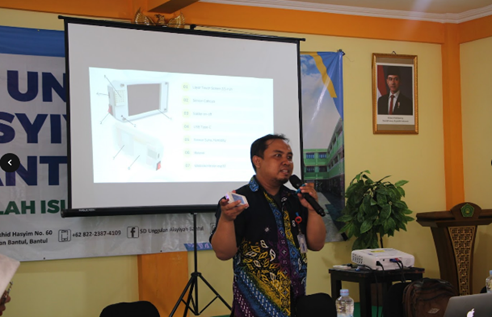
Method: The program consists of four stages: (1) collaboration with partner schools to assess needs, (2) installation of IoT devices in classrooms, (3) teacher training on interpreting and applying environmental data, and (4) continuous technical support. Data collection involved observations, interviews, and questionnaires, analyzed descriptively to evaluate the program’s effectiveness.
Results: Learnviro effectively provided real-time environmental data, improving teachers’ proficiency in utilizing IoT-based insights for classroom management. Students reported increased comfort and focus, while schools experienced better infrastructure maintenance through data-driven decision-making.
Conclusion: Learnviro has proven to be an effective tool for optimizing classroom conditions and empowering the school community. By integrating IoT technology into education, this initiative demonstrates the practical application of intelligent environmental monitoring in addressing real-world.
References
I. P. Rahayu, “Analisis Kenyamanan Pencahayaan dan Penghawaan Alami pada ruang kelas TK Kemala Bhayangkari Surakarta,” in SIAR-V, 2024, pp. 445–453. https://proceedings.ums.ac.id/siar/article/view/4229
H. Khatimah, “Gambaran School Well-Being pada Peserta Didik Program Kelas Akselerasi di SMA Negeri 8 Yogyakarta,” PSIKOPEDAGOGIA J. Bimbing. dan Konseling, vol. 4, no. 1, p. 20, 2015, doi: 10.12928/psikopedagogia.v4i1.4485.
Z. Yang, B. Becerik-Gerber, and L. Mino, “A study on student perceptions of higher education classrooms: Impact of classroom attributes on student satisfaction and performance,” Build. Environ., vol. 70, pp. 171–188, 2013, doi: https://doi.org/10.1016/j.buildenv.2013.08.030.
Y.-K. Juan and Y. Chen, “The influence of indoor environmental factors on learning: An experiment combining physiological and psychological measurements,” Build. Environ., vol. 221, p. 109299, 2022, doi: https://doi.org/10.1016/j.buildenv.2022.109299.
K. Widiastuti, M. J. Susilo, and H. S. Nurfinaputri, “How classroom design impacts for student learning comfort: Architect perspective on designing classrooms,” Int. J. Eval. Res. Educ., vol. 9, no. 3, pp. 469–477, 2020, doi: 10.11591/ijere.v9i3.20566.
Y. P. Villarreal Arroyo, R. Peñabaena-Niebles, and C. Berdugo Correa, “Influence of environmental conditions on students’ learning processes: A systematic review,” Build. Environ., vol. 231, p. 110051, 2023, doi: https://doi.org/10.1016/j.buildenv.2023.110051.
Mohaimen-Bin-noor, Z. Ahmed, D. Nandi, and M. Rahman, “Investigation of facilities for an m-learning environment,” Int. J. Mod. Educ. Comput. Sci., vol. 13, no. 1, pp. 34–48, 2021, doi: 10.5815/ijmecs.2021.01.03.
M. K. Smith, F. H. M. Jones, S. L. Gilbert, and C. E. Wieman, “The Classroom Observation Protocol for Undergraduate STEM (COPUS): A New Instrument to Characterize University STEM Classroom Practices,” CBE—Life Sci. Educ., vol. 12, no. 4, pp. 618–627, Dec. 2013, doi: 10.1187/cbe.13-08-0154.
S. Hannah and W. Wendee, “Does Classroom Architectture Count Beyond the Early Years?,” Teach. Educ. Adv. Netw. J., vol. 14, pp. 3–18, 2022. https://ojs.cumbria.ac.uk/index.php/TEAN/article/view/643
S. Power and C. Taylor, “Classroom exclusions: patterns, practices, and pupil perceptions,” Int. J. Incl. Educ., vol. 28, no. 12, pp. 2698–2712, Oct. 2024, doi: 10.1080/13603116.2022.2121434.
E. Hasanah, Ika Maryani, Suyatno, and R. Gestiardi, Diferensiasi Berbasis Digital. 2023. https://eprints.uad.ac.id/51287/1/BUKU%20DIFF%20DIGITAL.pdf
A. P. Selvam and S. N. S. Al-Humairi, “Environmental impact evaluation using smart real-time weather monitoring systems: a systematic review,” Innov. Infrastruct. Solut., 2025, doi: 10.1007/s41062-024-01817-7.
S. Moolchandani, “AI-driven risk platform automating data aggregation and risk insight generation,” International Journal of Science Engineering and Technology. researchgate.net, 2025, [Online]. Available: https://www.researchgate.net/profile/Sanjay-Moolchandani/publication/389142689_AI-Driven_Risk_Platform_Automating_Data_Aggregation_and_Risk_Insight_Generation_Sanjay_Moolchandani/links/67b6cf718311ce680c6b19b7/AI-Driven-Risk-Platform-Automating-Data-Aggregation-and-Risk-Insight-Generation-Sanjay-Moolchandani.pdf.
I. C. Alberto, Y. Jiao, and X. Zhang, “Too hot or too cold to study? The effect of temperature on student time allocation,” Econ. Educ. Rev., vol. 84, p. 102152, 2021, doi: https://doi.org/10.1016/j.econedurev.2021.102152.
U. V Anbazhagu and A. A. Blessie, “A Smart IoT-Enabled Wildfire Monitoring and Early Detection System using Convolutional Neural Networks and Sensor Data Analysis,” 2025 5th International Conference on Trends in Material Science and Inventive Materials (ICTMIM), 2025, [Online]. Available: https://ieeexplore.ieee.org/abstract/document/10988124/.
D. Amaripadath, R. Rahif, M. Velickovic, and S. Attia, “A systematic review on role of humidity as an indoor thermal comfort parameter in humid climates,” J. Build. Eng., vol. 68, p. 106039, 2023, doi: https://doi.org/10.1016/j.jobe.2023.106039.
O. Toyinbo, “Indoor Environmental Quality, Pupils’ Health, and Academic Performance-A Literature Review,” Buildings, vol. 13, no. 9, 2023, doi: 10.3390/buildings13092172.
M. Celik, A. Didikoglu, and T. Kazanasmaz, “Optimizing lighting design in educational settings for enhanced cognitive performance: A literature review,” Energy Build., vol. 328, p. 115180, 2025, doi: https://doi.org/10.1016/j.enbuild.2024.115180.
E. Erwin, Pengantar dan penerapan Internet of Things: Konsep dasar & Penerapan IoT di berbagai Sektor, no. March 2024. 2023. https://www.researchgate.net/publication/379374704_Pengantar_Penerapan_Internet_Of_Things_Konsep_Dasar_Penerapan_IoT_Di_Berbagai_Sektor
E. Hasanah, S. Suyatno, I. Maryani, M. I. Al Badar, Y. Fitria, and L. Patmasari, “Conceptual Model of Differentiated-Instruction (DI) Based on Teachers’ Experiences in Indonesia,” Educ. Sci. 2022, Vol. 12, Page 650, vol. 12, no. 10, p. 650, Sep. 2022, doi: 10.3390/EDUCSCI12100650.
I. Maryani and S. Suyatno, “Differentiated Instruction in Indonesian Private Kindergartens: Challenges in Implementing an Independent Curriculum,” Int. J. Educ. Manag. Innov., vol. 4, no. 3, pp. 2716–2338, 2023, doi: 10.12928/ijemi.v4i3.8967.
A. S. Ningsih, “Penguatan Disiplin positif melalui Pelatihan Guru dalam Implementasi Pembelajaran Kurikulum Merdeka di Sekolah Dasar Negeri Tunggul 2 , Kabupaten Sragen,” vol. 4, no. 3, pp. 555–561, 2024, doi: 10.59431/ajad.v4i3.388.
K. Zeeshan, T. Hämäläinen, and P. Neittaanmäki, “Internet of Things for Sustainable Smart Education: An Overview,” Sustain., vol. 14, no. 7, 2022, doi: 10.3390/su14074293.
S. Kaur and G. Singh, “Financial Comparative Analysis of State Public Universities of Punjab,” Int. J. Econ. Financ. Issues, vol. 10, no. 5, pp. 140–144, 2020, doi: 10.32479/ijefi.10458.
M. Johnson, D. Williams, S. Rodriguez, J. Smith, E. Brown, and A. Deshmukh, “Real-Time Temperature Prediction Models for Smart City Applications Real-Time Temperature Prediction Models for Smart City Applications,” no. January, 2025, doi: 10.13140/RG.2.2.23214.63041.
Dian Karina and Enny Putri Cahyani, “Penerapan Model Pembelajaran Group Investigation Melalui Pendekatan Saintifik Untuk Meningkatkan Kemampuan Penalaran Matematis dan Resiliensi Matematis Siswa,” J. Sade. Publ. Ilmu Pendidikan, pembelajaran dan Ilmu Sos., vol. 2, no. 2, pp. 149–161, 2024, doi: 10.61132/sadewa.v2i2.765.
M. Taylor, N. C. Brown, and D. Rim, “Optimizing thermal comfort and energy use for learning environments,” Energy Build., vol. 248, p. 111181, 2021, doi: https://doi.org/10.1016/j.enbuild.2021.111181.
Downloads
Published
How to Cite
Issue
Section
License
Copyright (c) 2025 Ika Maryani, Okimustava, Suyatno, Enung Hasanah

This work is licensed under a Creative Commons Attribution-ShareAlike 4.0 International License.
Authors who publish with SPEKTA (Jurnal Pengabdian Kepada Masyarakat: Teknologi dan Aplikasi) agree to the following terms:
- Authors retain copyright and grant the journal the right of first publication with the work simultaneously licensed under a Creative Commons Attribution License (CC BY-SA 4.0) that allows others to share the work with an acknowledgment of the work's authorship and initial publication in this journal.
- Authors are able to enter into separate, additional contractual arrangements for the non-exclusive distribution of the journal's published version of the work (e.g., post it to an institutional repository or publish it in a book), with an acknowledgment of its initial publication in this journal.
- Authors are permitted and encouraged to post their work online (e.g., in institutional repositories or on their website) prior to and during the submission process, as it can lead to productive exchanges, as well as earlier and greater citation of published work.

This work is licensed under a Creative Commons Attribution-ShareAlike 4.0 International License.