Weaving and Detail Filling of Smart Vocational Training Framework Based on 5G-Advanced and AI Intelligent Design
DOI:
https://doi.org/10.12928/spekta.v6i1.12221Keywords:
Smart Education, Model , System , EffectivenessAbstract
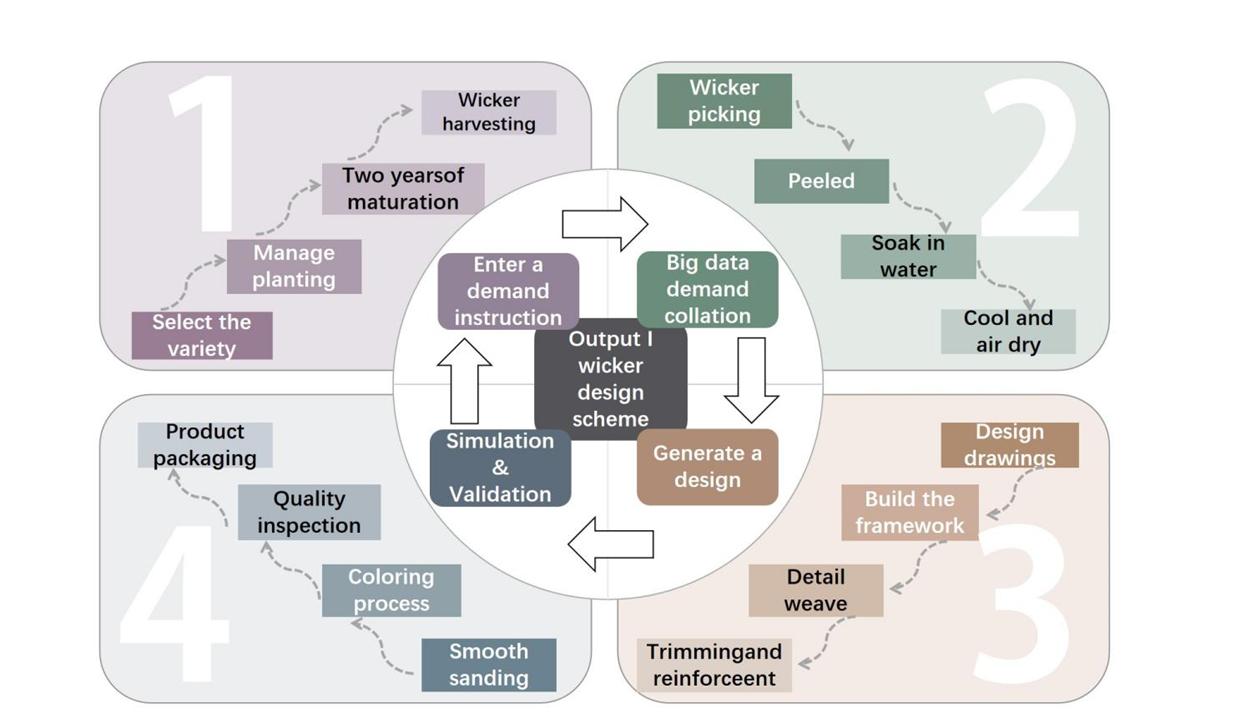
Background: Willow weaving is a traditional Chinese handicraft with profound historical and cultural value. However, in the context of modernization, it faces significant challenges including a generational gap in skill inheritance, low production efficiency, limited design innovation, and difficulties in quality control.
Contribution: This study contributes to the revitalization of intangible cultural heritage while enhancing the market relevance of the craft.
Method: The research applied a descriptive qualitative approach using both primary and secondary data. Methods included historical data analysis, AI-assisted design modelling, development of digital learning platforms and VR simulation systems, and the implementation of image recognition technology for quality control.
Results: The integration of AI enabled the generation of innovative design solutions based on trend analysis and consumer preferences. Automation improved production efficiency, and AI image recognition ensured consistent product quality through real-time defect detection. Additionally, the virtual learning system effectively supported the transfer of weaving skills to younger generations.
Conclusion: AI technology plays a vital role in modernizing traditional willow weaving. Its application not only enhances product uniqueness and efficiency but also offers a sustainable strategy for preserving intangible cultural heritage in the digital era.
References
L. Yan and Z. Mengyue, “The Model of Internet and Intangible Heritage Reviving Rural Industry“A Case Study of Chenghe Willow Weaving,” International J. Res. Innov. in Social Science, 2024, [Online]. Available: https://econpapers.repec.org/article/bcpjournl/v_3a8_3ay_3a2024_3ai_3a7_3ap_3a2624-2634.htm.
Z. Liman, Y. Shaoyi, W. Shaowen, and W. Lu, “Rural Revitalization Enabled by Traditional Culture –A Case Study of Chenghe Willow Weaving,” Int. J. of Research and Innovation in Social Science, 2024, [Online]. Available: https://econpapers.repec.org/article/bcpjournl/v_3a8_3ay_3a2024_3ai_3a6_3ap_3a3214-3221.htm.
O. Adiyanto and Z. Hananti, “Redesign of food packaging using Kansei Engineering and sustainability design,” BIO Web Conf., 2024, [Online]. Available: https://www.bio-conferences.org/articles/bioconf/abs/2024/67/bioconf_icobeaf2024_04017/bioconf_icobeaf2024_04017.html.
I. A. Primasari, E. Utami, and G. I. Budiarti, “A Design of Plastic Melting Equipment Waste Bank Scale Using Quality Function Deployment Method: Studi kasus di bank sampah Gurami Semanu,” Log. J. Ranc. Bangun dan Teknologi, 2023, [Online]. Available: http://ojs2.pnb.ac.id/index.php/LOGIC/article/view/976.
N. Sun, Y. He, C. Wang, and J. Zhang, “Research on sustainable design of consumers’ influence factors of Huaihe Willow Weaving based on AHP,” Sustainability. mdpi.com, 2023, [Online]. Available: https://www.mdpi.com/2071-1050/15/14/11115.
A. Pigott, “Willow, weaving, worlding and a politics of change,” Art Creat. an Era Ecocide Embodiment, 2023, [Online]. Available: https://www.torrossa.com/gs/resourceProxy?an=5546989&publisher=FZ0661#page=112.
Z. Chen, T. Xu, and P. Yu, “Application of metal additive testing and thermal conductivity technology in optimizing product appearance design in intelligent manufacturing industry,” Therm. Sci. Eng. Prog., 2024, [Online]. Available: https://www.sciencedirect.com/science/article/pii/S2451904924006139.
L. Symasek, T. Yeazitzis, K. Weger, and B. Mesmer, “Recent developments in individual difference research to inform the adoption of AI technology,” Systems. mdpi.com, 2025, [Online]. Available: https://www.mdpi.com/2079-8954/13/3/156.
J. Goodwill, C. Wilson, and J. MacKinnon, “Current AI technology in space,” Precis. Med. Long Safe Permanence of Humans in Space, 2025, [Online]. Available: https://www.sciencedirect.com/science/article/pii/B9780443222597000060.
X. Niu and D. Xu, “Teaching practice of out-of-school art curriculum in the inheritance of Funan willow weaving technique,” Curriculum and Teaching Methodology. pdfs.semanticscholar.org, 2023, [Online]. Available: https://pdfs.semanticscholar.org/2f90/525698ca06f5a6c0fd1841f6039cebb691a0.pdf.
H. Zhu, “Analysis on the Effect of Willow Weaving Service Industry Development in County Industry, Based on Funan Willow,” Financial Forum. scholar.archive.org, 2021, [Online]. Available: https://scholar.archive.org/work/z22er4ejazg6bpqhaztrtm3awe/access/wayback/https://ojs.piscomed.com/index.php/FF/article/download/1942/2091.
M. Ding, “Application of AI Technology in Improving Design Process Efficiency,” Eur. J. AI, Comput. &Informatics, 2025, [Online]. Available: http://pinnaclepubs.com/index.php/EJACI/article/view/78.
M. Cicek, D. Gursoy, and L. Lu, “Adverse impacts of revealing the presence of ‘Artificial Intelligence (AI)’ technology in product and service descriptions on purchase intentions: the mediating role of emotional trust and the moderating role of perceived risk,” J. Hosp. Mark. & Management, 2025, doi: 10.1080/19368623.2024.2368040.
J. Lin, J. Wu, and Y. Wu, “Design of Intelligent Monitoring and Early Warning System for Agarwood Pests and Diseases Based on AI Algorithm,” Artificial Intelligence Technology Research. ojs.scineer-pub.com, 2024, [Online]. Available: https://ojs.scineer-pub.com/index.php/AITR/article/viewFile/5265/4993.
J. W. Hyun, D. Kim, K. S. Choi, and J. W. Nam, “AI-Assisted Design Automation of Circular and Asymmetric Inductor in CMOS Technology,” 2024 21th Int. SoC Des. Conference (ISOCC), 2024, [Online]. Available: https://ieeexplore.ieee.org/abstract/document/10762371/.
Y. Y. Tsai, Y. C. Tsai, C. H. Tai, C. C. Chen, and U. K. Hsu, “The Design of a Drone-Assisted System for Large Wildlife Vaccination Shooting Based on AI Image Identification Technology,” 2024 IEEE Int. Conference on e-Business Engineering (ICEBE), 2024, [Online]. Available: https://ieeexplore.ieee.org/abstract/document/10784426/.
H. Liu, C. Liu, P. Xie, and S. Liu, “Design of Exterior Orientation Parameters Variation Real-Time Monitoring System in Remote Sensing Cameras,” Remote Sensing. mdpi.com, 2024, [Online]. Available: https://www.mdpi.com/2072-4292/16/21/3936.
K. Sidhu, D. Kim, D. Lebel, A. Alshammari, and G. Photopoulos, “90-day complications in robotic-assisted versus non-robotic-assisted lumbar fusionAbstract 56. No-tap (2-step) robotic-assisted cortical bone trajectory” canjsurg.ca, 2022, [Online]. Available: https://www.canjsurg.ca/content/65/6_Suppl_3/S112.abstract.
S. K. Panigrahy, Y. C. Tseng, B. R. Lai, and K. N. Chiang, “An overview of AI-assisted design-on-simulation technology for reliability life prediction of advanced packaging,” Materials. mdpi.com, 2021, [Online]. Available: https://www.mdpi.com/1996-1944/14/18/5342.
R. M. Burton, B. Obel, and D. D. Hakonsson, “Expanding the organizational design space: the emergence of AI robot bosses,” Journal of Organization Design. Springer, 2024, doi: 10.1007/s41469-023-00155-9.
Y. Dehui, “Application and Innovation of AI Intelligent Technology in Mobile Homestay Design,” Frontiers in Art Research. francis-press.com, 2023, [Online]. Available: https://francis-press.com/uploads/papers/xl6ftwFFDdzBNepYc0c6kmaog1RlInRQsa2o6ezb.pdf.
J. Dang, C. Sedikides, T. Wildschut, and L. Liu, “Nostalgia encourages exploration and fosters uncertainty in response to AI technology,” Br. J. Soc. Psychology, 2025, doi: 10.1111/bjso.12843.
L. Fontoura, D. L. de M. Nascimento, J. V Neto, and R. G. G. Caiado, “Energy Gen-AI technology framework: A perspective of energy efficiency and business ethics in operation management,” Technol. in Society, 2025, [Online]. Available: https://www.sciencedirect.com/science/article/pii/S0160791X25000375.
Z. B. Akhtar, “The design approach of an artificial intelligent (AI) medical system based on electronical health records (EHR) and priority segmentations,” J. Eng., 2024, doi: 10.1049/tje2.12381.
G. Zhang, H. Wu, J. Liu, H. Huang, and Y. Liu, “A multi-objective design optimization for the exterior wall coatings of residential buildings in hot summer and warm winter regions,” Build. Environ., 2024, [Online]. Available: https://www.sciencedirect.com/science/article/pii/S0360132324006188.
X. Wu, F. Zhu, M. Zhou, M. M. S. Sabri, and J. Huang, “Intelligent design of construction materials: a comparative study of AI approaches for predicting the strength of concrete with blast furnace slag,” Materials. mdpi.com, 2022, [Online]. Available: https://www.mdpi.com/1996-1944/15/13/4582.
M. Wu, G. Subramaniam, and Z. Li, and, “Using AI Technology to Enhance Data‐Driven Decision‐Making in the Financial Sector,” Artificial Intelligence‐Enabled Businesses How to Develop Strategies for Innovation, 2025, doi: 10.1002/9781394234028.ch11.
Q. Cheng, Y. Gong, Y. Qin, X. Ao, and Z. Li, “Secure digital asset transactions: integrating distributed ledger technology with safe AI mechanisms,” Academic Journal of Science and Technology. 2024. https://drpress.org/ojs/index.php/ajst/article/view/18564
F. Cao, M. Lei, S. Lin, and M. Xiang, “Application of Artificial Intelligence‐Based Big Data AI Technology in Physical Education Reform,” Mob. Inf. Syst., 2022, doi: 10.1155/2022/4017151.
Downloads
Published
How to Cite
Issue
Section
License
Copyright (c) 2025 Lekun Han, Lingqun Zuo, Xiaotong Zhu, Zhenghan Li

This work is licensed under a Creative Commons Attribution-ShareAlike 4.0 International License.
Authors who publish with SPEKTA (Jurnal Pengabdian Kepada Masyarakat: Teknologi dan Aplikasi) agree to the following terms:
- Authors retain copyright and grant the journal the right of first publication with the work simultaneously licensed under a Creative Commons Attribution License (CC BY-SA 4.0) that allows others to share the work with an acknowledgment of the work's authorship and initial publication in this journal.
- Authors are able to enter into separate, additional contractual arrangements for the non-exclusive distribution of the journal's published version of the work (e.g., post it to an institutional repository or publish it in a book), with an acknowledgment of its initial publication in this journal.
- Authors are permitted and encouraged to post their work online (e.g., in institutional repositories or on their website) prior to and during the submission process, as it can lead to productive exchanges, as well as earlier and greater citation of published work.

This work is licensed under a Creative Commons Attribution-ShareAlike 4.0 International License.