Training on School Management Health Diagnostics Using the SIDIKMAS-BRO Application
DOI:
https://doi.org/10.12928/spekta.v6i1.11872Keywords:
School Management Health, SIDIKMAS-BRO Application, School Leadership, Educational Technology, School Transformation Program (STP)Abstract
Background: Effective school leadership is a key determinant of educational quality and student outcomes. In Indonesia, the School Transformation Program, initiated by the Ministry of Education, aims to accelerate school improvement by strengthening the role of principals and promoting the Pancasila Student Profile.
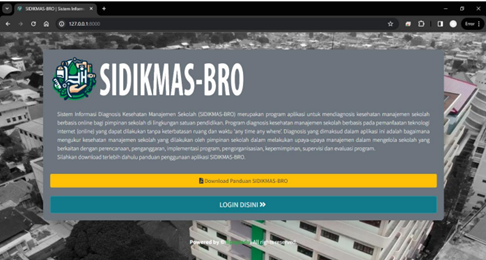
Contribution: This study contributes to the body of knowledge on digital transformation in school leadership by introducing and evaluating the SIDIKMAS-BRO application as a localized, user-friendly diagnostic tool.
Method: The training was implemented as a community service activity at SMPN 1 Pelabuhan Ratu, involving 35 school leaders. Participants engaged in panel discussions, interactive sessions, and hands-on practice using the SIDIKMAS-BRO application to assess school planning, leadership, and instructional supervision.
Results: The training enhanced participants’ understanding of data-driven school diagnostics. They demonstrated improved ability to use the application to evaluate key management areas and identify institutional strengths and weakness.
Conclusion: The program effectively strengthened the capacity of school leaders to utilize digital diagnostic tools. It contributed to promoting collaborative, evidence-based decision-making for school improvement.
References
E. S. Suharsono and E. Supriyadi, “Evaluasi program rintisan sekolah bertaraf internasional SMP Negeri 3 Purworejo,” Jurnal Akuntabilitas Manajemen Pendidikan. academia.edu, 2013, [Online]. Available: https://www.academia.edu/download/86508259/e719ab17fe0d82bdbc2f7429b348849248e5.pdf.
F. Sutedjo, “Evaluasi Pelaksanaan Program Rintisan Sekolah Bertaraf Internasional di SMKN 3 Singaraja,” J. Adm. Pendidik. Indonesia, 2012, [Online]. Available: https://ejournal-pasca.undiksha.ac.id/index.php/jurnal_ap/article/view/419.
S. Hennessy, S. D’Angelo, N. McIntyre, S. Koomar, A. Kreimeia, L. Cao, M. Brugha, and A. Zubairi, “Technology use for teacher professional development in low-and middle-income countries: A systematic review,” Computers and Education Open. Elsevier, 2022, [Online]. Available: https://www.sciencedirect.com/science/article/pii/S2666557322000088.
S. McCandless and S. G. Bishu, “A long road: Patterns and prospects for social equity, diversity, and inclusion in public administration,” Public Administration, 2022, doi: 10.1111/padm.12830.
N. Rachmawati, A. Marini, M. Nafiah, and I. Nurasiah, “Projek penguatan profil pelajar pancasila dalam impelementasi kurikulum prototipe di sekolah penggerak jenjang sekolah dasar,” J. basicedu, 2022, [Online]. Available: https://www.neliti.com/publications/451402/projek-penguatan-profil-pelajar-pancasila-dalam-impelementasi-kurikulum-prototip.
M. Marisa, “Inovasi kurikulum ‘Merdeka Belajar’ di era society 5.0,” Santhet (Jurnal Sej. Pendidik. Dan Humaniora, 2021, [Online]. Available: https://ejournal.unibabwi.ac.id/index.php/santhet/article/view/1317.
Haryanengsi and U. Radiana, “Transformational Leadership and Its Impact on School Performance in the 21st Century,” J. Manaj. Pendidik., vol. 15, no. 1, pp. 10–18, Jun. 2024, https://doi.org/10.21009/jmp.v15i1.49151.
M. Sulaeman and I. Sugiarto, “Peran motivasi, gaya kepemimpinan dalam meningkatkan kinerja pegawai di mediasi kepuasan kerja,” Insight Manag. J., 2024, [Online]. Available: http://journals.insightpub.org/index.php/imj/article/view/309.
W. A. Fuadi, Kepemimpinan Kepala Sekolah Dalam Penguatan Kompetensi Sosial Guru di SMP IT Nurul Ishlah Banda Aceh. repository.ar-raniry.ac.id, 2022. https://repository.ar-raniry.ac.id/id/eprint/23998/.
K. L. Ravshanovna, K. M. Abdi-Xafizovna, and B. M. Erkinjonovna, “Digital Technologies For Administrating The Education System For Transforming Management And Enhancing Efficiency,” Analysis of Mod. Sci. and Innovation, 2025, [Online]. Available: https://esiconf.org/index.php/AMSI/article/view/2019.
M. Bazarova, “Features Of Assessing The Effectiveness Of Innovation Risk Management Of An Educational Organization In The Process Of Digital Transformation of Activities,” J. Multidiscip. Sci. Innov., 2025, [Online]. Available: https://inlibrary.uz/index.php/jmsi/article/view/85576.
M. L. Humaini, “Peningkatan Kompetensi Staf Administrasi Madrasah untuk Meningkatan Kualitas Pendidikan,” JIIP-Jurnal Ilm. Ilmu Pendidik., 2025, [Online]. Available: http://www.jiip.stkipyapisdompu.ac.id/jiip/index.php/JIIP/article/view/7955.
F. Hakimov, “The role of digital technologies in the management of general secondary education institutions,” Am. J. Soc. Sci. Humanit. Research, 2024, [Online]. Available: https://inlibrary.uz/index.php/ajsshr/article/view/38241.
P. K. Sahu, Research methodology: a guide for researchers in agricultural science, social science and other related fields. books.google.com, 2013. https://books.google.co.id/books/about/Research_Methodology.html?id=6iIQswEACAAJ&redir_esc=y
D. Polit and C. Beck, “Essentials of nursing research: Appraising evidence for nursing practice.” Lippincott Williams &Wilkins, 2020, [Online]. Available: https://books.google.co.id/books/about/Essentials_of_Nursing_Research.html?id=7GtP8VCw4BYC&redir_esc=y.
P. Samuels and M. Gilchrist, Paired Samples t-test. 2014.
S. Gumuş, K. Arar, and I. Oplatka, “Review of international research on school leadership for social justice, equity and diversity,” J. Educ. Adm. Hist., vol. 53, no. 1, pp. 81–99, Jan. 2021, doi: 10.1080/00220620.2020.1862767.
A. Mulyani, “Pengaruh kinerja kepala sekolah dan kinerja guru terhadap mutu pembelajaran pada smk sekabupaten purwakarta,” J. Adm. Pendidik., 2012, [Online]. Available: https://ejournal.upi.edu/index.php/JAPSPs/article/view/6710.
K. L. Ravshanovna and K. M. Abdi-Xafizovna, “The role of modern digital technologies in education: transforming learning environments and enhancing student outcomes,” Modern Educ. Syst. and Innovative Teaching Solution, 2025, [Online]. Available: https://esiconf.org/index.php/MESAS/article/view/1857.
N. Abbas, I. Ruswandi, Hidayah, and Helmina, “Manajemen Pendidikan dalam Pengembangan Kurikulum: “Strategi dan Implementasi",” Rayah Al-Islam, vol. 8, no. 4, pp. 2004–2009, Nov. 2024, doi: 10.37274/rais.v8i4.1142.
K. Anwar, R. Widyanti, R. Adawiah, and U. Triyuliadi, “The Effect of Work Motivation and Commitment on Teacher Performance,” Int. J. Sci. Soc., vol. 3, no. 4, pp. 106–118, Dec. 2021, doi: 10.54783/ijsoc.v3i4.397.
A. M. Kusumawardani and A. F. Maulida, “Peran kepala sekolah dan partisipasi orang tua dalam meningkatkan mutu pendidikan di sdn bedono 03,” vol. 9, no. 1, pp. 98–102, 2025. https://oaj.jurnalhst.com/index.php/jimt/article/view/8542
N. Herawati, T. Tobari, and M. Missriani, “Analisis Pengelolaan Sarana dan Prasarana Pendidikan di Sekolah Dasar Negeri 20 Tanjung Raja Kabupaten Ogan Ilir,” Jurnal Pendidikan Tambusai. 2020. https://jptam.org/index.php/jptam/article/view/633
I. Primasari, A. Marini, and M. S. Sumantri, “Analisis kebijakan dan pengelolaan pendidikan terkait standar penilaian di Sekolah Dasar,” J. basicedu, 2021, [Online]. Available: https://www.neliti.com/publications/451564/analisis-kebijakan-dan-pengelolaan-pendidikan-terkait-standar-penilaian-di-sekol.
P. Arjanto, Manajemen Pendidikan Teori Dan Praktik. 2024. Https://Www.Researchgate.Net/Publication/387893075_Manajemen_Pendidikan_Teori_Dan_Praktik
A. Turmuzi, “Peran Kepala Sekolah dalam Meningkatkan Kualitas Pendidikan di Era Digital,” J. Syntax Admiration, 2023, [Online]. Available: https://jurnalsyntaxadmiration.com/index.php/jurnal/article/view/750.
S. Zolotarova, M. Ponomarova, S. Stankevych, and V. Novikova, “Integration Of The Educational Process In Higher Education With Digital Technologies,” Scientific Bulletin. nvngu.in.ua, 2024, [Online]. Available: https://nvngu.in.ua/jdownloads/pdf/2024/3/03_2024_Zolotarova.pdf.
M. C. Ahuchogu, T. O. Sanyaolu, and A. G. Adeleke, “Balancing innovation with riSK management in digital banking transformation for enhanced customer satisfaction and security,” International of Management & Enterpreneurship Research. researchgate.net, 2024, [Online]. Available: https://www.researchgate.net/profile/Temitope-Sanyaolu/publication/384003123_Balancing_innovation_with_riSK_management_in_digital_banking_transformation_for_enhanced_customer_satisfaction_and_security/links/66e407cc2390e50b2c86a771/Balancing-innovation-with-riSK-management-in-digital-banking-transformation-for-enhanced-customer-satisfaction-and-security.pdf.
H. Endres, J. Auburger, and R. Helm, “Industrial innovation management in the age of digital transformation: The riSK of too strong selling capabilities,” Industrial Marketing Management. Elsevier, 2024, [Online]. Available: https://www.sciencedirect.com/science/article/pii/S0019850124000087.
N. Khanam and M. S. Islam, “Role of cloud computing and blockchain technology in paradigm shift to modern online teaching culture in the education sector,” Artificial Intell. Blockchain Ind. 4.0, 2023, doi: 10.1201/9781003452591-18.
I. K. Sandhu, M. Malhotra, and P. R. Randhawa, “A review of trust and security concerns in cloud computing adoption intention in the higher education sector: research in progress,” Impacts and Challenges of Cloud Business Intelligence, 2021, [Online]. Available: https://www.igi-global.com/chapter/a-review-of-trust-and-security-concerns-in-cloud-computing-adoption-intention-in-the-higher-education-sector/269805.
M. K. K. Alsbou and R. A. I. Alsaraireh, “Data-Driven Decision-Making in Education: Leveraging AI for School Improvement,” in 2024 International Conference on Knowledge Engineering and Communication Systems (ICKECS), Apr. 2024, pp. 1–6, doi: 10.1109/ICKECS61492.2024.10616616.
Downloads
Published
How to Cite
Issue
Section
License
Copyright (c) 2025 Sururi, Cepi Triatna, Johar Permana, Yayah Rahyasih, Deni Kadarsah

This work is licensed under a Creative Commons Attribution-ShareAlike 4.0 International License.
Authors who publish with SPEKTA (Jurnal Pengabdian Kepada Masyarakat: Teknologi dan Aplikasi) agree to the following terms:
- Authors retain copyright and grant the journal the right of first publication with the work simultaneously licensed under a Creative Commons Attribution License (CC BY-SA 4.0) that allows others to share the work with an acknowledgment of the work's authorship and initial publication in this journal.
- Authors are able to enter into separate, additional contractual arrangements for the non-exclusive distribution of the journal's published version of the work (e.g., post it to an institutional repository or publish it in a book), with an acknowledgment of its initial publication in this journal.
- Authors are permitted and encouraged to post their work online (e.g., in institutional repositories or on their website) prior to and during the submission process, as it can lead to productive exchanges, as well as earlier and greater citation of published work.

This work is licensed under a Creative Commons Attribution-ShareAlike 4.0 International License.