Predictive Modeling of Porosity in Al₂O₃–TiO₂ Ceramic Coatings Produced by Plasma Spraying
DOI:
https://doi.org/10.12928/spekta.v6i1.10985Keywords:
Plasma Spraying , Alloy Ceramic , Powder AI2O3 – TiO2 , Orthogonal Experiment Plan , Metallographic PorosityAbstract
Background: Plasma spraying is a proven technique for applying ceramic coatings to enhance the mechanical and chemical resistance of components exposed to abrasive and corrosive environments. However, controlling coating porosity remains a critical factor that directly affects the coating's performance and lifespan.
Contribution: This study contributes to the field by developing a predictive model that quantifies the influence of key plasma spraying parameters on the porosity of Al₂O₃–TiO₂ coatings. The model enables process optimization and quality control for applications requiring high-performance surface protection.
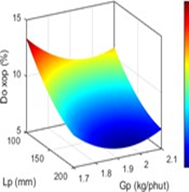
Method: An orthogonal experimental design (N27) was implemented to systematically vary three process parameters: spray distance (Lp), plasma current intensity (Ip), and powder feed rate (Gp). A total of 27 coating samples were produced and analyzed.
Results: The resulting porosity ranged from 5.96% to 14.52% depending on parameter combinations. The developed second-order polynomial regression model demonstrated good predictive accuracy, with deviation between measured and predicted values ranging from −8.67% to +13.96%, and typically within acceptable engineering limits.
Conclusion: The findings confirm that process parameters significantly affect coating porosity, and that the proposed model is a useful tool for optimizing plasma spray operations.
References
G. Yang, B. Fu, T. Dong, and G. Li, “Preparation of AlSi30Cu5 coating with fine microstructure using plasma spraying technology,” Mater. Lett., 2024, [Online]. Available: https://www.sciencedirect.com/science/article/pii/S0167577X23019857.
X. Li, “Effect of TiO2 content on the thermal control properties of Al2O3-xTiO2 composite coatings prepared by supersonic plasma spraying technology,” Journal of Materials Research and Technology. Elsevier, 2024, [Online]. Available: https://www.sciencedirect.com/science/article/pii/S2238785424019896.
S. Zhu, “Ablation behavior and mechanisms of high-entropy rare earth titanates (Y0. 2Gd0. 2Ho0. 2Er0. 2Yb0. 2) 2Ti2O7 coating deposited by plasma spraying technology,” Surface and Coatings Technol., 2024, [Online]. Available: https://www.sciencedirect.com/science/article/pii/S0257897224000446.
C. Cheng, “Thermal cycling property of the novel Hf6Ta2O17/YSZ TBCs prepared by atmospheric plasma spraying technology,” Surfaces and Interface, 2024, [Online]. Available: https://www.sciencedirect.com/science/article/pii/S2468023024012069.
P. Daram, Y. Morisada, T. Ogura, M. Kusano, and J. Yu, “Development of Tungsten Repair Technology by Atmospheric Plasma Spraying of Tungsten and Friction Stir Processing,” Journal of Thermal Spray Technol., 2024, doi: 10.1007/s11666-024-01820-5.
V. I. Kolesnikov, O. V Kudryakov, V. N. Varavka, I. V. Kolesnikov and K. N. Polityko, “Self-Organizing Processes in the Structure of CrTiZrNbHf (HEA) Ion-Plasma Coatings Obtained Using a Multicathode Arc Spraying Technology,” J. Mach. Manufacture and Reliability, 2024, doi: 10.1134/S105261882470122X.
K. Khanlari, I. E. Achouri, and F. Gitzhofer, “Exploring thermal-plasma spraying technology for advanced aluminum-based materials,” Powder Technol., 2023, [Online]. Available: https://www.sciencedirect.com/science/article/pii/S0032591023005193.
O. G. Devoino, A. V Gorbunov, A. S. Volodko, and A. N. Polyakov, “Investigation of upgraded technology for plasma spraying of bronze powder using the combined process with hydrocarbon additions,” Belarusian National Technical University. cyberleninka.ru, 2023, [Online]. Available: https://cyberleninka.ru/article/n/investigation-of-upgraded-technology-for-plasma-spraying-of-bronze-powder-using-the-combined-process-with-hydrocarbon-additions.
B. N. Guzanov, N. B. Pugacheva, E. Y. Slukin, and T. M. Bykova, “Technology of obtaining composite conglomerate powders for plasma spraying of high-temperature protective coatings,” Obrabotka metallov. 2021. Doi: 10.17212/1994-6309-2021-23.1-6-20
R. Wang, “Low-pressure plasma spraying of ZrB2–SiC coatings on C/C substrate by adding TaSi2. Surface &Coa tings Technology. 2021; 420: 127332.” 2021. Doi: 10.1016/j.surfcoat.2021.127332
G. Zheng, T. Xiong, S. Yanfang, X. Cui, W. Jiqiang, T. Junrog, L. Ning, Q. Jianzhong, and T. Yongshan, “Method for preparing a protective coating on a surface of key components and parts of IC devices based on plasma spraying technology and cold spraying technology,” US Pat. Google, 2023, [Online]. Available: https://patents.google.com/patent/US11834748B2/en.
N. X. Cuong, “Research on plasma spraying technology for fabrication of silicon carbide plasma coating on steel surface to protect against corrosion in the fluorine.” Ministry of Industry and Trade, Hanoi, 2023.
M. I. Boulos, P. L. Fauchais, and J. V. R. Heberlein, “DC Plasma Spraying, Process Technology,” Thermal Spray Fundamentals From Powder to Part, 2021, doi: 10.1007/978-3-030-70672-2_9.
P. Derevyankin and V. Frolov, “Analysis of the transient contact resistance of composite copper-graphite material obtained using plasma spraying technology,” Mater. Sci. Forum, 2021, [Online]. Available: https://www.scientific.net/MSF.1022.27.
V. S. Bessmertnyi, N. M. Zdorenko, V. M. Vorontsov, and M. A. Bondarenko, “Energy-Saving Technology of Assorted Glassware Decoration by Plasma Spraying,” Glas. Ceram., 2022, doi: 10.1007/s10717-022-00411-6.
P. G. Derevyankin and V. Y. Frolov, “Analysis of erosion processes of electrical contacts manufactured by plasma spraying technology,” 2020 IEEE Conf. of Russian Young Researchers in Electrial and Electronic Engineering, 2020, [Online]. Available: https://ieeexplore.ieee.org/abstract/document/9039012/.
V. I. Kalita, D. A. Malanin, A. I. Mamaev, V. A. Mamaeva, and V. V. Novochadov, “Plasma spraying for additive preparation technology of 3D bioactive coatings with a new type of porous ridge/cavity structure,” Cavity AMI: Materialia, 2020, [Online]. Available: https://papers.ssrn.com/sol3/papers.cfm?abstract_id=3702819.
Y. Zhiguts, V. Lazar, and B. Khomiak, “Fitments for technology of SHS and plasma spraying.” dspace-s.msu.edu.ua, 2020, [Online]. Available: http://dspace-s.msu.edu.ua:8080/bitstream/123456789/6588/1/Fitments_for_technology_of_SHS_and_plasma_spraying.pdf.
J. Xu, J. Lee, and Y. Shao, “Direct write plasma spraying technology applied to the semiconductor industry,” US Pat. App. 16/631,216, 2020, [Online]. Available: https://patents.google.com/patent/US20200140987A1/en.
M. Hong, “Low pressure plasma spraying technology and research status,” Precision Forming. 2020.
M. Shi, Z. Xue, Z. Zhang, X. Ji, E. Byon, and S. Zhang, “Effect of spraying powder characteristics on mechanical and thermal shock properties of plasma-sprayed YSZ thermal barrier coating,” Surf and Coat Technol. 2020. https://www.sciencedirect.com/science/article/abs/pii/S025789722030582X
A. A. Kovalev and A. S. Krasko, “Problems of the application of supersonic plasma spraying in the conditions of small-batch production,(Modern Materials, Technics, and Technology).” Yugo-Zapadnyi Gos. Univ., 2020.
J. Chen, J. Xiao, H. Tan, Y. Wu, J. Chen, and C. Zhang, “Microstructure and Wear Behavior of FeCoNiCrMn High Entropy Alloy Coating Deposited by Plasma Spraying,” Surf. Coat. Technol. 2020. https://www.sciencedirect.com/science/article/abs/pii/S0257897220300992
R. Musalek, J. Medricky, J. Kotlan, T. Tesar, Z. Pala, F. Lukac, and T. Chraska, “Plasma Spraying of Suspensions with Hybrid Water-Stabilized Plasma Technology,” Int. Thermal Spray Conference, 2016, [Online]. Available: https://dl.asminternational.org/itsc/proceedings-abstract/ITSC2016/83768/267/26112.
S. S. Dautov, P. G. Shornikov, L. R. Rezyapova, and I. S. Akhatov, “Increasing thermal and mechanical properties of thermal barrier coatings by suspension plasma spraying technology,” J. Phys. Conferences Series, 2019, doi: 10.1088/1742-6596/1281/1/012008.
Z. Wang, L. Z. Du, H. Lan, C. B. Huang, and W. G. Zhang, “A novel technology of Sol precursor plasma spraying to obtain the ceramic matrix abradable sealing coating,” Mater. Lett., 2019, [Online]. Available: https://www.sciencedirect.com/science/article/pii/S0167577X19307918.
I. P. Grishina, S. V Telegin, A. V Lyasnikova, O. A. Markelova, and O. A. Dudareva, “Development of the combined technology of modification of the surface of titanium implants by laser radiation with subsequent plasma spraying of biocompatible coatings,” Metallurgist, 2019, doi: 10.1007/s11015-019-00812-z.
P. Derevyankin, V. Frolov, D. Gonzalez, S. Gortschakow, R. Methling and D. Uhrlandt, “Analysis of erosion resistance of CuC arcing contacts manufactured by plasma spraying technology,” Plasma Physics and Technol., 2019, [Online]. Available: https://ojs.cvut.cz/ojs/index.php/PPT/article/view/5741.
S. Niu, K. Zhou, C. Deng, L. Xu, M. Liu, W. Zeng and Z. Chen, “Formation mechanism of island CoO in La-Sr-Co-Fe oxygen transport membrane deposited by low pressure plasma spraying-thin film technology,” J. Phys.: Conference Series, 2019, doi: 10.1088/1742-6596/1347/1/012115.
H. Z. Cai, H. E. Hui-Xia, and F. X. Wang, “The plasma spraying technology on titanium bases surface treatment on the effects of the human periodontal ligament stem cell growth,” Chin J Geriat Dent. 2017.
Downloads
Published
How to Cite
Issue
Section
License
Copyright (c) 2025 Duong Vu, Ha Minh Hung

This work is licensed under a Creative Commons Attribution-ShareAlike 4.0 International License.
Authors who publish with SPEKTA (Jurnal Pengabdian Kepada Masyarakat: Teknologi dan Aplikasi) agree to the following terms:
- Authors retain copyright and grant the journal the right of first publication with the work simultaneously licensed under a Creative Commons Attribution License (CC BY-SA 4.0) that allows others to share the work with an acknowledgment of the work's authorship and initial publication in this journal.
- Authors are able to enter into separate, additional contractual arrangements for the non-exclusive distribution of the journal's published version of the work (e.g., post it to an institutional repository or publish it in a book), with an acknowledgment of its initial publication in this journal.
- Authors are permitted and encouraged to post their work online (e.g., in institutional repositories or on their website) prior to and during the submission process, as it can lead to productive exchanges, as well as earlier and greater citation of published work.

This work is licensed under a Creative Commons Attribution-ShareAlike 4.0 International License.