Effects of Pollen Layer Thickness and Botanical Origin on Color and Moisture Content in Dried Bee Pollen
DOI:
https://doi.org/10.12928/jafost.v7i3.15944Keywords:
Color, Drying characteristics, Layer thickness, Trigona bee pollen, Water contentAbstract
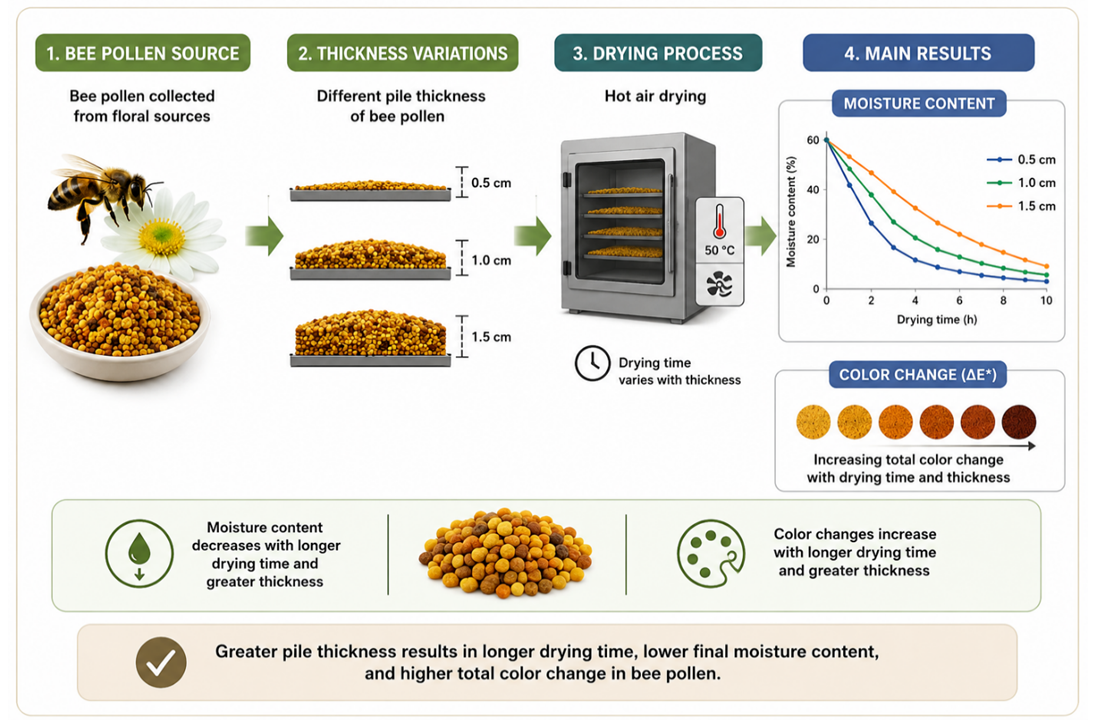
Bee pollen is used as a substitute ingredient, a fortification material, and a dietary supplement. It contains both macro- and micronutrients such as carbohydrates, proteins, lipids, minerals, and vitamins. In addition, bee pollen has a role as an antioxidant and antibacterial. Its chemical and physical characteristics differ by several factors, particularly its botanical origins. Bee pollen is often incorporated into food products in dried form, which offers a longer shelf life, compared to fresh bee pollen. The drying method is a factor that affects the quality of bee pollen. While previous research has focused primarily on drying temperatures, this study differentiates itself by investigating how the interaction between pollen layer thickness and botanical origin affects color and moisture content. This reveals how different floral species respond to physical heat-and-mass limitations during the drying process. The contribution of this research was to investigate the effect of layer thickness during drying in the container and botanical origin, on the color and moisture content of the dried bee pollen. The research experimental design was a completely randomized design (CRD) with two factors: thickness (0 cm; 1 cm; 1.5 cm) and botanical origins. The experiment consisted of 9 treatments, each executed with 3 repetitions. Data were analyzed using the Analysis of Variance (ANOVA); if there was a significant effect, the Duncan Multiple Range Test (DMRT) was conducted with α=5%. The results showed that the interaction between layer thickness and botanical origins of bee pollen significantly affected a* value, and hue angle. On the contrary, the interaction between the two factors had no significant effect on the moisture content, chroma, and b* value. Dried bee pollen had moisture content of just under 10%. Quantitatively, the applied drying conditions successfully reduced the moisture content below 10%, while maintaining a lightness (L*) of 31–49, an a* value of 4–16, a b* value of 20–30, a hue angle of 58–82 and a chroma 20–30.
References
N. S. Mwakigonja, S. K. Mashilingi, S. M. Limbu, and C. A. Masao, “Pollen and bee venom harvesting technologies enhance honey quality by improving physicochemical , nutritional and antioxidant properties,” Sci. African, vol. 33, p. e03451, 2026, https://doi.org/10.1016/j.sciaf.2026.e03451.
S. V. Rupanar, R. Satpute, P. Gadhave, and N. Kakade, “Bee pollen beyond nutrition : An integrated review of its chemical ,” J. Drug Res. Ayurvedic Sci., vol. 9, no. 4, pp. 211–221, 2024, https://doi.org/10.4103/jdras.jdras_81_24.
A. M. Ares, M. T. Martín, L. Toribio, and J. Bernal, “Determination of free amino acids in bee pollen by liquid chromatography with fluorescence detection,” Food Anal. Methods, pp. 2172–2180, 2022, https://doi.org/10.1007/s12161-022-02281-8.
B. B. Rajs, L. Primorac, K. Gal, D. Bubalo, S. Prđun, and I. Flanjak, “Influence of botanical origin on phenolic content and antioxidant capacity of monofloral bee pollen,” Acta Sci. Pol. Technol. Aliment., vol. 21, no. 2, pp. 213–222, 2022, https://doi.org/10.17306/J.AFS.2022.1024.
A. M. Ares, S. Valverde, J. L. Bernal, M. J. Nozal, and J. Bernal, “Extraction and determination of bioactive compounds from bee pollen,” J. Pharm. Biomed. Anal., vol. 147, pp. 110–124, 2018, https://doi.org/10.1016/j.jpba.2017.08.009.
T. Damto, M. Gemeda, and D. Kebaba, “Chemical and mineral composition of the mono-floral pollen of honeybees (Apis mellifera) in Ethiopia,” Bee Stud., vol. 16, no. 2, pp. 23–31, 2024, http://doi.org/10.51458/BSTD.2024.42 R.
A. N. P. Gomes, C. A. Camara, A. dos S. Sousa, F. de A. R. dos Santos, M. G. Campos, and T. M. S. Silva, “Chemical composition and free radical-scavenging activities of monofloral bee pollen from Mimosa pudica L .,” J. Apic. Res., vol. 63, no. 5, pp. 1050–1057, 2024, https://doi.org/10.1080/00218839.2022.2056290.
G. Moldakhmetova, A. Torekhanov, A. Tajiyeva, U. Nuraliyeva, and O. Krupskiy, “Seasonal variation in nutritional, physicochemical, and mineral composition of honeybee pollen in Southern Kazakhstan,” agriculture, vol. 15, pp. 1–17, 2025, https://doi.org/10.3390/agriculture15181922.
V. Adaškevičiūtė, V. Kaškonienė, P. Kaškonas, K. Barčauskaitė, and A. Maruška, “Comparison of physicochemical properties of bee pollen with other bee products,” Biomolecules, vol. 9, no. 12, pp. 1–22, 2019, https://doi.org/10.3390/biom9120819.
S. Prdun, L. Svečnjak, M. Valentić, Z. Marijanović, and I. Jerković, “Characterization of bee pollen: Physico-chemical properties, headspace composition and ftir spectral profiles,” Foods, vol. 10, no. 9, pp. 1–25, 2021, https://doi.org/10.3390/foods10092103.
L. M. Estevinho, T. Dias, and O. Anjos, “Influence of the storage conditions (frozen vs. dried) in health-related lipid indexes and antioxidants of bee pollen,” Eur. J. Lipid Sci. Technol., vol. 121, no. 2, pp. 1–9, 2019, https://doi.org/10.1002/ejlt.201800393.
S. Wang, L. Chen, S. Li, and F. Hu, “Uncovering proteome variations and concomitant quality changes of differently drying-treated rape (Brassica napus) bee pollen by label-free quantitative proteomics,” Food Chem., vol. 434, no. September 2023, pp. 1–10, 2024, https://doi.org/10.1016/j.foodchem.2023.137559.
B. A. Castellanos-Paez, A. Durán-Jiménez, C. A. Fuenmayor, M. C. Quicazán, and C. M. Zuluaga-Domínguez, “Effects of solar drying on the structural and thermodynamic characteristics of bee pollen,” Vitae, vol. 29, no. 3, pp. 1–12, 2022, https://doi.org/10.17533/udea.vitae.v29n3a350572.
A. Isik, M. Ozdemir, and I. Doymaz, “Effect of hot air drying on quality characteristics and physicochemical properties of bee pollen,” Food Sci. Technol., vol. 39, no. 1, pp. 224–231, 2019, https://doi.org/10.1590/fst.02818.
A. Isik, M. Ozdemir, and I. Doymaz, “Investigation of microwave drying on quality attributes, sensory properties and surface structure of bee pollen grains by scanning electron microscopy,” Brazilian J. Chem. Eng., vol. 38, no. 1, pp. 177–188, 2021, https://doi.org/10.1007/s43153-020-00088-w.
A. Castagna, G. Benelli, G. Conte, C. Sgherri, F. Signorini, C. Nicolella, A. Ranieri, and A. Canale, “Drying techniques and storage: Do they affect the nutritional value of bee-collected pollen?,” Molecules, vol. 25, pp. 1–15, 2020, https://doi.org/10.3390/molecules25214925.
Y.-X. Bi, S. Zielinska, J.-B. Ni, X.-X. Li, X.-F. Xue, W.-L. Tian, W.-J. Peng, and X.-M. Fang, “Effects of hot-air drying temperature on drying characteristics and color deterioration of rape bee pollen,” Food Chem. X, vol. 16, p. 100464, 2022, https://doi.org/10.1016/j.fochx.2022.100464.
S. Kayacan, O. Sagdic, and I. Doymaz, “Effects of hot-air and vacuum drying on drying kinetics, bioactive compounds and color of bee pollen,” J. Food Meas. Charact., vol. 12, no. 2, pp. 1274–1283, 2018, https://doi.org/10.1007/s11694-018-9741-4.
J. B. Ni, Y. X. Bi, S. K. Vidyarthi, H. W. Xiao, L. Da Han, J. Wang, and X. M. Fang, “Non-thermal electrohydrodynamic (EHD) drying improved the volatile organic compounds of lotus bee pollen via HS-GC-IMS and HS-SPME-GC-MS,” Lwt, vol. 176, no. September 2022, p. 114480, 2023, https://doi.org/10.1016/j.lwt.2023.114480.
A. Amro, “Nutraceutical properties of potentially pollen sources in Riyadh, Saudi Arabia and their impact on the activities of honey bee colonies,” Int. J. Zool. Anim. Biol., vol. 6, no. 6, pp. 1–11, 2023, https://doi.org/10.23880/izab-16000544.
D. N. Çobanoğlu, “Assessing monofloral bee pollens from Türkiye: Palynological verification, phenolic profile, and antioxidant activity,” Food Sci., vol. 89, pp. 1711–1726, 2024, https://doi.org/10.1111/1750-3841.16928.
Y. Saker, O. Escuredo, M. C. Seijo, S. Harbane, A. Ouelhadj, and M. S. Rodríguez-flores, “Bioactive properties of Algerian bee pollen: Influence of botanical origin on polyphenol content and antioxidant capacity,” Foods, vol. 15, pp. 1–19, 2026, https://doi.org/10.3390/foods15020202.
S. Anık and F. Vardar, “Botanical origin and biochemical composition of different color fractions of bee pollen,” J. Apic. Sci., vol. 68, no. 2, pp. 143–154, 2024, https://doi.org/10.2478/JAS-2024-0011.
C. Mutlu, C. Candal-Uslu, A. Özkök, A. Koç, H. Özhanlı, G. Akdeniz, S. Arslan-Tontul, and M. Erbaş, “Comprehensive analysis of botanical origin and amino acid composition of bee pollen samples from various regions of Turkey,” J. Apic. Res., vol. 64, no. 4, pp. 1142–1150, 2024, https://doi.org/10.1080/00218839.2024.2373401.
E. Gloch, P. Tiwari, and A. S. Bagri, “Botanical origin and chemical composition of bee pollens collected from Apis cerana hives domesticated in Pauri Garhwal, Western Himalaya, India,” Ecol. Quest., vol. 34, no. 2, pp. 81–90, 2023, https://doi.org/10.12775/EQ.2023.020.
R. Bleha, T. V. Shevtsova, M. Živčáková, A. Korbářová, M. Ježková, I. Saloň, J. Brindza, and A. Synytsya, “Spectroscopic discrimination of bee pollen by composition, color, and botanical origin,” Foods, vol. 10, no. 8, pp. 1–13, 2021, https://doi.org/10.3390/foods10081682.
C. Zhang, J. Tao, P. P. Sutar, Y. Fan, X. Fang, J. Ni, B. Tian, and H. Xiao, “Comparative study of hot air and vacuum drying on drying behavior, phytochemical composition, browning, and microstructural changes in bee pollen: The role of oxygen, temperature and vacuum,” J. Futur. Foods, pp. 1–45, 2025, https://doi.org/10.1016/j.jfutfo.2025.06.001.
N. Nafisah, I. N. Syamsiana, R. I. Putri, W. Kusuma, and A. D. W. Sumari, “Implementation of fuzzy logic control algorithm for temperature control in robusta rotary dryer coffee bean dryer,” MethodsX, vol. 12, p. 102580, 2024, https://doi.org/10.1016/j.mex.2024.102580.
Y. Yuwana and B. Sidebang, “Potential heat of exhaust gas and fuel supply rate of hybrid tandem coffee dryer using solar-biomass heat,” J. Teknol. Pertan., vol. 25, no. 1, pp. 9–24, 2024, https://doi.org/10.21776/ub.jtp.2024.025.01.2.
A. Çelekli and S. Maras, “Effect of Arthrospira platensis on physicochemical, texture, and microstructure properties of low-density marshmallows,” Food Humanit., vol. 2, pp. 1–8, 2024, https://doi.org/10.1016/j.foohum.2023.12.004.
L. P. T. Quoc, “Chemical composition and physical properties of coffee (Coffea robusta) bee pollen in Daklak province, Vietnam,” Acta Aliment., vol. 50, no. 3, pp. 453–463, 2021, https://doi.org/10.1556/066.2021.00092.
C. Y. Salazar-González, C. M. Stinco, F. J. Rodríguez-Pulido, C. Díaz-Moreno, C. Fuenmayor, F. J. Heredia, and M. L. González-Miret, “Characterization of carotenoid profile and α-tocopherol content in Andean bee pollen influenced by harvest time and particle size,” Lwt- Food Sci. Technol., vol. 170, no. September, pp. 1–9, 2022, https://doi.org/10.1016/j.lwt.2022.114065.
A. F. Attia, Y. A., Abd El‐Hack, M. E., Alagawany, M., Alyileili, S. R., Asiry, K. A., Hassan, S., Elnaggar, A. Sh., Habiba, H. I., Alqurashi, S. I., Khafaga and M. C. de Oliveira, “Bee pollen,” in Phytogenic and Phytochemical as Alternative Feed Additives for Animal Production, 2025, pp. 135–150, https://doi.org/10.2174/9789815322767125010013.
E. K. A. Taha, S. Al-Kahtani, and R. Taha, “Protein content and amino acids composition of bee-pollens from major floral sources in Al-Ahsa, eastern Saudi Arabia,” Saudi J. Biol. Sci., vol. 26, no. 2, pp. 232–237, 2019, https://doi.org/10.1016/j.sjbs.2017.06.003.
S. Husband, K. Cankar, O. Catrice, S. Chabert, and S. Erler, “A guide to sunflowers: Floral resource nutrition for bee health and key pollination syndromes,” Front. Plant Sci., vol. 16, 2025, https://doi.org/10.3389/fpls.2025.1552335.
M.-C. Velásquez, Patricia Eduardo, L. Grimau, D. Bustos, G. Montenegro, and A. Giordano, “Floral pollen bioactive properties and their synergy in honeybee pollen,” Chem. Biodivers., vol. 20, no. 4, 2023, https://doi.org/10.1002/cbdv.202201138.
S. Castiglioni, M. Stefano, P. Astolfi, and M. Pisani, “Characterisation of bee pollen from the marche region (Italy) according to the botanical and geographical origin with analysis of antioxidant activity and colour, using a chemometric approach,” Molecules, vol. 27, pp. 1–14, 2022, https://doi.org/10.3390/molecules27227996.
S. Murakonda, G. Patel, and M. Dwivedi, “Characterization of engineering properties and modeling mass and fruit fraction of wood apple (Limonia acidissima) fruit for post-harvest processing,” J. Saudi Soc. Agric. Sci., vol. 21, no. 4, pp. 267–277, 2022, https://doi.org/10.1016/j.jssas.2021.09.005.
A. Bianchi, S. Capparelli, I. Taglieri, C. Sanmartin, L. Pistelli, and F. Venturi, “Salty biscuits enriched with fresh and dried bee pollen: Chemical, technological, and sensory characterization,” Foods, vol. 14, no. 3, pp. 1–16, 2025, https://doi.org/10.3390/foods14030527.
M. Thakur and V. Nanda, “Process optimization of polyphenol-rich milk powder using bee pollen based on physicochemical and functional properties,” J. Food Process Eng., vol. 42, no. 6, pp. 1–12, 2019, https://doi.org/10.1111/jfpe.13148.
Downloads
Published
Issue
Section
License
Copyright (c) 2026 Ulfah Anis, Sri Wulandari, Fitri Yuwita, Faulina Maissy, Trio Putra Setiawan

This work is licensed under a Creative Commons Attribution-ShareAlike 4.0 International License.
Authors who publish with the Journal of Agri-food Science and Technology (JAFOST) agree to the following terms:
- Authors retain copyright and grant the journal right of first publication with the work simultaneously licensed under a Creative Commons Attribution License (CC BY-SA 4.0) that allows others to share the work with an acknowledgment of the work's authorship and initial publication in this journal.
- Authors are able to enter into separate, additional contractual arrangements for the non-exclusive distribution of the journal's published version of the work (e.g., post it to an institutional repository or publish it in a book), with an acknowledgment of its initial publication in this journal.
- Authors are permitted and encouraged to post their work online (e.g., in institutional repositories or on their website) prior to and during the submission process, as it can lead to productive exchanges, as well as earlier and greater citation of published work.