Effect of Ulva sp. Incorporation on the Physical and Sensory Properties of Lemuru (Sardinella lemuru) Fish Crackers
DOI:
https://doi.org/10.12928/jafost.v7i3.15837Keywords:
Diversification, Hedonic, Linear expansion, Oil absorption, SeaweedAbstract
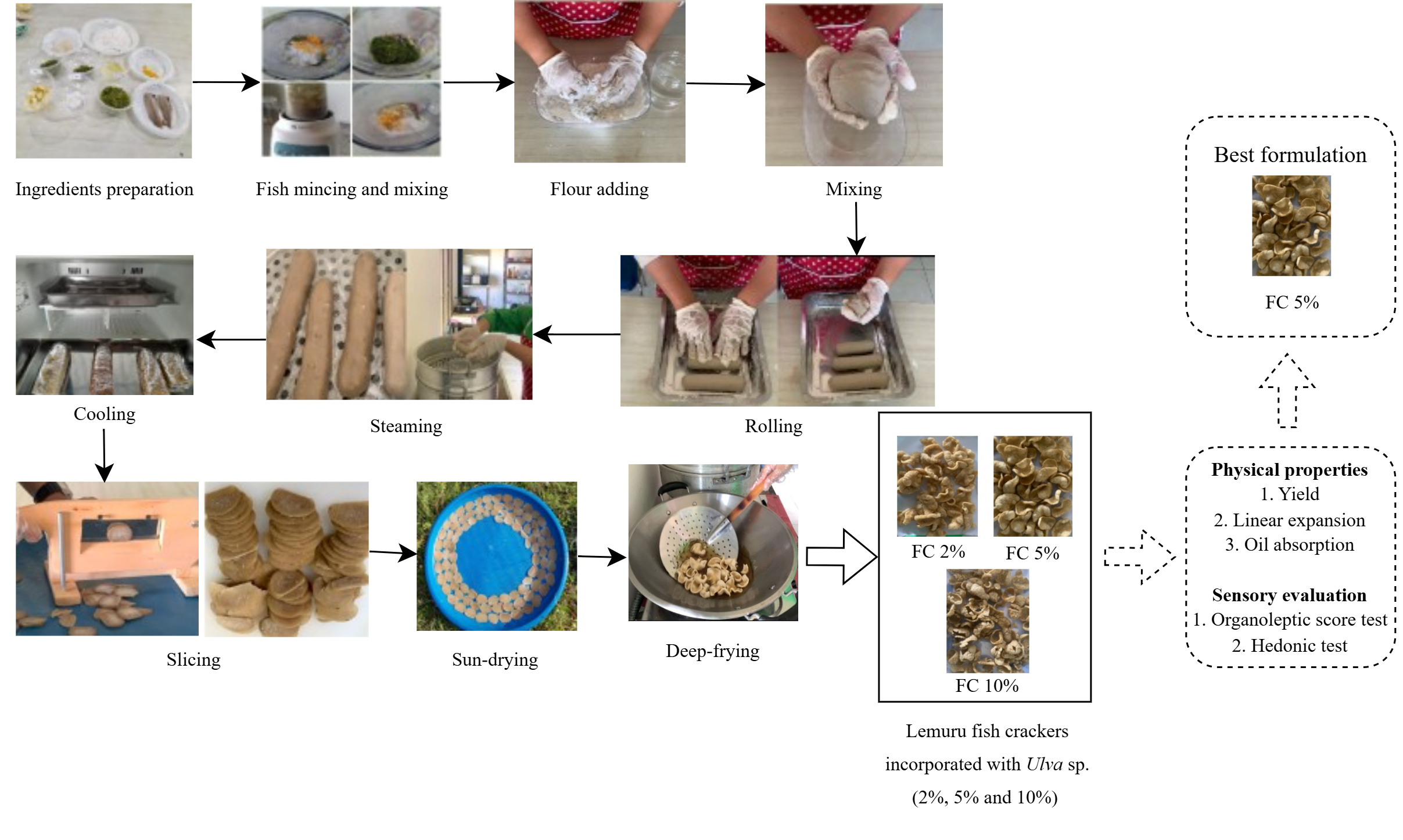
Fish crackers are a widely consumed ready-to-eat snacks in Southeast Asian. They are rich in carbohydrates and protein, but low levels of dietary fiber and minerals. Recently, Ulva sp. has received increasing attention as a new sustainable food resource due to its high dietary fiber and nutritional value. Its incorporation into food products may enhance food diversification and quality. This study aimed to evaluate the effects of Ulva sp. incorporation on the physical characteristics and sensory properties of lemuru (Sardinella lemuru) fish crackers, as well as to determine the most acceptable formulation for product quality. Results revealed that Ulva sp. supplementation significantly increased product yield (p<0.05), while linear expansion and oil absorption decreased with increasing concentration. After deep-frying, crackers with 2% Ulva sp. showed the highest linear expansion (82.24 ± 3.68%) and oil absorption (12.62 ± 0.90%, p<0.05), whereas those with 10% Ulva sp. showed the lowest levels, at 51.06 ± 7.53% for linear expansion (p<0.05) and 8.38 ± 0.76% for oil absorption (p<0.05). Sensory evaluation indicated that the addition of 10% Ulva sp. significantly (p<0.05) reduced the consumer acceptance of the appearance attribute, while odor, taste and texture were not significantly altered. Based on overall attribute, lemuru cracker with 5% Ulva sp. was identified as the optimal formulation. This study contributes to use of Ulva sp. as a functional ingredient in resulting food products with acceptable product quality.
References
S. Khan, A. Rehman, H. Shah, R. M. Aadil, A. Ali, Q. Shehzad, W. Ashraf, F. Yang, A. Karim, and A. Khaliq, "Fish protein and its derivatives: The novel applications, bioactivities, and their functional significance in food products," Food Reviews International, vol. 38, no. 8, pp. 1607–1634, 2022, https://doi.org/10.1080/87559129.2020.1828452.
C. G. Awuchi, C. N. Chukwu, A. O. Iyiola, S. Noreen, S. Morya, A. O. Adeleye, H. Twinomuhwezi, K. Leicht, N. B. Mitaki, and C. O. R. Okpala, "Bioactive compounds and therapeutics from fish: revisiting their suitability in functional foods to enhance human wellbeing," BioMed Research International, pp. 1–18, 2022, https://doi.org/10.1155/2022/3661866.
N. N. Baishak, M. R. Islam, M. S. Moazzem, I. Ahmad, and W. Zzaman, "Quality evaluation of nutritious fish crackers developed from three carp fish species," Asian Food Science Journal, vol. 17, no. 1, pp. 15–23, 2020, https://doi.org/10.9734/afsj/2020/v17i130182.
O. S. Omoba and H. I. Azeez, "Quality characteristics and overall acceptability of steamed and boiled blue whiting fish (Micromesistius poutassou) cracker," Nutrition & Food Science, vol. 46, no. 6, pp. 857–870, 2016, https://doi.org/10.1108/NFS-12-2015-0164.
A. Sartimbul, H. Nakata, E. Herawati, E. Rohadi, D. Yona, L. Harlyan, A. Putri, V. Winata, R. Khasanah, and Z. Arifin, "Monsoonal variation and its impact on the feeding habit of Bali Sardinella (S. lemuru Bleeker, 1853) in Bali Strait," Deep Sea Research Part II: Topical Studies in Oceanography, vol. 211, p. 105317, 2023, https://doi.org/10.1016/j.dsr2.2023.105317.
E. D. Pertiwi, “Analysis of omega-3, AA, EPA, omega-6, DHA, Pb and Hg fatty acid levels of Sardinella lemuru,” Proceeding ISETH (International Summit Sci. Technol. Humanit., pp. 21–24, 2023, https://doi.org/10.23917/iseth.2639.
H. Mahrus, A. Syukur, and L. Zulkifli, "Lemuru fish (Sardinella lemuru), rich in nutrients, has the potential as a medicine and health product," in AIP Conference Proceedings, vol. 2956, no. 1, p. 040005, 2023, https://doi.org/10.1063/5.0178424.
K. Labrador, A. Agmata, J. D. Palermo, J. Follante, and M. J. Pante, “Authentication of processed Philippine sardine products using Hotshot DNA extraction and minibarcode amplification,” Food Control, vol. 98, pp. 150–155, 2019, https://doi.org/10.1016/j.foodcont.2018.11.027.
N. M. A. S. Singapurwa, D. N. Suprapta, I. B. W. Gunam, I. G. N. A. S. Wirya, and K. Khalimi, "The ability of seasoning to inhibit contaminant Aspergillus spp. on traditional food sardine pedetan (Sardinella lemuru)," Trends in Sciences, vol. 19, no. 18, pp. 5822–5822, 2022, https://doi.org/10.48048/tis.2022.5822.
D. Mutamimah, Y. L. V. Arista, D. Untari, and A. Liasari, "Nutritional enrichment from Bali sardinella (Sardinella lemuru) head meal in fish crackers as emergency food," Jurnal Pengolahan Hasil Perikanan Indonesia, vol. 27, no. 12, pp. 1146–1155, 2024, https://doi.org/10.17844/jphpi.v27i12.59233.
A. V. Yani, Idealistuti, D. Savitri, and N. S. Sebayang, “Analysis of protein levels of fermented sarden fish pempek,” Indones. J. Agric. Res., vol. 5, no. 03, pp. 172–178, 2023, https://doi.org/10.32734/injar.v5i03.10109.
O. Martony, E. Irianti, and D. Lestrina, "Nuggets of lemuru (Sardinella lemuru) fish durian seed flour to increase height of stunting in elementary school children," International Journal of Health Sciences, vol. 6, no. 3, pp. 2354–2359, 2022, https://doi.org/10.53730/ijhs.v6nS3.6021.
G. A. Rahmawati, C. R. Wardhani, M. A. Alamsjah, L. Sulmartiwi, M. N. G. Amin, and A. R. bin Md Nor, "Innovative production of highly nutritive value margarine from refined fish oil by-products of lemuru fish (Sardinella lemuru) canning industry–A novel approach through activated charcoal adsorbent," ES Food & Agroforestry, vol. 19, p. 1306, 2024, http://dx.doi.org/10.30919/esfaf1306.
R. F. Pari, Uju, A. T. Wijayanta, W. Ramadhan, S. D. Hardiningtyas, K. A. Kurnia, M. L. Firmansyah, A. Hana, M. N. Abrar, and R. Wakabayashi, "Prospecting Ulva lactuca seaweed in Java Island, Indonesia, as a candidate resource for industrial applications," Fisheries Science, vol. 90, no. 5, pp. 795–808, 2024, https://doi.org/10.1007/s12562-024-01799-6.
N. Lailaturramadhini, A. Yuniarti, Y. Maimunah, F. E. Supriatin, D. Suryanto, and A. Ridwanudin, "The comparison of phytochemical composition, total polysaccharides, and highest nutrient content in seaweed (Ulva lactuca) from two different locations," Journal of Aquaculture & Fish Health, vol. 14, no. 2, 2025, https://doi.org/10.20473/jafh.v14i2.70265.
P. Bikker, M. M. van Krimpen, P. van Wikselaar, B. Houweling-Tan, N. Scaccia, J. W. van Hal, W. J. Huijgen, J. W. Cone, and A. M. López-Contreras, "Biorefinery of the green seaweed Ulva lactuca to produce animal feed, chemicals and biofuels," Journal of applied phycology, vol. 28, no. 6, pp. 3511–3525, 2016, https://doi.org/10.1007/s10811-016-0842-3.
C. Hamit, K.-C. Nam, and E. Abeyrathne, "Bioactive peptide production and determination of functional properties using crude water extracts of Ulva lactuca (Chlorophyta) and Sargassum crassifolium (Phaeophyceae) collected from Sri Lanka," Applied Phycology, vol. 3, no. 1, pp. 72–81, 2022, https://doi.org/10.1080/26388081.2022.2063758.
Z. Li, Y. He, H. He, W. Zhou, M. Li, A. Lu, T. Che, and S. Shen, "Purification identification and function analysis of ACE inhibitory peptide from Ulva prolifera protein," Food Chemistry, vol. 401, p. 134127, 2023, https://doi.org/10.1016/j.foodchem.2022.134127.
A. M. Abu-Resha, M. M. El-Sheekh, G. W. Abou-El-Souod, H. Morsi, and M. Makhlof, "Optimized production and characterization of ulvan from Ulva lactuca with in vitro biological activities," Scientific Reports, vol. 16, 11374, 2026, https://doi.org/10.1038/s41598-026-44503-7.
B. S. Alotaibi, T. A. El‐Masry, M. M. El‐Bouseary, M. M. El‐Sheekh, A. Saleh, A. M. Sultan, M. E. Alosaimi, and M. M. El‐Nagar, "Antioxidant and anti‐inflammatory activities of Ulva lactuca aqueous extract: An in vitro and in vivo study supported with phytochemical profiling," Chemistry & Biodiversity, vol. 23, no. 1, p. e01923, 2026, https://doi.org/10.1002/cbdv.202501923.
E. Shannon and M. Hayes, "Alaria esculenta, Ulva lactuca, and Palmaria palmata as potential functional food ingredients for the management of metabolic syndrome," Foods, vol. 14, no. 2, p. 284, 2025, https://doi.org/10.3390/foods14020284.
J. Samarathunga, I. Wijesekara, M. Jayasinghe, G. Mahajan, and V. G. Warke, "Effect of green seaweed Ulva fasciata as a protein supplement in breads: Biochemical characterization and bread crumb properties," Journal of Food Measurement and Characterization, vol. 19, no. 1, pp. 38–48, 2025, https://doi.org/10.1007/s11694-024-02929-5.
N. Ratnaningsih, B. Lastariwati, and A. W. Perdani, "Physicochemical, textural, and sensory properties of wheat-based crackers substituted with tilapia (Oreochromis niloticus) and green seaweed (Ulva lactuca) flours," Canrea Journal: Food Technology, Nutritions, and Culinary Journal, pp. 42–60, 2026, https://doi.org/10.20956/canrea.v9i1.1427.
E. H. Mohan, S. Madhusudan, J. S. Rao, P. Monika, P. Prabhasankar, and R. Baskaran, "Structural, quality, and shelf-life assessment of pasta enriched with seaweed Ulva lactuca," Food Bioscience, vol. 68, p. 106390, 2025, https://doi.org/10.1016/j.fbio.2025.106390.
M. Mohibbullah, A. Amin, M. A. Talha, M. A. Baten, M. M. Rana, A. A. Sabuz, A. W. Newaz, and J.-S. Choi, "Physicochemical and nutritional characteristics of cookies prepared with untapped seaweed Ulva intestinalis: An approach to value addition as a functional food," Foods, vol. 12, no. 1, p. 205, 2023, https://doi.org/10.3390/foods12010205.
A. Maulida, W. Ramadhan, and J. Santoso, "The development of hybrid food as meat analog strips based on seaweed Ulva ohnoi and surimi," BIO Web of Conferences, vol. 147, p. 01021, 2024, https://doi.org/10.1051/bioconf/202414701021.
E. Harsha Mohan, S. Madhusudan, B. Roopa, N. P. Shetty, A. Martin, and R. Baskaran, "Characterisation of seaweed (Ulva lactuca) powder and its incorporation for the development of vegetable patty enriched with dietary fibre, protein and antioxidants," Journal of Food Science and Technology, vol. 62, no. 8, pp. 1449–1459, 2025, https://doi.org/10.1007/s13197-024-06115-9.
J. W. Lee, S. Lee, M.-Y. Lee, and G.-P. Hong, "Effects of sea lettuce (Ulva prolifera) extracted via subcritical water on the physicochemical properties of pork patties," Food science of animal resources, vol. 45, no. 5, pp. 1431–1443, 2025, https://doi.org/10.5851/kosfa.2024.e113.
M. Alboofetileh, S. Jeddi, T. M. Subi, and H. R. Vasanthi, "Sulfated polysaccharides from Ulva rigida as antioxidant and antibacterial enhancers in chicken sausages," Algal Research, vol. 86, p. 103940, 2025, https://doi.org/10.1016/j.algal.2025.103940.
A. Raiyan, M. M. Hossain, M. A. Zahid, N. N. Lina, S. D. Shuvo, and R. Parvin, "Physicochemical characterization and microbial quality evaluation of Gracilaria tenuistipitata added crackers’," Applied Food Research, vol. 4, no. 2, p. 100623, 2024, https://doi.org/10.1016/j.afres.2024.100623.
A. A. Aganduk, P. Matanjun, T. S. Tan, and B.-H. Khor, "Proximate and physical analyses of crackers incorporated with red seaweed, Kappaphycus alvarezii," Journal of Applied Phycology, vol. 36, no. 2, pp. 867–873, 2024, https://doi.org/10.1007/s10811-023-03022-y.
L. Chanjuan, N. Guo, and S. Zhongliang, "Harmful algal blooms and tourism systems: Health risks, behavioral and economic impacts, and bidirectional feedback," Sustainability, vol. 18, no. 12, p. 6116, 2026, https://doi.org/10.3390/su18126116.
F. Multazam, R. A. Kurniasih, and A. D. Anggo, "Pengaruh rasio tepung udang rebon (Acetes sp.) dan tepung tapioka terhadap karakteristik sensori, fisik dan kimia kerupuk," Jurnal Ilmu dan Teknologi Perikanan, vol. 5, no. 1, pp. 10–18, 2023, https://doi.org/10.14710/jitpi.2023.15032.
G. Tokarczyk, G. Bienkiewicz, P. Biernacka, S. Przybylska, W. Sawicki, and M. Tabaszewska, "Effect of frying temperature on lipid binding, fatty acid composition, and nutritional quality of fish crackers prepared from carp (Ciprinus carpio L.) and tapioca starch (Manihot esculentus)," Molecules, vol. 30, no. 5, p. 1139, 2025, https://doi.org/10.3390/molecules30051139.
X. Zhao, X. Wang, J. Zhang, L. Feng, and G. Gao, "Sustainable production of ulvan from green macroalgae and its potential in carbon sequestration: A critical review," International Journal of Biological Macromolecules, vol 330, no. 1, p. 147978, 2025, https://doi.org/10.1016/j.ijbiomac.2025.147978.
N. Huda, L. Ang Li, Y. Chung Xian, and Herpandi, "Chemical composition, colour and linear expansion properties of Malaysian commercial fish cracker (keropok)," Asian Journal of Food and Agro-Industry, vol. 3, no. 5, pp. 473–482, 2010, https://www.cabidigitallibrary.org/doi/full/10.5555/20113064760.
R. F. Pari, Uju, A. T. Wijayanta, W. Ramadhan, S. D. Hardiningtyas, K. A. Kurnia, M. L. Firmansyah, A. Hana, M. N. Abrar, and R. Wakabayashi, "Prospecting Ulva lactuca seaweed in Java Island, Indonesia, as a candidate resource for industrial applications," Fish Sci, vol 90, pp. 795–808, 2024, https://doi.org/10.1007/s12562-024-01799-6.
G. Scott and J. M. Awika, "Effect of protein–starch interactions on starch retrogradation and implications for food product quality," Comprehensive Reviews in Food Science and Food Safety, vol. 22, no. 3, pp. 2081–2111, 2023, https://doi.org/10.1111/1541-4337.13141.
Y. Zhang, J. Zhang, Z. Wang, L. Fan, and Y. Chen, "Effect of rice protein on the gelatinization and retrogradation of rice starch with different moisture content," Foods, vol. 13, no. 23, p. 3734, 2024, https://doi.org/10.3390/foods13233734.
J. Zhang, Y. Liu, P. Wang, Y. Zhao, Y. Zhu, and X. Xiao, "The effect of protein–starch interaction on the structure and properties of starch, and its application in flour products," Foods, vol. 14, no. 5, p. 778, 2025, https://doi.org/10.3390/foods14050778.
A. R. NS, F. Abdullah, A. Yusoff, H. Hasbollah, M. Ahmad, M. Razab, A. Zulhisyam, and M. H. Jamaludin, "The effect of ratio between tilapia fish (Oreochromis niloticus) and otoshimi on properties of sago fish crackers," Journal of Tropical Resources and Sustainable Science (JTRSS), vol. 9, no. 2, pp. 117–122, 2021, https://doi.org/10.47253/jtrss.v9i2.786.
L. Cui, J. Chen, J. Zhai, L. Peng, and Y. L. Xiong, "Hydrocolloids-aided control of oil penetration and distribution in deep-fried breaded fish nuggets," Food Hydrocolloids, vol. 145, p. 109028, 2023. https://doi.org/10.1016/j.foodhyd.2023.109028.
N. Francezon, A. Tremblay, J. L. Mouget, P. Pasetto, and L. Beaulieu, "Algae as a source of natural flavors in innovative foods," Journal of Agricultural and Food Chemistry, vol. 69, no. 40, pp. 11753–11772, 2021, https://doi.org/10.1021/acs.jafc.1c04409.
V. Figueroa, M. Farfán, and J. M. Aguilera, "Seaweeds as novel foods and source of culinary flavors," Food Reviews International, vol. 39, no. 1, pp. 1–26, 2023, https://doi.org/10.1080/87559129.2021.1892749.
Downloads
Published
Issue
Section
License
Copyright (c) 2026 Fenny Crista Anastasia Panjaitan, Amelia Mulya Berliana, Putri Wening Ratrinia, Raini Panjaitan, Honey Lyn R Gomez

This work is licensed under a Creative Commons Attribution-ShareAlike 4.0 International License.
Authors who publish with the Journal of Agri-food Science and Technology (JAFOST) agree to the following terms:
- Authors retain copyright and grant the journal right of first publication with the work simultaneously licensed under a Creative Commons Attribution License (CC BY-SA 4.0) that allows others to share the work with an acknowledgment of the work's authorship and initial publication in this journal.
- Authors are able to enter into separate, additional contractual arrangements for the non-exclusive distribution of the journal's published version of the work (e.g., post it to an institutional repository or publish it in a book), with an acknowledgment of its initial publication in this journal.
- Authors are permitted and encouraged to post their work online (e.g., in institutional repositories or on their website) prior to and during the submission process, as it can lead to productive exchanges, as well as earlier and greater citation of published work.