Detection Metabolite Volatile Compounds and In Silico Bioactivity of Robusta Leaves (Coffea canephora) from Pakusari Village, Jember
DOI:
https://doi.org/10.12928/jafost.v7i3.15489Keywords:
Coffea canephora, GC-MS, Metabolite compound, PASS online, RobustaAbstract
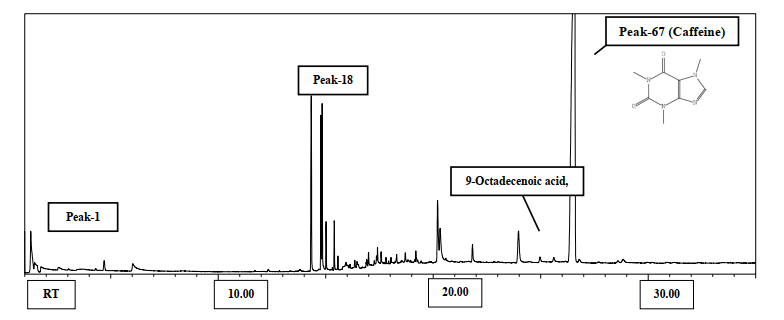
Robusta coffee is among the most plentiful varieties, although the utilisation of its foliage remains suboptimal. People belief that coffee leaves help reduce hypertension. The objective of this research was to identify volatile metabolites from robusta coffee foliage utilising GC-MS and this study will contribute to advances in the further development of natural phytopharmaceuticals. This study acts as a preliminary evaluation for the creation of herbal treatments derived from coffee leaves. The primary technique of GC-MS involves identifying volatile metabolites using molecular weight, retention time, and percentage area. The research employed maceration extraction over three days with a leaf sample ratio of 30 g to 300 mL of 96% methanol, chemical identification via GC-MS, and in silico bioactivity assessment using PASS Online. The results of GC-MS detection showed that robusta coffee leaf extract contained 73 metabolite compounds. Dominant compounds in coffee leaf extract included 2-Propanol, 1,1'-oxybis- (peak 18), 1-Propanol, 2-(2-hydroxypropoxy)- (peak 21), Butanedioic acid, monomethyl ester (peak 43), Benzofuran, 2,3-dihydro- (peak 46), Succinimide (peak 49), 5-Hydroxymethylfurfural (peak 50), Phenol, 4-ethenyl-2,6-dimethoxy- (peak 52), Phytol (peak 53), Catechol (peak 57), Niacin (peak 58), n-Hexadecanoic acid (peak 61), Hydroquinone (peak 63), 9-Octadecenoic acid, (E)- [Elaidic acid] (peak 65), Caffeiene (peak 67), 9,12-Octadecadienoic acid (Z,Z)- [linoeic acid] (peak 68), Xanthine, 1,3,7,8-tetramethyl- (peak 69), 9,12,15-Octadecatrienoic acid, (Z,Z,Z)- (peak 70), dan 1,3-Propanediol, 2-(hydroxymethyl)-2-nitro- (peak 71). The area percentage value of caffeine was 45.37%, and in silico bioactivity showed analeptic characteristics. This analysis could not match the phenomenon in Pakusari Village, where coffee leaves are antihypertensive.
References
A. M. Rodrigues, T. Jorge, S. Osorio, D. M. Pott, F. C. Lidon, F. M. DaMatta, I. Marques, A. I. Ribeiro-Barros, J. C. Ramalho, and C. António, “Primary metabolite profile changes in Coffea spp. promoted by single and combined exposure to drought and elevated CO2 concentration,” Metabolites, vol. 11, no. 7, p. 427, 2021, https://doi.org/10.3390/metabo11070427.
A. Kodape and A. Kodape, “Exploring coffee’s impact: Aflatoxins, phytochemicals, and public health considerations,” Food Biosci., vol. 61, p. 104991, 2024, https://doi.org/10.1016/j.fbio.2024.104991.
R. Novita, A. Kasim, T. Anggraini, and D. P. Putra, “Kahwa daun: Traditional knowledge of a coffee leaf herbal tea from West Sumatera, Indonesia,” J. Ethn. Foods, vol. 5, no. 4, pp. 286–291, 2018, https://doi.org/10.1016/j.jef.2018.11.005.
K. Zhang, J. Cheng, Q. Hong, W. Dong, X. Chen, G. Wu, and Z. Zhang, “Identification of changes in the volatile compounds of robusta coffee beans during drying based on HS-SPME/GC-MS and E-nose analyses with the aid of chemometrics,” Lwt Food Sci. Technol., vol. 161, p. 113317, 2022, https://doi.org/10.1016/j.lwt.2022.113317.
A. M. Farhan, D. Setyati, N. A. Gilani, M. Su’udi, and F. B. Ulum, “Phytochemistry profile and antioxidant activity of Dumortiera hirsuta (Sw.) Nees from Gumitir, East Java,” H A Y I J. Biosci., vol. 32, no. 6, 2025, https://doi.org/10.4308/hjb.32.6.1643-1653.
Y. M. El Dakroury, A. H. A. Zeid, A. A. El Hela, A. Temraz, and S. Reda, “GC-MS profiling , in-vitro antioxidant, anti-inflammatory, and anti-diabetic activities of petroleum ether extracts of Dypsis decaryi and Dypsis leptocheilos leaves cultivated in Egypt: Experimental and computational studies,” Azhar Int J Pharm, vol. 10, no. 10, 2024, https://doi.org/10.21608/aijpms.2022.69608.1058.
C. Arata, P. K. Misztal, Y. Tian, D. M. Lunderberg, K. Kristensen, A. Novoselac, M. E. Vance, D. K. Farmer, W. W. Nazaroff, and A. H. Goldstein, “Volatile organic compound emissions during HOMEChem,” Indoor Air, vol. 31, no. 6, pp. 2099–2117, 2021, https://doi.org/10.1111/ina.12906.
A. A. Assiry, S. K. Bhavikatti, F. A. Althobaiti, R. N. Mohamed, and M. I. Karobari, “Evaluation of in vitro antiprotease activity of selected traditional medicinal herbs in dentistry and its in silico PASS prediction,” Biomed Res. Int., vol. 2022, 2022, https://doi.org/10.1155/2022/5870443.
A. M. Farhan, W. Rosida, and F. B. Ulum, “In silico biological activity prediction of bioactive compounds from Dumortiera hirsuta (Sw.) Nees. using Way2Drug PASS online,” Life Sci. Biotechnol., vol. 3, no. 1, pp. 13–19, 2025, https://doi.org/https://doi.org/10.19184/lsb.v3i1.53690.
K. Lohidashan, M. Rajan, A. Ganesh, M. Paul, and J. Jerin, “Pass and Swiss ADME collaborated in silico docking approach to the synthesis of certain pyrazoline spacer compounds for dihydrofolate reductase inhibition and antimalarial activity,” Bangladesh J. Pharmacol., vol. 13, no. 1, pp. 23–29, 2018, https://doi.org/10.3329/bjp.v13i1.33625.
Y. Koshiro, M. C. Jackson, R. Katahira, M. L. Wang, C. Nagai, and H. Ashihara, “Biosynthesis of chlorogenic acids in growing and ripening fruits of Coffea arabica and Coffea canephora plants,” Zeitschrift fur Naturforsch. - Sect. C J. Biosci., vol. 62, no. 9–10, pp. 731–742, 2007, https://doi.org/10.1515/znc-2007-9-1017.
C. F. Tsai and I. P. J. Jioe, “The analysis of chlorogenic acid and caffeine content and its correlation with coffee bean color under different roasting degree and sources of coffee (Coffea arabica Typica),” Processes, vol. 9, no. 11, 2021, https://doi.org/10.3390/pr9112040.
A. Ali, H. F. Zahid, J. J. Cottrell, and F. R. Dunshea, “A comparative study for nutritional and phytochemical profiling of Coffea arabica (C. arabica) from different origins and their antioxidant potential and molecular docking,” Mol. mdpi, vol. 5126, no. 27, 2022, https://doi.org/10.3390/molecules27165126.
Y. Maxiselly, P. Anusornwanit, A. Rugkong, R. Chiarawipa, and P. Chanjula, “Morpho-physiological traits, phytochemical composition, and antioxidant activity of canephora coffee leaves at various stages,” Int. J. Plant Biol., vol. 13, no. 2, pp. 106–114, 2022, https://doi.org/10.3390/ijpb13020011.
F. B. Ulum, Y. A. Putri, A. M. Farhan, D. Setyati, R. Rajamani, B. Sugiharto, and M. Su’udi, “Phytochemical and pharmacological evaluation of Vanda tricolor from Gumitir, East Java, Indonesia,” Biodiversitas, vol. 26, no. 9, pp. 4783–4792, 2025, https://doi.org/10.13057/biodiv/d260947.
F. B. Ulum, D. Setyati, M. I. A. Rizqoni, and M. Su’udi, “Antimicrobial and phytochemistry study of Liparis resupinata Ridl. from Mount Gumitir, East Java, Indonesia,” JPSCR J. Pharm. Sci. Clin. Res., vol. 8, no. 3, p. 373, 2023, https://doi.org/10.20961/jpscr.v8i3.70856.
D. Setyati, M. Su’udi, E. S. Ravitamala, F. F. Miladina, B. Babudin, E. Utarti, S. Arimurti, A. S. Nugraha, Y. A. Putri, A. M. Farhan, and F. B. Ulum, “Antimicrobial and phytochemistry study of Dendrobium linearifolium Teijsm. & Binn. from Gumitir, Jember, Indonesia,” BIO Web Conf., vol. 101, pp. 1–12, 2024, https://doi.org/10.1051/bioconf/202410101001.
A. M. Farhan, “Pharmacological prediction of Marchantia polymorpha: GC-MS and molecular docking approaches,” Bioeksperimen J. Penelit. Biol., vol. 12, no. 1, pp. 14–30, 2026, https://doi.org/10.23917/bioeksperimen.v12i1.15983.
Y. R. Amalini, K. Muzakhar, M. Su’udi, D. Setyati, E. F. Dwinianti, and F. B. Ulum, “Morphological, molecular, and phytochemical characteristics of wild edible fern (Diplazium esculentum) from Jember, East Java, Indonesia,” Biodiversitas, vol. 26, no. 6, pp. 2794–2805, 2025, https://doi.org/10.13057/biodiv/d260624.
S. Subramanian, M. J. H. Dowlath, S. K. Karuppannan, M. Saravanan, and K. D. Arunachalam, “Effect of solvent on the phytochemical extraction and gc-ms analysis of gymnema sylvestre,” Pharmacogn. J., vol. 12, no. 4, pp. 749–761, 2020, https://doi.org/10.5530/pj.2020.12.108.
A. Jurinjak Tušek, D. Šamec, and A. Šalić, “Modern techniques for flavonoid extraction-to optimize or not to optimize?,” Appl. Sci., vol. 12, no. 22, 2022, https://doi.org/10.3390/app122211865.
M. Butnariu and N.-S. Bocso, “The biological role of primary and secondary plants metabolites,” Nutr. Food Process., vol. 5, no. 3, pp. 01–07, 2022, https://doi.org/10.31579/2637-8914/094.
I. I. Ilmiah, F. F. Mufidi, E. Taruna, R. Perkasa, C. Dzaky, P. Isdarmanto, M. H. Shodiq, A. H. Shodiq, and A. M. Farhan, “Chemical profiling of locally grown Zingiber officinale Roscoe (Ginger) rhizomes using GC-MS and biological activities,” vol. 3, no. 1, pp. 1–5, 2025, https://doi.org/10.19184/lsb.v3i1.53645.
M. F. Lemos, N. de Andrade Salustriano, M. M. de Souza Costa, K. Lirio, A. F. A. da Fonseca, H. P. Pacheco, D. C. Endringer, M. Fronza, and R. Scherer, “Chlorogenic acid and caffeine contents and anti-inflammatory and antioxidant activities of green beans of conilon and arabica coffees harvested with different degrees of maturation,” J. Saudi Chem. Soc., vol. 26, no. 3, 2022, https://doi.org/10.1016/j.jscs.2022.101467.
H. Ashihara, A. M. Monteiro, F. M. Gillies, A. Crozier, H. Ashiharal, A. M. Monteiro, F. M. Gillies, and A. Crozier, “Biosynthesis of caffeine in leaves of coffee,” vol. 111, no. 3, pp. 747–753, 2016, https://doi.org/10.1104/pp.111.3.747.
Y. Zhang, J. Fu, Q. Zhou, F. Li, Y. Shen, Z. Ye, D. Tang, N. Chi, L. Li, S. Ma, M. A. Inayat, T. Guo, J. Zhao, and P. Li, “Metabolite profiling and transcriptome analysis revealed the conserved transcriptional regulation mechanism of caffeine biosynthesis in tea and coffee plants,” J. Agric. Food Chem., vol. 70, no. 10, pp. 3239–3251, 2022, https://doi.org/10.1021/acs.jafc.1c06886.
E. S. Siker, K. Mustafa, and B. Wolfson, “The analeptic effects of doxapram hydrochloride on thiopentone induced depression,” Br. J. Anaesth., vol. 36, no. 4, pp. 216–223, 1964, https://doi.org/10.1093/bja/36.4.216.
J. F. Peppin, J. V. Pergolizzi, J. Fudin, T. A. Meyer, and R. B. Raffa, “History of respiratory stimulants,” J. Pain Res., vol. 14, pp. 1043–1049, 2021, https://doi.org/10.2147/JPR.S298607.
J. C. La Rosa, “Understanding risk in hypercholesterolemia,” Clin. Cardiol., vol. 26, no. 1 SUPPL. 1, 2003, https://doi.org/10.1002/clc.4960261303.
Y. Song, J. Liu, K. Zhao, L. Gao, and J. Zhao, “Cholesterol-induced toxicity: An integrated view of the role of cholesterol in multiple diseases,” Cell Metab., vol. 33, no. 10, pp. 1911–1925, 2021, https://doi.org/10.1016/j.cmet.2021.09.001.
L. Pérez De Isla, G. F. Watts, R. Alonso, J. L. Díaz-Díaz, O. Muñiz-Grijalvo, D. Zambón, F. Fuentes, R. De Andrés, T. Padró, J. López-Miranda, and P. Mata, “Lipoprotein(a), LDL-cholesterol, and hypertension: Predictors of the need for aortic valve replacement in familial hypercholesterolaemia,” Eur. Heart J., vol. 42, no. 22, pp. 2201–2211, 2021, https://doi.org/10.1093/eurheartj/ehaa1066.
X. Yang, H. Han, Z. He, and M. Jia, “Octacosanol: A natural bioactive ingredient for atherosclerosis prevention and cardiovascular health promotion,” Molecules, vol. 31, no. 14, p. 2451, 2026, https://doi.org/10.3390/molecules31142451.
K. Fibrianto, A. ‘izza, E. Martati, and I. A. Bimo, “The potentials of Robusta (Coffea robusta L.) and Arabica (Coffea arabica L.) coffee leaf by-product as anti-diabetic drinks,” Canrea J. Food Technol. Nutr. Culin. J., vol. 6, no. 2, pp. 154–166, 2023, https://doi.org/10.20956/canrea.v6i2.974.
A. S. Al-Goblan, M. A. Al-Alfi, and M. Z. Khan, “Mechanism linking diabetes mellitus and obesity,” Diabetes, Metab. Syndr. Obes., vol. 7, pp. 587–591, 2014, https://doi.org/10.2147/DMSO.S67400.
Y. A. Jeon, P. Natraj, S. C. Kim, J. K. Moon, and Y. J. Lee, “Comparative analysis of phytochemical and functional profiles of arabica coffee leaves and green beans across different cultivars,” Foods, vol. 13, no. 23, 2024, https://doi.org/10.3390/foods13233744.
R. Bollen, O. Rojo-Poveda, L. Verleysen, R. Ndezu, E. A. Tshimi, H. Mavar, T. Ruttink, O. Honnay, P. Stoffelen, C. Stévigny, F. Souard, and C. Delporte, “Metabolite profiles of green leaves and coffee beans as predictors of coffee sensory quality in Robusta (Coffea canephora) germplasm from the Democratic Republic of the Congo,” Appl. Food Res., vol. 4, no. 2, 2024, https://doi.org/10.1016/j.afres.2024.100560.
M. Muchtaridi, D. Lestari, N. K. K. Ikram, A. M. Gazzali, M. Hariono, and H. A. Wahab, “Decaffeination and neuraminidase inhibitory activity of arabica green coffee (Coffea arabica) beans: Chlorogenic acid as a potential bioactive compound,” Molecules, vol. 26, no. 11, pp. 1–11, 2021, https://doi.org/10.3390/molecules26113402.
J. Huang, M. Xie, L. He, X. Song, and T. Cao, “Chlorogenic acid: a review on its mechanisms of anti-inflammation, disease treatment, and related delivery systems,” Front. Pharmacol., vol. 14, no. September, pp. 1–10, 2023, https://doi.org/10.3389/fphar.2023.1218015.
S. Patil, M. Das, G. S. Kumar, and P. S. Murthy, “Coffee leaf extract exhibits anti-obesity property and improves lipid metabolism in high-fat diet-induced C57BL6 obese mice,” 3 Biotech, vol. 13, no. 8, p. 278, 2023, https://doi.org/10.1007/s13205-023-03698-6.
E. Yohannis, T. A. Teka, J. A. Adebo, M. M. Urugo, A. Hossain, and T. Astatkie, “Phytochemical constituents, ethnomedicinal uses, and applications of coffee (Coffea arabica) leaves in functional beverages,” J. Food Compos. Anal., vol. 135, p. 106570, 2024, https://doi.org/10.1016/j.jfca.2024.106570.
Downloads
Published
Issue
Section
License
Copyright (c) 2026 Abdillah Maulana Farhan, Putri Aisiyya Qutlana Munawaroh

This work is licensed under a Creative Commons Attribution-ShareAlike 4.0 International License.
Authors who publish with the Journal of Agri-food Science and Technology (JAFOST) agree to the following terms:
- Authors retain copyright and grant the journal right of first publication with the work simultaneously licensed under a Creative Commons Attribution License (CC BY-SA 4.0) that allows others to share the work with an acknowledgment of the work's authorship and initial publication in this journal.
- Authors are able to enter into separate, additional contractual arrangements for the non-exclusive distribution of the journal's published version of the work (e.g., post it to an institutional repository or publish it in a book), with an acknowledgment of its initial publication in this journal.
- Authors are permitted and encouraged to post their work online (e.g., in institutional repositories or on their website) prior to and during the submission process, as it can lead to productive exchanges, as well as earlier and greater citation of published work.