Optimization of Vitamin C and Antioxidant Activity in Jelly Candies through the Addition of Tomato Juice and Red Guava
DOI:
https://doi.org/10.12928/jafost.v7i2.14787Keywords:
Antioxidants, Guava, Gummy, Tomato, Vitamin CAbstract
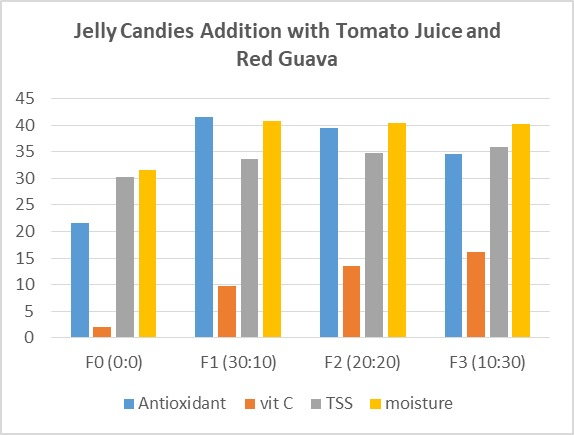
Adding functional foods to confectionery can increase children's nutritional intake. Gummy candy is a type of confectionery that children enjoy. It contains high sugar but low nutritional value. The innovation of adding fruit extracts rich in vitamin C and antioxidants from abundant local foods, such as tomatoes and red guava, was expected to improve the gummy candy's chemical properties. This research contributes to improving the chemical characteristics and sensory acceptability of gummy candy by adding tomato and red guava extract. The ingredients are tomato and red guava juice, gelatin, high-fructose syrup, sucrose, and citric acid. Treatments Formula F0, F1, F2, and F3 received 0, 10, 30, and 30% tomato juice and 0, 10, 20, and 30% red guava. The results of sensory testing showed that the panelists preferred the F3 gummy candy formulation. Chemical characteristics show that the addition of red guava extract increases the moisture content, vitamin C, antioxidants, and total soluble solids. In F0, the moisture content was 31.14%, vitamin C 0.21 mg, antioxidant activity 21.63%, and total soluble solids 30.17 mg/L. The optimal treatment at F3 produced a moisture content of 40.19%, total soluble solids of 35.83 oBrix, antioxidant activity of 34.56%, and vitamin C of 1.61 mg. Adding tomato and red guava juice to gummy sweets can increase their vitamin C and antioxidant content. Gummy candy is a nutritious food that tastes good and has enough vitamin C and antioxidants for people to consume.
References
C. Elliott, E. Truman, and J. E. Black, “Tracking teen food marketing: Participatory research to examine persuasive power and platforms of exposure,” Appetite, vol. 186, p. 106550, 2023, https://doi.org/10.1016/j.appet.2023.106550.
L.-H. Pan, C.-L. Wu, S.-Z. Luo, J.-P. Luo, Z. Zheng, S.-T. Jiang, Y.-Y. Zhao, and X.-Y. Zhong, “Preparation and characteristics of sucrose-resistant emulsions and their application in soft candies with low sugar and high lutein contents and strong antioxidant activity,” Food Hydrocoll., vol. 129, p. 107619, 2022, https://doi.org/10.1016/j.foodhyd.2022.107619.
H. Gómez-Llorente, M. D. Ortolá, I. Fernández-Segovia, J. M. Barat, and É. Pérez-Esteve, “Reformulating gummy candies with carob flour: A nutritional strategy to enhance bioactive compounds and functional properties,” Food Hydrocoll. Heal., vol. 9, p. 100262, 2026, https://doi.org/10.1016/j.fhfh.2025.100262.
P. Jaglan, H. S. Buttar, O. A. Al-bawareed, and S. Chibisov, “Potential health benefits of selected fruits: Apples, blueberries, grapes, guavas, mangos, pomegranates, and tomatoes,” Functional Foods and Nutraceuticals in Metabolic and Non-Communicable Diseases, Elsevier, 2022, pp. 359–370. https://doi.org/10.1016/B978-0-12-819815-5.00026-4.
J. F. S. Neto, S. de S. Khan, C. A. de A. Filho, A. G. de C. Neto, A. G. Torres, and E. P. P. Azevedo, “Photostability of vitamin C in industrialized fruit juices and isomers determination by HPLC-DAD,” J. Chromatogr. Open, vol. 4, p. 100103, 2023, https://doi.org/10.1016/j.jcoa.2023.100103.
M. Gandhi, O. Elfeky, H. Ertugrul, H. K. Chela, and E. Daglilar, “Scurvy: Rediscovering a forgotten disease,” Diseases, vol. 11, no. 2, p. 78, 2023, https://doi.org/10.3390/diseases11020078.
Z. Li and F. Yu, “Recent advances in lycopene for food preservation and shelf-life extension,” Foods, vol. 12, no. 16, p. 3121, 2023, https://doi.org/10.3390/foods12163121.
B. G. Nabi, K. Mukhtar, W. Ahmed, M. F. Manzoor, M. M. A. N. Ranjha, M. Kieliszek, Z. F. Bhat, and R. M. Aadil, “Natural pigments: Anthocyanins, carotenoids, chlorophylls, and betalains as colorants in food products,” Food Biosci., vol. 52, p. 102403, 2023, https://doi.org/10.1016/j.fbio.2023.102403.
M. S. Islam, M. S. Rahman, M. Khatun, M. Hajibeigy, M. N. Uddin, and M. M. Khatun, “Extraction of organic pigments from tomato (Solanum lycopersicum L.), turmeric (Curcuma longa L.) and red amaranth (Amaranthus tricolor L.) for safe use in agro-products,” Heliyon, vol. 10, no. 3, p. e25278, 2024, https://doi.org/10.1016/j.heliyon.2024.e25278.
E. Butt, A. B. Altemimi, A. Younas, M. S. Butt, M. Jalal, M. Bhatty, G. Abdi, and R. M. Aadil, “Guava (Psidium guajava): A brief overview of its therapeutic and health potential,” Food Chem. X, vol. 31, p. 103027, 2025, https://doi.org/10.1016/j.fochx.2025.103027.
A. Yadav, N. Kumar, A. Upadhyay, O. A. Fawole, M. K. Mahawar, K. Jalgaonkar, D. Chandran, S. Rajalingam, G. Zengin, M. Kumar, and M. Mekhemar, “Recent advances in novel packaging technologies for shelf-life extension of guava fruits for retaining health benefits for longer duration,” Plants, vol. 11, no. 4, p. 547, 2022, https://doi.org/10.3390/plants11040547.
L. Xu, M. Pan, X. Cheng, Z. Liu, B. Pang, R. Zhang, Y. Liu, and Q. Wang, “Comparative analysis of the aroma characteristics of three different cultivars of guavas under different storage conditions using HS-SPME-GC–MS and HS-GC-IMS,” Food Chem. X, vol. 31, p. 103193, 2025, https://doi.org/10.1016/j.fochx.2025.103193.
Z. Yang, Z. Feng, J. Bi, Z. Zhang, Y. Jiang, T. Yang, and Z. Zhang, “Characterization of key aroma compounds of tomato quality under enriched CO2 coupled with water and nitrogen based on E-nose and GC–MS,” Sci. Hortic. (Amsterdam)., vol. 338, p. 113709, 2024, https://doi.org/10.1016/j.scienta.2024.113709.
Z. Hu, Y. He, S. Gu, W. He, P. Zhan, G. Fan, H. Tian, H. Wei, and P. Wang, “Machine learning-assisted aroma profile prediction in tomato puree based on flavoromics,” Food Chem., vol. 496, p. 146915, 2025, https://doi.org/10.1016/j.foodchem.2025.146915.
W. P. Mohr, “Colour retention of ‘high colour’ lines of tomatoes canned as juice,” Can. Inst. Food Sci. Technol. J., vol. 9, no. 1, pp. 20–24, 1976, https://doi.org/10.1016/S0315-5463(76)73587-9.
Hasneli, Safyanti, and A. Mardhiyah, “The effectivity of tomato and guava combination juice and guava juice administration on blood glucose level in patients with type II diabetes mellitus,” KnE Life Sci., vol. 2019, pp. 74–81, 2019, https://doi.org/10.18502/kls.v4i15.5739.
M. I. Tousif, M. Nazir, M. Saleem, S. Tauseef, N. Shafiq, L. Hassan, H. Hussian, D. Montesano, D. Naviglio, G. Zengin, and I. Ahmad, “Psidium guajava L. an incalculable but underexplored food crop: Its phytochemistry, ethnopharmacology, and industrial applications,” Molecules, vol. 27, no. 20, p. 7016, 2022, https://doi.org/10.3390/molecules27207016.
B. Choi and Y. Shin, “Comparative analysis of physicochemical characteristics, antioxidant compound contents, and antioxidant activities of five guava (Psidium guajava L.) cultivars harvested in Korea,” Foods, vol. 14, no. 21, p. 3645, 2025, https://doi.org/10.3390/foods14213645.
W. Maeaba, P. Singh, and S. Prasad, “Development of method for simultaneous determination of water-soluble vitamins (B2, B3, B6, B9 and C) in guava (Psidium guineense) fruit by HPLC-photodiode array detection,” J. Food Compos. Anal., vol. 144, p. 107569, 2025, https://doi.org/10.1016/j.jfca.2025.107569.
J. Zhang, Y. Zhang, S. Zou, E. Yang, Z. Lei, T. Xu, and C. Feng, “Characterization of the aroma and flavor profiles of guava fruit (Psidium guajava) during developing by HS-SPME-GC/MS and RNA sequencing,” Food Chem. Mol. Sci., vol. 9, p. 100228, 2024, https://doi.org/10.1016/j.fochms.2024.100228.
B. S. Kalsi, S. Singh, M. S. Alam, and S. Bhatia, “Application of thermosonication for guava juice processing: Impacts on bioactive, microbial, enzymatic and quality attributes,” Ultrason. Sonochem., vol. 99, p. 106595, 2023, https://doi.org/10.1016/j.ultsonch.2023.106595.
M. Romero-Martínez, R. Andrade-Pizarro, and C. De Paula, “Functional compounds in tropical fruit processing by-products and intrinsic factors affecting their composition: A review,” Curr. Res. Food Sci., vol. 10, p. 101028, 2025, https://doi.org/10.1016/j.crfs.2025.101028.
A. Cendrowski, J. L. Przybył, and M. Studnicki, “Physicochemical characteristics, vitamin C, total polyphenols, antioxidant capacity, and sensory preference of mixed juices prepared with rose fruits (Rosa rugosa) and apple or strawberry,” Appl. Sci., vol. 14, no. 1, p. 113, 2023, https://doi.org/10.3390/app14010113.
S. N. Rahmadhia, R. S. Dewi, and S. K. Putri, “Physicochemical properties of ambarella fruit leather with variations in gum arab concentration,” J. Keteknikan Pertan., vol. 13, no. 4, pp. 627–641, 2026, https://doi.org/10.19028/jtep.013.4.627-641.
R. Apriadi, K. Sari, M. Racmawati, M. R. N. Fauzan, and M. Rohmah, “Evaluation of antioxidant activity in traditional Indonesian herbal medicine (jamu) using ABTS and DPPH testing methods,” J. Agri-Food Sci. Technol., vol. 6, no. 4, pp. 219–227, 2025, https://doi.org/10.12928/jafost.v6i4.13005.
A. A. Mahmoud, A. A. Owayss, J. Iqbal, and H. S. A. Raweh, “Modified equations to calculate water content and refractive index of honey based on its total soluble solids,” J. Food Eng. Technol., vol. 12, no. 1, pp. 29–33, 2023, https://doi.org/10.32732/jfet.2023.12.1.29.
E. Sulastri, M. Ikram, and Y. Yuliet, “Stability test and antioxidant activity of tomato lycopene (Solanum lycopersicum L.) microemulsion,” J. Farm. Galen. (Galenika J. Pharmacy), vol. 3, no. 1, p. 10, 2017, https://doi.org/10.22487/j24428744.2017.v3.i1.8134.
Z. Berk, “Chapter 1 - Physical properties of food materials,” in Food Science and Technology, Z. B. T.-F. P. E. and T. Third E. Berk, Ed., Academic Press, 2018, pp. 1–29. https://doi.org/10.1016/B978-0-12-812018-7.00001-4.
S. Fatima and V. Kumar, “Sustainable valorization of amla pomace: Optimization of a sweetmeat using the fuzzy logic approach and its quality characterization,” Sustain. Food Technol., vol. 3, no. 5, pp. 1542–1555, 2025, https://doi.org/10.1039/d4fb00301b.
T. Motlhalamme, A. G. Kaningini, R. Maropeng, F. T. Thema, K. C. Mohale, and M. Maaza, “Tomato lycopene, total flavonoids, vitamin C content and mineral composition as affected by biosynthesized calcium carbonate nanoparticles foliar application,” J. Food Compos. Anal., vol. 139, p. 107173, 2025, https://doi.org/10.1016/j.jfca.2024.107173.
X. Yin, K. Chen, H. Cheng, X. Chen, S. Feng, Y. Song, and L. Liang, “Chemical stability of ascorbic acid integrated into commercial products: A review on bioactivity and delivery technology,” Antioxidants, vol. 11, no. 1, p. 153, 2022, https://doi.org/10.3390/antiox11010153.
S. Lee, Y. Choi, H. S. Jeong, J. Lee, and J. Sung, “Effect of different cooking methods on the content of vitamins and true retention in selected vegetables.,” Food Sci. Biotechnol., vol. 27, no. 2, pp. 333–342, 2018, https://doi.org/10.1007/s10068-017-0281-1.
Z. Fartoosi, M. Kolahi, F. Heidarizadeh, and A. Goldson-Barnaby, “The impact of thermal and non-thermal processing on the phytochemical characteristics and nutritional value of Daucus carota (carrots),” Appl. Food Res., vol. 5, no. 1, p. 100732, 2025, https://doi.org/10.1016/j.afres.2025.100732.
K. M. Phillips, M. Council-Troche, R. C. McGinty, A. S. Rasor, and M. T. Tarrago-Trani, “Stability of vitamin C in fruit and vegetable homogenates stored at different temperatures,” J. Food Compos. Anal., vol. 45, pp. 147–162, 2016, https://doi.org/10.1016/j.jfca.2015.09.008.
Z. Kotíková, J. Lachman, A. Hejtmánková, and K. Hejtmánková, “Determination of antioxidant activity and antioxidant content in tomato varieties and evaluation of mutual interactions between antioxidants,” LWT - Food Sci. Technol., vol. 44, no. 8, pp. 1703–1710, 2011, https://doi.org/10.1016/j.lwt.2011.03.015.
Y. Jiang, J. Ye, Y. Hu, J. Zhang, W. Li, X. Zhou, M. Yu, Y. Yu, J. Yang, W. Yang, J. Jiang, J. Cui, and Y. Hu, “Extraction and synthesis of typical carotenoids: Lycopene, β-carotene, and astaxanthin,” Molecules, vol. 29, no. 19, p. 4549, 2024, https://doi.org/10.3390/molecules29194549.
M. Y. Ali, A. A. I. Sina, S. S. Khandker, L. Neesa, E. M. Tanvir, A. Kabir, M. I. Khalil, and S. H. Gan, “Nutritional composition and bioactive compounds in tomatoes and their impact on human health and disease: A review,” Foods, vol. 10, no. 1, p. 45, 2020, https://doi.org/10.3390/foods10010045.
A. Vojvodić Cebin, M. Bunić, A. Mandura Jarić, D. Šeremet, and D. Komes, “Physicochemical and sensory stability evaluation of gummy candies fortified with mountain germander extract and prebiotics,” Polymers (Basel)., vol. 16, no. 2, p. 259, 2024, https://doi.org/10.3390/polym16020259.
S. M. Vanmathi, M. Monitha Star, N. Venkateswaramurthy, and R. Sambath Kumar, “Preterm birth facts: A review,” Res. J. Pharm. Technol., vol. 12, no. 3, pp. 1383–1390, 2019, https://doi.org/10.5958/0974-360X.2019.00231.2.
M. Roudbari, M. Barzegar, M. A. Sahari, and H. A. Gavlighi, “Formulation of functional gummy candies containing natural antioxidants and stevia,” Heliyon, vol. 10, no. 11, p. e31581, 2024, https://doi.org/10.1016/j.heliyon.2024.e31581.
P. Swapnil, M. Meena, S. K. Singh, U. P. Dhuldhaj, Harish, and A. Marwal, “Vital roles of carotenoids in plants and humans to deteriorate stress with its structure, biosynthesis, metabolic engineering and functional aspects,” Curr. Plant Biol., vol. 26, p. 100203, 2021, https://doi.org/10.1016/j.cpb.2021.100203.
T. Tufail, H. Bader Ul Ain, S. Noreen, A. Ikram, M. T. Arshad, and M. A. Abdullahi, “Nutritional benefits of lycopene and beta‐carotene: A comprehensive overview,” Food Sci. Nutr., vol. 12, no. 11, pp. 8715–8741, 2024, https://doi.org/10.1002/fsn3.4502.
J. Liu, Y. Niu, J. Zhu, R. Zhou, Z. Guo, Z. Miao, Q. Lu, Y. Yu, J. Zhang, Z. Xiao, and Q. Xiao, “Sweetness enhancement and mechanism by sweet aroma compounds in the sucrose solution using sensory, electronic tongue, molecular docking, and molecular dynamics simulation,” Food Chem. X, vol. 35, p. 103753, 2026, https://doi.org/10.1016/j.fochx.2026.103753.
D. Radványi, L. Csambalik, D. Szakál, and A. Gere, “Identification of cherry tomato volatiles using different electron ionization energy levels,” Molecules, vol. 29, no. 23, p. 5567, 2024, https://doi.org/10.3390/molecules29235567.
N. Dragomir, D.-M. Grigore, and E. N. Pogurschi, “Beyond sugar: A holistic review of sweeteners and their role in modern nutrition,” Foods, vol. 14, no. 18, p. 3182, 2025, https://doi.org/10.3390/foods14183182.
K. S. Gill, “Guavas,” in Encyclopedia of Food and Health, Elsevier, 2016, pp. 270–277. https://doi.org/10.1016/B978-0-12-384947-2.00363-9.
N. S. Said, I. F. Olawuyi, and W. Y. Lee, “Pectin hydrogels: Gel-forming behaviors, mechanisms, and food applications.,” Gels (Basel, Switzerland), vol. 9, no. 9, 2023, https://doi.org/10.3390/gels9090732.
Y. Liu, W. Qu, Y. Liu, and H. Ma, “Chemical, structural and functional properties of pectin from tomato pulp under different peeling methods,” Food Chem., vol. 403, p. 134373, 2023, https://doi.org/10.1016/j.foodchem.2022.134373.
A. S. Formiga, E. M. Pereira, J. S. P. Junior, F. B. Costa, and B.-H. Mattiuz, “Effects of edible coatings on the quality and storage of early harvested guava,” Food Chem. Adv., vol. 1, p. 100124, 2022, https://doi.org/10.1016/j.focha.2022.100124.
Y. Zhang, H. He, S. Feng, J. Bi, X. Huang, J. Xiong, L. Chen, H. Chen, X. Li, L. Chen, J. Sun, and K. Liu, “Effect of grapefruit peel pectin on the structure, pasting characteristics, and in vitro digestibility of starch under different moisture content and temperature,” Int. J. Biol. Macromol., vol. 307, p. 142284, 2025, https://doi.org/10.1016/j.ijbiomac.2025.142284.
Downloads
Published
Issue
Section
License
Copyright (c) 2026 Fitriyah Zulfa, Alfi Nur Rochmah, Yenny Febriana Ramadhan Abdi, Dininurilmi Putri Suleman, Dini Nadhilah, Prajwalita Rukmakharisma Rizki, Dea Yoana Putri

This work is licensed under a Creative Commons Attribution-ShareAlike 4.0 International License.
Authors who publish with the Journal of Agri-food Science and Technology (JAFOST) agree to the following terms:
- Authors retain copyright and grant the journal right of first publication with the work simultaneously licensed under a Creative Commons Attribution License (CC BY-SA 4.0) that allows others to share the work with an acknowledgment of the work's authorship and initial publication in this journal.
- Authors are able to enter into separate, additional contractual arrangements for the non-exclusive distribution of the journal's published version of the work (e.g., post it to an institutional repository or publish it in a book), with an acknowledgment of its initial publication in this journal.
- Authors are permitted and encouraged to post their work online (e.g., in institutional repositories or on their website) prior to and during the submission process, as it can lead to productive exchanges, as well as earlier and greater citation of published work.