Application of Pulsed Electric Field (PEF) for Improving the Quality of MSME Tomato Sauce: A Comprehensive Pre- and Post-Treatment Analysis
DOI:
https://doi.org/10.12928/jafost.v7i3.14764Keywords:
Microbiological safety, Non-thermal processing, Pulsed electric field, Sensory quality, Tomato sauceAbstract
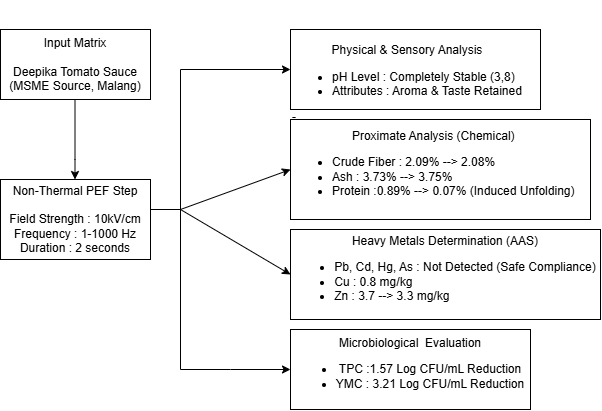
The increasing demand for high-quality, minimally processed foods has driven interest in non-thermal technologies such as pulsed electric field (PEF). This study evaluated the effect of PEF treatment on Deepika tomato sauce produced by micro, small, and medium enterprises (MSME) in Malang, Indonesia. Samples were divided into control and PEF-treated groups. PEF was applied at 10 kV/cm, with pulse frequencies of 1–1000 Hz for approximately 2 seconds. pH, aroma, taste, proximate composition, heavy metals, and microbiological quality were compared before and after treatment. The pH remained 3.8, while the characteristic tomato aroma and taste were retained. Crude fiber changed from 2.09% to 2.08%, ash from 3.73% to 3.75%, carbohydrate from 26.40% to 23.34%, protein from 0.89% to 0.07%, and crude fat from 8.66% to 8.40%. Pb, Cd, Hg, and As were not detected. Cu remained 0.8 mg/kg and Zn changed from 3.7 to 3.3 mg/kg. TPC decreased from 3.4 × 10⁴ to 9.2 × 10² CFU/mL (1.57 log reduction), while YMC decreased from 6.2 × 10⁴ to 3.8 × 10¹ CFU/mL (3.21 log reduction). This study contributes to provide an integrated pre- and post-treatment assessment of PEF applied to an MSME-scale viscous tomato sauce in Indonesia, linking sensory, nutritional, heavy-metal, and microbiological quality within one evaluation framework. The findings support further optimization of PEF parameters for small-scale tomato-sauce processing.
References
Nithya C, “Advances and opportunities of pulsed electric field technology for preservation of fruit juices and beverages: A comprehensive review,” Madras Agric. J., vol. 112, no. 4–6, pp. 67–76, 2025, https://doi.org/10.29321/maj.10.701212.
S. Fabroni, G. M. Platania, M. Amenta, G. Ballistreri, F. Galvano, I. A. Nges, and N. Timpanaro, “Pulsed electric field as a mild treatment for extended shelf-life and preservation of bioactive compounds in blood orange juice,” Appl. Sci., vol. 14, no. 16, 2024, https://doi.org/ 10.3390/app14167275.
B. Yan, J. Li, Q.-C. Liang, Y. Huang, S.-L. Cao, L.-H. Wang, and X.-A. Zeng, “From laboratory to industry: The evolution and impact of pulsed electric field technology in food processing,” Food Reviews International, vol. 41, no. 2, pp. 373–398, 2025, https://doi.org/10.1080/87559129.2024.2401433.
L.-H. Wang, Y. Hu, X.-A. Zeng, R. Wang, and F. Xu, “Pulsed electric field technology in fruit and vegetable products processing: A non-thermal path to preserving quality and enhancing efficiency,” J. Futur. Foods, 2026, https://doi.org/10.1016/j.jfutfo.2026.05.007.
A. Taha, F. Casanova, P. Šimonis, V. Stankevič, M. A. E. Gomaa, and A. Stirkė, “Pulsed electric field: Fundamentals and effects on the structural and techno-functional properties of dairy and plant proteins,” Foods, vol. 11, no. 11, p. 1556, 2022, https://doi.org/10.3390/foods11111556.
I. P. C. Brito and E. K. Silva, “Pulsed electric field technology in vegetable and fruit juice processing: A review,” Food Research International, vol. 184, p. 114207, 2024, https://doi.org/10.1016/j.foodres.2024.114207.
S. K. Khojasteh, A. Elmizadeh, M. Sarraf, and S. Dodange, “Non-thermal innovations in solid food processing: Eco-friendly alternatives to thermal methods,” Appl. Food Res., vol. 5, no. 2, 2025, https://doi.org/10.1016/j.afres.2025.101256.
A. Thamsuaidee, A. Silva, P.-L. P. Gialouris, P. Lekka, M. E. Dasenaki, J. Ewert, A. Schwartz, C. Rocha, R. C. Lima, D. Frickhofen, L. Methven, N. S. Thomaidis, S. Toepfl, C. Siemer, L. M. Cunha, et al., “How pulsed electric field (PEF) processing shapes consumer acceptance and physicochemical properties of oat beverages,” Futur. Foods, vol. 14, p. 101108, 2026, https://doi.org/10.1016/j.fufo.2026.101108.
Y. Liu, L. Li, M. Fan, Z. Ni, R. Ma, Z. Wei, and K. Thakur, “Induced electric field processing of watermelon juice: Effects on microbial inactivation, physicochemical stability, and flavor retention during refrigerated storage,” Foods, vol. 15, no. 8, pp. 1–15, 2026, https://doi.org/10.3390/foods15081426.
A. Šalaševičius, M. Simonis, R. Vaitkevičienė, and R. Stankevičius, “Effect of pulsed electric field (PEF) on bacterial viability and whey protein in the processing of raw milk,” Applied Sciences, vol. 11, no. 23, p. 11281, 2021, https://doi.org/10.3390/app112311281.
H. Zia, A. Slatnar, T. Košmerl, and M. Korošec, “A review study on the effects of thermal and non-thermal processing techniques on the sensory properties of fruit juices and beverages,” Front. Food Sci. Technol., vol. 4, pp. 1–23, 2024, https://doi.org/10.3389/frfst.2024.1405384.
L. M. Rábago-Panduro, M. Morales-de la Peña, M. P. Romero-Fabregat, O. Martín-Belloso, and J. Welti-Chanes, “Effect of pulsed electric fields (PEF) on extraction yield and stability of oil obtained from dry pecan nuts (Carya illinoinensis (Wangenh.) K. Koch),” Foods, vol. 10, no. 7, p. 1541, 2021, https://doi.org/10.3390/foods10071541.
S. Kanafusa, E. Uhlig, K. Uemura, F. Gómez Galindo, and Å. Håkansson, “The effect of nanosecond pulsed electric field on the production of metabolites from lactic acid bacteria in fermented watermelon juice,” Innov. Food Sci. Emerg. Technol., vol. 72, 2021, https://doi.org/10.1016/j.ifset.2021.102749.
M. Al-Khalili, P. B. Pathare, S. Rahman, and N. Al-Habsi, “Aroma compounds in food: Analysis, characterization and flavor perception,” Meas. Food, vol. 18, p. 100220, 2025, https://doi.org/10.1016/j.meafoo.2025.100220.
A. Mendelová, Ľ. Mendel, M. Solgajová, J. Golian, and A. Kolesárová, “Nutritional and sensory potential of innovative vegetable sauces in the context of processing changes and technological modifications,” J. Microbiol. Biotechnol. Food Sci., vol. 15, no. 5, pp. 1–5, 2026, https://doi.org/10.55251/jmbfs.13822.
V. Abad, M. Alejandre, E. Hernández-Fernández, J. Raso, G. Cebrián, and I. Álvarez-Lanzarote, “Evaluation of pulsed electric fields (PEF) parameters in the inactivation of Anisakis larvae in saline solution and hake meat,” Foods, vol. 12, no. 2, p. 264, 2023, https://doi.org/10.3390/foods12020264.
Badan Standardisasi Nasional, SNI 01-2976-2006: Saus Tomat, Jakarta, Indonesia: Badan Standardisasi Nasional, 2006, https://pesta.bsn.go.id/produk/detail/7124-sni01-2976-2006.
Badan Pengawas Obat dan Makanan, Regulation of the National Agency of Drug and Food Control No. 9 of 2022 concerning Heavy Metal Standards in Processed Foods, Jakarta, Indonesia: BPOM RI, 2022, https://peraturan.bpk.go.id/Details/223968/peraturan-bpom-no-9-tahun-2022.
Q. Qirom, R. Darpono, A. Darmawan, M. P. Mahardika, A. Parikesit, F. Novianti, R. Handayani, A. M. J. Putra, “Engineering development of a pulsed electric field system for heavy metal reduction in blood clams (Anadara granosa),” Eng. Technol. Appl. Sci. Res., vol. 16, no. 1, pp. 31963–31969, 2026, https://doi.org/10.48084/etasr.15968.
A. Rondineli and E. K. Silva, “Pulsed electric field as a pre-treatment in food freezing processes: Fundamentals, mechanisms, applications and impacts on frozen food quality,” Food Bioscience, vol. 60, p. 104275, 2024, https://doi.org/10.1016/j.fbio.2024.104275.
X. Yuan, Y. Fang, Y. Diao, B. Wu, X. Wen, A. Nag, and Y. Liang, “Non-thermal processing technologies in food industries,” Foods, vol. 15, no. 10, pp. 1–27, 2026, https://doi.org/10.3390/foods15101677.
R. Fan, L. Wang, J. Fan, W. Sun, and H. Dong, “The pulsed electric field assisted-extraction enhanced the yield and the physicochemical properties of soluble dietary fiber from orange peel,” Frontiers in Nutrition, vol. 9, p. 925642, 2022, https://doi.org/10.3389/fnut.2022.925642.
R. Fan, L. Wang, J. Fan, W. Sun, and H. Dong, “Characterization of the structure and physicochemical properties of soluble dietary fiber from peanut shells prepared by pulsed electric fields with three-phase partitioning,” Molecules, vol. 29, no. 7, p. 1603, 2024, https://doi.org/10.3390/molecules29071603.
I. Sabljak, M. Grubelić, D. Vlahović, J. Dukić, A. Samardžija, and A. R. Jambrak, “Betaine and total dietary fiber recovery from red beetroot peels by means of ultrasound and pulsed electric fields,” Clean Technologies, vol. 7, no. 2, p. 37, 2025, https://doi.org/10.3390/cleantechnol7020037.
G. Ghoshal, “Comprehensive review on pulsed electric field in food preservation: Gaps in current studies for potential future research,” Heliyon, vol. 9, no. 6, p. e17532, 2023, https://doi.org/10.1016/j.heliyon.2023.e17532.
W. Su, Q. Wang, J. Li, Z. Qiu, and Y. Qiu, “Effects of pulsed electric field technology on the nutritional value and biological function of plant food,” Frontiers in Sustainable Food Systems, vol. 8, p. 1385533, 2024, https://doi.org/10.3389/fsufs.2024.1385533.
W. Xiao, Y. Geng, W. Gao, X.-A. Zeng, M. Woo, J. Ma, and Z. Han, “A comprehensive review of the applications of pulsed electric field: Primary emphasis on extraction, modification, and inactivation,” Innov. Food Sci. Emerg. Technol., vol. 109, p. 104420, 2026, https://doi.org/10.1016/j.ifset.2025.104420.
Z. T. Alkanan, A. B. Altemimi, M. I. Younis, M. R. Ali, and F. Cacciola, “Trends, recent advances, and application of pulsed electric field in food processing: A review,” ChemBioEng Reviews, vol. 11, no. 4, e202300078, 2024, https://doi.org/10.1002/cben.202300078.
R. A. H. Timmermans, W. S. U. Roland, K. van Kekem, A. M. Matser, and M. A. J. S. van Boekel, “Effect of pasteurization by moderate intensity pulsed electric fields (PEF) treatment compared to thermal treatment on quality attributes of fresh orange juice,” Foods, vol. 11, no. 21, 2022, https://doi.org/10.3390/foods11213360.
M. Wang, J. Zhou, J. M. Castagnini, H. Berrada, and F. J. Barba, “Pulsed electric field (PEF) recovery of biomolecules from Chlorella: Extract efficiency, nutrient relative value, and algae morphology analysis,” Food Chemistry, vol. 404, p. 134615, 2023, https://doi.org/10.1016/j.foodchem.2022.134615.
R. Bocker and E. K. Silva, “Pulsed electric field assisted extraction of natural food pigments and colorings from plant matrices,” Food Chemistry: X, vol. 15, p. 100398, 2022, https://doi.org/10.1016/j.fochx.2022.100398.
S. K. Vanga, J. Wang, S. Jayaram, and V. Raghavan, “Effects of pulsed electric fields and ultrasound processing on proteins and enzymes: A review,” Processes, vol. 9, no. 4, p. 722, 2021, https://doi.org/10.3390/pr9040722.
R. N. Pereira, R. Rodrigues, Z. Avelar, A. C. Leite, R. Leal, R. S. Pereira, and A. Vicente, “Electrical fields in the processing of protein-based foods,” Foods, vol. 13, no. 4, p. 577, 2024, https://doi.org/10.3390/foods13040577.
R. Ramaswamy, S. B. Krishnan, and S. S. J. Leong, “Pulsed electric field technology for recovery of proteins from waste plant resources and deformed mushrooms: A review,” Processes, vol. 12, no. 2, p. 342, 2024, https://doi.org/10.3390/pr12020342.
F. J. Martí-Quijal, J. M. Castagnini, M. J. Ruiz, and F. J. Barba, “Sea bass side streams extracts obtained by pulsed electric fields: Nutritional characterization and effect on SH-SY5Y cells,” Foods, vol. 12, no. 14, p. 2717, 2023, https://doi.org/10.3390/foods12142717.
S. Qin, Z. Zhang, J. Han, S. Huang, and J. Meng, “Indirect contact chamber with dielectric layers for pulsed electric field treatment of microorganisms,” Processes, vol. 10, no. 11, p. 2432, 2022, https://doi.org/10.3390/pr10112432.
Z. T. Alkanan, A. R. S. Al-Hilphy, A. B. Altemimi, R. Mandal, and A. Pratap-Singh, “Comparison of quality characteristics of tomato paste produced under ohmic-vacuum combination heating and conventional heating,” Applied Food Research, vol. 1, no. 2, p. 100014, 2021, https://doi.org/10.1016/j.afres.2021.100014.
X. Wang, R. Han, H. S. Ramaswamy, C. Wang, and H. Duan, “Effects of high-pressure processing on physicochemical, structural and emulsifying properties of chicken myofibrillar proteins,” LWT, vol. 229, p. 118168, 2025, https://doi.org/10.1016/j.lwt.2025.118168.
C. De Gol, A. Moodycliffe, H. M. W. den Besten, M. H. Zwietering, and M. Beyrer, “Pulsed electric field treatment for preservation of Chlorella suspensions and retention of gelling capacity,” Food Research International, vol. 182, p. 114154, 2024, https://doi.org/10.1016/j.foodres.2024.114154.
G. Dimopoulos, A. Katsimichas, K. Balachtsis, E. Dermesonlouoglou, and P. Taoukis, “Effect of pulsed electric fields on the shelf stability and sensory acceptability of osmotically dehydrated spinach: A mathematical modeling approach,” Foods, vol. 13, no. 9, p. 1410, 2024, https://doi.org/10.3390/foods13091410.
Downloads
Published
Issue
Section
License
Copyright (c) 2026 Meiria Istiana Sari, Andini Andini, M. Suseno Aji Sari

This work is licensed under a Creative Commons Attribution-ShareAlike 4.0 International License.
Authors who publish with the Journal of Agri-food Science and Technology (JAFOST) agree to the following terms:
- Authors retain copyright and grant the journal right of first publication with the work simultaneously licensed under a Creative Commons Attribution License (CC BY-SA 4.0) that allows others to share the work with an acknowledgment of the work's authorship and initial publication in this journal.
- Authors are able to enter into separate, additional contractual arrangements for the non-exclusive distribution of the journal's published version of the work (e.g., post it to an institutional repository or publish it in a book), with an acknowledgment of its initial publication in this journal.
- Authors are permitted and encouraged to post their work online (e.g., in institutional repositories or on their website) prior to and during the submission process, as it can lead to productive exchanges, as well as earlier and greater citation of published work.