Antidiabetic Potential of Kencur (Kaempferia galanga L.) Extract Supplemented with Stevia (Stevia rebaudiana Bertoni) as A Low-calorie Herbal Beverage
DOI:
https://doi.org/10.12928/jafost.v7i2.14592Keywords:
Antidiabetic, Blood glucose, Kencur, Stevia, StreptozotocinAbstract
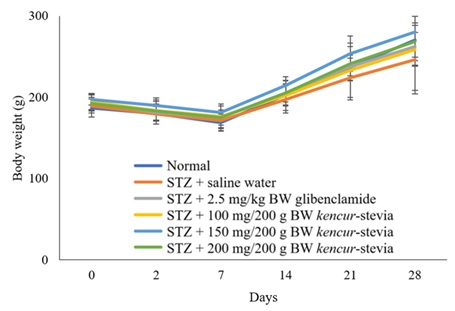
The prevalence of diabetes mellitus (DM) in Indonesia continues to rise, making the search for alternative treatments urgent, including the utilization of Indonesian medicinal plants such as kencur and stevia. Stevia was utilized to support glucose regulation by enhancing insulin sensitivity and providing antioxidant protection without increasing the caloric load. This study aimed to evaluate the antidiabetic potential of kencur-stevia extract. An in vivo design was used with Wistar rats induced by intraperitoneal injection of streptozotocin (STZ). Animals were allocated to the following groups: healthy control, STZ + saline, STZ + glibenclamide (2.5 mg/kg body weight), and STZ + kencur-stevia extract at doses of 100, 150, and 200 mg/200 g body weight. Body weight (BW), blood glucose, hemoglobin (Hb), and hematocrit (Ht) were assessed on days 0, 2, 7, 14, 21, and 28. The results showed that the 150 mg/200 g dose most effectively maintained body-weight gain approaching the healthy control, whereas the 200 mg/200 g dose produced the greatest reduction in blood glucose compared to the diabetic control (245 mg/dL on day 28), showing comparable results to the glibenclamide group. Hematological indices showed minor fluctuations but remained relatively stable at the 200 mg/200 g dose. In conclusion, these preliminary findings indicate that kencur-stevia extract is a promising antidiabetic agent; the 200 mg/200 g dose is optimal for glycemic control, while the 150 mg/200 g dose is better for weight maintenance. This study contributes to the development of evidence-based herbal antidiabetic therapies by demonstrating the dose-dependent effects of a novel kencur-stevia extract combination on glycemic control.
References
F. S. Thomaz, O. D. John, P. Sinha, S. R. Shafie, and S. Worrall, "The metabolic syndrome: An overview and proposed mechanisms," Obesities, vol. 4, no. 3, pp. 226–255, 2024, https://doi.org/10.3390/obesities4030020.
F. Mallamaci and G. Tripepi, "Risk factors of chronic kidney disease progression: Between old and new concepts," Journal of Clinical Medicine, vol. 13, no. 3, Art. no. 678, 2024, https://doi.org/10.3390/jcm13030678.
C. N. Anyaogu, P. A. Momodu, O. E. Okobi, A. T. Amadi, J. K. Okechukwu, O. Polna, D. A. Adeola, O. A. Dike, E. M. Nwachukwu, O. K. Akudinobi, and H. Gabriel, "Impact of blood pressure control on stroke and myocardial infarction risk in hypertensive patients with and without diabetes: A narrative review," Cureus, vol. 17, no. 7, 2025, https://doi.org/10.7759/cureus.88984.
A. Saitama, D. Saptadi, M. D. Maghfoer, and E. Widaryanto, "Potential for production of kencur (Kaempferia galanga L.) secondary metabolites with auxin and cytokinin in vitro," International Journal of Agriculture and Biosciences, vol. 13, no. 4, pp. 717–726, 2024, https://doi.org/10.47278/journal.ijab/2024.174.
L. Song, S. Huang, J. Zhang, Y. Wang, and Q. Zhang, "Kaempferia galanga Linn. Extract–A potential antibacterial agent for preservation of poultry products," LWT - Food Sci. Technol., vol. 147, no. 111553, pp. 1–11, 2021, https://doi.org/10.1016/j.lwt.2021.111553.
X. Chen, Y. Wang, J. Zhang, Z. Liu, and Q. Zhang, "Antiviral effect of an extract from Kaempferia galanga L. rhizome in mice infected with pseudorabies virus," J. Virol. Methods, vol. 307, no. 114573, pp. 1–10, 2022, https://doi.org/10.1016/j.jviromet.2022.114573.
I. S. Wahyuni, I. Sufiawati, W. Nittayananta, and J. Levita, "Anti-inflammatory activity and wound healing effect of Kaempferia galanga L. rhizome on the chemical-induced oral mucosal ulcer in Wistar rats," Journal of Inflammation Research, vol. 15, pp. 2281–2294, 2022, https://doi.org/10.2147/JIR.S359042.
N. Srivastava, S. Mishra, H. Iqbal, D. Chanda, and K. Shanker, "Standardization of Kaempferia galanga L. rhizome and vasorelaxation effect of its key metabolite ethyl p-methoxycinnamate," J. Ethnopharmacol., vol. 271, no. 113911, pp. 1–10, 2021, https://doi.org/10.1016/j.jep.2021.113911.
S. Y. Kiptiyah, E. Harmayani, U. Santoso, and Supriyadi, "The effect of blanching and extraction method on total phenolic content, total flavonoid content and antioxidant activity of Kencur (Kaempferia galanga L.) extract," IOP Conf. Ser. Earth Environ. Sci., vol. 709, no. 012025, 2021, https://doi.org/10.1088/1755-1315/709/1/012025.
S. Y. Kiptiyah, U. Santoso, I. Supriyadi, and E. Harmayani, "Effect of heat treatment on antioxidant and antibacterial activity of Kaempferia galanga L. extract," Food Res., vol. 7, no. 6, pp. 205–213, 2023, https://doi.org/10.26656/fr.2017.7(6).1002.
V. Peteliuk, L. Rybchuk, M. Bayliak, K. B. Storey, and O. Lushchak, "Natural sweetener Stevia rebaudiana: Functionalities, health benefits and potential risks," EXCLI Journal, vol. 20, pp. 1412–1430, 2021, https://doi.org/10.17179/EXCLI2021-4211.
A. M. Orellana-Paucar, "Steviol glycosides from Stevia rebaudiana: An updated overview of their sweetening activity, pharmacological properties, and safety aspects," Molecules, vol. 28, no. 3, 2023, https://doi.org/10.3390/molecules28031258.
N. Harmanto, I. Maulidya, and W. Nurcholis, "Khasiat jamu antidiabetes pada tikus Sprague Dawley yang diinduksi streptozocin," J. Jamu Indones., vol. 4, no. 1, pp. 37–41, 2019, https://doi.org/10.29244/jji.v4i1.94.
A. Penkaová, M. Slobodníková, E. Trajčíková, K. Rendeková, P. Mučaji, A. Sychrová, and S. B. Fialová, "Therapeutic potential of flavonoids and tannins in management of oral infectious diseases—A review," Molecules, vol. 28, no. 1, 2023, https://doi.org/10.3390/molecules28010158.
N. Omar, C. A. N. Ismail, and I. Long, "Tannins in the treatment of diabetic neuropathic pain: Research progress and future challenges," Frontiers in Pharmacology, vol. 12, 2021, https://doi.org/10.3389/fphar.2021.805854.
F. S. Yen, C. S. Qin, S. T. S. Xuan, P. J. Ying, H. Y. Le, T. Darmarajan, B. Gunasekaran, and S. Salvamani, "Hypoglycemic effects of plant flavonoids: A review," Evidence-Based Complementary and Alternative Medicine, vol. 2021, 2021, https://doi.org/10.1155/2021/2057333.
J. Jung, S. Kim, S. Park, and J.-H. Hong, "Sweetness profiles of glycosylated rebaudioside A and its binary mixtures with allulose and maltitol," Food Science and Biotechnology, vol. 30, no. 3, pp. 423–432, 2021, https://doi.org/10.1007/s10068-020-00873-w.
N. Muenprasitivej, R. Tao, S. J. Nardone, and S. Cho, "The effect of steviol glycosides on sensory properties and acceptability of ice cream," Foods, vol. 11, no. 12, p. 1745, 2022, https://doi.org/10.3390/foods11121745.
Md. S. Moazzem, R. Williams, M. Hayden, N. D'Souza, and S. Cho, "Taste profiles of steviol glycoside blends and their application in ice cream," International Journal of Gastronomy and Food Science, vol. 40, 2025, https://doi.org/10.1016/j.ijgfs.2025.101143.
A. Rai and S.-S. Han, "Critical review on key approaches to enhance synthesis and production of steviol glycosides: A blueprint for zero-calorie sweetener," Applied Sciences, vol. 12, no. 17, 2022, https://doi.org/10.3390/app12178640.
A. Ghasemi and S. Jeddi, "Streptozotocin as a tool for induction of rat models of diabetes: a practical guide," EXCLI Journal, vol. 22, pp. 274–294, 2023, https://doi.org/10.17179/EXCLI2022-5720.
A. A. Sedik, A. E. M. K. El-Mosallamy, N. N. Yassen, and N. M. E. Abo El-Nasr, "Dose-dependent toxicity of streptozotocin inducing diabetic complications in male Sprague Dawley rats with metabolic biochemical histopathological effects," Scientific Reports, vol. 15, 2025, https://doi.org/10.1038/s41598-025-27100-y.
R. Praparatana, P. Maliyam, L. R. Barrows, and P. Puttarak, "Flavonoids and phenols, the potential anti-diabetic compounds from Bauhinia strychnifolia Craib stem," Molecules, vol. 27, no. 8, 2022, https://doi.org/10.3390/molecules27082393.
E. Barber, M. J. Houghton, and G. Williamson, "Flavonoids as human intestinal α-glucosidase inhibitors," Foods, vol. 10, no. 8, 2021, https://doi.org/10.3390/foods10081939.
R. M. Pérez Gutiérrez, A. Muñiz-Ramírez, A. H. Garcia-Campoy, and J. M. Mota Flores, "Evaluation of the antidiabetic potential of extracts of Urtica dioica, Apium graveolens, and Zingiber officinale in mice, zebrafish, and pancreatic β-cell," Plants, vol. 10, no. 7, 2021, https://doi.org/10.3390/plants10071438.
S. Sapian, I. S. Taib, J. Latip, H. Katas, K. Y. Chin, N. A. Mohd Nor, F. F. Jubaidi, and S. B. Budin, "Therapeutic approach of flavonoid in ameliorating diabetic cardiomyopathy by targeting mitochondrial-induced oxidative stress," Int. J. Mol. Sci., vol. 22, no. 21, p. 11616, 2021, https://doi.org/10.3390/ijms222111616.
A. H. Ali, S. Sudi, N. Shi-Jing, W. R. M. Hassan, R. Basir, H. K. Agustar, N. Embi, H. M. Sidek, and J. Latip, "Dual Anti-malarial and GSK3β-mediated cytokine-modulating activities of quercetin are requisite of its potential as a plant-derived therapeutic in malaria," Pharmaceuticals, vol. 14, no. 3, p. 248, 2021, https://doi.org/10.3390/ph14030248.
N. F. Shamsudin, Q. U. Ahmed, S. Mahmood, S. A. A. Shah, M. N. Sarian, M. M. A. K. Khattak, A. Khatib, A. S. M. Sabere, Y. M. Yusoff, and J. Latip, "Flavonoids as antidiabetic and anti-inflammatory agents: A review on structural activity relationship-based studies and meta-analysis," International Journal of Molecular Sciences, vol. 23, no. 20, 2022, https://doi.org/10.3390/ijms232012605.
B. Chen, T. Li, Y. Wu, L. Song, Y. Wang, Y. Bian, Y. Qiu, and Z. Yang, "Lipotoxicity: A new perspective in type 2 diabetes mellitus," Diabetes, Metabolic Syndrome and Obesity: Targets and Therapy, vol. 18, pp. 1223–1237, 2025, https://doi.org/10.2147/DMSO.S511436.
X. Liu, C. Zhang, Y. Fu, L. Xie, Y. Kong, and X. Yang, "Inflammation, apoptosis, and fibrosis in diabetic nephropathy: Molecular crosstalk in proximal tubular epithelial cells and therapeutic implications," Current Issues in Molecular Biology, vol. 47, no. 11, 2025, https://doi.org/10.3390/cimb47110885.
H. M. Abuohashish, A. F. AlAsmari, M. Mohany, M. M. Ahmed, and S. S. Al-Rejaie, "Supplementation of morin restores the altered bone histomorphometry in hyperglycemic rodents via regulation of insulin/IGF-1 signaling," Nutrients, vol. 13, no. 7, 2021, https://doi.org/10.3390/nu13072365.
S. Terzo, A. Amato, A. Magán-Fernández, G. Castellino, P. Calvi, R. Chianetta, R. V. Giglio, A. M. Patti, D. Nikolic, A. Firenze, F. Mulè, M. Ciaccio, and M. Rizzo, "A nutraceutical containing chlorogenic acid and luteolin improves cardiometabolic parameters in subjects with pre-obesity: A 6-month randomized, double-blind, placebo-controlled study," Nutrients, vol. 15, no. 2, 2023, https://doi.org/10.3390/nu15020462.
X. Jian, S. Jian, and B. Deng, "Konjac glucomannan: A functional food additive for preventing metabolic syndrome," Journal of Functional Foods, vol. 115, 2024, https://doi.org/10.1016/j.jff.2024.106108.
M. A. Mengstie, E. C. Abebe, A. B. Teklemariam, A. T. Mulu, M. M. Agidew, M. T. Azezew, E. A. Zewde, and A. A. Teshome, "Endogenous advanced glycation end products in the pathogenesis of chronic diabetic complications," Frontiers in Molecular Biosciences, vol. 9, 2022, https://doi.org/10.3389/fmolb.2022.1002710.
H. Sun, P. Saeedi, S. Karuranga, M. Pinkepank, K. Ogurtsova, B. B. Duncan, C. Stein, A. Basit, J. C. N. Chan, and J. C. Mbanya, "IDF diabetes atlas: Global, regional and country-level diabetes prevalence estimates for 2021 and projections for 2045," Diabetes Res. Clin. Pract., vol. 183, p. 109119, 2022, https://doi.org/10.1016/j.diabres.2021.109119.
E. Młynarska, W. Czarnik, N. Dzieża, W. Jędraszak, G. Majchrowicz, F. Prusinowski, M. Stabrawa, J. Rysz, and B. Franczyk, "Type 2 diabetes mellitus: New pathogenetic mechanisms, treatment and the most important complications," International Journal of Molecular Sciences, vol. 26, no. 3, 2025, https://doi.org/10.3390/ijms26031094.
A. I. Yousef, H. H. Shawki, A. A. El-Shahawy, S. M. A. El-Twab, A. Abdel-Moneim, and H. Oishi, "Polydatin mitigates pancreatic beta-cell damage through its antioxidant activity," Biomed. Pharmacother., vol. 133, p. 111027, 2021, https://doi.org/10.1016/j.biopha.2020.111027.
S. G. Yılmaz, A. Uçar, and S. Yılmaz, "Do steviol glycosides affect the oxidative and genotoxicity parameters in BALB/c mice?," Drug Chem. Toxicol., vol. 45, no. 1, pp. 464–469, 2022, https://doi.org/10.1080/01480545.2020.1716000.
W. Dar, "Aspartame-induced cognitive dysfunction: Unveiling role of microglia-mediated neuroinflammation and molecular remediation," International Immunopharmacology, vol. 135, 2024, https://doi.org/10.1016/j.intimp.2024.112295.
S. A. A. Shaher, D. F. Mihailescu, and B. Amuzescu, "Aspartame safety as a food sweetener and related health hazards," Nutrients, vol. 15, no. 16, 2023, https://doi.org/10.3390/nu15163627.
P. Pino-Seguel, O. Moya, J. C. Borquez, F. Pino-de la Fuente, F. Díaz-Castro, C. Donoso-Barraza, M. Llanos, R. Troncoso, and R. Bravo-Sagua, "Sucralose consumption ameliorates high-fat diet-induced glucose intolerance and liver weight gain in mice," Frontiers in Nutrition, vol. 9, 2022, https://doi.org/10.3389/fnut.2022.979624.
Downloads
Published
Issue
Section
License
Copyright (c) 2026 Sakina Yeti Kiptiyah, Khairiah Khairiah, Meli Maesari, Ismail Ibadurrahman

This work is licensed under a Creative Commons Attribution-ShareAlike 4.0 International License.
Authors who publish with the Journal of Agri-food Science and Technology (JAFOST) agree to the following terms:
- Authors retain copyright and grant the journal right of first publication with the work simultaneously licensed under a Creative Commons Attribution License (CC BY-SA 4.0) that allows others to share the work with an acknowledgment of the work's authorship and initial publication in this journal.
- Authors are able to enter into separate, additional contractual arrangements for the non-exclusive distribution of the journal's published version of the work (e.g., post it to an institutional repository or publish it in a book), with an acknowledgment of its initial publication in this journal.
- Authors are permitted and encouraged to post their work online (e.g., in institutional repositories or on their website) prior to and during the submission process, as it can lead to productive exchanges, as well as earlier and greater citation of published work.