Trends in Indonesian Fermented Fish Research (1967–2024): A Bibliometric Analysis Based on Scopus Database
DOI:
https://doi.org/10.12928/jafost.v6i4.14582Keywords:
Bibliometric, Fermented Fish, Indonesia, Lactic Acid Bacteria, VosviewerAbstract
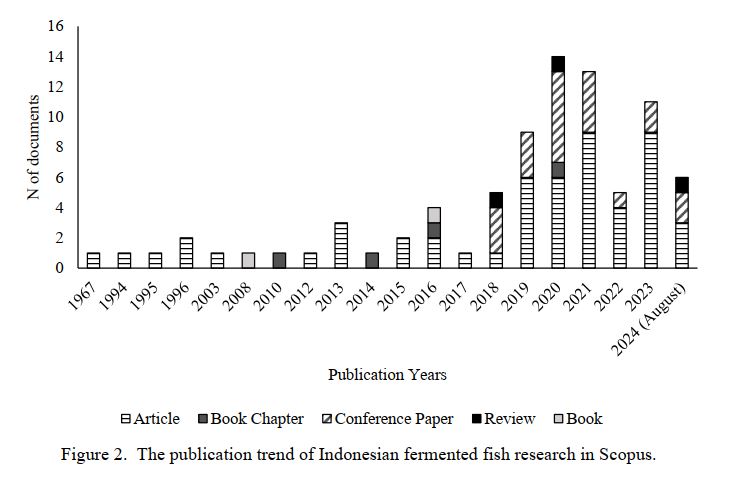
Indonesia has a variety of fermented fish products. These products are frequently the subject of academic studies, which result in related research publications. This research contributes to identifying research trends in fermented fish products, particularly in Indonesia using bibliometric analysis. The data sources used are scientific documents published in Scopus. The data were processed in Excel and VOSviewer for data mapping. A total of 83 relevant publications on Indonesian fermented fish were obtained, with the largest output from Indonesia, namely 73 publications. The collected publications published from 1967 to 2024 include 53 articles, 21 conference papers, 4 book chapters, 3 reviews, and 2 books. Data were retrieved in August 2024 using four search strings, i.e, “Fermented Fish AND Indonesia”, “Indonesian Fermented AND Fish”, “Fish Fermentation AND Indonesia”, and “Fermented Seafood AND Indonesia”. The main fermented fish products discussed are terasi (13 publications), bakasang (8 publications), budu (8 publications), peda (6 publications), bekasam (11 publications), jambal (3 publications), rusip (4 publications), chao (4 publications), wadi (3 publications), and inasua (5 publications). The current trend in Indonesian fermented fish focuses on three main areas: microbial diversity and the role of lactic acid bacteria; chemical characteristics and nutritional value; and food safety of fermented fish products. Further research has the potential to develop starter cultures, identify the bioactive compounds, assess food safety, and standardize the fermentation process to maintain product quality.
References
R. S. Pontoh, S. Mulyani, S. Zhahira, O. A. Wiratama, M. N. Farras, and R. Arisanti, “Mapping Indonesian potential fishing zone using hierarchical and non-hierarchical clustering,” Commun. Math. Biol. Neurosci., vol. 23, pp. 1–18, 2023, https://doi.org/10.28919/cmbn/8088.
N. M. S. Iswari, Wella, and Ranny, “Fish freshness classification method based on fish image using k-Nearest Neighbor,” in 4th International Conference on New Media Studies (CONMEDIA), IEEE, pp. 87–91, 2017, https://doi.org/10.1109/CONMEDIA.2017.8266036.
Ministry of Maritime and Fisheries Affairs, “Data and statistics of fisheries production in Indonesia.” [Online]. Available: https://portaldata.kkp.go.id/portals/data-statistik/layer1.
X. Nie, R. Zhang, L. Cheng, W. Zhu, S. Li, and X. Chen, “Mechanisms underlying the deterioration of fish quality after harvest and methods of preservation,” Food Control, vol. 135, p. 108805, 2022, https://doi.org/10.1016/j.foodcont.2021.108805.
R. Azara, I. A. Saidi, Omega, and L. Hudi, “Quality of snakehead fish (Channa striata) bekasam fermented in various media and salt concentration,” J. Phys. Conf. Ser., vol. 1232, no. 1, p. 012044, 2019, https://doi.org/10.1088/1742-6596/1232/1/012044.
R. H. B. Setiarto and V. T. Herlina, “Exploring bekasam, an indigenous fermented fish product of Indonesia: Original South Sumatra region,” J. Ethn. Foods, vol. 11, no. 1, p. 18, 2024, https://doi.org/10.1186/s42779-024-00230-w.
A. A. Ayeloja and W. A. Jimoh, “Fermented fish products in Sub-Saharan Africa,” in African Fermented Food Products- New Trends, Cham: Springer International Publishing, pp. 251–263, 2022, https://doi.org/10.1007/978-3-030-82902-5_17.
N. S. Antara, I. B. W. Gunam, P. K. D. Kencana, and I. M. S. Utama, “The role of lactic acid bacteria on safety and quality of fermented foods,” in AIP Conference Proceedings, p. 020005, 2019, https://doi.org/10.1063/1.5125509.
M. Intania, N. Arpi, and Hasanuddin, “Effect of salt pretreatment, chitosan, and storage period on the sensory acceptability of peda, fermented sardine (Sardinella sp.),” IOP Conf. Ser. Earth Environ. Sci., vol. 425, no. 1, p. 012082, 2020, https://doi.org/10.1088/1755-1315/425/1/012082.
A. A. Prihanto, N. I. Umam, and J. D. G. Bangun, “Unveiling the secrets of Indonesian fermented fish: Characteristics of lactic acid bacteria, roles, and potential in product development,” Food Biosci., vol. 61, p. 104629, 2024, https://doi.org/10.1016/j.fbio.2024.104629.
C. Leenaars, K. Tsaioun, F. Stafleu, K. Rooney, F. Meijboom, M. Ritskes-Hoitinga, and A. Bleich, “Reviewing the animal literature: How to describe and choose between different types of literature reviews,” Lab. Anim., vol. 55, no. 2, pp. 129–141, 2021, https://doi.org/10.1177/0023677220968599.
C. L. Russell, “An overview of the integrative research review,” Prog. Transplant., vol. 15, no. 1, pp. 8–13, 2005, https://doi.org/10.1177/152692480501500102.
G. Haddow, “Bibliometric research,” in Research Methods, Elsevier, pp. 241–266, 2018, https://doi.org/10.1016/B978-0-08-102220-7.00010-8.
T. Brown, S. A. Gutman, and Y. Ho, “Occupational therapy publications by Australian authors: A bibliometric analysis,” Aust. Occup. Ther. J., vol. 65, no. 4, pp. 249–258, 2018, https://doi.org/10.1111/1440-1630.12453.
M. S. Patel, D. Franceschelli, A. Grossbach, J. K. Zhang, P. A. Mercier, and T. A. Mattei, “Top 50 spine surgery publications most cited by patents: A bibliometric analysis focused on research driving innovation,” World Neurosurg., vol. 191, pp. 234–244, 2024, https://doi.org/10.1016/j.wneu.2024.08.079.
C. B. Persulessy, E. Kusdiyantini, R. S. Ferniah, T. W. Agustini, and A. Budiharjo, “Ina sua: The traditional food fermentation from Teon Nila Serua, Central of Maluku, Indonesia,” J. Ethn. Foods, vol. 7, no. 1, p. 24, 2020, https://doi.org/10.1186/s42779-020-00055-3.
M. Djalal, J. Tashi Wangdi, A. Dirpan, F. Bastian, R. Latief, A. F. Ainani, and D. S. Yolanda, “Traditional Indonesian food: A bibliometric review from 2013-2022,” Canrea J. Food Technol. Nutr. Culin. J., pp. 172–182, 2022, https://doi.org/10.20956/canrea.v5i2.736.
F. I. Maulana, D. Lestari, V. P. Widartha, N. Haidar, and W. Dirgantara, “Digital technology in health education trend mapping through bibliometrics analysis,” in International Conference on Informatics, Multimedia, Cyber and Information System (ICIMCIS), IEEE, pp. 523–528, 2022, https://doi.org/10.1109/ICIMCIS56303.2022.10017990.
A. Fitriani, H. Onyeaka, and F. C. Agustia, “Mapping the worldwide knowledge of jack bean by a bibliometric approach,” J. Agri-Food Sci. Technol., vol. 5, no. 1, pp. 1–17, 2024, https://doi.org/10.12928/jafost.v5i1.10235.
O. D. W. Ardhi, T. R. Soeprobowati, K. Adi, E. Prakasa, and A. Rachman, “Deep learning methods for plankton identification: A bibliometric analysis and general review,” in 1st International Conference on Smart Technology, Applied Informatics, and Engineering (APICS), IEEE, pp. 96–101, 2022, https://doi.org/10.1109/APICS56469.2022.9918707.
S. C. J. Lim and I. S. Ghazali, “Research evolution in design engineering education: A visual approach using thematic network,” in IEEE International Conference on Industrial Engineering and Engineering Management (IEEM), IEEE, pp. 504–508, 2017, https://doi.org/10.1109/IEEM.2017.8289942.
J. Han, H.-J. Kang, M. Kim, and G. H. Kwon, “Mapping the intellectual structure of research on surgery with mixed reality: Bibliometric network analysis (2000–2019),” J. Biomed. Inform., vol. 109, p. 103516, 2020, https://doi.org/10.1016/j.jbi.2020.103516.
S. Janzen, “Advancing the advanced search: Improving the web of science user experience with a spreadsheet search query tool,” HCI International 2022 Posters, pp. 292–299, 2022, https://doi.org/10.1007/978-3-031-06417-3_40.
J. Li, C. Deacon, and M. R. Keezer, “The performance of bibliometric analyses in the health sciences,” Curr. Med. Res. Opin., vol. 40, no. 1, pp. 97–101, 2024, https://doi.org/10.1080/03007995.2023.2281503.
Z. Yin, Y. Chen, J. Gu, S. Ying, and Y. Guo, “A knowledge graph construction method based on co-occurrence for traffic entity prediction,” Int. J. Appl. Earth Obs. Geoinf., vol. 142, p. 104717, 2025, https://doi.org/10.1016/j.jag.2025.104717.
Y. B. Soemarie, T. Milanda, and M. I. Barliana, “Isolation, characterization, and identification candidate of probiotic bacteria isolated from Wadi Papuyu (Anabas testudineus Bloch.) a fermented fish product from central Kalimantan, Indonesia,” Int. J. Food Sci., vol. 22, pp. 1–9, 2022, https://doi.org/10.1155/2022/4241531.
H. Cai, L. Tao, X. Zhou, Y. Liu, D. Sun, Q. Ma, Z. Yu, and W. Jiang, “Lactic acid bacteria in fermented fish: Enhancing flavor and ensuring safety,” J. Agric. Food Res., vol. 16, p. 101206, 2024, https://doi.org/10.1016/j.jafr.2024.101206.
S. Sukmawati, R. Ratna, S. Sipriyadi, and M. Yunita, “Characterization and molecular identification of bacteria from mackerel bekasam in Sorong City, Southwest Papua Province, Indonesia,” Biodiversitas J. Biol. Divers., vol. 24, no. 9, 2023, https://doi.org/10.13057/biodiv/d240940.
A. Miftachurrochmah, K. Fibrianto, and W. Bekti Sunarharum, “Bekasam, an Indonesian unique traditional fermented fish as umami sources,” Adv. Food Sci. Sustain. Agric. Agroindustrial Eng., vol. 7, no. 2, pp. 158–168, 2024, https://doi.org/10.21776/ub.afssaae.2024.007.02.5.
M. Karyantina, S. Anggrahini, T. Utami, and E. S. Rahayu, “Moderate halophilic lactic acid bacteria from jambal roti: A traditional fermented fish of Central Java, Indonesia,” J. Aquat. Food Prod. Technol., vol. 29, no. 10, pp. 990–1000, 2020, https://doi.org/10.1080/10498850.2020.1827112.
Y. Syafitri, H. D. Kusumaningrum, and R. Dewanti-Hariyadi, “Identification of microflora and lactic acid bacteria in pado, a fermented fish product prepared with dried Pangium edule seed and grated coconut,” Food Sci. Technol., vol. 42, 2022, https://doi.org/10.1590/fst.19921.
Y. Marlida, M. Susalam, H. Harnentis, J. Jamsari, N. Huda, W. Noordin, L. Anggraini, and L. Ardani, “Metagenomic analysis and biodiversity of bacteria in traditional fermented fish or Budu from West Sumatera, Indonesia,” J. Adv. Vet. Anim. Res., p. 1, 2024, https://doi.org/10.5455/javar.2023.j736.
H. Harnentis, Y. Marlida, Y. S. Nur, W. Wizna, M. A. Santi, N. Septiani, F. Adzitey, and N. Huda, “Novel probiotic lactic acid bacteria isolated from indigenous fermented foods from West Sumatera, Indonesia,” Vet. World, vol. 13, no. 9, pp. 1922–1927, 2020, https://doi.org/10.14202/vetworld.2020.1922-1927.
M. Karyantina, S. Anggrahini, T. Utami, and E. S. Rahayu, “Jambal roti characteristics: A traditional fermented fish from Rembang, Central Java,” Food Res., vol. 5, no. S2, pp. 128–134, 2021, https://doi.org/10.26656/fr.2017.5(S2).011.
L. Anggriani, S. Budiarti, and N. R. Mubarik, “Lipase-producing ability of bacteria from inasua (fish fermented product) from Central Moluccas, Indonesia,” Biodiversitas J. Biol. Divers., vol. 21, no. 2, 2020, https://doi.org/10.13057/biodiv/d210226.
J. Kanklai, T. C. Somwong, P. Rungsirivanich, and N. Thongwai, “Screening of GABA-producing lactic acid bacteria from Thai fermented foods and probiotic potential of Levilactobacillus brevis F064A for GABA-fermented mulberry juice production,” Microorganisms, vol. 9, no. 1, p. 33, 2020, https://doi.org/10.3390/microorganisms9010033.
H.-Y. Lin, P.-Y. Chen, F.-Y. Shen, H.-W. Chang, and T.-T. Chou, “Improving antagonistic effect of Lactobacillus gasseri MS-72 with herbal medicine extracts against pathogenic bacteria,” The Microbe, vol. 9, p. 100583, 2025, https://doi.org/10.1016/j.microb.2025.100583.
A. L. O. Putri, E. Kusdiyantini, and S. Pujiyanto, “The growth and potential of gamma-aminobutyric acid (GABA) by lactic acid bacteria isolated from fish fermented food from Maluku, Indonesia,” J. Phys. Conf. Ser., vol. 1524, no. 1, p. 012133, 2020, https://doi.org/10.1088/1742-6596/1524/1/012133.
I. Desniar, A. Rusmana, Suwanto, and N. R. Mubarik, “Organic acid produced by lactic acid bacteria from bekasam as food biopreservatives,” IOP Conf. Ser. Earth Environ. Sci., vol. 414, no. 1 (Jan), p. 012003, 2020, https://doi.org/10.1088/1755-1315/414/1/012003.
U. Syahriati, M. N. Fitriani, R. Yusuf, Saleh, Luthfiah, and Sumarni, “Chao teri: The traditional fish fermentation from South Sulawesi, Indonesia,” IOP Conf. Ser. Earth Environ. Sci., vol. 1097, no. 1 (Oct), p. 012070, 2022, https://doi.org/10.1088/1755-1315/1097/1/012070.
J. Leiwakabessy, R. B. D. Sormin, and M. N. Mailoa, “Amino acid profile of tuna (Thunnus albacores) fish sauce fermented by salt and papain enzyme,” IOP Conf. Ser. Earth Environ. Sci., vol. 777, no. 1, p. 012027, 2021, https://doi.org/10.1088/1755-1315/777/1/012027.
A. A. Prihanto, R. Nurdiani, Y. D. Jatmiko, M. Firdaus, and T. S. Kusuma, “Physicochemical and sensory properties of terasi (an Indonesian fermented shrimp paste) produced using Lactobacillus plantarum and Bacillus amyloliquefaciens,” Microbiol. Res., vol. 242, p. 126619, 2021, https://doi.org/10.1016/j.micres.2020.126619.
F. Mahulette, “Microbiological and chemical characteristics of porkfish inasua, traditional fish fermented from Maluku, Indonesia,” Biodiversitas J. Biol. Divers., vol. 25, no. 1, 2024, https://doi.org/10.13057/biodiv/d250101.
L. Rianingsih, Sumardianto, Romadhon, M. B. Rusdi, and P. H. Riyadi, “The effect of sucrose addition on the sensory quality of ‘terasi’ an Indonesian shrimp paste,” IOP Conf. Ser. Earth Environ. Sci., vol. 890, no. 1, p. 012048, 2021, https://doi.org/10.1088/1755-1315/890/1/012048.
R. Surya, D. Nugroho, N. Kamal, and K. Petsong, “Characteristics of Indonesian traditional fermented seafood paste (terasi) made from shrimp and anchovy,” J. Ethn. Foods, vol. 11, no. 1, p. 2, 2024, https://doi.org/10.1186/s42779-023-00218-y.
M. T. D. Ambarita, K. Raes, and B. De Meulenaer, “Identification of key sensory attributes of sambal-terasi, impact of different type of terasi, chemical characteristics and salt addition,” Sains Malaysiana, vol. 49, no. 3, pp. 561–571, 2020, https://doi.org/10.17576/jsm-2020-4903-11.
A. Dirpan, M. Djalal, K. I. Prahesti, N. A. Bahmid, and S. Asab, “A bibliometric analysis of understanding absorbent food for the development of sustainable packaging,” in IOP Conference Series: Earth and Environmental Science, p. 012183, 2023, https://doi.org/10.1088/1755-1315/1230/1/012183.
Downloads
Published
Issue
Section
License
Copyright (c) 2025 Mutiara Ulfah, Athiefah Fauziyyah, Anis Khairunnisa, Dini Nur Hakiki

This work is licensed under a Creative Commons Attribution-ShareAlike 4.0 International License.
Authors who publish with the Journal of Agri-food Science and Technology (JAFOST) agree to the following terms:
- Authors retain copyright and grant the journal right of first publication with the work simultaneously licensed under a Creative Commons Attribution License (CC BY-SA 4.0) that allows others to share the work with an acknowledgment of the work's authorship and initial publication in this journal.
- Authors are able to enter into separate, additional contractual arrangements for the non-exclusive distribution of the journal's published version of the work (e.g., post it to an institutional repository or publish it in a book), with an acknowledgment of its initial publication in this journal.
- Authors are permitted and encouraged to post their work online (e.g., in institutional repositories or on their website) prior to and during the submission process, as it can lead to productive exchanges, as well as earlier and greater citation of published work.