The Effectiveness of The Food Supply and Price Stabilization Rice Policy on The Rice Market in East Java
DOI:
https://doi.org/10.12928/jafost.v6i3.14334Keywords:
Food price stabilization, Food security, Panel regression, Premium rice, SPHPAbstract
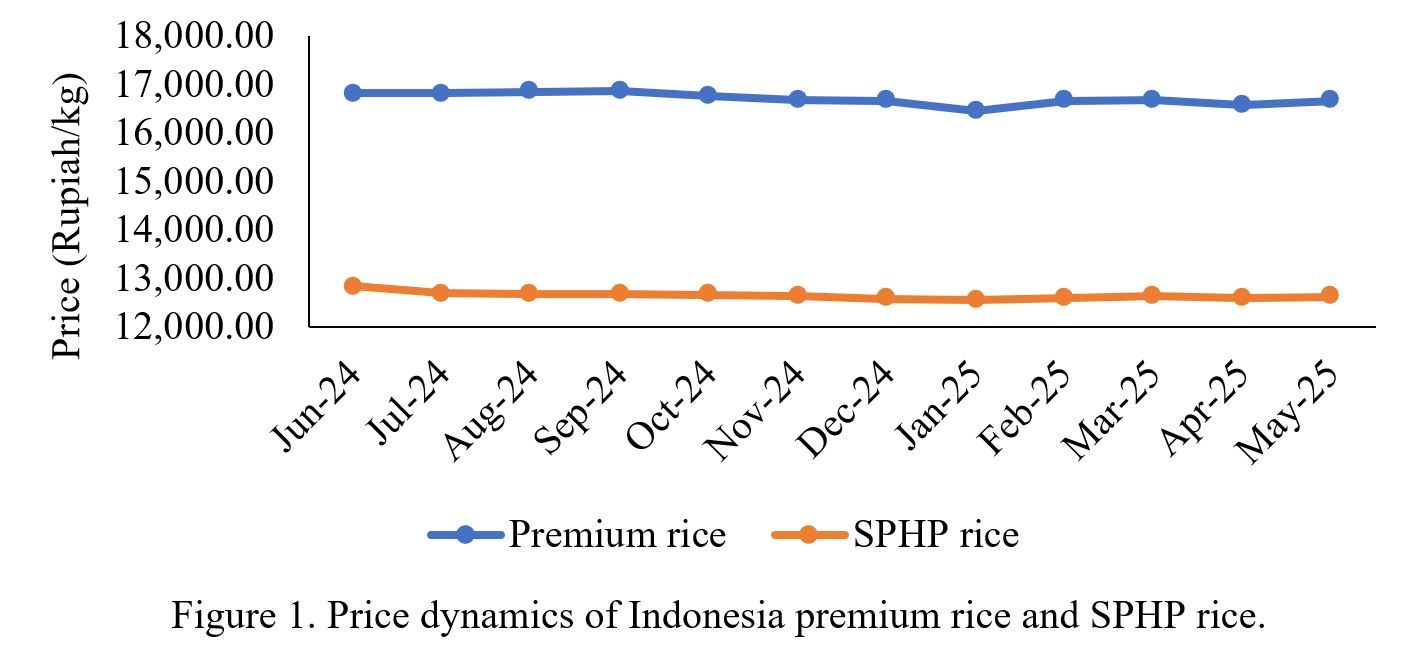
Rice has become a central focus of the Indonesian government in ensuring both availability and price stability. To address these concerns, the government, through Perum Bulog, introduced the SPHP (Stabilization of Food Supply and Prices) rice policy. This study aims to analyze the effectiveness of SPHP rice policy in influencing the price of premium rice in East Java Province. This study contributes to the limited empirical evidence on food policy evaluation in Indonesia and offers insights for designing more differentiated price stabilization strategies. The analysis in this study was conducted using a fixed effect model–dynamic unbalanced panel data regression with a double-log natural functional form. The dataset consists of monthly panel data covering 34 cities/regencies in East Java Province over the period June 2024–May 2025. The estimation results indicate that only the lagged premium rice price has a significant effect on the premium rice price. However, the price of SPHP rice, both current and lagged, does not have a significant effect on the price of premium rice.
References
Fitrawaty, W. Hermawan, M. Yusuf, and I. Maipita, “A simulation of increasing rice price toward the disparity of income distribution: An evidence from Indonesia,” Heliyon, vol. 9, no. 3, p. e13785, 2023, https://doi.org/10.1016/j.heliyon.2023.e13785.
R. P. Dewanti, E. Paryanto, W. Rahayu, and A. A. Rachmadhan, “The impact of the Covid-19 pandemic on staple food prices in Semarang,” in IOP Conf. Series: Earth and Environmental Science 1364, 2024, https://doi.org/10.1088/1755-1315/1364/1/012044.
E. Manihuruk and A. A. Rachmadhan, “The effect of the Covid-19 pandemic on the price of staple foods in Medan City,” Agrisep, vol. 23, no. 1, pp. 227–240, 2024, https://doi.org/10.31186/jagrisep.23.
I. N. Hamzah and W. Huang, “The dynamics of strategically important food preference in Indonesia: An empirical evaluation of consumption pattern and welfare loss,” Econ. Anal. Policy, vol. 79, pp. 435–449, 2023, https://doi.org/10.1016/j.eap.2023.06.024.
A. Şen, A. G. Akpolat, and İ. Balkan, “Commodity prices and economic growth: Empirical evidence from countries with different income groups,” Heliyon, vol. 10, no. 13, p. e34038, 2024, https://doi.org/10.1016/j.heliyon.2024.e34038.
E. Suryani, R. A. Hendrawan, I. Muhandhis, and R. Indraswari, “A simulation model to improve the value of rice supply chain (A case study in East Java – Indonesia),” J. Simul., vol. 16, no. 4, pp. 392–414, 2022, https://doi.org/10.1080/17477778.2020.1829118.
F. Rozi, A. B. Santoso, I. G. A. P. Mahendri, R. T. P. Hutapea, D. Wamaer, V. Siagian, D. A. A. Elisabeth, S. Sugiono, H. Handoko, H. Subagio, and A. Syam, “Indonesian market demand patterns for food commodity sources of carbohydrates in facing the global food crisis,” Heliyon, vol. 9, no. 6, p. e16809, 2023, https://doi.org/10.1016/j.heliyon.2023.e16809.
M. Shobur, I. Nyoman Marayasa, S. Bastuti, A. C. Muslim, G. A. Pratama, and R. Alfatiyah, “Enhancing food security through import volume optimization and supply chain communication models: A case study of East Java’s rice sector,” J. Open Innov. Technol. Mark. Complex., vol. 11, no. 1, p. 100462, 2025, https://doi.org/10.1016/j.joitmc.2024.100462.
A. Ansari, A. Pranesti, M. Telaumbanua, T. Alam, Taryono, R. A. Wulandari, B. D. A. Nugroho, and Supriyanta, “Evaluating the effect of climate change on rice production in Indonesia using multimodelling approach,” Heliyon, vol. 9, no. 9, p. e19639, 2023, https://doi.org/10.1016/j.heliyon.2023.e19639.
A. Sapthu, F. H. Louhenapessy, F. Saptenno, D. Louhenapessy, U. Duwila, and Jani, “Analysis of the elasticity of rice demand for poor households in Sirimau District, Ambon City in 2024,” ARRUS J. Soc. Sci. Humanit., vol. 4, no. 3, pp. 419–428, 2024, https://doi.org/10.35877/soshum2684.
M. A. B. Siddique, M. A. Salam, and M. C. Rahman, “Estimating the demand elasticity of rice in Bangladesh: An application of the aids model,” Asian J. Agric. Rural Dev., vol. 10, no. 3, pp. 721–728, 2020, https://doi.org/10.18488/journal.ajard.2020.103.721.728.
T. Ruspayandi, T. Bantacut, B. Arifin, and I. Fahmi, “Market-approach-based policy to achieve rice price stability in Indonesia—Can it be a complement?,” Economies, vol. 10, no. 12, pp. 1–19, 2022, https://doi.org/10.3390/economies10120296.
A. M. E. Bella, L. Rahmawati, and M. R. Jim, “Market intervention policy in the case of rising rice prices in Indonesia from the perspective of Ibn Taimiyah,” J. Islam. Econ. Laws, vol. 7, no. 01, pp. 36–55, 2024, https://doi.org/10.23917/jisel.v7i01.3484.
D. N. Gujarati and D. C. Porter, Basic Econometric. New York: McGraw-Hill, 2008, https://books.google.co.id/books?id=6l1CPgAACAAJ&redir_esc=y.
A. W. Putra, J. Supriatna, R. H. Koestoer, and T. E. Soesilo, “Differences in local rice price volatility, climate, and macroeconomic determinants in the Indonesian market,” Sustainability, vol. 13, no. 8, 2021, https://doi.org/10.3390/su13084465.
J. B. Adewopo, G. Solano-hermosilla, L. Colen, and F. Micale, “Using crowd-sourced data for real-time monitoring of food prices during the COVID-19 pandemic: Insights from a pilot project in northern Nigeria,” Glob. Food Sec., vol. 29, p. 100523, 2021, https://doi.org/10.1016/j.gfs.2021.100523.
A. A. Cariappa, K. K. Acharya, C. A. Adhav, R. Sendhil, and P. Ramasundaram, “COVID-19 induced lockdown effects on agricultural commodity prices and consumer behaviour in India-Implications for food loss and waste management,” Socioecon. Plann. Sci., vol. 0, no. 9, 2021, https://doi.org/10.1016/j.seps.2021.101160.
R. A. Birgani, A. Kianirad, S. Shab-Bidar, A. Djazayeri, H. Pouraram, and A. Takian, “Climate change and food price: A systematic review and meta-analysis of observational studies, 1990-2021,” Am. J. Clim. Chang., vol. 11, no. 02, pp. 103–132, 2022, https://doi.org/10.4236/ajcc.2022.112006.
S. Bairagi, C. R. Gustafson, M. C. Custodio, J. Ynion, and M. Demont, “What drives consumer demand for packaged rice? Evidence from South and Southeast Asia,” Food Control, vol. 129, p. 108261, 2021, https://doi.org/10.1016/j.foodcont.2021.108261.
J. Balié and H. G. Valera, “Domestic and international impacts of the rice trade policy reform in the Philippines,” Food Policy, vol. 92, p. 101876, 2020, https://doi.org/10.1016/j.foodpol.2020.101876.
I. Hermawan and E. Budiyanti, “Integrasi harga beras era perdagangan terbuka dan dampaknya terhadap swasembada dan pelaku ekonomi beras,” Bul. Ilm. Litbang Perdagang., vol. 14, no. 1, pp. 21–46, 2020, https://doi.org/10.30908/bilp.v14i1.429.
P. D. Wijayati, D. Laily, and D. Atasa, “Volatilitas harga pangan pokok di pasar global sebagai dampak pandemi COVID-19 dan resesi ekonomi dunia,” AGROMIX, vol. 13, no. 1, pp. 89–103, 2022, https://doi.org/10.35891/agx.v13i1.2874.
R. M. Rukka, A. Amiruddin, A. N. Tenriawaru, and C. D. Muslimah, “Effect analysis of market segmentation on purchasing decisions local rice in modern market,” IOP Conf. Ser. Earth Environ. Sci., vol. 575, no. 1, p. 12044, 2020, https://doi.org/10.1088/1755-1315/575/1/012044.
N. Lanuhu, R. M. Rukka, A. Amrullah, L. Fudjaja, C. D. Muslimah, Suyono, and H. Sa’diyah, “Analysis of the effect of behavior market segmentation on purchasing decisions of local rice in the modern market,” IOP Conf. Ser. Earth Environ. Sci., vol. 681, no. 1, p. 12098, 2021, https://doi.org/10.1088/1755-1315/681/1/012098.
G. J. Alaerts, “Adaptive policy implementation: Process and impact of Indonesia’s national irrigation reform 1999–2018,” World Dev., vol. 129, p. 104880, 2020, https://doi.org/10.1016/j.worlddev.2020.104880.
G. Ji, H. Zhong, H. L. Feukam Nzudie, P. Wang, and P. Tian, “The structure, dynamics, and vulnerability of the global food trade network,” J. Clean. Prod., vol. 434, p. 140439, 2024, https://doi.org/10.1016/j.jclepro.2023.140439.
Nurdiana, A. S. R. Esso, Nuraisyiah, Nurjannah, and A. W. Angka, “Segmentation, targeting and positioning strategies (STP) rice production and their social economic impacts in Maros District,” J. Res. Bus. Manag., vol. 11, no. 5, pp. 190–204, 2023, https://www.questjournals.org/jrbm/papers/vol11-issue5/1105190204.pdf.
D. C. Brennan, “Price dynamics in the Bangladesh rice market: implications for public intervention,” Agric. Econ., vol. 29, no. 1, pp. 15–25, 2003, https://ageconsearch.umn.edu/record/177986?ln=en.
X. Zhou, J. Checco, M. A. Akber, and A. A. Aziz, “Factors influencing consumer preferences for sustainably produced rice: A systematic review,” Clean. Responsible Consum., vol. 18, p. 100309, 2025, https://doi.org/10.1016/j.clrc.2025.100309.
A. L. H. Achmad, D. Chaerani, and T. Perdana, “Designing a food supply chain strategy during COVID-19 pandemic using an integrated agent-based modelling and robust optimization,” Heliyon, vol. 7, no. 1207, p. e08448, 2021, https://doi.org/10.1016/j.heliyon.2021.e08448.
Downloads
Published
Issue
Section
License
Copyright (c) 2025 Aditya Arief Rachmadhan, Prasmita Dian Wijayati

This work is licensed under a Creative Commons Attribution-ShareAlike 4.0 International License.
Authors who publish with the Journal of Agri-food Science and Technology (JAFOST) agree to the following terms:
- Authors retain copyright and grant the journal right of first publication with the work simultaneously licensed under a Creative Commons Attribution License (CC BY-SA 4.0) that allows others to share the work with an acknowledgment of the work's authorship and initial publication in this journal.
- Authors are able to enter into separate, additional contractual arrangements for the non-exclusive distribution of the journal's published version of the work (e.g., post it to an institutional repository or publish it in a book), with an acknowledgment of its initial publication in this journal.
- Authors are permitted and encouraged to post their work online (e.g., in institutional repositories or on their website) prior to and during the submission process, as it can lead to productive exchanges, as well as earlier and greater citation of published work.