Sensory Characteristics of Mocaf-Substituted Noodles Enriched with Latoh (Caulerpa lentillifera)
DOI:
https://doi.org/10.12928/jafost.v6i3.14145Keywords:
Enrichment, Latoh, Mocaf, Noodles, SensoryAbstract
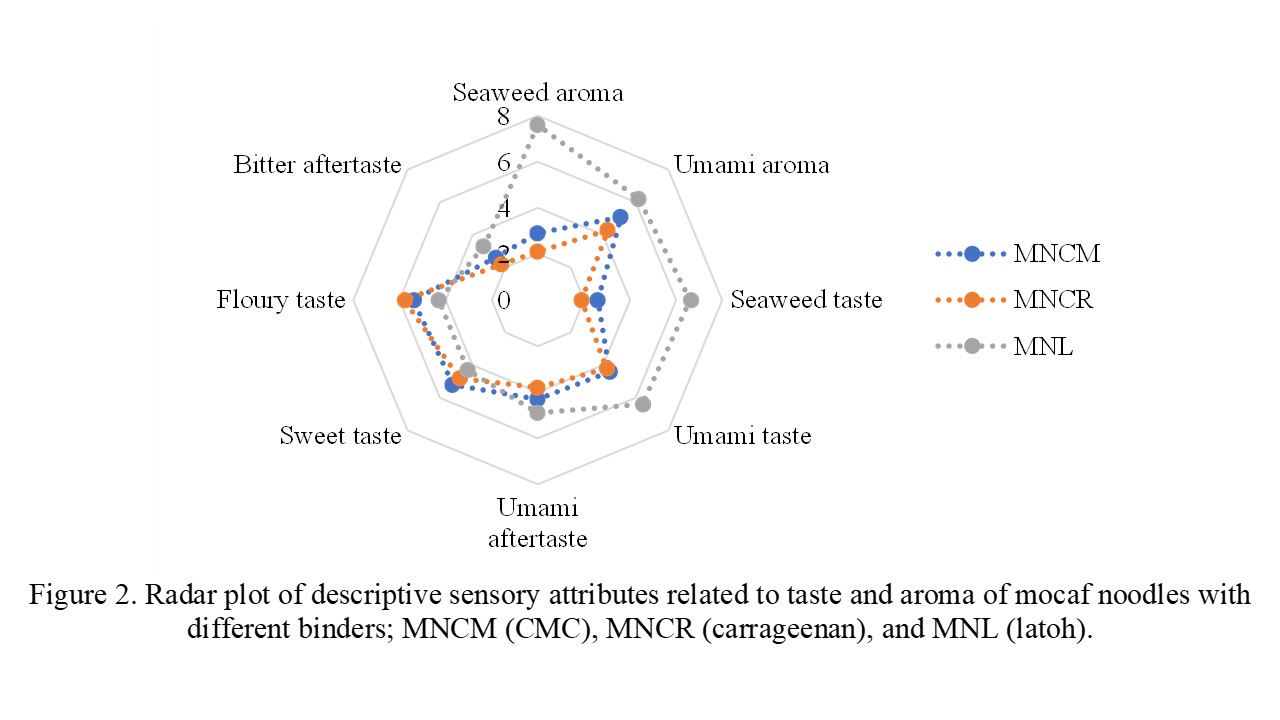
Noodles are widely consumed globally. However, conventional wheat-based noodles are limited in dietary fiber and functional compounds. Modified cassava flour (mocaf) and latoh (Caulerpa lentillifera) offer potential as natural ingredients to improve the nutritional value and sensory quality of noodles, and Latoh also serves as an alternative to conventional binders such as carboxymethyl cellulose (CMC) and carrageenan. This study aimed to evaluate the sensory characteristics and consumer acceptance of mocaf-based noodles formulated with three different binders: Latoh (MNL), carboxymethyl cellulose (MNCM), and carrageenan (MNCR). The noodles were prepared using a flour blend of 63% mocaf, 36% wheat flour, and 1% binder. Sensory analysis was conducted using a 9-point hedonic scale (taste, aroma, texture, appearance, and overall acceptability) and descriptive analysis. MNCM achieved the highest overall liking score (7.30), with superior ratings in appearance (7.50), taste (6.90), and aftertaste (6.80), indicating better consumer preference due to firmer texture and improved structure. MNCR showed the highest crispness (6.60) but lower fragility (5.00, p<0.05), reflecting brittleness. MNL demonstrated favorable values for fragility (6.80) and mouthfeel (6.10) but received slightly lower taste (5.80) and aftertaste (5.50), likely due to distinct seaweed flavor notes. Principal Component Analysis (PCA) confirmed strong associations of MNCM with elasticity, taste, and overall acceptability, while MNCR aligned with crispness. MNL, although less aligned with hedonic preferences, showed functional potential. In conclusion, CMC was the most effective binder for sensory appeal, while Latoh represents a promising natural alternative that requires further optimization to balance functional benefits with consumer acceptance.
References
G. G. Hou, Asian noodle manufacturing. Duxford, UK: Woodhead Publishing and AACC International Press, 2020, https://doi.org/10.1016/C2016-0-02429-4.
S. B. Wahjuningsih, R. Rohadi, Z. D. Siqhny, R. I. Oktaviani, M. N. Azkia, and D. Haryati, “Evaluation of sensory profiles, protein digestibility, and mineral composition in mocaf-multi-grain noodles with different binding agents,” Trends in Sciences, vol. 22, no. 8, p. 10099, 2025, https://doi.org/10.48048/tis.2025.10099.
A. Hinggiranja, N. M. A. S. Singapurwa, I. G. P. Mangku, I. P. Candra, and A. A. M. Semariyani, “The characteristics of wet noodles from mocaf flour and moringa flour,” Formosa Journal of Science and Technology, vol. 2, no. 4, pp. 1091–1104, 2023, https://doi.org/10.55927/fjst.v2i4.3647.
Y. Khasanah, A. W. Indrianingsih, P. Triwitono, and A. Murdiati, “Production, biological activities and functional food of modified cassava flour (mocaf),” Canrea Journal: Food Technology, Nutritions, and Culinary Journal, vol. 7, no. 2, pp. 213–229, 2024, https://doi.org/10.20956/canrea.v7i2.1280.
P. N. Utami and E. Farida, “Pengaruh tepung beras merah (Oryza nivara) dan tepung mocaf (modified cassava flour) terhadap indeks glikemik dan kandungan gizi cookies,” IJPHN, vol. 3, no. 3, pp. 376–383, 2023, https://doi.org/10.15294/ijphn.v3i3.60951.
S. B. Wahjuningsih, Haslina, S. Untari, and A. Wijanarka, “Hypoglycemic effect of analog rice made from modified cassava flour (mocaf), arrowroot flour and kidney bean flour on STZ-NA induced diabetic rats,” Asian Journal of Clinical Nutrition, vol. 10, no. 1, pp. 8–15, 2018, https://doi.org/10.3923/ajcn.2018.8.15.
J. Firdaus, E. Sulistyani, and A. Subagio, “Resistant starch modified cassava flour (mocaf) improves insulin resistance,” Asian Journal of Clinical Nutrition, vol. 10, no. 1, pp. 32–36, 2017, https://doi.org/10.3923/ajcn.2018.32.36.
S. B. Wahjuningsih and B. Kunarto, “Pembuatan tepung mokal dengan penambahan biang fermentasi alami untuk beras analog,” Jurnal Litbang Provinsi Jawa Tengah, vol. 11, no. 2, pp. 221–230, 2013, https://doi.org/10.36762/jurnaljateng.v11i2.309.
S. B. Wahjuningsih, D. Anggraeni, Z. D. Siqhny, A. Triputranto, M. R. Kusumastuti, and M. N. Azkia, “Exploring antidiabetic effects of enriched mocaf noodles: a combined computational and in vivo study,” Current Research in Nutrition and Food Science Journal, vol. 13, no. 1, pp. 231–242, 2025, https://doi.org/10.12944/CRNFSJ.13.1.15.
Md. S. Rahman, Md. S. Hasan, A. S. Nitai, S. Nam, A. K. Karmakar, Md. S. Ahsan, M. J. A. Shiddiky, and M. B. Ahmed, “Recent developments of carboxymethyl cellulose,” Polymers, vol. 13, no. 8, p. 1345, 2021, https://doi.org/10.3390/polym13081345.
T. Udo, G. Mummaleti, A. Mohan, R. K. Singh, and F. Kong, “Current and emerging applications of carrageenan in the food industry,” Food Research International, vol. 173, p. 113369, 2023, https://doi.org/10.1016/j.foodres.2023.113369.
N. Syakilla, R. George, F. Y. Chye, W. Pindi, S. Mantihal, N. Ab Wahab, F. M. Fadzwi, P. H. Gu, and P. Matanjun, “A review on nutrients, phytochemicals, and health benefits of green seaweed, Caulerpa lentillifera,” Foods, vol. 11, no. 18, p. 2832, 2022, https://doi.org/10.3390/foods11182832.
X. Chen, Y. Sun, H. Liu, S. Liu, Y. Qin, and P. Li, “Advances in cultivation, wastewater treatment application, bioactive components of Caulerpa lentillifera and their biotechnological applications,” PeerJ, vol. 7, p. e6118, 2019, https://doi.org/10.7717/peerj.6118.
M. K. Setiadi and A. Husni, “Aktivitas antioksidan dan tingkat penerimaan konsumen yoghurt yang diperkaya rumput laut Caulerpa lentillifera,” J Pengolah Has Perikan Indones, vol. 27, no. 5, pp. 417–430, 2024, https://doi.org/10.17844/jphpi.v27i5.53538.
B. R. Sharma and D. Y. Rhyu, “Anti-diabetic effects of Caulerpa lentillifera: stimulation of insulin secretion in pancreatic β-cells and enhancement of glucose uptake in adipocytes,” Asian Pac J Trop Biomed, vol. 4, no. 7, pp. 575–580, 2014, https://doi.org/10.12980/APJTB.4.2014APJTB-2014-0091.
A. Kristiningsih, K. Wittriansyah, S. W. Utami, and S. Purwaningrum, “Effect of addition of carrageenan concentration on quality of breadfruit (Artocarpus atili) and Cannabis (Canna edulis) wet noodles,” Jurnal Agroindustri, vol. 12, no. 1, pp. 39–47, 2022, https://doi.org/10.31186/j.agroindustri.12.1.39-47.
Suharman and B. I. Pambudi, “Effect of seaweed addition (Eucheuma cottonii) and CMC on organoleptic assessment of mocaf noodles,” p. 020020, 2023, https://doi.org/10.1063/5.0105837.
S. B. Wahjuningsih, Haslina, N. Nazir, M. N. Azkia, and A. Triputranto, “Characteristic of mocaf noodles with sago flour substitution (Metroxylon sago) and addition of Latoh (Caulerpa lentillifera),” Int J Adv Sci Eng Inf Technol, vol. 13, no. 2, pp. 417–422, 2023, https://doi.org/10.18517/ijaseit.13.2.18205.
T. Lux, J. Krapf, F. Reimold, A. Lochny, A. Erdoes, and E. Floeter, “Amaranth-alginate hydrogels: rheological, textural, and sensory properties for gluten-free noodles,” Future Foods, vol. 11, p. 100676, 2025, https://doi.org/10.1016/j.fufo.2025.100676.
W. Y. Koh, P. Matanjun, X. X. Lim, and R. Kobun, “Sensory, physicochemical, and cooking qualities of instant noodles incorporated with red seaweed (Eucheuma denticulatum),” Foods, vol. 11, no. 17, pp. 1–19, 2022, https://doi.org/10.3390/foods11172669.
M. Mendes, J. Cotas, D. Pacheco, K. Ihle, A. Hillinger, M. Cascais, J. C. Marques, L. Pereira, and A. M. M. Gonçalves, “Red seaweed (Rhodophyta) phycocolloids: A road from the species to the industry application,” Mar Drugs, vol. 22, no. 10, p. 432, 2024, https://doi.org/10.3390/md22100432.
W. Y. Koh, P. Matanjun, X. X. Lim, and R. Kobun, “Sensory, physicochemical, and cooking qualities of instant noodles incorporated with red seaweed (Eucheuma denticulatum),” Foods, vol. 11, no. 17, p. 2669, 2022, https://doi.org/10.3390/foods11172669.
N. A. H. A. Nasir, M. H. Yuswan, N. N. A. K. Shah, A. Abd Rashed, K. Kadota, and Y. A. Yusof, “Evaluation of physicochemical properties of a hydrocolloid-based functional food fortified with Caulerpa lentillifera: A D-optimal design approach,” Gels, vol. 9, no. 7, p. 531, 2023, https://doi.org/10.3390/gels9070531.
R. Chaiklahan, C. Suaisom, N. Chirasuwan, and T. Srinorasing, “Separation and characterization of high- and low-molecular-weight polysaccharides from Caulerpa lentillifera,” Carbohydrate Polymer Technologies and Applications, vol. 10, p. 100776, 2025, https://doi.org/10.1016/j.carpta.2025.100776.
P. S. Widyawati, T. I. P. Suseno, A. I. Widjajaseputra, T. E. W. Widyastuti, V. W. Moeljadi, and S. Tandiono, “The effect of κ-Carrageenan proportion and hot water extract of the Pluchea indica less leaf tea on the quality and sensory properties of stink lily (Amorphophallus muelleri) wet noodles,” Molecules, vol. 27, no. 16, p. 5062, 2022, https://doi.org/10.3390/molecules27165062.
A. Rezagholizade-shirvan, M. Soltani, S. Shokri, R. Radfar, M. Arab, and E. Shamloo, “Bioactive compound encapsulation: Characteristics, applications in food systems, and implications for human health,” Food Chem X, vol. 24, p. 101953, 2024, https://doi.org/10.1016/j.fochx.2024.101953.
B. Naseer, H. R. Naik, S. Z. Hussain, I. Zargar, Beenish, T. A. Bhat, and N. Nazir, “Effect of carboxymethyl cellulose and baking conditions on in-vitro starch digestibility and physico-textural characteristics of low glycemic index gluten-free rice cookies,” LWT, vol. 141, p. 110885, 2021, https://doi.org/10.1016/j.lwt.2021.110885.
N. I. N. Nasruddin, M. S. Md Jamil, I. Zakaria, and S. I. Zubairi, “Optimization of noodle formulation using commercialized empty fruit bunch palm oil carboxylmethyl cellulose (CMC) and flours with different protein content,” J Teknol, vol. 80, no. 5, 2018, https://doi.org/10.11113/jt.v80.10594.
F. Jabeen, Zil-e-Aimen, R. Ahmad, S. Mir, N. S. Awwad, and H. A. Ibrahium, “Carrageenan: Structure, properties and applications with special emphasis on food science,” RSC Adv, vol. 15, no. 27, pp. 22035–22062, 2025, https://doi.org/10.1039/D5RA03296B.
M. F. Manzoor, M. T. Afraz, B. B. Yılmaz, M. Adil, N. Arshad, G. Goksen, M. Ali, and X. Zeng, “Recent progress in natural seaweed pigments: Green extraction, health-promoting activities, techno-functional properties and role in intelligent food packaging,” J Agric Food Res, vol. 15, p. 100991, 2024, https://doi.org/10.1016/j.jafr.2024.100991.
S. R. Dahlstedt, J. P. Trigo, K. Stedt, F. Rosqvist, I. Undeland, H. Pavia, C. J. B. Rune, D. Giacalone, and P. Sandvik, “Sensory evaluation of seaweed – a scoping review and systematic assessment of sensory studies,” Applied Food Research, vol. 5, no. 2, p. 101057, 2025, https://doi.org/10.1016/j.afres.2025.101057.
E. K. Parassih, E. Y. Purwani, and W. El Kiyat, “Optimisation of cassava dried noodle using hydrocolloid and protein isolates: A tropical noodle,” Future of Food: Journal on Food, Agriculture and Society, vol. 8, no. 4, pp. 1–84, 2020, https://doi.org/10.17170/kobra-202010131943.
S. B. Wahjuningsih, Sudjatinah, M. N. Azkia, and D. Anggraeni, “The study of sorghum (Sorghum bicolor L.), mung bean (Vigna radiata) and sago (Metroxylon sagu) noodles: Formulation and physical characterization,” Current Research in Nutrition and Food Science, vol. 8, no. 1, pp. 217–225, 2020, https://doi.org/10.12944/CRNFSJ.8.1.20.
W. Zhou, Y. Wang, R. Xu, J. Tian, T. Li, and S. Chen, “Comparative analysis of the nutrient composition of Caulerpa lentillifera from various cultivation sites,” Foods, vol. 14, no. 3, p. 474, 2025, https://doi.org/10.3390/foods14030474.
S. Kraithong and S. Rawdkuen, “Quality attributes and cooking properties of commercial Thai rice noodles,” PeerJ, vol. 9, 2021, https://doi.org/10.7717/peerj.11113.
A. Górska, D. Mańko-Jurkowska, and E. Domian, “Comparative gelation characteristics of carrageenan via rheological and optical techniques: Glazing gels with different sweeteners,” Food Hydrocoll, vol. 152, p. 109941, 2024, https://doi.org/10.1016/j.foodhyd.2024.109941.
N. Osakabe, T. Shimizu, Y. Fujii, T. Fushimi, and V. Calabrese, “Sensory nutrition and bitterness and astringency of polyphenols,” Biomolecules, vol. 14, no. 2, p. 234, 2024, https://doi.org/10.3390/biom14020234.
T. Chen, Y. Li, Y. Wang, J. Chen, L. Fan, and Z. Liu, “Study on quality changes of kelp gel edible granules during storage,” Foods, vol. 13, no. 14, p. 2267, 2024, https://doi.org/10.3390/foods13142267.
J. D. Wilkin, K. Ross, T. Alric, M. Hooper, J. V. Grigor, and B.-S. Chu, “Optimisation of concentration of Undaria pinnarifida (wakame) and Himathalia elongate (sea spaghetti) varieties to effect digestibility, texture and consumer attribute preference,” Journal of Aquatic Food Product Technology, vol. 30, no. 8, pp. 932–943, 2021, https://doi.org/10.1080/10498850.2021.1958114.
I. T. Jolliffe and J. Cadima, “Principal component analysis: A review and recent developments,” Philosophical Transactions of the Royal Society A: Mathematical, Physical and Engineering Sciences, vol. 374, no. 2065, p. 20150202, 2016, https://doi.org/10.1098/rsta.2015.0202.
R. Ma, B. Li, Y. Wang, J. Wang, X. Yang, B. Xu, and J. Sun, “Quality assessment framework for salted duck eggs: Indicator model,” Journal of Food Composition and Analysis, vol. 145, p. 107751, 2025, https://doi.org/10.1016/j.jfca.2025.107751.
E. Asiamah, Y. Wang, J. Gan, D. Geng, M. R. Nemţanu, S. Sharafeldin, and Y. Cheng, “Effects of pre-gelatinized starch and dry starch supplementation on the structural and functional integrity of single-component smooth pea starch noodles,” Int J Biol Macromol, vol. 319, p. 144267, 2025, https://doi.org/10.1016/j.ijbiomac.2025.144267.
Downloads
Published
Issue
Section
License
Copyright (c) 2025 Mita Nurul Azkia

This work is licensed under a Creative Commons Attribution-ShareAlike 4.0 International License.
Authors who publish with the Journal of Agri-food Science and Technology (JAFOST) agree to the following terms:
- Authors retain copyright and grant the journal right of first publication with the work simultaneously licensed under a Creative Commons Attribution License (CC BY-SA 4.0) that allows others to share the work with an acknowledgment of the work's authorship and initial publication in this journal.
- Authors are able to enter into separate, additional contractual arrangements for the non-exclusive distribution of the journal's published version of the work (e.g., post it to an institutional repository or publish it in a book), with an acknowledgment of its initial publication in this journal.
- Authors are permitted and encouraged to post their work online (e.g., in institutional repositories or on their website) prior to and during the submission process, as it can lead to productive exchanges, as well as earlier and greater citation of published work.