Analysis of Starch Content and Impurities During Tapioca Flour Production Process
DOI:
https://doi.org/10.12928/jafost.v7i2.14005Keywords:
Cassava, Impurities, Strach content, TapiocaAbstract
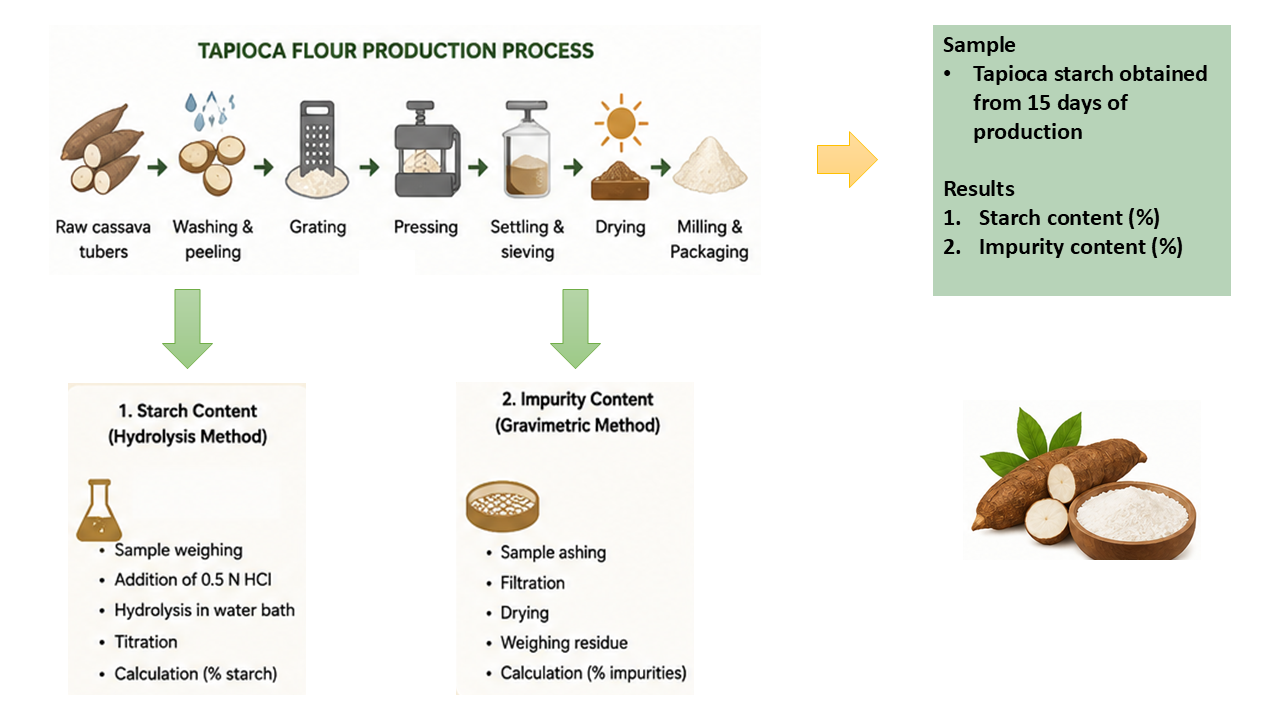
Tapioca is a processed product from cassava tubers (Manihot esculenta) that plays an important role in the food industry, both as a main ingredient and an additive. The quality of tapioca is greatly influenced by its starch content as the main component and the level of contaminants in it. Starch content is the main indicator of quality because it determines the physical and functional characteristics of tapioca, while contaminants are important parameters that reflect the presence of foreign substances or unwanted contaminants. The main contribution of this study is to focus on samples from one tapioca industry in Central Java without seasonal replication or interlaboratory validation. Starch content was measured using the hydrolysis method, which began with sample weighing, the addition of 0.5N HCl, hydrolysis in a water bath, and finally titration. The scientific significance of this study is that it provides real-time field data on daily variations in starch content (79.83–83.67%) and impurity content (0.19–0.28%), which supports continuous quality monitoring for SNI 3451:2011 (starch content ≥ 75%) and SNI 01-3451:1994 (impurity content ≤ 0.6%). This research is expected to provide data-based practical recommendations to optimize the production process and contribute to increasing the added value of tapioca in Indonesia. With a starch content of >80% and impurities of <0.3%, it can increase export competitiveness because it meets the international Codex Alimentarius standard (food-grade tapioca).
References
W. G. Adebayo, “Cassava production in africa: A panel analysis of the drivers and trends,” Heliyon, vol. 9, no. 9, p. e19939, 2023, https://doi.org/10.1016/j.heliyon.2023.e19939.
S. R. N. S. P. Mohidin, S. Moshawih, A. Hermansyah, M. I. Asmuni, N. Shafqat, and L. C. Ming, “Cassava (Manihot esculenta Crantz): A systematic review for the pharmacological activities, traditional uses, nutritional values, and phytochemistry,” J. Evidence-Based Integr. Med., vol. 28, no., pp. 1–26, 2023, https://doi.org/10.1177/2515690X231206227.
H. Ceballos and S. Fenstemaker, “Cassava breeding: Past, present and future,” Trop. Agric. Sci., vol. 1, no. 1, p. 100002, 2026, https://doi.org/10.1016/j.tas.2025.100002.
A. W. Borku, T. T. Tora, and M. Masha, “Cassava in focus: A comprehensive literature review, its production, processing landscape, and multi-dimensional benefits to society,” Food Chem. Adv., vol. 7, p. 100945, 2025, https://doi.org/10.1016/j.focha.2025.100945.
Y. Zhao, Z. Zheng, Y. Zhao, J. Chen, and S. Tang, “Cross-linked modification of tapioca starch by sodium trimetaphosphate: An influence on its structure,” Food Chem. X, vol. 23, p. 101670, 2024, https://doi.org/10.1016/j.fochx.2024.101670.
S. N. Rahmadhia, W. Wuryantoro, and D. Ayuningtyas, “Tapioca quality observation based on physical and chemical properties of products,” J. Halal Sci. Res., vol. 3, no. 2, pp. 53–57, 2022, https://doi.org/10.12928/jhsr.v3i2.6772.
A. Pokharel, R. K. Jaidka, N. U. Sruthi, and R. R. Bhattarai, “Effects of incorporation of porous tapioca starch on the quality of white salted (udon) noodles,” Foods, vol. 12, no. 8, p. 1662, 2023, https://doi.org/10.3390/foods12081662.
C. Cabeza, A. E. G. Ahmed, M. Minauf, K. Wieland, and M. Harasek, “Starch hydrolysates, their impurities and the role of membrane-based technologies as a promising sustainable purification method at industrial scale,” Food Res. Int., vol. 209, p. 116300, 2025, https://doi.org/10.1016/j.foodres.2025.116300.
T. Siriwong, S. Lunprom, and A. Salakkam, “L-lactic acid production from cassava pulp through high-solids simultaneous saccharification and fermentation: Development of fed-batch strategy based on substrate degradation kinetics,” Chem. Eng. J. Adv., vol. 26, p. 101134, 2026, https://doi.org/10.1016/j.ceja.2026.101134.
H. Konch, R. K. Gupta, and P. P. Srivastav, “Novel frontier of arrowroot starch: Extraction, modification, characterization and application in food industry,” Food Biomacromolecules, vol. 2, no. 4, pp. 451–470, 2025, https://doi.org/10.1002/fob2.70027.
A. Vinothkanna, O. I. Dar, Z. Liu, and A.-Q. Jia, “Advanced detection tools in food fraud: A systematic review for holistic and rational detection method based on research and patents,” Food Chem., vol. 446, p. 138893, 2024, https://doi.org/10.1016/j.foodchem.2024.138893.
A. Al Azawei, K. Loughrey, K. Surim, M. E. Connolly, and B. D. Naughton, “The management of good manufacturing practice (GMP) inspections: A scoping review of the evidence,” Front. Med., vol. 12, 2025, https://doi.org/10.3389/fmed.2025.1687864.
S. A. Maidana, A. P. Butiuk, L. A. Brumovsky, and M. A. Martos, “Cassava starch extraction with a polygalacturonase from a wild yeast strain with disintegration activity on plant tissues,” Carbohydr. Res., vol. 550, p. 109386, 2025, https://doi.org/10.1016/j.carres.2025.109386.
A. I. Malik, P. Kongsil, V. A. Nguyễn, W. Ou, Sholihin, P. Srean, M. Sheela, L. A. Becerra López-Lavalle, Y. Utsumi, C. Lu, P. Kittipadakul, H. H. Nguyễn, H. Ceballos, T. H. Nguyễn, M. Selvaraj Gomez, et al., “Cassava breeding and agronomy in Asia: 50 years of history and future directions,” Breed. Sci., vol. 70, no. 2, pp. 145–166, 2020, https://doi.org/10.1270/jsbbs.18180.
E. O. Alamu, B. Maziya-Dixon, and A. G. Dixon, “Evaluation of the pasting characteristics of cassava roots grown in different locations in Nigeria from the genetic gain assessment trial,” Front. Sustain. Food Syst., vol. 6, 2022, https://doi.org/10.3389/fsufs.2022.1012410.
A. Tafesse, B. Mena, A. Belay, E. Aynekulu, J. W. Recha, P. M. Osano, D. Darr, T. D. Demissie, T. B. Endalamaw, and D. Solomon, “Cassava production efficiency in Southern Ethiopia: The parametric model analysis,” Front. Sustain. Food Syst., vol. 5, 2021, https://doi.org/10.3389/fsufs.2021.758951.
P. Pinamang Acheampong, E. Owusu Danquah, K. Agyeman, K. Obeng Dankwa, and M. Addison, “Research and development for improved cassava varieties in Ghana: Farmers’ adoption and effects on livelihoods,” in Cassava - Biology, Production, and Use, IntechOpen, 2021. https://doi.org/10.5772/intechopen.97588.
I. Boukhers, F. Boudard, S. Morel, A. Servent, K. Portet, C. Guzman, M. Vitou, J. Kongolo, A. Michel, and P. Poucheret, “Nutrition, healthcare benefits and phytochemical properties of cassava (Manihot esculenta) leaves sourced from three countries (Reunion, Guinea, and Costa Rica),” Foods, vol. 11, no. 14, p. 2027, 2022, https://doi.org/10.3390/foods11142027.
T. T. Alemu and C. G. Kuyu, “Review on the role of soybean and cassava root flours in enhancing the nutritional value, antioxidant capacity, anti-nutritional factors reduction, and sensory properties of wheat flour-based bread,” Discov. Food, vol. 6, no. 1, p. 49, 2025, https://doi.org/10.1007/s44187-025-00763-2.
H. Vardhan, N. Singhal, P. Vashistha, R. Jain, Y. Bist, A. Gaur, and N. K. Wagri, “Starch–biomacromolecule complexes: A comprehensive review of interactions, functional materials, and applications in food, pharma, and packaging,” Carbohydr. Polym. Technol. Appl., vol. 11, p. 101001, 2025, https://doi.org/10.1016/j.carpta.2025.101001.
P. A. Pawase, A. M. Pathare, O. Bashir, F. Saleem, E. Shrama, S. Mudgal, and M. Ahmad, “Physical, chemical, and nano-enabled modifications of starch for sustainable food packaging films: Recent trends, challenges, and prospects,” Carbohydr. Polym. Technol. Appl., vol. 11, p. 100986, 2025, https://doi.org/10.1016/j.carpta.2025.100986.
A. Vilela, B. Gonçalves, C. Gonçalves, F. Cosme, and T. Pinto, “Novel applications of starch and starch derivatives in the food and alcoholic beverages industry: A review,” Foods, vol. 15, no. 2, p. 277, 2026, https://doi.org/10.3390/foods15020277.
A. Puri, P. Mohite, A. Ramole, S. Verma, M. Kamble, K. Ranch, and S. Singh, “Starch science advancement: Isolation techniques, modification strategies, and multifaceted applications,” Macromol, vol. 5, no. 3, p. 40, 2025, https://doi.org/10.3390/macromol5030040.
B. N. Biyimba, I. Ekaette, and E. Cobbinah-Sam, “Starch functionality in cosmetics and personal care products,” Carbohydr. Polym., vol. 364, p. 123597, 2025, https://doi.org/10.1016/j.carbpol.2025.123597.
S. Anis, D. F. Fitriyana, A. Bahatmaka, M. C. Anwar, A. Z. Ramadhan, F. C. Anam, R. A. Permana, A. J. Hakim, N. F. D. S. Guterres, and M. D. S. Da Silva, “Effect of adhesive type on the quality of coconut shell charcoal briquettes prepared by the screw extruder machine,” J. Renew. Mater., pp. 1–10, 2023, https://doi.org/10.32604/jrm.2023.047128.
M. Das and R. Banerjee, “Increase of resistant starch content by hydrolysis of potato amylopectin and its microstructural studies by 2D and 3D imaging,” Int. J. Biol. Macromol., vol. 223, pp. 1674–1683, 2022, https://doi.org/10.1016/j.ijbiomac.2022.10.186.
Y. Wang, X. Ou, Q. A. Al-Maqtari, H.-J. He, and N. Othman, “Evaluation of amylose content: Structural and functional properties, analytical techniques, and future prospects,” Food Chem. X, vol. 24, p. 101830, 2024, https://doi.org/10.1016/j.fochx.2024.101830.
K. Saengchan, M. Nopharatana, and W. Songkasiri, “Recovery of tapioca starch from pulp in a conical basket centrifuge – Effects of rotational speed and liquid to solid (L/S) ratio on cake formation and starch–pulp separation efficiency,” Sep. Purif. Technol., vol. 127, pp. 192–201, 2014, https://doi.org/10.1016/j.seppur.2014.02.026.
K. Riewklang, C. Polprasert, K. Nakason, S. Polprasert, S. Kwonpongsagoon, S. Mahasandana, and B. Panyapinyopol, “Enhancing chemical phosphorus precipitation from tapioca starch anaerobic digestion effluent in a modified pilot-scale fluidized bed reactor,” Environ. Res., vol. 231, p. 116277, 2023, https://doi.org/10.1016/j.envres.2023.116277.
S. S. Scaria, B. Balasubramanian, A. Meyyazhagan, J. Gangwar, J. P. Jaison, J. T. Kurian, K. Pushparaj, M. Pappuswamy, S. Park, and K. S. Joseph, “Cassava (Manihot esculenta Crantz)—A potential source of phytochemicals, food, and nutrition—An updated review,” eFood, vol. 5, no. 1, 2024, https://doi.org/10.1002/efd2.127.
A. Apriyanto, J. Compart, and J. Fettke, “A review of starch, a unique biopolymer – Structure, metabolism and in planta modifications,” Plant Sci., vol. 318, p. 111223, 2022, https://doi.org/10.1016/j.plantsci.2022.111223.
J. Zhu and R. G. Gilbert, “Starch molecular structure and diabetes,” Carbohydr. Polym., vol. 344, p. 122525, 2024, https://doi.org/10.1016/j.carbpol.2024.122525.
K. J. Falua, A. Pokharel, A. Babaei-Ghazvini, Y. Ai, and B. Acharya, “Valorization of starch to biobased materials: A review,” Polymers (Basel)., vol. 14, no. 11, p. 2215, 2022, https://doi.org/10.3390/polym14112215.
L. Zhang, J. Zhao, F. Li, X. Jiao, B. Yang, and Q. Li, “Effects of amylose and amylopectin fine structure on the thermal, mechanical and hydrophobic properties of starch films,” Int. J. Biol. Macromol., vol. 282, p. 137018, 2024, https://doi.org/10.1016/j.ijbiomac.2024.137018.
R. A. Cullano, A. M. Tiu, S. S. Evangelista, and L. Ocampo, “Informing starch‐based food product designs with seaweeds using an analytical kano‐Quality function deployment model,” J. Texture Stud., vol. 56, no. 2, 2025, https://doi.org/10.1111/jtxs.70007.
T. Toniazzo, C. Leverrier, N. L. Souza, G. Almeida, C. C. Tadini, and V. Guenard-Lampron, “Influence of starch-based gels on 3D food printing: Linking printability, texture, rheological properties, and sensory evaluation,” Futur. Foods, vol. 12, p. 100725, 2025, https://doi.org/10.1016/j.fufo.2025.100725.
B. Aloka, S. Olum, and D. Ongeng, “Evaluation of the nutritional quality of food composites developed from local ingredients to target the needs of persons experiencing nodding syndrome in Northern Uganda,” Sci. Rep., vol. 15, no. 1, p. 41572, 2025, https://doi.org/10.1038/s41598-025-25483-6.
Y. Zhou, J. Hua, and L. Xu, “Exogenous impurities in Baijiu: Sources, detection, and safety strategies,” Beverages, vol. 12, no. 1, p. 2, 2025, https://doi.org/10.3390/beverages12010002.
B. Q. Saeed, T. M. Osaili, and S. Taha, “Foodborne diseases risk factors associated with food safety knowledge and practices of women in Sharjah-United Arab Emirate,” Food Control, vol. 125, p. 108024, 2021, https://doi.org/10.1016/j.foodcont.2021.108024.
V. Albert, T. Ramamurthy, S. Das, K. G Dolma, T. Majumdar, P. J. Baruah, S. Chaliha Hazarika, B. Apum, and M. Das, “Comprehending the risk of foodborne and waterborne disease outbreaks: Current situation and control measures with Special reference to the Indian Scenario,” Heliyon, vol. 10, no. 16, p. e36344, 2024, https://doi.org/10.1016/j.heliyon.2024.e36344.
A. Boman, M. Miguel, I. Andersson, and D. Slunge, “The effect of information about hazardous chemicals in consumer products on behaviour – A systematic review,” Sci. Total Environ., vol. 947, p. 174774, 2024, https://doi.org/10.1016/j.scitotenv.2024.174774.
A. Ait Chekdid, C. J. F. Kahn, B. Lemois, and M. Linder, “Impact of a starch hydrolysate on the production of exopolysaccharides in a fermented plant-based dessert formulation,” Foods, vol. 12, no. 20, p. 3868, 2023, https://doi.org/10.3390/foods12203868.
J. Miłek and J. Liszkowska, “Potato starch hydrolysis by α-amylase: Effect of duration on the optimum temperature and deactivation energy,” J. Therm. Anal. Calorim., vol. 150, no. 27, pp. 22743–22751, 2025, https://doi.org/10.1007/s10973-025-15122-7.
A. F. Chamorro, M. Palencia, and T. A. Lerma, “Physicochemical characterization and properties of cassava starch: A review,” Polymers (Basel)., vol. 17, no. 12, p. 1663, 2025, https://doi.org/10.3390/polym17121663.
J. L. Moreno Alzate, T. Tran, H. Ceballos, C.-N. Nguyen, T. C. Nguyen, X. Zhang, J. Newby, D. Dufour, and S. Chu-Ky, “Physicochemical characterization of special cassava starches and their application for bio-ethanol production through no-cook technology at very high gravity,” Ind. Crops Prod., vol. 219, p. 119095, 2024, https://doi.org/10.1016/j.indcrop.2024.119095.
Downloads
Published
Issue
Section
License
Copyright (c) 2026 Istiqomah Istiqomah, Aprilia Fitriani, Nur Dinan

This work is licensed under a Creative Commons Attribution-ShareAlike 4.0 International License.
Authors who publish with the Journal of Agri-food Science and Technology (JAFOST) agree to the following terms:
- Authors retain copyright and grant the journal right of first publication with the work simultaneously licensed under a Creative Commons Attribution License (CC BY-SA 4.0) that allows others to share the work with an acknowledgment of the work's authorship and initial publication in this journal.
- Authors are able to enter into separate, additional contractual arrangements for the non-exclusive distribution of the journal's published version of the work (e.g., post it to an institutional repository or publish it in a book), with an acknowledgment of its initial publication in this journal.
- Authors are permitted and encouraged to post their work online (e.g., in institutional repositories or on their website) prior to and during the submission process, as it can lead to productive exchanges, as well as earlier and greater citation of published work.