Comparative Analysis of the Quality of White Wine Prepared with Commercial Wine Yeast and Isolated Yeast Strain from Indigenous Murcha
DOI:
https://doi.org/10.12928/jafost.v6i3.13946Keywords:
Murcha, Optimized yeast, Physiochemical analysis, Sensory evaluation, Wine FermentationAbstract
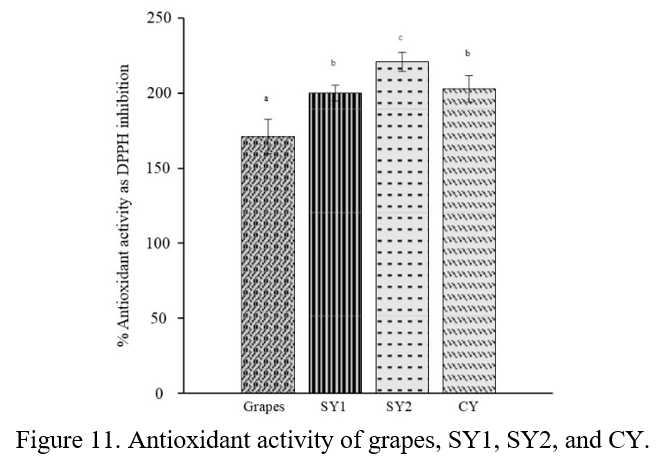
Nepal, has a long tradition of fermenting indigenous alcoholic beverages. However, its potential in winemaking remains undiscovered, Nepal’s researcher growing interest in viticulture and wine production. This study goal to compare the quality of white wine produced using commercial yeast (CY) and yeast strains (SY1 and SY2) isolated from indigenous murcha, a traditional Himalayan starter culture. Altogether 12 yeast strains were isolated. Screening of fermentative yeast were performed on the basis of effervescence of carbon-dioxide gas in Durham’s tube, flavor, turbidity and surface growth in YM broth containing 1.8% sugar. Strain Y1 and Y7 were selected on WYDM media. Strains Y1, Y2 and commercial wine yeast were used as starter culture in wine fermentation. The grape juice (15.4 °Bx) was fermented for 12 days at room temperature. The biochemical characteristics, antioxidant activity, total phenolic content and the sensory analysis of wine were conducted. The methodology involving isolating yeast from murcha, screening fermentative strains, and wine fermentation. Statistical analysis suggested that alcohol content, ester content and total phenolic compounds were significantly different from each other in all wine samples SY1, SY2, CY (p<0.05). Results indicated that SY1 and SY2 exhibited higher fermentation activity, producing wines with significantly (p<0.05) better alcohol content (7.33–7.51% v/v), lower residual sugar (1.27–1.38), and enhanced phenolic and antioxidant properties compared to CY (7.08% alcohol, 1.45% residual sugar). Sensory evaluation ranked SY2 highest in overall acceptability. Encouraging Nepalese winemakers to adopt and apply murcha-derived yeast strains (SY2) to enhance fermentation efficiency and develop unique regional wine profiles.
References
P. Saranraj, P. Sivasakthivelan, and M. Naveen, “Fermentation of fruit wine and its quality analysis: A review,” Aust. J. Sci. Technol., vol. 1, no. 2, pp. 85–97, 2017. https://www.aujst.com/vol-1-2/07_AJST.pdf.
G. G. Brostrom and J. Brostrom, The business of wine. Greenwood Publishing Group, Inc., 2008. https://doi.org/10.5040/9798400622588.
K. M. Daane, C. Vincent, R. Isaacs, and C. Ioriatti, “Entomological opportunities and challenges for sustainable viticulture in a global market,” Annu. Rev. Entomol., vol. 63, no. 1, pp. 193–214, 2018, https://doi.org/10.1146/annurev-ento-010715-023547.
V. K. Joshi and R. C. Ray, Winemaking. Boca Raton, FL : CRC Press, Taylor & Francis Group, CRC Press, 2021. https://doi.org/10.1201/9781351034265.
S. S. Mane, V. Ghormade, S. G. Tupe, and M. V. Deshpande, “Diversity of natural yeast flora of grapes and its significance in wine making,” in Yeast Diversity in Human Welfare, Singapore: Springer Singapore, pp. 1–27, 2017. https://doi.org/10.1007/978-981-10-2621-8_1.
R. Gonzalez and P. Morales, “Truth in wine yeast,” Microb. Biotechnol., vol. 15, no. 5, pp. 1339–1356, 2022, https://doi.org/10.1111/1751-7915.13848.
Á. Benito, F. Calderón, and S. Benito, “New trends in Schizosaccharomyces use for winemaking,” in Grape and Wine Biotechnology, InTech, pp. 307–323, 2016. https://doi.org/10.5772/64807.
I. Belda, E. Navascués, D. Marquina, A. Santos, F. Calderon, and S. Benito, “Dynamic analysis of physiological properties of Torulaspora delbrueckii in wine fermentations and its incidence on wine quality,” Appl. Microbiol. Biotechnol., vol. 99, no. 4, pp. 1911–1922, 2015, https://doi.org/10.1007/s00253-014-6197-2.
S. Benito, T. Hofmann, M. Laier, B. Lochbühler, A. Schüttler, K. Ebert, S. Fritsch, J. Röcker, and D. Rauhut, “Effect on quality and composition of Riesling wines fermented by sequential inoculation with non-Saccharomyces and Saccharomyces cerevisiae,” Eur. Food Res. Technol., vol. 241, no. 5, pp. 707–717, 2015, https://doi.org/10.1007/s00217-015-2497-8.
F. Comitini, M. Gobbi, P. Domizio, C. Romani, L. Lencioni, I. Mannazzu, and M. Ciani, “Selected non-Saccharomyces wine yeasts in controlled multistarter fermentations with Saccharomyces cerevisiae,” Food Microbiol., vol. 28, no. 5, pp. 873–882, 2011, https://doi.org/10.1016/j.fm.2010.12.001.
V. Rojas, J. V Gil, F. Piñaga, and P. Manzanares, “Studies on acetate ester production by non-Saccharomyces wine yeasts,” Int. J. Food Microbiol., vol. 70, no. 3, pp. 283–289, 2001, https://doi.org/10.1016/S0168-1605(01)00552-9.
T. Karki, P. Ojha, and O. P. Panta, “Ethnic fermented foods of Nepal,” in Ethnic Fermented Foods and Alcoholic Beverages of Asia, New Delhi: Springer India, pp. 91–117, 2016. https://doi.org/10.1007/978-81-322-2800-4_4.
S. Majumder and M. Bhattacharya, “Himalayan fermented beverages and their therapeutic properties with scientific validations: A comprehensive review,” J. Ethn. Foods, vol. 11, no. 1, p. 44, 2024, https://doi.org/10.1186/s42779-024-00260-4.
J. P. Tamang, S. Dewan, B. Tamang, A. Rai, U. Schillinger, and W. H. Holzapfel, “Lactic acid bacteria in Hamei and Marcha of North East India,” Indian J. Microbiol., vol. 47, no. 2, pp. 119–125, 2007, https://doi.org/10.1007/s12088-007-0024-8.
R. P. Chaudhary, G. B. Basnet, S. K. Rai, D. K. Limbu, R. Maharjan, and B. Rai, “Ethnic alcoholic beverages of Nepal Himalaya,” pp. 1–34, 2023. https://doi.org/10.1007/978-3-031-04195-2_162-1.
C. P. Kurtzman, J. W. Fell, T. Boekhout, and V. Robert, “Methods for isolation, phenotypic characterization and maintenance of yeasts,” in The Yeasts, Elsevier, pp. 87–110, 2011. https://doi.org/10.1016/B978-0-444-52149-1.00007-0.
S. Pokhrel, “Hydroxyapatite: Preparation, Properties and Its Biomedical Applications,” Adv. Chem. Eng. Sci., vol. 08, no. 04, pp. 225–240, 2018, https://doi.org/10.4236/aces.2018.84016.
R. S. Kirk and R. Sawyer, Pearson’s Composition and Analysis of Foods. Longman, 1991. https://books.google.co.id/books?id=KUV2QgAACAAJ.
S. Ranganna, Handbook of analysis and quality control for fruit and vegetable products. Tata McGraw-Hill, 2000. https://books.google.co.id/books?id=jQN8Kpj0UOMC.
R. Mahdavi, Z. Nikniaz, M. Rafraf, and A. Jouyban, “Determination and comparison of total polyphenol and vitamin c contents of natural fresh and commercial fruit juices,” Pakistan J. Nutr., vol. 9, no. 10, pp. 968–972, 2010, https://doi.org/10.3923/pjn.2010.968.972.
V. L. Singleton, R. Orthofer, and R. M. Lamuela-Raventós, “Analysis of total phenols and other oxidation substrates and antioxidants by means of folin-ciocalteu reagent,” Methods Enzymol., vol. 299, pp. 152–178, 1999, https://doi.org/10.1016/S0076-6879(99)99017-1.
N. Ramadani Fitri and A. Puspitarini Siswanto, “Formulation of instant powder drink combination of red ginger and banana peel,” Mater. Today Proc., vol. 87, pp. 101–105, 2023, https://doi.org/10.1016/j.matpr.2023.02.379.
I. A. T. Wahyuniari, I. G. A. M. Putra, M. D. D. Devani, P. W. D. Wiguna, and D. P. Kartika, “Sensory evaluation and antioxidant activity of functional ice cream with the ratio of cardamom powder and dragon fruit peel puree,” J. Agri-Food Sci. Technol., vol. 6, no. 2, pp. 117–128, 2025, https://doi.org/10.12928/jafost.v6i2.12896.
P. Buragohain, D. K. Saikia, P. Sotelo-Cardona, and R. Srinivasan, “Evaluation of bio-pesticides against the South American tomato leaf miner, Tuta absoluta Meyrick (Lepidoptera: Gelechiidae) in India,” Horticulturae, vol. 7, no. 9, p. 325, 2021, https://doi.org/10.3390/horticulturae7090325.
G. L. Creasy and L. L. Creasy, Grapes. Wallingford: CABI, 2018. https://doi.org/10.1079/9781786391360.0000.
M. R. González-Centeno, C. Rosselló, S. Simal, M. C. Garau, F. López, and A. Femenia, “Physico-chemical properties of cell wall materials obtained from ten grape varieties and their byproducts: Grape pomaces and stems,” LWT - Food Sci. Technol., vol. 43, no. 10, pp. 1580–1586, 2010, https://doi.org/10.1016/j.lwt.2010.06.024.
L. Rolle, S. Giacosa, V. Gerbi, and V. Novello, “Comparative study of texture properties, color characteristics, and chemical composition of ten white table-grape varieties,” Am. J. Enol. Vitic., vol. 62, no. 1, pp. 49–56, 2011, https://doi.org/10.5344/ajev.2010.10029.
C. Vion, M. Le Scanff, T. Estier, R. Faustine, M. Lorenzo, A. Marchal, and P. Marullo, “Untargeted LC-HRMS analyses reveal metabolomic specificities between wine yeast strains selected for their malic acid production,” Food Chem., vol. 471, p. 142686, 2025, https://doi.org/10.1016/j.foodchem.2024.142686.
N. Brizuela, E. E. Tymczyszyn, L. C. Semorile, D. Valdes La Hens, L. Delfederico, A. Hollmann, and B. Bravo-Ferrada, “Lactobacillus plantarum as a malolactic starter culture in winemaking: A new (old) player?,” Electron. J. Biotechnol., vol. 38, pp. 10–18, 2019, https://doi.org/10.1016/j.ejbt.2018.12.002.
K. Küçükgöz, A. Franczak, W. Borysewicz, K. Kamińska, M. Salman, W. Mosiej, M. Kruk, D. Kołożyn-Krajewska, and M. Trząskowska, “Impact of lactic acid fermentation on the organic acids and sugars of developed oat and buckwheat beverages,” Fermentation, vol. 10, no. 7, p. 373, 2024, https://doi.org/10.3390/fermentation10070373.
C. W. Bamforth, Food, Fermentation and Micro‐organisms. Wiley, 2005. https://doi.org/10.1002/9780470995273.
M. P. Ngwenya, T. P. Nkambule, and S. W. Kidane, “Physicochemical attributes and acceptability of marula wine fermented with natural Lactiplantibacillus plantarum and Saccharomyces cerevisiae,” Heliyon, vol. 9, no. 11, p. e21613, 2023, https://doi.org/10.1016/j.heliyon.2023.e21613.
P. Ribéreau‐Gayon, Y. Glories, A. Maujean, and D. Dubourdieu, Handbook of Enology. Wiley, 2006. https://doi.org/10.1002/0470010398.
S. Guerrini, V. Galli, D. Barbato, G. Facchini, S. Mangani, L. Pierguidi, and L. Granchi, “Effects of Saccharomyces cerevisiae and Starmerella bacillaris on the physicochemical and sensory characteristics of sparkling pear cider (Perry),” Eur. Food Res. Technol., vol. 249, no. 2, pp. 341–352, 2023, https://doi.org/10.1007/s00217-022-04119-3.
H. J. Rai and P. Manandhar, “Preparation and evaluation of mead,” Int. J. Adv. Res., vol. 11, no. 11, pp. 429–439, 2023, https://doi.org/10.21474/IJAR01/17844.
J. Y. H. Toy, Y. Lu, D. Huang, K. Matsumura, and S.-Q. Liu, “Enzymatic treatment, unfermented and fermented fruit-based products: current state of knowledge,” Crit. Rev. Food Sci. Nutr., vol. 62, no. 7, pp. 1890–1911, 2022, https://doi.org/10.1080/10408398.2020.1848788.
C. E. Webster, D. Barker, R. C. Deed, and L. I. Pilkington, “Mead production and quality: A review of chemical and sensory mead quality evaluation with a focus on analytical methods,” Food Res. Int., vol. 202, p. 115655, 2025, https://doi.org/10.1016/j.foodres.2024.115655.
K. Adamenko, J. Kawa-Rygielska, A. Z. Kucharska, A. Głowacki, and N. Piórecki, “Changes in the antioxidative activity and the content of phenolics and iridoids during fermentation and aging of natural fruit meads,” Biomolecules, vol. 11, no. 8, p. 1113, 2021, https://doi.org/10.3390/biom11081113.
M. Gorman, A. Stright, L. Baxter, R. Moss, and M. B. McSweeney, “An analysis of consumer perception, emotional responses, and beliefs about mead,” Int. J. Food Sci. Technol., vol. 59, no. 10, pp. 7426–7435, 2024, https://doi.org/10.1111/ijfs.17483.
W. M. Gebremichael, K. H. Abay, D. B. Sbhatu, G. G. Berhe, and G. Gebreyohannes, “Process standardization and characterization of Mies: Ethiopian honey wine,” Heliyon, vol. 10, no. 20, p. e39272, 2024, https://doi.org/10.1016/j.heliyon.2024.e39272.
P. S. Patil, U. B. Deshannavar, M. Ramasamy, and S. Emani, “Production, optimization, and characterization of sugarcane (Saccharum officinarum)–papaya (Carica papaya) wine using Saccharomyces cerevisiae,” Environ. Technol. Innov., vol. 21, p. 101290, 2021, https://doi.org/10.1016/j.eti.2020.101290.
L.-H. Wang, B. Yan, D. Tang, Z. Han, J. Li, and X.-A. Zeng, “Quality enhancement and time reduction in soaking green plum wine using pulsed electric field,” J. Food Eng., vol. 372, p. 112004, 2024, https://doi.org/10.1016/j.jfoodeng.2024.112004.
X. Xu, J. Wei, R. Hou, M. Li, Y. Wang, X.-L. Gao, J. Liang, and H. Zhang, “Sequential inoculation of non-Saccharomyces yeasts and Saccharomyces cerevisiae modulates strawberry wine quality: Physicochemical, volatile and sensory analyses,” Appl. Food Res., vol. 5, no. 1, p. 100890, 2025, https://doi.org/10.1016/j.afres.2025.100890.
J. N. Jackowetz, S. Dierschke, and R. Mira de Orduña, “Multifactorial analysis of acetaldehyde kinetics during alcoholic fermentation by Saccharomyces cerevisiae,” Food Res. Int., vol. 44, no. 1, pp. 310–316, 2011, https://doi.org/10.1016/j.foodres.2010.10.014.
S.-Q. Liu and G. J. Pilone, “An overview of formation and roles of acetaldehyde in winemaking with emphasis on microbiological implications,” Int. J. Food Sci. Technol., vol. 35, no. 1, pp. 49–61, 2000, https://doi.org/10.1046/j.1365-2621.2000.00341.x.
K. S. Kandhare, R. S. Gaikwad, and S. S. Pate, “Production and evaluation of wine prepared from banana (Saccharomyces cerevisiae),” World J. Biol. Pharm. Heal. Sci., vol. 13, no. 1, pp. 312–321, 2023, https://doi.org/10.30574/wjbphs.2023.13.1.0044.
G. Romero, L. Nieddu, A. Mouhssine, P. Nowicka, J. Bueso-Ródenas, N. Fernández, and J. R. Díaz, “Bale ensiling preserves nutritional composition and phenolic compounds of red grape pomace,” AgriEngineering, vol. 7, no. 6, p. 172, 2025, https://doi.org/10.3390/agriengineering7060172.
G. A. Lluna, “Study of the production and release of aromas during winemaking carried out by different Saccharomyces species and hybrids,” Universitat Politècnica de València, Valencia (Spain), 2011. https://doi.org/10.4995/Thesis/10251/10741.
A. Singh and G. S. Kocher, “Standardization of seed and peel infused Syzygium cumini -wine fermentation using response surface methodology,” LWT, vol. 134, p. 109994, 2020, https://doi.org/10.1016/j.lwt.2020.109994.
C. Zhu, O. Chou, F. Y. Lee, Z. Wang, C. J. Barrow, F. R. Dunshea, and H. A. R. Suleria, “Characterization of phenolics in rejected kiwifruit and their antioxidant potential,” Processes, vol. 9, no. 5, p. 781, 2021, https://doi.org/10.3390/pr9050781.
Y. El Rayess, N. Nehme, S. Azzi-Achkouty, and S. G. Julien, “Wine phenolic compounds: Chemistry, functionality and health benefits,” Antioxidants, vol. 13, no. 11, p. 1312, 2024, https://doi.org/10.3390/antiox13111312.
M. Khalil and S. Sulaiman, “The potential role of honey and its polyphenols in preventing heart disease: A review,” African J. Tradit. Complement. Altern. Med., vol. 7, no. 4, 2010, https://doi.org/10.4314/ajtcam.v7i4.56693.
J. Duan, H. Guo, Y. Fang, and G. Zhou, “The mechanisms of wine phenolic compounds for preclinical anticancer therapeutics,” Food Nutr. Res., vol. 65, 2021, https://doi.org/10.29219/fnr.v65.6507.
A. Balmaseda, N. Rozès, A. Bordons, and C. Reguant, “Characterization of malolactic fermentation by Lactiplantibacillus plantarum in red grape must,” LWT, vol. 199, p. 116070, 2024, https://doi.org/10.1016/j.lwt.2024.116070.
M. N. Mitić, M. V. Obradović, Z. B. Grahovac, and A. N. Pavlović, “Antioxidant capacities and phenolic levels of different varieties of Serbian white wines,” Molecules, vol. 15, no. 3, pp. 2016–2027, 2010, https://doi.org/10.3390/molecules15032016.
T. K. Koley, S. Walia, P. Nath, O. P. Awasthi, and C. Kaur, “Nutraceutical composition of Zizyphus mauritiana Lamk (Indian ber ): Effect of enzyme-assisted processing,” Int. J. Food Sci. Nutr., vol. 62, no. 3, pp. 276–279, 2011, https://doi.org/10.3109/09637486.2010.526930.
A.-L. Gancel, P. Alter, C. Dhuique-Mayer, J. Ruales, and F. Vaillant, “Identifying carotenoids and phenolic compounds in naranjilla (Solanum quitoense Lam. Var. Puyo Hybrid), an andean fruit,” J. Agric. Food Chem., vol. 56, no. 24, pp. 11890–11899, 2008, https://doi.org/10.1021/jf801515p.
İ. Gulcin, “Antioxidants: A comprehensive review,” Arch. Toxicol., vol. 99, no. 5, pp. 1893–1997, 2025, https://doi.org/10.1007/s00204-025-03997-2.
Ó. A. Muñoz-Bernal, A. A. Vazquez-Flores, L. A. de la Rosa, J. Rodrigo-García, N. R. Martínez-Ruiz, and E. Alvarez-Parrilla, “Enriched red wine: Phenolic profile, sensory evaluation and in vitro bioaccessibility of phenolic compounds,” Foods, vol. 12, no. 6, p. 1194, 2023, https://doi.org/10.3390/foods12061194.
R. S. Jackson, “Table wines: sensory characteristics and sensory analysis,” in Alcoholic Beverages, Elsevier, 2012, pp. 196–226. https://doi.org/10.1533/9780857095176.2.196.
T. R. Alexander and B. L. E. Valliere, The professional handbook of cider tasting. UK: CABI, 2020. https://doi.org/10.1079/9781789245493.0000.
Downloads
Published
Issue
Section
License
Copyright (c) 2025 Sanjog Sharma, Ganga Sangroula, Tika Bahadur Karki

This work is licensed under a Creative Commons Attribution-ShareAlike 4.0 International License.
Authors who publish with the Journal of Agri-food Science and Technology (JAFOST) agree to the following terms:
- Authors retain copyright and grant the journal right of first publication with the work simultaneously licensed under a Creative Commons Attribution License (CC BY-SA 4.0) that allows others to share the work with an acknowledgment of the work's authorship and initial publication in this journal.
- Authors are able to enter into separate, additional contractual arrangements for the non-exclusive distribution of the journal's published version of the work (e.g., post it to an institutional repository or publish it in a book), with an acknowledgment of its initial publication in this journal.
- Authors are permitted and encouraged to post their work online (e.g., in institutional repositories or on their website) prior to and during the submission process, as it can lead to productive exchanges, as well as earlier and greater citation of published work.