Effect of Seaweed Flour Addition (Eucheuma cottonii) on Mackerel Fish Crackers (Rastrelliger kanagurta) as an Alternative of Nutritious and Halal Food
DOI:
https://doi.org/10.12928/jafost.v7i3.12962Keywords:
Fish crackers, Halal, Mackerel, Nutritious, SeaweedAbstract
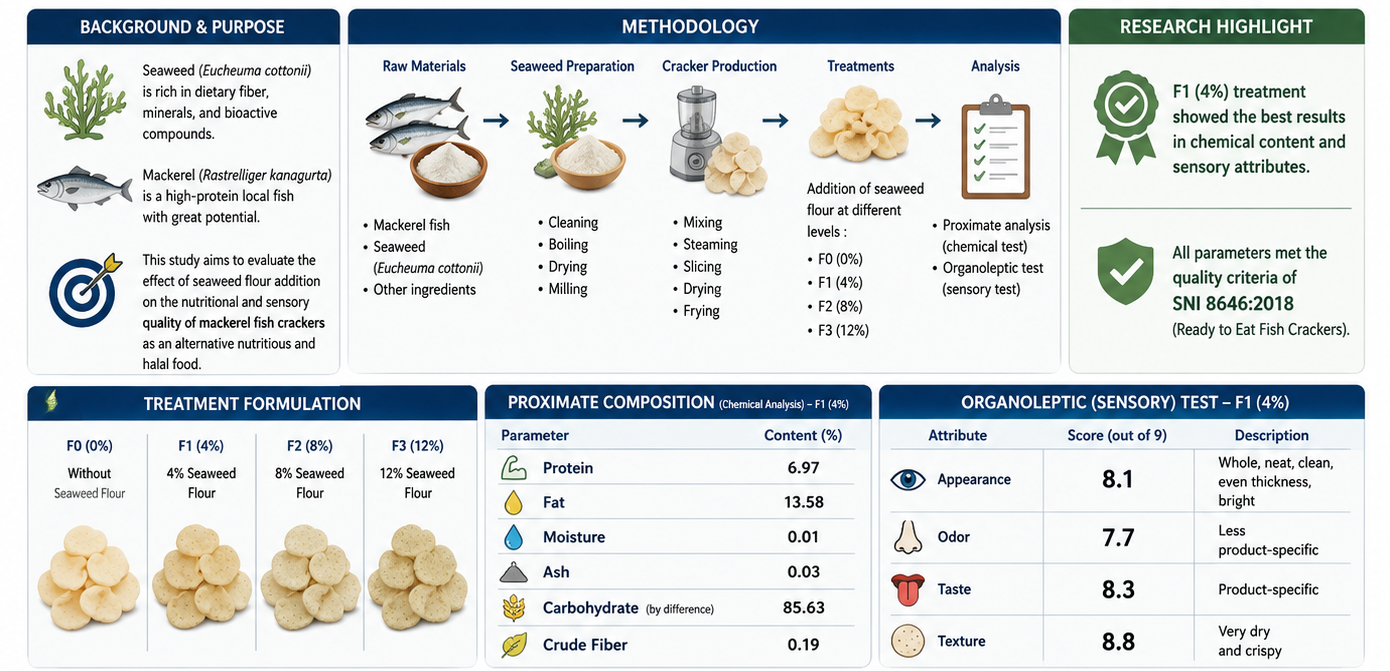
In Indonesia, there is a growing demand for nutritious and halal food products, particularly among consumers and producers. Seaweed flour emerges as a promising alternative ingredient, with the potential to enhance the nutritional value and quality of fish crackers. This study contributes to delve deeper into the impact of incorporating seaweed flour (Eucheuma cottonii) in mackerel (Rastrelliger kanagurta) crackers, exploring its role as a nutritious and halal food alternative. The experimental laboratory method employed a quantitative descriptive analysis (chemical test) and a descriptive (organoleptic test). Cracker samples were prepared with varying levels of seaweed flour (4%, 8%, and 12%). The results demonstrated that the F1 treatment (4%) yielded optimal chemical content (proximate), exhibiting a protein content of 6.97%, a fat content of 13.58%, a moisture content of 0.01%, an ash content of 0.03%, a carbohydrate content of 85.63%, and a crude fiber content of 0.19%. The results of the organoleptic (sensory) test demonstrated that the F1 (4%) treatment produced the optimal characteristics, exhibiting sensory attributes in the components of appearance ((8.1% (whole, neat, clean, even thickness, bright)), odor ((7.7% (less product-specific)), taste ((8.3% (product-specific)), and texture ((8.8% (very dry and crispy)). The outcomes of the chemical analysis (proximate) and the organoleptic test (sensory) have satisfied the quality criteria outlined in the SNI Ready to Eat Fish Crackers 8646: 2018. 8646:2018 standard. This study contributes to the development of functional food products by demonstrating that the addition of seaweed flour can improve the nutritional profile and sensory quality of fish-based snacks, while also offering an innovative solution that aligns with halal dietary standards.
References
A. Djakasaputra, Juliana, B. Aditi, Fachrurazi, and M. A. Mas’ad, “The influence of halal certification, halal awareness, and brand image on interest in buying halal food products: An empirical study of consumers in Indonesia,” Int. J. Islam. Bus. Econ., vol. 7, no. 2, pp. 103–115, 2023, https://doi.org/10.28918/ijibec.v7i2.2003.
L. A. Alavazo, “Exploring the characteristics and applications of Eucheuma cottonii seaweed flour in crepe production,” Advances in Research, vol. 25, no. 2, pp. 30–38, 2024, https://doi.org/10.9734/air/2024/v25i21030.
A. Basit, “The role of halal certification as a state regulatory instrument in strengthening the competitiveness of sharia-based MSMEs in the global market,” KASTA J. Ilmu Sos. Agama, Budaya dan Terap., vol. 6, no. 1, pp. 724–736, 2026, https://doi.org/10.58218/kasta.v6i1.2415.
D. N. Afifah, I. R. Sari, N. T. Prastifani, F. Fulyani, G. Anjani, N. Widyastuti, and V. N. Hastuti, “Effect of fermentation time on nutrition content, physical properties, pH, amino acids, fatty acids composition and organoleptics on fermented mackerel sausage (Rastrelliger kanagurta Cuvier) characteristics,” International Journal of Food Studies, vol. 12, no. 1, pp. 57–70, 2023, https://doi.org/10.7455/ijfs/12.1.2023.a4.
M. Canti, F. Kurniady, R. A. Hutagalung, and W. Prasetya, “Nutritional, physical, and sensory properties of fish crackers produced from the head of catfish (Clarias gariepinus),” Food Research, vol. 7, pp. 51–63, 2023, https://doi.org/10.26656/fr.2017.7(S1).17.
Badan Pusat Statistik, "Buletin Statistik Perdagangan Luar Negeri: Ekspor Menurut Kelompok Komoditi dan Negara 2024," Badan Pusat Statistik, vol. 20, no. 1, 2025. https://www.bps.go.id/id/publication/2025/01/30/ee890bd5d17a48ce912fd7b2/buletin-statistik-perdagangan-luar-negeri-ekspor-menurut-kelompok-komoditi-dan-negara--november-2024.html.
J. Cropotova, R. Mozuraityte, I. B. Standal, O. Szulecka, T. Kulikowski, A. Mytlewski, and T. Rustad, “Sensory and physicochemical quality characteristics of haddock fish cake enriched with atlantic mackerel,” Food Technology & Biotechnology, vol. 59, no. 1, pp. 4–15, 2021, https://doi.org/10.17113/ftb.59.01.21.6695.
A. S. Widati, D. Rosyidi, L. E. Radiati, and H. Nursyam, “The effect of seaweed (Eucheuma cottonii) flour addition on physicochemical and sensory characteristics of an Indonesian-style beef meatball,” International Journal of Food Studies, vol. 10, no. 2, pp. 112–120, 2021, https://doi.org/10.7455/ijfs/10.si.2021.a9.
E. S. Kaseng and F. W. Suhaeb, “Analysis the effect of the use seaweed (Eucheuma cottonii) as the substitution material to tapioca flour on the quality of snakehead fish (Channa striata) nugget,” J. Phys. Conf. Ser., vol. 1752, no. 1, pp 1–7, 2021, https://doi.org/10.1088/1742-6596/1752/1/012054.
Suharman and B. I. Pambudi, “Analysis of the nutritional value of seaweed (Eucheuma Cottonii) mocaf noodles,” J. Food Nutr., vol. 9, no. 1, pp. 1–6, 2023, https://doi.org/10.17303/jfn.2023.9.102.
N. N. Baishak, M. R. Islam, M. S. Moazzem, I. Ahmad, and W. Zzaman, “Quality evaluation of nutritious fish crackers developed from three carp fish species,” Asian Food Sci. J., vol. 17, no. 1, pp. 15–23, 2020, https://doi.org/10.9734/afsj/2020/v17i130182.
T. N. Ma’rifat, E. Musafi’in, H. S. Yufidasari, B. Kusuma, A. W. Perdana, A. S. F. Q.R.M, A. Rahmawan, and S. Teerawut, “Product quality evaluation of smoked catfish producer in Pati regency, Jawa Tengah based on proximate, microbiological, and organoleptic parameters,” J. Agri-Food Sci. Technol., vol. 7, no. 2, pp. 119–133, 2026, https://doi.org/10.12928/jafost.v7i2.12601.
A. Jebreen, M. I. Puspa, S. N. Rahmadhia, and S. P. Gautam, “Physicochemical characteristics of watermelon rind puree ice cream with cornstarch addition,” J. Agri-Food Sci. Technol., vol. 7, no. 2, pp. 165–176, 2026, https://doi.org/10.12928/jafost.v7i2.16160.
S. N. Rahmadhia, R. S. Dewi, and S. K. Putri, “Physicochemical properties of ambarella fruit leather with variations in gum arab concentration,” J. Keteknikan Pertan., vol. 13, no. 4, pp. 627–641, 2026, https://doi.org/10.19028/jtep.013.4.627-641.
H. Hamidatun, L. Azis, A. Zahra, N. Alfilasari, and A. N. Habyba, “Effect of steaming time on the bioactive compound content and antioxidant activity of sprouted cowpea (Vigna unguiculata) tempeh flour,” J. Agri-Food Sci. Technol., vol. 7, no. 1, pp. 43–54, 2026, https://doi.org/10.12928/jafost.v7i1.15444.
A. E. Ujong, N. J. T. Emelike, F. I. Woka, and F. Otekeiwebia JNR, “Formulation of fiber enriched crackers biscuit: Effect on nutritional composition, physical and sensory properties,” Heliyon, vol. 9, no. 5, p. e15941, 2023, https://doi.org/10.1016/j.heliyon.2023.e15941.
Q. Zhang, P. Liu, Y. Ma, Y. Diao, Y. Gu, and X. Fan, “Research progress on generation, detection and control of hazards in baked foods during thermal processing,” Food Chem. X, vol. 32, p. 103252, 2025, https://doi.org/10.1016/j.fochx.2025.103252.
Badan Standarisasi Nasional, “SNI 8646:2018 Kerupuk ikan, udang dan moluska siap makan,” Badan Standarisasi Nasional, 2018. https://pesta.bsn.go.id/produk/detail/12058-86462018.
Badan Standardisasi Nasional, "SNI 2364 Standar Nasional Indonesia pedoman pengujian sensori pada produk perikanan," Badan Standarisasi Nasional, 2015. https://akses-sni.bsn.go.id/viewsni/baca/6148.
M. Moosavi-Nasab, R. Mohammadi, and N. Oliyaei, “Physicochemical evaluation of sausages prepared by lantern fish (Benthosema pterotum) protein isolate,” Food Sci. Nutr., vol. 6, no. 3, pp. 617–626, 2018, https://doi.org/10.1002/fsn3.583.
A. S. Patel, A. Kar, R. C. Pradhan, D. Mohapatra, and B. Nayak, “Effect of baking temperatures on the proximate composition, amino acids and protein quality of de-oiled bottle gourd (Lagenaria siceraria) seed cake fortified biscuit,” LWT–Food Science and Technology, vol. 106, pp. 247–253, 2019, https://doi.org/10.1016/j.lwt.2019.02.026.
M. Canti, C. A. Wirawan, and D. Lestari, “Physicochemical and sensory quality of mackerel fish ball formulated by dumbo catfish (Clarias gariepinus) protein isolate as a binder,” Food Research, vol. 8, no. 6, pp. 318–330, 2024, https://doi.org/10.26656/fr.2017.8(6).630.
A. N. Zulfahmi, F. Swastawati, and Romadhon, “Pemanfaatan daging ikan tenggiri (Scomberomorus commersoni) dengan konsentrasi yang berbeda pada pembuatan kerupuk ikan,” J. Pengolah. dan Bioteknol. Has. Perikan., vol. 3, no. 4, pp. 133–139, 2014, https://ejournal3.undip.ac.id/index.php/jpbhp/article/view/7790/7546.
M. L. R. de Souza, E. Gasparino, E. S. dos R. Goes, M. F. Coradini, V. I. Vieira, G. G. Oliveira, M. A. Matiucci, A. C. V. J. de Castro, S. Siemer, V. R. T. Fernandes, and A. C. Feihrmann, “Fish carcass flours from different species and their incorporation in tapioca cookies,” Futur. Foods, vol. 5, p. 100132, 2022, https://doi.org/10.1016/j.fufo.2022.100132.
C. Litaay, A. Indriati, Sriharti, N. K. I. Mayasti, R. I. Tribowo, Y. Andriana, and R. C. E. Andriansyah, “Physical, chemical, and sensory quality of noodles fortification with anchovy (Stolephorus sp.) flour,” Food Science and Technology, vol. 42, pp. 1–7, 2022, https://doi.org/10.1590/fst.75421.
H. Mamat, Y. Y. Ling, A. H. A. Aziz, N. A. Wahab, R. G. M. Rosli, M. S. Sarjadi, M. K. Zainol, N. R. Putra, and M. A. C. Yunus, “Utilization of seaweed composite flour (Kappaphycus alvarezii) in the development of steamed bun,” J. Applied Phycology, vol. 35, no. 4, pp. 1911–1919, 2023, https://doi.org/10.1007/s10811-023-02989-y.
N. Mahmud, J. Islam, W. Oyom, K. Adrah, S. C. Adegoke, and R. Tahergorabi, “A review of different frying oils and oleogels as alternative frying media for fat-uptake reduction in deep-fat fried foods,” Heliyon, vol. 9, no. 11, p. 23, 2023, https://doi.org/10.1016/j.heliyon.2023.e21500.
M. Moosavi-Nasab, F. Asgari, and N. Oliyaei, “Quality evaluation of surimi and fish nuggets from Queen fish (Scomberoides commersonnianus),” Food Sci. Nutr., vol. 7, no. 10, pp. 3206–3215, 2019, https://doi.org/10.1002/fsn3.1172.
L. Zhu, L. Zha, H. Yi, B. Li, X. Pi, D. Qiao, and B. Zhang, “Effects of moisture content on the physicochemical properties and swallowing function of surimi gel,” Food Chem., vol. 508, p. 148372, 2026, https://doi.org/10.1016/j.foodchem.2026.148372.
L. Wei, P. Li, Y. Liu, and Y. Xie, “Effects of drying methods, temperature, and initial moisture content on drying characteristics, nutritional quality, texture, and oxidative stability of peanuts,” Foods, vol. 15, no. 7, p. 1248, 2026, https://doi.org/10.3390/foods15071248.
T. P. Murti, A. H. Purnomo, N. Dharmayanti, and R. B. S. Salampessy, “Application of refined carrageenan (RC) in the non-gluten crispy fish seaweed product processing,” IOP Conf. Ser. Earth Environ. Sci., vol. 278, no. 012048, 2019, https://doi.org/10.1088/1755-1315/278/1/012048.
M. Mohibbullah, A. Amin, M.A. Talha, M. A. Baten, M. M. Rana, A. A. Sabuz, A. W. Newaz, and J. S. Choi, “Physicochemical and nutritional characteristics of cookies prepared with untapped seaweed (Ulva intestinalis): An approach to value addition as a functional food,” Foods, vol. 12, no. 1, pp. 1–15, 2023, https://doi.org/10.3390/foods12010205.
S. N. Jamaluddin, Fitriana, S. Amirah, “Molecular identification of endophytic fungi isolated from bidara root (Ziziphus Mauritiana Lam.) using polymerase chain reaction (PCR),” Journal Microbiology Science, vol. 4, no. 1, pp 11–21, 2024, https://doi.org/10.56711/jms.v4i1.994.
N. Naghera, R. Parmar, D. Dudhagara, S. Gamit, N. Nandaniya, D. Chaun, R. Kothari, H. N, and S. Vyas, “Colloidal and structural perspectives on seaweed-derived bioactives: Extraction techniques and emerging applications,” Food Hydrocoll. Heal., vol. 9, p. 100260, 2026, https://doi.org/10.1016/j.fhfh.2025.100260.
M. Medina, R. M. García-Gimeno, J. A. Neira-Mosquera, A. Barrera, and G. D. Posada-Izquierdo, “nutritional and organoleptic characteristics of sausage based on an autochthonous ecuatorian fish, old blue (Andinoacara rivulatus),” Foods, vol. 13, no. 9, 1399, 2024, https://doi.org/10.3390/foods13091399.
D. Sundari, A. Almasyhuri, and A. Lamid, “Pengaruh proses pemasakan terhadap komposisi zat gizi bahan pangan sumber protein,” Media Penelit. dan Pengemb. Kesehat., vol. 25, no. 4, pp. 235–242, 2015, https://doi.org/10.22435/mpk.v25i4.4590.235-242.
A. Yaacob and N. S. Mohamed, “Compliance of Malaysia standard dried fish crackers of selected fish processor in terengganu,” Int. J. Adv. Res. Food Sci. Agric. Technol. 2, vol. 2, no. 1, 2024, https://doi.org/10.37934/fsat.2.1.5460a.
N. N. Baishak, M. R. Islam, M. S. Moazzem, I. Ahmad, and W. Zzaman, “Quality evaluation of nutritious fish crackers developed from three carp fish species,” Asian Food Sci. J., vol. 17, no. 1, pp. 15–23, 2020, https://doi.org/10.9734/AFSJ/2020/V17I130182.
O. B. Oprea, I. Tolstorebrov, I. C. Claussen, S. Sannan, L. Apostol, C. Moșoiu, and L. Gaceu, “Potential for Saccharina latissima flour as a functional ingredient in the baking sector,” Foods, vol. 12, no. 24, p. 4498, 2023, https://doi.org/10.3390/foods12244498.
S. Rauf Dahlstedt, J. P. Trigo, K. Stedt, F. Rosqvist, I. Undeland, H. Pavia, C. J. B. Rune, D. Giacalone, and P. Sandvik, “Sensory evaluation of seaweed – A scoping review and systematic assessment of sensory studies,” Appl. Food Res., vol. 5, no. 2, p. 101057, 2025, https://doi.org/10.1016/j.afres.2025.101057.
C. Ouyang, Z. Zeng, Z. Qin, J. Ding, and Y. Liu, “Optimizing crisp meat quality with modified starches: From rheological properties to post-freezing performance,” Foods, vol. 14, no. 17, p. 2947, 2025, https://doi.org/10.3390/foods14172947.
A. Raiyan, M. M. Hossain, M. A. Zahid, N. N. Lina, S. Das Shuvo, and R. Parvin, “Physicochemical characterization and microbial quality evaluation of (Gracilaria tenuistipitata) added crackers,” Appl. Food Res., vol. 4, no. 2, p. 100623, 2024, https://doi.org/10.1016/j.afres.2024.100623.
M. Ledbetter, K. Ross, J. Templeman, B. S. Chu, and J. D. Wilkin, “Effect of pre-processing treatment and concentration of Alaria esculenta, Saccharina latissima, and Laminaria digitata varieties on texture and consumer attribute preference of crackers,” Food Sci. Nutr., vol. 13, no. 1, 2025, https://doi.org/10.1002/fsn3.4710.
R. Ramesh, J. Shakila, Sivaraman, Ganesan, and P. Velayutham, “Optimization of the gelatinization conditions to improve the expansion and crispiness of fish crackers using RSM,” vol. 89, 2018, https://doi.org/10.1016/j.lwt.2017.10.045.
R. A. T. Cullano, “Optimization of seafood crackers formulation as influenced by Eucheuma cottonii and Caulerpa lentillifera seaweed levels,” J. Appl. Nat. Sci., vol. 17, no. 2, pp. 885–893, 2025, https://doi.org/10.31018/jans.v17i2.6612.
Downloads
Published
Issue
Section
License
Copyright (c) 2026 Nurul Ma'rifatul Azizah, Misbakhul Munir, Dian Sari Maisaroh

This work is licensed under a Creative Commons Attribution-ShareAlike 4.0 International License.
Authors who publish with the Journal of Agri-food Science and Technology (JAFOST) agree to the following terms:
- Authors retain copyright and grant the journal right of first publication with the work simultaneously licensed under a Creative Commons Attribution License (CC BY-SA 4.0) that allows others to share the work with an acknowledgment of the work's authorship and initial publication in this journal.
- Authors are able to enter into separate, additional contractual arrangements for the non-exclusive distribution of the journal's published version of the work (e.g., post it to an institutional repository or publish it in a book), with an acknowledgment of its initial publication in this journal.
- Authors are permitted and encouraged to post their work online (e.g., in institutional repositories or on their website) prior to and during the submission process, as it can lead to productive exchanges, as well as earlier and greater citation of published work.