Sensory Evaluation and Antioxidant Activity of Functional Ice Cream with The Ratio of Cardamom Powder and Dragon Fruit Peel Puree
DOI:
https://doi.org/10.12928/jafost.v6i2.12896Keywords:
Cardamom, Dragon fruit peel, Functional food, Ice cream, RatioAbstract
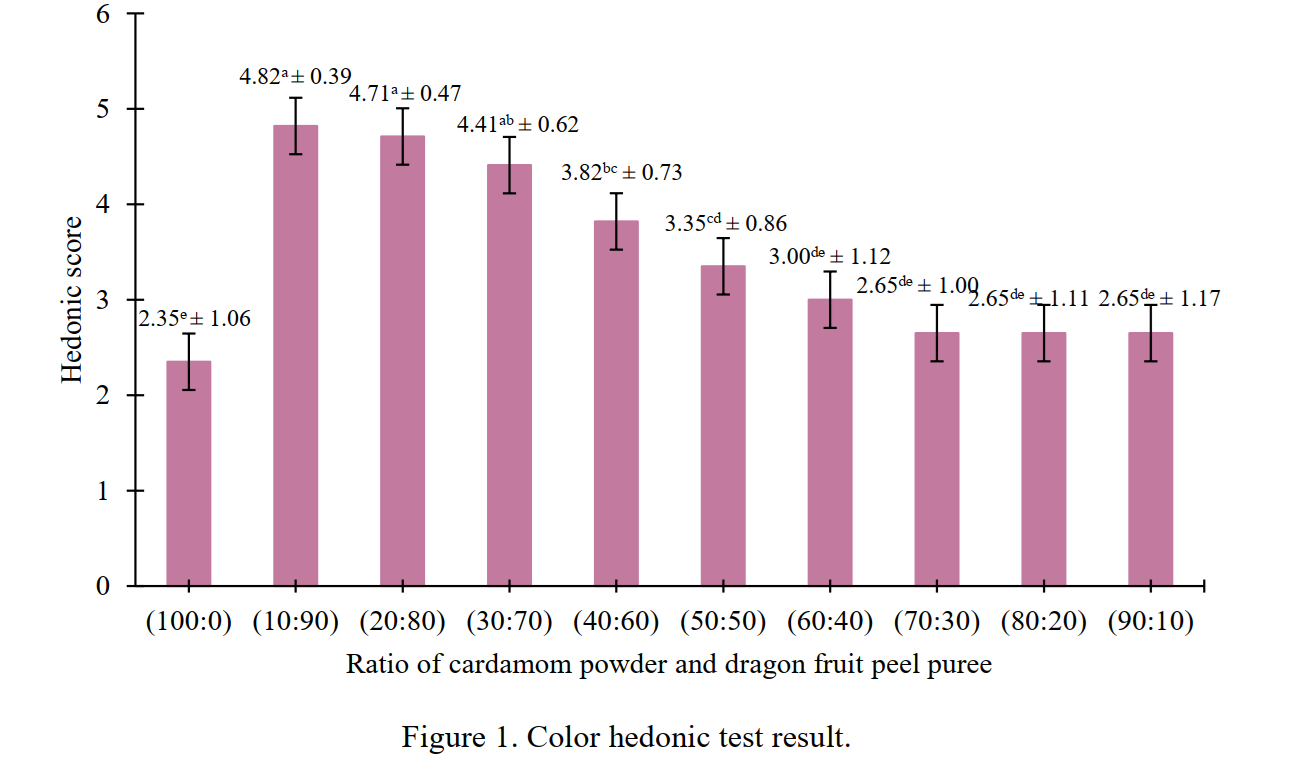
Functional food products are emerging due to increased public health awareness. Cardamom (Amomum cardamomum L.), a spice cultivated in Manukaya Village, Bali, is rich in flavonoids and essential oils such as 1,8-cineole, α-terpinyl acetate, α-terpineol, limonene, linalool, and α-pinene. These compounds act as natural flavorings and antioxidants, making cardamom a potential ingredient for functional ice cream. To enhance the ice cream’s appearance, natural colorants like dragon fruit peel waste, which are rich in anthocyanins, can be used. This study contributed to determine the optimal ratio of cardamom powder and dragon fruit peel puree to produce ice cream with favorable characteristics and functional potential. A Randomized Group Design (RGD) was applied with 10 treatment ratios (100:0; 10:90; 20:80; 30:70; 40:60; 50:50; 60:40; 70:30; 80:20; and 90:10) and two replications, totaling 20 experimental units. Ice cream was produced by mixing the ingredients according to each treatment, followed by freezing for 10 hours. The data were analyzed using ANOVA and Tukey’s test. The results indicated that the 10:90 ratio of cardamom powder to dragon fruit peel puree produced the best ice cream, with average sensory scores of 4.82 (slightly liked) for color, 4.65 (slightly liked) for taste, and 4.59 (slightly liked) for overall acceptance. This formulation also showed 20.19% antioxidant activity and had a rosy brown appearance with color values of L* 61.90, a* 10.64, and b* 3.85, supporting its potential as a functional food product.
References
M. F. Ramadan, Cardamom (Elettaria cardamomum): Production, Processing and Properties. Cham: Springer International Publishing, 2023, https://doi.org/10.1007/978-3-031-35426-7.
S. Qiblawi, M. A. Kausar, S. M. A. Shahid, Mohd. Saeed, and A. Y. Alazzeh, “Therapeutic interventions of cardamom in cancer and other human diseases,” J Pharm Res Int, vol. 32, no. 22, pp. 74–84, 2020, https://doi.org/10.9734/jpri/2020/v32i2230774.
A. Nizori, N. Sihombing, and Surhaini, “Karakteristik ekstrak kulit buah naga merah (Hylocereus polyrhizus) dengan penambahan berbagai kosentrasi asam sitrat sebagai pewarna alami makanan,” Jurnal Teknologi Industri Pertanian, vol. 30, no. 2, pp. 228–233, 2020, https://doi.org/10.24961/j.tek.ind.pert.2020.30.2.228.
A. Fitria and K. Y Mulkiya, “Penelusuran pustaka: potensi aktivitas antioksidan dan serat pangan kulit buah naga merah (Hylocereus polyrhizus) serta pemanfaatannya dalam pangan fungsional,” Bandung Conference Series: Pharmacy, vol. 2, no. 2, pp. 1–4, 2022, https://doi.org/10.29313/bcsp.v2i2.ID.
M. Mardiana, N. Sativa, H. Hariadi, N. Triandita, and N. E. Putri, “Optimation and sensory profile of functional drink from cinnamon and cardamom,” Journal of Applied Agricultural Science and Technology, vol. 4, no. 2, pp. 189–195, 2020, https://doi.org/10.32530/jaast.v4i2.138.
R. A. Arista, B. P. Priosoeryanto, and W. Nurcholis, “Profile volatile compounds in essential oils on different parts of cardamom with antioxidant activity,” Biointerface Res Appl Chem, vol. 13, no. 4, pp. 1–17, 2023, https://doi.org/10.33263/BRIAC134.328.
V. Simanjuntak, D. Fortuna Ayu, and E. Rossi, “Karakteristik fisik, kimia, dan organoleptik kombinasi susu kedelai dan ekstrak kulit buah naga merah (Hylocereus polyrhizus) dalam pembuatan es krim,” Jurnal Teknologi Pangan, vol. 11, no. 2, pp. 86–98, 2022, doi: https://doi.org/10.32520/jtp.v11i2.2010.
N. Ren, C. Wang, Z. Zhao, C. Cheng, W. Wei, and G. Qin, “Extraction of betacyanins from Hylocereus polyrhizus (dragon fruit) peel and further enrichment by adsorption,” International Journal of Food Engineering, vol. 16, no. 12, pp. 2–7, 2020, https://doi.org/10.1515/ijfe-2020-0037.
S. A. Hamdy, R. Prabha, D. P. Singh, and M. A. Farag, “Cardamom seed bioactives: A review of agronomic factors, preparation, extraction and formulation methods based on emerging technologies to maximize spice aroma economic value and applications,” Food Chemistry, vol. 462, 2025, https://doi.org/10.1016/j.foodchem.2024.141009.
M. K. Sugiyanto, M. F. Sumual, and G. S. S. Djarkasi, “Pengaruh suhu pasteurisasi terhadap profil dan aktivitas antioksidan puree buah naga merah,” Jurnal Teknologi Pertanian, vol. 11, no. 2, pp. 100–107, 2020, https://doi.org/10.35791/jteta.11.2.2020.31278.
G. T. Wangsaputri, I. G. A. M. Putra, M. R. M. Putri, and R. A. Sutisna, “Characteristics of ice cream innovation based on soy whey and dragon fruit peel puree and its potential as a functional food,” Journal of Functional Food and Nutraceutical, vol. 6, no. 1, pp. 1–8, 2024, https://doi.org/10.33555/jffn.v6i1.161.
H. T. Lawless and H. Heymann, Sensory evaluation of food: principles and practices, Second Edition. New York: Springer, 2010, https://doi.org/10.1007/978-1-4419-6488-5.
P. Shah and H. A. Modi, “Comparative study of DPPH, ABTS and FRAP assays for determination of antioxidant activity,” International Journal for Research in Applied Science & Engineering Technology (IJRASET), vol. 3, no. 6, pp. 636–641, 2015, [Online]. Available: https://www.researchgate.net/publication/307464470.
M. Zhao, Y. Lan, L. Cui, E. Monono, J. Rao, and B. Chen, “Formation, characterization, and potential food application of rice bran wax oleogels: Expeller-pressed corn germ oil versus refined corn oil,” Food Chem, vol. 309, pp. 1–9, 2020, https://doi.org/10.1016/j.foodchem.2019.125704.
L. Permana, P. Sriprom, K. Manamoongmongkol, L. Phumjan, and P. Assawasaengrat, “Optimization of betalain extraction from dragon fruit (Hylocereus undatus) peel and effect of pH on its properties,” Biomass Convers Biorefin, vol. 15, pp. 3545–3556, 2025, https://doi.org/10.1007/s13399-023-05260-z.
K. Tarfaoui et al., “Chemical profile, antibacterial and antioxidant potential of Zingiber officinale Roscoe and Elettaria cardamomum (L.) Maton essential oils and extracts,” Plants, vol. 11, no. 11, pp. 1–14, 2022, https://doi.org/10.3390/plants11111487.
Singletary and Keith, “Cardamom: Potential health Benefits,” Nutr Today, vol. 57, no. 1, pp. 38–49, 2022, https://doi.org/10.1097/NT.0000000000000507.
M. Alagupalamuthirsolai, M. Murugan, K. Ashokkumar, S. J. Ankegowda, S. Vellaikumar, V. Srinivasan, H. Asangi, H. J. Akshitha, M. F. Peeran, R. Sivaranjani, and R. A. Kumar, “Bio-active essential oil components in small cardamom as influenced by weather elements,” Agricultural Mechanization in Asia, Africa & Latin America, vol. 55, no. 04, pp. 17549–17560, 2024, https://l1nq.com/WANkE.
Z. M. Cai, J. Q. Peng, Y. Chen, L. Tao, Y. Y. Zhang, L. Y. Fu, Q. D. Long, and X. C. Shen, “1,8-Cineole: a review of source, biological activities, and application,” Journal of Asian Natural Products Research, vol. 23, no. 10, 2021, https://doi.org/10.1080/10286020.2020.1839432.
N. N. T. Tien, N. L. Le, T. T. Khoi, and A. Richel, “Characterisation of dragon fruit peel pectin extracted with natural deep eutectic solvent and sequential microwave-ultrasound-assisted approach,” Int J Food Sci Technol, vol. 57, no. 6, pp. 3735–3749, 2022, https://doi.org/10.1111/ijfs.15699.
M. L. Čolić, M. Antunović, M. Jukić, I. Popović, and J. Lukinac, “Sensory acceptance and characterisation of turmeric- and black-pepper-enriched ice cream,” Applied Sciences (Switzerland), vol. 13, no. 21, pp. 1–19, 2023, https://doi.org/10.3390/app132111802.
S. Thaiudom, R. Oonsivilai, and N. Thaiwong, “Production of colorant powder from dragon fruit (Hylocerecus polyrhizus) peel: Bioactivity, heavy metal contamination, antimutagenicity, and antioxidation aspects,” J Food Process Preserv, vol. 45, no. 1, 2021, https://doi.org/10.1111/jfpp.15044.
W. Nurcholis, R. Alfadzrin, N. Izzati, R. Arianti, B. Á. Vinnai, F. Sabri, E. Kristóf, and I. M. Artika, “Effects of methods and durations of extraction on total flavonoid and phenolic contents and antioxidant activity of java cardamom (Amomum compactum Soland Ex Maton) fruit,” Plants, vol. 11, no. 17, pp. 1–13, 2022, https://doi.org/10.3390/plants11172221.
H. Du, I. F. Olawuyi, N. S. Said, and W. Y. Lee, “Comparative analysis of physicochemical and functional properties of pectin from extracted dragon fruit waste by different techniques,” Polymers (Basel), vol. 16, no. 8, pp. 1–16, 2024, https://doi.org/10.3390/polym16081097.
V. T. Pham, N. D. Vu, T. N. P. Nguyen, N. M. Truong, Q. M. Bui, T. T. T. Bui, and N. Q. T. Phan, “Study of using ultrasonic waves in the producing dried dragon fruit peel processes,” Int J Food Sci, pp. 1–10, 2024, https://doi.org/10.1155/2024/8619783.
C. L. Roriz, S. A. Heleno, M. J. Alves, M. B. P.P. Oliveira, J. Pinela, M. I. Dias, R. C. Calhelha, P. Morales, I. C.F.R. Ferreira, and L. Barros, “Red pitaya (Hylocereus costaricensis) peel as a source of valuable molecules: Extraction optimization to recover natural colouring agents,” Food Chem, vol. 372, pp. 1–9, 2022, https://doi.org/10.1016/j.foodchem.2021.131344.
W. Tang, W. Li, Y. Yang, X. Lin, L. Wang, C. Li, and R. Yang, “Phenolic compounds profile and antioxidant capacity of pitahaya fruit peel from two red-skinned species (Hylocereus polyrhizus and Hylocereus undatus),” Foods, vol. 10, no. 6, pp. 1–16, 2021, https://doi.org/10.3390/foods10061183.
S. N. Jimenez-Garcia, L. Garcia-Mier, X. S. Ramirez-Gomez, H. Aguirre-Becerra, A. Escobar-Ortiz, L. M. Contreras-Medina, J. F. Garcia-Trejo, and A. A. Feregrino-Perez, “Pitahaya peel: A by-product with great phytochemical potential, biological activity, and functional application,” Molecules, vol. 27, no. 16, pp. 1–14, 2022, https://doi.org/10.3390/molecules27165339.
N. J. Temple, “A rational definition for functional foods: A perspective,” Front Nutr, vol. 9, pp. 1–4, 2022, https://doi.org/10.3389/fnut.2022.957516.
Y. Ozdemir, C. Ozbek, and S. Ilhan, “Ice cream cone enriched with carob molasses pulp,” Journal of Food Measurement and Characterization, vol. 16, no. 5, pp. 3782–3791, 2022, https://doi.org/10.1007/s11694-022-01489-w.
R. Alicia and M. W. Hapsari, “Karakteristik es krim ubi jalar kuning dengan pewarna alami tepung kulit buah naga merah,” Journal of Tropical AgriFood, vol. 6, no. 1, pp. 42–49, 2024, https://doi.org/10.35941/jtaf.6.1.2024.15507.42-49.
M. Parcheta, R. Świsłocka, S. Orzechowska, M. Akimowicz, R. Choińska, and W. Lewandowski, “Recent developments in effective antioxidants: The structure and antioxidant properties,” Materials, vol. 14, no. 8, 1984, https://doi.org/10.3390/ma14081984.
D. D. Zhou, M. Luo, A. Shang, Q. Q. Mao, B. Y. Li, R. Y. Gan, and H. B. Li, “Antioxidant food components for the prevention and treatment of cardiovascular diseases: Effects, mechanisms, and clinical studies,” Oxidative Medicine and Cellular Longevity, 2021, https://doi.org/10.1155/2021/6627355.
D. M. Salsabila, N. Alifiani, N. Islam, S. Febriana, and T. C. Nisa, “Aktivitas antioksidan dan total flavonoid es krim naga merah dan lidah buaya sebagai nonfarmakoterapi DMT2,” Jurnal Teknologi Pangan dan Kesehatan, vol. 4, no. 1, pp. 1–10, 2022, https://l1nq.com/R80kK.
S. Sreedharan, V. Nair, and L. Cisneros-Zevallos, “Protective role of phenolic compounds from whole cardamom (Elettaria cardamomum (L.) Maton) against LPS-induced inflammation in colon and macrophage cells,” Nutrients, vol. 15, no. 13, pp. 1–19, 2023, https://doi.org/10.3390/nu15132965.
Downloads
Published
Issue
Section
License
Copyright (c) 2025 Ida Ayu Tisna Wahyuniari, I Gede Arie Mahendra Putra, Made Dita Dewi Devani, Putu Wedananta Darma Wiguna

This work is licensed under a Creative Commons Attribution-ShareAlike 4.0 International License.
Authors who publish with the Journal of Agri-food Science and Technology (JAFOST) agree to the following terms:
- Authors retain copyright and grant the journal right of first publication with the work simultaneously licensed under a Creative Commons Attribution License (CC BY-SA 4.0) that allows others to share the work with an acknowledgment of the work's authorship and initial publication in this journal.
- Authors are able to enter into separate, additional contractual arrangements for the non-exclusive distribution of the journal's published version of the work (e.g., post it to an institutional repository or publish it in a book), with an acknowledgment of its initial publication in this journal.
- Authors are permitted and encouraged to post their work online (e.g., in institutional repositories or on their website) prior to and during the submission process, as it can lead to productive exchanges, as well as earlier and greater citation of published work.