Phytochemical Test of Sacha Inchi Oil from Central Java
DOI:
https://doi.org/10.12928/jafost.v6i3.12885Keywords:
Antioxidants, Bioactive compounds, Nutraceutical, Phytochemical analysis, Sacha inchi oilAbstract
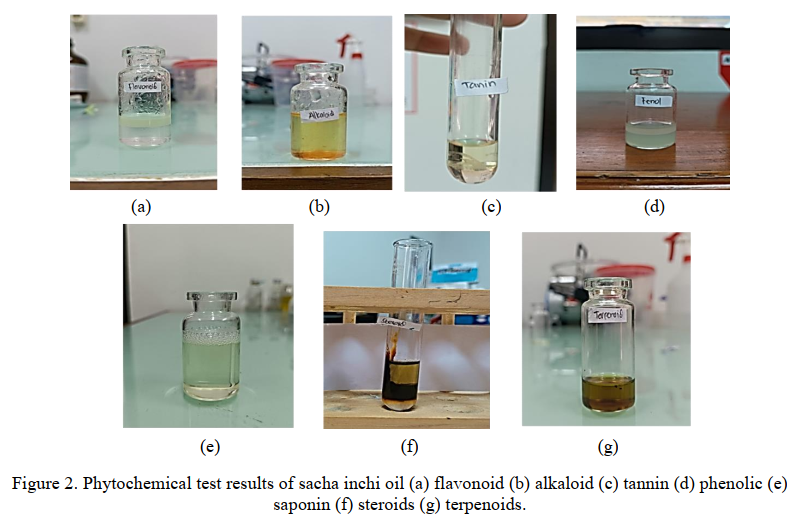
Sacha inchi oil is a seed-derived oil from the Amazon Rainforest, known for its high nutritional value and bioactive compounds. It contains essential fatty acids such as omega-3 and omega-6, along with tocopherols, polyphenols, carotenoids, and phytosterols, making it beneficial for health applications. Due to its nutritional and therapeutic properties, sacha inchi oil has gained significant attention in the food, cosmetic, and pharmaceutical industries. This study contributed to identify and analyze the bioactive compounds in sacha inchi oil extracted from seeds obtained in Central Java, Indonesia. The extraction process was carried out using a hot pressing method, followed by qualitative phytochemical analysis and LC-HRMS identification. The phytochemical tests confirmed the presence of flavonoids, alkaloids, tannins, phenolics, saponins, steroids, and terpenoids, all of which contribute to antioxidant, anti-inflammatory, anticancer, and antimicrobial properties. However, LC-HRMS analysis did not detect flavonoids, tannins, and saponins, possibly due to their low concentration, matrix effects, or degradation during analysis. These findings highlight sacha inchi oil’s potential in nutraceutical, pharmaceutical, and cosmetic industries. Its bioactive compounds suggest its potential use in functional foods, dietary supplements, and therapeutic applications, particularly in preventing oxidative stress-related diseases. Further research is recommended to optimize extraction techniques, improve compound stability, and evaluate its bioavailability and long-term health benefits. The presence of bioactive compounds indicates that sacha inchi oil can be a valuable functional ingredient for health and medical applications, contributing to sustainable and natural health solutions.
References
F. Ramos-Escudero, M. T. Morales, M. Ramos Escudero, A. M. Muñoz, K. Cancino Chavez, and A. G. Asuero, “Assessment of phenolic and volatile compounds of commercial Sacha inchi oils and sensory evaluation,” Food Research International, vol. 140, pp. 110022, 2021, https://doi.org/10.1016/j.foodres.2020.110022.
R. G. P. K. Ningrat and B. Pamungkas, “Review book of ‘Sacha inchi : A rich nutrient superfood from Amazon.’ by tresno saras,” Interdisciplinary International Journal of Conservation and Culture, vol. 2, no. 1, pp. 1–4, 2024, https://doi.org/10.25157/iijcc.v2i1.3847.
Q. V. Van, N. Y. P. Thi, T. N. Thi, M. N. Van, T. L. Van, B. N. V. Thi, and B. H. N. Thi, “Variation in growth and yield of sacha inchi (Plukenetia volubilis L.) under different ecological regions in Vietnam,” Journal of Ecological Engineering, vol. 23, no. 8, pp. 161–168, 2022, https://doi.org/10.12911/22998993/150659.
A. Lupi, Halimathusyakhdyah, H. A. P. Gulo, M. W. Putri, N. O. Maema, M. A. Akbar, S. Nazzal, and A. Permadi, “Composition analysis of Indonesian Sacha inchi (Plukenetia volubilis L.) oil and potential for food nutrition,” BIO Web Conf, vol. 148, pp. 04009, 2024, https://doi.org/10.1051/bioconf/202414804009.
A. Mukhametov, M. Yerbulekova, G. Aitkhozhayeva, G. Tuyakova, and D. Dautkanova, “Effects of ω-3 fatty acids and ratio of ω-3/ω-6 for health promotion and disease prevention,” Food Science and Technology, pp 1-10, 2022, https://doi.org/10.1590/fst.58321.
S. G. Redjeki, A. F. Hulwana, R. N. Aulia, I. Maya, A. Y. Chaerunisaa, and S. Sriwidodo, “Sacha inchi (Plukenetia volubilis): Potential bioactivity, extraction methods, and microencapsulation techniques,” Molecules, vol. 30, no. 1, pp. 160, 2025, https://doi.org/10.3390/molecules30010160.
S. Dubale, D. Kebebe, A. Zeynudin, N. Abdissa, and S. Suleman, “Phytochemical screening and antimicrobial activity evaluation of selected medicinal plants in ethiopia,” J Exp Pharmacol, vol. vol. 15, pp. 51–62, 2023, https://doi.org/10.2147/JEP.S379805.
H. S. Elshafie, I. Camele, and A. A. Mohamed, “A comprehensive review on the biological, agricultural and pharmaceutical properties of secondary metabolites based-plant origin,” Int J Mol Sci, vol. 24, no. 4, pp. 3266, 2023, https://doi.org/10.3390/ijms24043266.
M. Butnariu And N.-S. Bocso, “The biological role of primary and secondary plants metabolites,” Nutrition and Food Processing, vol. 5, no. 3, pp. 01–07, 2022, https://doi.org/10.31579/2637-8914/094.
S. Chen, X. Wang, Y. Cheng, H. Gao, and X. Chen, “A review of classification, biosynthesis, biological activities and potential applications of flavonoids,” Molecules, vol. 28, no. 13, pp. 4982, 2023, https://doi.org/10.3390/molecules28134982.
M. Russo, S. Moccia, C. Spagnuolo, I. Tedesco, and G. L. Russo, “Roles of flavonoids against coronavirus infection,” Chem Biol Interact, vol. 328, pp. 109211, 2020, https://doi.org/10.1016/j.cbi.2020.109211.
N. Habibah and G. A. M. Ratih, “Phytochemical profile and bioactive compounds of pineapple infused arak bali,” International Journal of Natural Science and Engineering, vol. 7, no. 1, pp. 84–94, 2023, https://doi.org/10.23887/ijnse.v7i1.58776.
J. M. Al-Khayri, R. Rashmi, V. Toppo, P. B. Chole, A. Banadka, W. N. Sudheer, P. Nagella, W. F. Shehata, M. Q. Al-Mssallem, F. M. Alessa, M. I. Almaghasla, and A. A. –S. Rezk, “Plant secondary metabolites: the weapons for biotic stress management,” Metabolites, vol. 13, no. 6, pp. 716, 2023, https://doi.org/10.3390/metabo13060716.
Y. Yan, X. Li, C. Zhang, L. Lv, B. Gao, and M. Li, “Research progress on antibacterial activities and mechanisms of natural alkaloids: A review,” Antibiotics, vol. 10, no. 3, pp. 318, 2021, https://doi.org/10.3390/antibiotics10030318.
M. Girard and G. Bee, “Invited review: Tannins as a potential alternative to antibiotics to prevent coliform diarrhea in weaned pigs,” Animal, vol. 14, no. 1, pp. 95–107, 2020, https://doi.org/10.1017/S1751731119002143.
F. Cosme, A. Aires, T. Pinto, I. Oliveira, A. Vilela, and B. Gonçalves, “A comprehensive review of bioactive tannins in foods and beverages: Functional properties, health benefits, and sensory qualities,” Molecules, vol. 30, no. 4, pp. 800, 2025, https://doi.org/10.3390/molecules30040800.
B. R. Albuquerque, S. A. Heleno, M. B. P. P. Oliveira, L. Barros, and I. C. F. R. Ferreira, “Phenolic compounds: current industrial applications, limitations and future challenges,” Food Funct, vol. 12, no. 1, pp. 14–29, 2021, https://doi.org/10.1039/D0FO02324H.
A. Kumar and F. Khan, “Phenolic compounds and their biological and pharmaceutical activities,” The chemistry inside spices & herbs: research and development, vol. 1, 2022, pp. 206-236, https://doi.org/10.2174/9789815039566122010010.
G. Wang, J. Wang, W. Liu, M. F. Nisar, M. A. El-Esawi, and C. Wan, “Biological activities and chemistry of triterpene saponins from medicago species: an update review,” Hindawi Evidence-Based Complementary and Alternative Medicine, vol. 21, pp. 1–11, 2021, https://doi.org/10.1155/2021/6617916.
S. Rai, E. Acharya-Siwakoti, A. Kafle, H. P. Devkota, and A. Bhattarai, “Plant-derived saponins: A review of their surfactant properties and applications,” Sci, vol. 3, no. 4, pp. 44, 2021, https://doi.org/10.3390/sci3040044.
M. Sochacki and O. Vogt, “Triterpenoid saponins from washnut (Sapindus mukorossi gaertn.)—A source of natural surfactants and other active components,” Plants, vol. 11, no. 18, pp. 2355, 2022, https://doi.org/10.3390/plants11182355.
O. D. Indriani and A. N. Khairi, “Physico-chemical characteristics of jelly drink with variation of red dragon fruit peel (Hylocereus polyrhizus) and additional sappan wood (Caesalpinia sappan),” Journal of Agri-Food Science and Technology (JAFoST), vol. 4, no. 1, pp 37–48, 2023, https://doi.org/10.12928/jafost.v4i1.7069.
E. Proshkina, S. Plyusnin, T. Babak, E. Lashmanova, F. Maganova, L. Koval, E. Platonova, M. Shaposhnikov, and A. Moskalev, “Terpenoids as potential geroprotectors,” Antioxidants, vol. 9, no. 6, pp. 529, 2020, https://doi.org/10.3390/antiox9060529.
J. S. Câmara, R. Perestrelo, R. Ferreira, C. V. Berenguer, J. A. M. Pereira, and P. C. Castilho, “Plant-derived terpenoids: A plethora of bioactive compounds with several health functions and industrial applications—A comprehensive overview,” Molecules, vol. 29, no. 16, pp. 3861, 2024, https://doi.org/10.3390/molecules29163861.
D. I. F. Asari, R. Rafsanjani, M. F. Vikriansyah, A. R. Muzayyan, N. J. Mubarakati, and G. E. Jayanti, “Detection of secondary metabolites in cucumber (Cucumis sativus) leaves and its potential as candidates for acne drug using histochemical analysis and in silico study,” EXSACT-A, vol. 1, pp. 55, 2023, https://doi.org/10.36722/exc.v1i1.2232.
M. Musdalipah, S. A. Tee, K. Karmilah, S. Sahidin, A. Fristiohady, and A. W. M. Yodha, “Total phenolic and flavonoid content, antioxidant, and toxicity test with bslt of meistera chinensis fruit fraction from southeast sulawesi,” Borneo Journal of Pharmacy, vol. 4, no. 1, pp. 6–15, 2021, https://doi.org/10.33084/bjop.v4i1.1686.
K. Godlewska, P. Pacyga, A. Najda, and I. Michalak, “Investigation of chemical constituents and antioxidant activity of biologically active plant-derived natural products.,” Molecules, vol. 28, no. 14, 2023, https://doi.org/10.3390/molecules28145572.
E. Bolat S. Sarıtaş, H. Duman, F. Eker, E. Akdaşçi, S. Karav, and A. M. Witkowska, “Polyphenols: Secondary metabolites with a biological impression,” Nutrients, vol. 16, no. 15, pp. 2550, 2024, https://doi.org/10.3390/nu16152550.
Masfria, A. Dalimunthe, N. Suci, and H. Syahputra, “Phytochemical constituent analysis of Phyllanthus emblica L. fruit nanoherbals by lc-hrms and their antimutagenic activity and teratogenic effects,” Molecules, vol. 29, no. 7, pp. 1642, 2024, https://doi.org/10.3390/molecules29071642.
A. Roy, A. Khan, I. Ahmad, S. Alghamdi, B. S. Rajab, A. O. Babalghith, M. Y. Alshahrani, S. Islam, Md. R. Islam, “Flavonoids a bioactive compound from medicinal plants and its therapeutic applications,” Biomed Res Int, vol. 22, no. 1, 2022, https://doi.org/10.1155/2022/5445291.
M. Zahra, H. Abrahamse, and B. P. George, “Flavonoids: antioxidant powerhouses and their role in nanomedicine,” Antioxidants (Basel), vol. 13, no. 8, 2024, https://doi.org/10.3390/antiox13080922.
L. Ciumărnean, M. V. Milaciu, O. Runcan, Ș. C. Vesa, A. L. Răchișan, V. Negrean, M.-G. Perné, V. I. Donca, T. –G. Alexescu, I. Para, and G. Dogaru, “The Effects of Flavonoids in Cardiovascular Diseases,” Molecules, vol. 25, no. 18, pp. 4320, 2020, https://doi.org/10.3390/molecules25184320.
Md. R. Islam, S. Akash, M. M. Islam, N. Sarkar, A. Kumer, S. Chakraborty, K. Dhama, M. A. Al-Shaeri, Y. Anwar, P. Wilairatana, A. Rauf, I. F. Halawani, F. M. Alzahrani, and H. Khan, “Alkaloids as drug leads in alzheimer’s treatment: Mechanistic and therapeutic insights,” Brain Res, vol. 1834, pp. 148886, 2024, https://doi.org/10.1016/j.brainres.2024.148886.
C. R. M. Souza, W. P. Bezerra, and J. T. Souto, “Marine alkaloids with anti-inflammatory activity: Current knowledge and future perspectives,” Mar Drugs, vol. 18, no. 3, pp. 147, 2020, https://doi.org/10.3390/md18030147.
Md. M. Rahman, Md. S. Rahaman, Md. R. Islam, F. Rahman, F. M. Mithi, T. Alqahtani, M. A. Almikhlafi, S. Q. Alghamdi, S. Alruwaili, Md. S. Hossain, M. Ahmed, R. Das, T. B. Emran, and Md. S. Uddin, “Role of phenolic compounds in human disease: Current knowledge and future prospects,” Molecules, vol. 27, no. 1, pp. 233, 2021, https://doi.org/10.3390/molecules27010233.
W. Sun and M. H. Shahrajabian, “Therapeutic potential of phenolic compounds in medicinal plants—natural health products for human health,” Molecules, vol. 28, no. 4, pp. 1845, Feb. 2023, https://doi.org/10.3390/molecules28041845.
L. L. Pruteanu, D. S. Bailey, A. C. Grădinaru, and L. Jäntschi, “The biochemistry and effectiveness of antioxidants in food, fruits, and marine algae,” Antioxidants, vol. 12, no. 4, pp. 860, 2023, https://doi.org/10.3390/antiox12040860.
N. A. R. Mhd Rodzi and L. K. Lee, “Sacha inchi (Plukenetia volubilis L.): Recent insight on phytochemistry, pharmacology, organoleptic, safety and toxicity perspectives,” Heliyon, vol. 8, no. 9, pp. e10572, 2022, https://doi.org/10.1016/j.heliyon.2022.e10572.
S. M. Mawazi, M. Kumar, N. Ahmad, Y. Ge, and S. Mahmood, “Recent applications of chitosan and its derivatives in antibacterial, anticancer, wound healing, and tissue engineering fields,” Polymers (Basel), vol. 16, no. 10, pp. 1351, 2024, https://doi.org/10.3390/polym16101351.
J. Jamaludin, “The sacha inchi (Plukenetia volubilis) research trends for health,” Jurnal Eduhealth, vol. 16, no. 1, pp. 344–351, 2025, htpps://doi.org/10.54209/eduhealth.v16i01.
V. E. Kaban, N. Nasri, Z. Rani, N. Suci, E. S. K. Sekali, and H. U. B. Sagala, “The effect of turmeric parent extract gel (Curcuma longa Linn) on incision wound healing in male white rats (Rattus norvegicus),” JPS, vol. 24, no. 4, pp. 616–627, 2020, https://doi.org/10.36490/journal-jps.com.v7i4.590.
Downloads
Published
Issue
Section
License
Copyright (c) 2025 Mulyono Hadi, Adi Permadi, Totok Eka Suharto, Mutiara Wilson Putri, Herbert Alessandro Panias Gulo, Nadin Okta Maema, Halimathusyakhdyah Halimathusyakhdyah, Ahmad Lupi

This work is licensed under a Creative Commons Attribution-ShareAlike 4.0 International License.
Authors who publish with the Journal of Agri-food Science and Technology (JAFOST) agree to the following terms:
- Authors retain copyright and grant the journal right of first publication with the work simultaneously licensed under a Creative Commons Attribution License (CC BY-SA 4.0) that allows others to share the work with an acknowledgment of the work's authorship and initial publication in this journal.
- Authors are able to enter into separate, additional contractual arrangements for the non-exclusive distribution of the journal's published version of the work (e.g., post it to an institutional repository or publish it in a book), with an acknowledgment of its initial publication in this journal.
- Authors are permitted and encouraged to post their work online (e.g., in institutional repositories or on their website) prior to and during the submission process, as it can lead to productive exchanges, as well as earlier and greater citation of published work.