Sago Porridge Enriched with Red Dragon Fruit (Hylocereus polyrhizus) Extract: A Functional Food with Enhanced Sensory and Nutritional Properties
DOI:
https://doi.org/10.12928/jafost.v6i2.12847Keywords:
Natural colorant, Physical parameters, Red dragon fruit extract, Sago porridge, Sensory evaluationAbstract
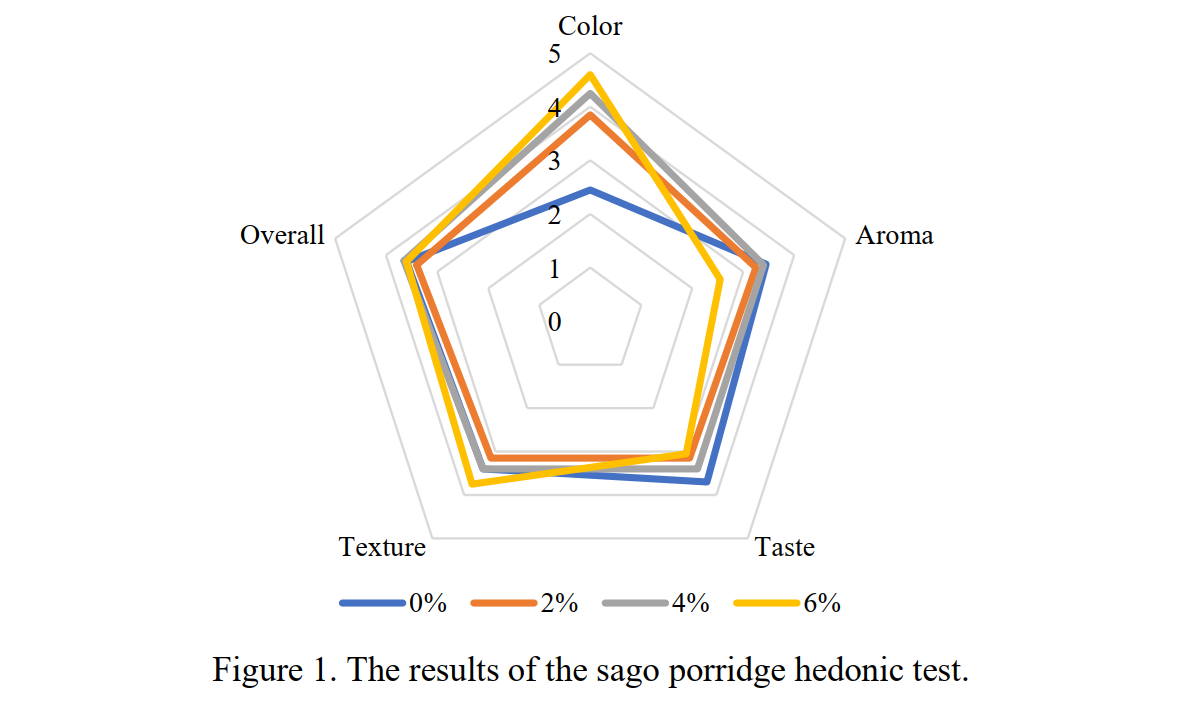
Sago, one of Indonesia’s staple foods, holds significant potential for food diversification due to its high carbohydrate content. However, despite its nutritional benefits, sago consumption remains less popular than corn and potatoes. Sago porridge, a traditional food product, can be developed into a healthy alternative, but its translucent brown color is visually unappealing, affecting consumer acceptance. This study aims to evaluate the optimal concentration of red dragon fruit extract as a natural colorant to enhance the visual appeal of sago porridge. The research method involved testing varying concentrations of red dragon fruit extract (0%, 2%, 4%, 6%) through sensory evaluation and physical analysis. Results showed that a 6% concentration yielded the highest acceptability, with the following physical properties: strawberry red color (L*:48.4; a*:70.8; b*:21.5), viscosity of 56,000 mPas, texture force of 8.7980 N, and pH of 7.21. This study contributes through the innovative use of red dragon fruit extract as a natural colorant, improving both the visual appeal and nutritional value of sago porridge. The optimal 6% concentration provides a practical reference for local food industries to produce value-added products, supporting food diversification based on local resources and aligning with global trends in healthy, natural foods.
References
F. F. Sidiq, D. Coles, C. Hubbard, B. Clark, and L. J. Frewer, “Factors influencing consumption of traditional diets: stakeholder views regarding sago consumption among the indigenous peoples of West Papua,” Agric Food Secur, vol. 11, no. 1, p. 51, 2022, https://doi.org/10.1186/s40066-022-00390-5.
W. Puspantari, P. T. Cahyana, A. Saepudin, Budiyanto, I. Kurniasari, A. D. Kusumasmarawati, H. Henanto, and M. Untoro, “Sago rice as an environmentally sustainable food,” BIO Web Conf, vol. 69, p. 03012, 2023, https://doi.org/10.1051/bioconf/20236903012.
Z. A. Syahariza and H. Y. Yong, “Evaluation of rheological and textural properties of texture-modified rice porridge using tapioca and sago starch as thickener,” Journal of Food Measurement and Characterization, vol. 11, no. 4, pp. 1586–1591, 2017, https://doi.org/10.1007/s11694-017-9538-x.
M. Mustafa Kamal, R. Baini, S. Mohamaddan, O. S. Selaman, N. Ahmad Zauzi, M. R. Rahman, N. Abdul Rahman, K. H. Chong, M. F. Atan, N. A. S. Abdul Samat, S. N. L. Taib, and A. K. Othman, “Effect of temperature to the properties of sago starch,” IOP Conf Ser Mater Sci Eng, vol. 206, p. 012039, 2017, https://doi.org/10.1088/1757-899X/206/1/012039.
M. A. Zailani, H. Kamilah, A. Husaini, A. Z. R. Awang Seruji, and S. R. Sarbini, “Functional and digestibility properties of sago (Metroxylon sagu) starch modified by microwave heat treatment,” Food Hydrocoll, vol. 122, p. 107042, 2022, https://doi.org/10.1016/J.FOODHYD.2021.107042.
W. Dewayani, Suryani, R. H. Arum, and E. Septianti, “Potential of sago products supporting local food security in South Sulawesi,” IOP Conf Ser Earth Environ Sci, vol. 974, no. 1, p. 012114, 2022, https://doi.org/10.1088/1755-1315/974/1/012114.
Shabrina Itsnaini Oktafira and B. Setiawan, “Formulasi bubur ready to eat berbasis kacang hijau (Vigna radiata) dan beras hitam (Oryza sativa L.) sebagai pangan darurat,” Jurnal Ilmu Gizi dan Dietetik, vol. 1, no. 2, pp. 110–118, 2022, https://doi.org/10.25182/jigd.2022.1.2.110-118.
T. W. Lim, R. L. H. Lim, L. P. Pui, C. P. Tan, and C. W. Ho, “Red dragon fruit (Hylocereus polyrhizus), a superfruit rich in betacyanins pigments with antioxidative potential for hepatoprotection: A review,” Future Foods, vol. 11, p. 100562, 2025, https://doi.org/10.1016/J.FUFO.2025.100562.
I. Tarte, A. Singh, A. H. Dar, A. Sharma, A. Altaf, and P. Sharma, “Unfolding the potential of dragon fruit (Hylocereus spp.) for value addition: A review,” eFood, vol. 4, no. 2, 2023, https://doi.org/10.1002/efd2.76.
S. Sumardiono, B. Budiyono, H. Kusumayanti, N. Silvia, V. F. Luthfiani, and H. Cahyono, “Production and physicochemical characterization of analog rice obtained from sago flour, mung bean flour, and corn flour using hot extrusion technology,” Foods, vol. 10, no. 12, p. 3023, 2021, https://doi.org/10.3390/foods10123023.
S. Wahjuningsih, H. Haslina, and M. Marsono, “Hypolipidaemic effects of high resistant starch sago and red bean flour- based analog rice on diabetic rats,” Materia Socio Medica, vol. 30, no. 4, p. 232, 2018, https://doi.org/10.5455/msm.2018.30.232-239.
K. A. Puspa Hapsari, I. M. Sugitha, and I. P. Suparthana, “Pengaruh penambahan puree daun kelor (Moringa oleifera Lamk.) terhadap karakteristik nugget ikan kembung (Rastrelliger kanagurta),” Jurnal Ilmu dan Teknologi Pangan (ITEPA), vol. 11, no. 1, p. 123, 2022, https://doi.org/10.24843/itepa.2022.v11.i01.p13.
Rahayu P Winarni, Pambayun Rindit, Santoso Umar, Giyatmi, and Ardiansyah, “Produk Pangan Indonesia 2017,” Edisi Pertama. Penerbit IPB Press, 2017, https://patpi.or.id/wp-content/uploads/2023/04/Ensiklopedia-Produk-Pangan-Indonesia_Jilid-1.pdf.
N. Fauziah Putri, A. S. Aji, V. Aprilia, R. Salfarino, R. B. S. MZ, N. Triwahyuni, and R. K. Triastanti, “Sensory evaluation of gulu naga ijo as a complementary finger food product,” Indonesian Journal of Human Nutrition, vol. 10, no. 2, pp. 105–115, 2023, https://doi.org/10.21776/ub.ijhn.2023.010.02.2.
J. A. Célia, O. Resende, M. S. de Lima, J. S. Correia, K. B. de Oliveira, and K. P. Takeuchi, “Technological properties of gluten-free biscuits from sorghum flour granifero (Sorghum bicolor (L.) Moench),” Food Science and Technology (Brazil), vol. 42, 2022, https://doi.org/10.1590/fst.29222.
D. W. Dari, L. Alfiatul, and D. Junita, “Karakteristik kimia dan derajat keasaman minuman sari buah pedada (Sonneratia sp.) dengan penambahan natrium benzoat,” Jurnal Teknologi Pangan dan Gizi, vol. 20, no. 1, pp. 35–44, 2021, https://doi.org/10.33508/jtpg.v20i1.2863.
O. D. Indriani and A. N. Khairi, “Physico-chemical characteristics of jelly drink with variation of red dragon fruit peel (Hylocereus polyrhizus) and additional sappan wood (Caesalpinia sappan),” Journal of Agri-Food Science and Technology, vol. 4, no. 1, pp. 37–48, 2023, https://doi.org/10.12928/jafost.v4i1.7069.
L. H. Afrianti, Y. Taufik, and H. Gustianova, “Karaktersitik fisiko-kimia dan sensorik jus ekstrak buah salak (Salacca edulis Reinw) varietas bongkok,” Chimica et Natura Acta, vol. 2, no. 2, 2014, https://doi.org/10.24198/cna.v2.n2.9155.
S. Kumari, D. Thakur, S. Singh, M. Bakshi, and S. K. Singh, “Dragon fruit: Exploring bioactive compounds and their promising role in functional food innovation and value-added products,” Journal of Food Composition and Analysis, vol. 141, p. 107370, 2025, https://doi.org/10.1016/j.jfca.2025.107370.
A. Hasanah, N. Nurrahman, and A. Suyatno, “Penambahan ekstrak kulit buah naga terhadap derajat warna, kadar antosianin, aktivitas antioksidan dan sifat sensoris cendol,” Jurnal Pangan dan Gizi, vol. 12, no. 1, p. 25, 2022, https://doi.org/10.26714/jpg.12.1.2022.25-31.
S. A. Prayitno and A. Rahma, “The sensory evaluation on pumpkin ice cream that formulated by red dragon fruit,” Food Science and Technology Journal, vo. 2, no. 2, 2019, https://doi.org/10.25139/fst.v0i0.2036.
A. E. Putri, M. Murhadi, N. Herdiana, and S. Hidayati, “Effect of adding jackfruit dami (Artocarpus heterophyllus) on the sensory and chemical characteristics of red dragon fruit (Hylocereus polyrhizus) fruit leather,” Jurnal Keteknikan Pertanian Tropis dan Biosistem, vol. 12, no. 2, pp. 86–93, 2024, https://doi.org/10.21776/ub.jkptb.2024.012.02.02.
X. Chen, Y. Cao, W. Lan, Z. Gu, W. He, J. He, and L. Zhao, “Quality-driven design of pandan-flavored sponge cake: Unraveling the role of thermal processing on typical pandan aroma,” Foods, vol. 13, no. 19, p. 3074, 2024, https://doi.org/10.3390/foods13193074.
C. Chusak, J. A. Y. Ying, J. L. Zhien, P. Pasukamonset, C. J. Henry, S. Ngamukote, and S. Adisakwattana, “Impact of Clitoria ternatea (butterfly pea) flower on in vitro starch digestibility, texture and sensory attributes of cooked rice using domestic cooking methods,” Food Chem, vol. 295, pp. 646–652, 2019, https://doi.org/10.1016/J.FOODCHEM.2019.05.157.
N. Yeasmin, B. R. Sarker, A. Begum, M. Z. U. Al Mamun, N. Rahman, M. S. Hossen, M. Motalab, and R. A. Sathee, “Fortification of yogurt with red dragon fruit’s (Hylocereus polyrhizus) peel powder: Effects on comprehensive quality attributes and sensory properties,” Turkish Journal of Agriculture-Food Science and Technology, vol. 11, no. 12, pp. 2300–2307, 2023, https://doi.org/10.24925/turjaf.v11i12.2300-2307.6187.
D. B. Rodriguez-Amaya, “Update on natural food pigments - A mini-review on carotenoids, anthocyanins, and betalains,” Food Research International, vol. 124, pp. 200–205, 2019, https://doi.org/10.1016/j.foodres.2018.05.028.
G. B. Raj and K. K. Dash, “Development of hydrocolloids incorporated dragon fruit leather by conductive hydro drying: Characterization and sensory evaluation,” Food Hydrocolloids for Health, vol. 2, p. 100086, 2022, https://doi.org/10.1016/j.fhfh.2022.100086.
I. D. Kumalasari and A. P. Devira, “Aktivitas antioksidan dan evaluasi sensori kukis tersubstitusi tepung kacang hijau dan tepung kulit buah naga merah,” Jurnal Teknologi dan Industri Pangan, vol. 35, no. 1, pp. 67–78, 2024, https://doi.org/10.6066/jtip.2024.35.1.67.
O. Lina, O. Rahayu, A. Fidyasari, A. F. Putra, and I. Malang, “Organoleptic and dietary fiber quality of black pigeon pea flour as bioencapsulation material,” vol. 3, no. 4, 2022, https://doi.org/10.47492/jip.v3i6.1968.
S. Shameena, P. R. G. Lekshmi, P. P. Gopinath, P. Gidagiri, and S. Kanagarajan, “Dynamic transformations in fruit color, bioactive compounds, and textural characteristics of purple-fleshed dragon fruit (Hylocereus costaricensis) across fruit developmental stages under humid tropical climate,” Horticulturae, vol. 10, no. 12, p. 1280, 2024, https://doi.org/10.3390/horticulturae10121280.
G. Kaur, B. Thawkar, S. Dubey, and P. Jadhav, “Pharmacological potentials of betalains,” J Complement Integr Med, vol. 15, no. 3, 2018, https://doi.org/10.1515/jcim-2017-0063.
W. Liaotrakoon, N. de Clercq, V. van Hoed, D. van de Walle, B. Lewille, and K. Dewettinck, “Impact of thermal treatment on physicochemical, antioxidative and rheological properties of white-flesh and red-flesh dragon fruit (Hylocereus spp.) purees,” Food Bioproc Tech, vol. 6, no. 2, pp. 416–430, 2013, https://doi.org/10.1007/s11947-011-0722-4.
T. P. Dao, L. P. U. Nguyen, D. T. Le, T. Y. N. Tran, and X. P. Huynh, “Effects of pectinase treatment on the quality of red dragon fruit (Hylocereus polyrhizus) juice,” Int Food Res J, vol. 30, no. 4, pp. 945–952, 2023, https://doi.org/10.47836/ifrj.30.4.12.
Y. Sato and O. Miyawaki, “Analysis of intermolecular interaction among pectin molecules in aqueous sugar solutions,” Food Sci Technol Res, vol. 14, no. 3, pp. 232–238, 2008, https://doi.org/10.3136/fstr.14.232.
N. Addion, S. Nola, and Surhaini, “Karakteristik ekstrak kulit buah naga merah (Hylocereus Polyrhizus) dengan penambahan berbagai kosentrasi asam sitrat sebagai pewarna alami makanan,” Jurnal Teknologi Industri Pertanian, pp. 228–233, 2020, https://doi.org/10.24961/j.tek.ind.pert.2020.30.2.228.
N. Salma, A. Setiyoko, Y. P. Sari, and Y. Rahmadian, “Effect of wheat flour and yellow pumpkin flour ratios on the physical, chemical properties, and preference level of cookies,” J. Agri-Food Sci. Technol., vol. 4, no. 2, pp. 59–70, 2024, https://doi.org/10.12928/jafost.v4i2.7882.
E. Asimakopoulou et al., “Analytical rheology as a tool for the structural investigation of citrus pectin,” J Texture Stud, vol. 55, no. 2, 2024, https://doi.org/10.1111/jtxs.12828.
F. Zhu, Y.-Z. Cai, M. Sun, and H. Corke, “Influence of Amaranthus betacyanin pigments on the physical properties and color of wheat flours,” J Agric Food Chem, vol. 56, no. 17, pp. 8212–8217, 2008, https://doi.org/10.1021/jf801579c.
S. Nabawiyati, N. Makiyah, I. Setyawati, and S. N. Rahmadhia, “Comparison of yam composite cookies sensory characteristic between sugar and stevia sweeteners,” J. Agri-Food Sci. Technol., vol. 5, no. 2, pp. 120–133, 2024, https://doi.org/10.12928/jafost.v5i2.10211.
Z. A. Syahariza and H. Y. Yong, “Evaluation of rheological and textural properties of texture-modified rice porridge using tapioca and sago starch as thickener,” Journal of Food Measurement and Characterization, vol. 11, no. 4, pp. 1586–1591, 2017, https://doi.org/10.1007/s11694-017-9538-x.
R. Barlina, S. Liwu, L. Trivana, A. P. Manambangtua, and J. Wungkana, “Karakteristik papeda instan pati sagu,” Buletin Palma, vol. 23, no. 1, p. 51, 2022, https://doi.org/10.21082/bp.v23n1.2022.51-59.
R. Qalbi, S. Giovani, Q. Guo, and N. M. Adelina, “Effect of drying time on physicochemical characteristics of dragon fruit peels powder (Hylocereus polyrhizus),” J. Agri-Food Sci. Technol., vol. 4, no. 2, pp. 81–96, 2024, https://doi.org/10.12928/jafost.v4i2.9294.
Downloads
Published
Issue
Section
License
Copyright (c) 2025 I Gede Arie Mahendra Putra, Luh Dian Rna Fajarini, Putu Julyantika Nica Dewi, Wafi Adizara Muzakki, Nur Syamsi Ibrahim

This work is licensed under a Creative Commons Attribution-ShareAlike 4.0 International License.
Authors who publish with the Journal of Agri-food Science and Technology (JAFOST) agree to the following terms:
- Authors retain copyright and grant the journal right of first publication with the work simultaneously licensed under a Creative Commons Attribution License (CC BY-SA 4.0) that allows others to share the work with an acknowledgment of the work's authorship and initial publication in this journal.
- Authors are able to enter into separate, additional contractual arrangements for the non-exclusive distribution of the journal's published version of the work (e.g., post it to an institutional repository or publish it in a book), with an acknowledgment of its initial publication in this journal.
- Authors are permitted and encouraged to post their work online (e.g., in institutional repositories or on their website) prior to and during the submission process, as it can lead to productive exchanges, as well as earlier and greater citation of published work.