Total Phenolic Content and Hedonic Quality of Germinated Jack Bean Tempeh at Different Fermentation Times and Packaging Types
DOI:
https://doi.org/10.12928/jafost.v6i2.12698Keywords:
Fermentation duration, Germinated jack bean tempeh, Hedonic quality, Packaging type, Total phenolic contentAbstract
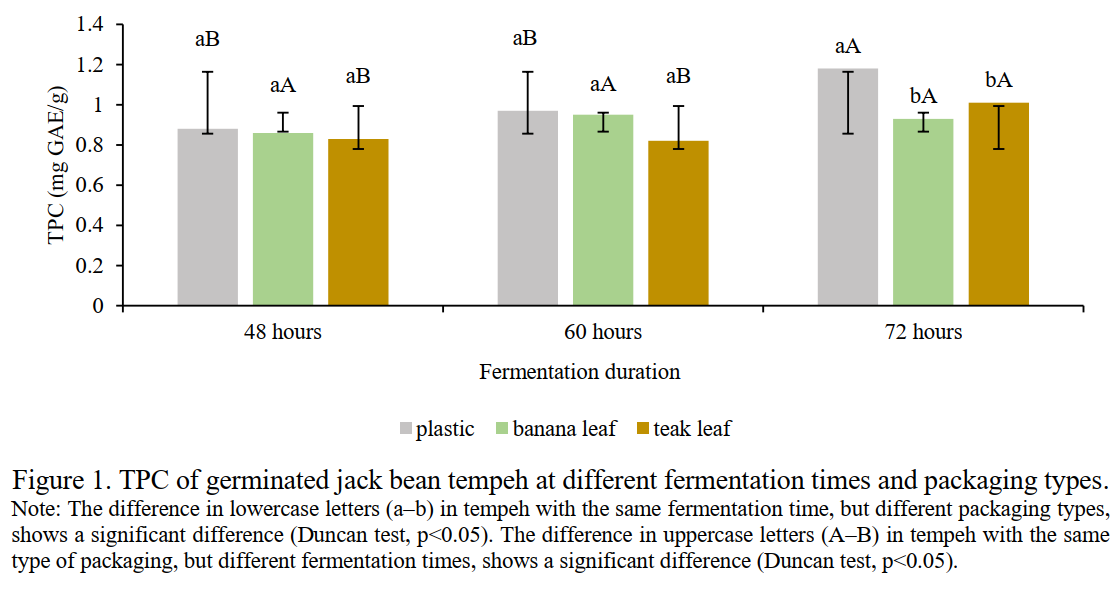
This study evaluated the interaction effects of different fermentation durations and packaging types on producing the best-germinated jack bean tempeh based on total phenolic content (TPC) and hedonic quality. This study uses a factorial experimental design with a randomized group of 3 × 3 treatments. The factors included fermentation durations (48, 60, and 72 hours) and packaging types (plastic, banana leaves, and teak leaves). There were 9 treatments with 3 replications each. Statistical analysis for TPC was performed using ANOVA, while hedonic quality was analyzed using the Friedman test. If significant effects (p<0.05) were detected, data analysis was continued with DMRT. The best treatment was determined using De Garmo's effectiveness index test. The interaction between fermentation duration and packaging type significantly affected TPC (p=0.045), color quality (p=0.000), aroma (p=0.004), and appearance (p=0.000), but had no significant effect on taste quality (p=0.100). The best treatment was tempeh which had a fermentation duration of 60 hours and used plastic packaging. It contained 0,97 mg GAE/g of phenolic compounds (low) with antioxidant activity IC50 value of 6.951,38 ppm (weak). It had hedonic scores of 3.50 for taste (characteristic of tempeh), 3.20 for aroma (not musty), 3.90 for color (white), and 3.20 for appearance (compact). Based on its TPC and antioxidant activity, it is not sufficiently strong to inhibit oxidative stress. These results can be used as a basis for considering the use of germinated jack beans as an alternative antidiabetic functional food product.
References
S. Q. Teoh, N. L. Chin, C. W. Chong, A. M. Ripen, S. How, and J. J. L. Lim, “A review on health benefits and processing of tempeh with outlines on its functional microbes,” Futur. Foods, vol. 9, p. 100330, 2024, https://doi.org/10.1016/j.fufo.2024.100330.
F. S. Sundari, Khoirunnisa, A. P. G. Prayudani, N. Wulandari, M. Syukur, and M. Astawan, “A nutritional, physicochemical, and sensory evaluation of tempe combination from cowpea and soybean,” Indones. Food Sci. Technol. J., vol. 8, no. 1, pp. 16–26, 2024, https://doi.org/10.22437/ifstj.v8i1.36386.
I. Kusumawati, M. Astawan, and E. Prangdimurti, “Production process and characteristic of tempe from dehulled soybean,” Pangan, vol. 29, no. 2, pp. 117–126, 2020, https://doi.org/10.33964/jp.v29i2.492.
A. T. Hartanti, G. Rahayu, and I. Hidayat, “Rhizopus species from fresh tempeh collected from several regions in indonesia,” HAYATI J. Biosci., vol. 22, no. 3, pp. 136–142, 2015, https://doi.org/10.1016/j.hjb.2015.10.004.
S. Rizal, M. E. Kustyawati, D. Sartika, R. Sasriany, R. Hidayat, and A. Suyantohadi, “Innovation of tempeh from jack bean (Canavalia ensiformis) fermented with Mosaccha inoculum,” Food Biosci., vol. 62, 2024, https://doi.org/10.1016/j.fbio.2024.105564.
M. Burkard, C. Leischner, U. M. Lauer, C. Busch, S. Venturelli, and J. Frank, “Dietary flavonoids and modulation of natural killer cells: Implications in malignant and viral diseases,” J Nutr Biochem, vol. 46, pp. 1–12, 2017, https://doi.org/10.1016/j.jnutbio.2017.01.006.
W. T. Liu, C. L. Huang, R. Liu, T. C. Yang, C. L. Lee, R. Tsao, and W. J. Yang, “Changes in isoflavone profile, antioxidant activity, and phenolic contents in Taiwanese and Canadian soybeans during tempeh processing,” Lwt, vol. 186, p. 115207, 2023, https://doi.org/10.1016/j.lwt.2023.115207.
A. Murdiati, S. Anggrahini, Supriyanto, and A. ’Alim, “Peningkatan kandungan protein mie basah dari tapioka dengan substitusi tepung koro pedang putih (Canavalia ensiformis L.),” Agritech, vol. 35, no. 3, pp. 251–260, 2015, https://doi.org/10.22146/agritech.9334.
C. A. Nursalma, S. Setyowati, and A. Sitasari, “Substitusi tepung kacang koro pedang (Canavalia ensiformis (L.) DC.) pada pie susu ditinjau dari sifat organoleptik, kandungan gizi dan unit cost,” Puinovakesmas, vol. 2, no. 1, pp. 1–11, 2021, https://doi.org/10.29238/puinova.v2i1.1061.
F. C. Agustia, S. Rosyidah, Y. P. Subardjo, G. R. Ramadhan, and D. Betaditya, “Formulation of flakes made from mocaf-black rice-tapioca high in protein and dietary fiber by soy and jack bean flour addition,” IOP Conf. Ser. Earth Environ. Sci., vol. 255, no. 1, pp. 1–9, 2019, https://doi.org/10.1088/1755-1315/255/1/012019.
B. Arifin and S. Ibrahim, “Struktur, bioaktivitas dan antioksidan flavonoid,” J. Zarah, vol. 6, no. 1, pp. 21–29, 2018, https://doi.org/10.31629/zarah.v6i1.313.
I. Tsalissavrina, A. Murdiati, S. Raharjo, and L. A. Lestari, “Distribusi isoflavon dan aktivitas antioksidan pada kecambah koro pedang putih (Canavalia Ensiformis L. (DC)),” Indones. J. Hum. Nutr., vol. 9, no. 2, pp. 190–199, 2022, https://doi.org/10.21776/ub.ijhn.2022.009.02.7.
S. Widoyo, S. Handajani, and Nandariyah, “The effect of fermentation time to crude fiber contents and antioxidant activities in several soybean varieties of tempeh,” Biofarmasi, vol. 13, no. 2, pp. 59–65, 2015, https://doi.org/10.13057/biofar/f130203.
F. C. Agustia, S. Supriyadi, A. Murdiati, and R. Indrati, “Germination of jack bean [Canavalia ensiformis (L.) DC.] and its impact on nutrient and anti-nutrient composition,” Food Res., vol. 7, no. 5, pp. 210–218, 2023, https://doi.org/10.26656/fr.2017.7(5).905.
A. Starzyńska-Janiszewska, R. Duliński, B. Stodolak, B. Mickowska, and A. Wikiera, “Prolonged tempe-type fermentation in order to improve bioactive potential and nutritional parameters of quinoa seeds,” J. Cereal Sci., vol. 71, pp. 116–121, 2016, https://doi.org/10.1016/j.jcs.2016.08.001.
Y. Asbur and Khairunnisyah, “Tempe as a source of antioxidants : A review,” Agril. J. Ilmu Pertan., vol. 9, no. 3, pp. 183–192, 2021, https://jurnal.uisu.ac.id/index.php/agriland/article/view/5034/3605.
A. Liuspiani, I. HimayatulAsri, Y. Lestarini, Z. Muspita, and M. Husni, “Pengaruh jenis bahan kemasan terhadap kualitas organoleptik dan daya simpan tempe kedelai,” JISIP (Jurnal Ilmu Sos. dan Pendidikan), vol. 4, no. 4, pp. 521–524, 2020, https://doi.org/10.58258/jisip.v4i4.1565.
S. Rizal, M. E. Kustyawati, Zulferiyenni, Murhadi, D. Zulfa, F. Rosida, F. N. A. Syifani, and A. D. P. Permatahati, “Chemical properties, sensory characteristics, and antibacterial activity to Staphylococcus aureus of tempeh gembus fermented with Mosaccha inocula,” Innov. Food Sci. Emerg. Technol., vol. 95, p. 103742, 2024, https://doi.org/10.1016/j.ifset.2024.103742.
S. Sayuti, “Pengaruh bahan kemasan dan lama inkubasi terhadap kualitas tempe kacang gude sebagai sumber belajar ipa,” BIOEDUKASI (Jurnal Pendidik. Biol., vol. 6, no. 2, pp. 148–158, 2015, https://doi.org/10.24127/bioedukasi.v6i2.345.
M. S. Drabo, A. Savadogo, and K. Raes, “Effects of tempeh fermentation using Rhizopus oryzae on the nutritional and flour technological properties of Zamnè (Senegalia macrostachya seeds): Exploration of processing alternatives for a hard-to-cook but promising wild legume,” Food Biosci., vol. 54, p. 102823, 2023, https://doi.org/10.1016/j.fbio.2023.102823.
O. H. Kristiadi and A. T. Lunggani, “Tempeh as indonesian special fermented food: Literature review,” J. Andaliman-Jurnal Gizi Pangan, Klin. Dan Masy., vol. 2, no. 2, pp. 48–56, 2022, https://doi.org/10.24114/jgpkm.v2i2.40334.
E. Puspitojati, R. Indrati, M. N. Cahyanto, and Y. Marsono, “Effect of fermentation time on the molecular weight distribution of ACE inhibitory peptide from jack bean tempe,” IOP Conf. Ser. Earth Environ. Sci., vol. 1177, no. 1, p. 4, 2023, https://doi.org/10.1088/1755-1315/1177/1/012026.
E. Puspitojati, R. Indrati, M. N. Cahyanto, and Y. Marsono, “Formation of ACE-inhibitory peptides during fermentation of jack bean tempe inoculated by usar Hibiscus tiliaceus leaves starter,” IOP Conf. Ser. Earth Environ. Sci., vol. 292, no. 1, 2019, https://doi.org/10.1088/1755-1315/292/1/012022.
H. H. Orak, “Total antioxidant activities, phenolics, anthocyanins, polyphenoloxidase activities of selected red grape cultivars and their correlations,” Sci. Hortic. (Amsterdam)., vol. 111, no. 3, pp. 235–241, 2007, https://doi.org/10.1016/j.scienta.2006.10.019.
H. R. Moskowitz, J. H. Beckley, and A. V. A. Resurreccion, "Sensory and consumer research in food product design and development." 2007, https://doi.org/10.1002/9780470277706.
E. P. DeGarmo, J. R. Canada, and W. G. Sullivan, "Engineering economy." New Jersey: Prentice Hall, 1997.
P. Molyneux, “The Use of the stable free radical diphenylpicryl-hydrazyl (DPPH) for estimating antioxidant activity,” Songklanakarin J. Sci. Technol., vol. 26, no. 2, pp. 211–219, 2004, https://www.thaiscience.info/journals/article/song/10462423.pdf.
C. E. Dhurhania and A. Novianto, “Uji kandungan fenolik total dan pengaruhnya terhadap aktivitas antioksidan dari berbagai bentuk sediaan sarang semut (Myrmecodia pendens),” J. Farm. Dan Ilmu Kefarmasian Indones., vol. 5, no. 2, pp. 62–68, 2018, https://doi.org/10.20473/jfiki.v5i22018.62-68.
I. Tsalissavrina, A. Murdiati, S. Raharjo, and L. A. Lestari, “The Effects of duration of fermentation on total phenolic content, antioxidant activity, and isoflavones of the germinated jack bean tempeh (Canavalia ensiformis),” Indones. J. Pharm., vol. 34, no. 3, pp. 460–470, 2023, https://doi.org/10.22146/ijp.6658.
D. L. A. K. Razak, N. Y. A. Rashid, A. Jamaluddin, and S. A. Sharifudin, “Enhancement of phenolic acid content and antioxidant activity of rice bran fermented with Rhizopus oligosporus and Monascus purpureus,” Biocatal. Agric. Biotechnol., vol. 4, no. 1, pp. 33–38, 2014, https://doi.org/10.1016/j.bcab.2014.11.003.
J. S. Kim, J. Kim, S. H. Kim, and K. D. Moon, “Development of chickpea tempeh using Rhizopus oryzae for dysphagia diet: Effect of fermentation time and heat treatment,” Innov. Food Sci. Emerg. Technol., vol. 100, no. 3, p. 103940, 2025, https://doi.org/10.1016/j.ifset.2025.103940.
M. Ayyash, S. K. Johnson, S. Q. Liu, A. Al-Mheiri, and A. Abushelaibi, “Cytotoxicity, antihypertensive, antidiabetic and antioxidant activities of solid-state fermented lupin, quinoa and wheat by Bifidobacterium species: In-vitro investigations,” LWT - Food Sci. Technol., vol. 95, pp. 295–302, 2018, https://doi.org/10.1016/j.lwt.2018.04.099.
B. C. Ramadhan, S. Arifin, and M. Ghulamahdi, “Potential bioactive content of Kepel leaves (Stelechocarpus burahol),” Bul. Penelit. Tanam. Rempah dan Obat, vol. 26, no. 2, pp. 99–108, 2015, https://l1nq.com/EB4bw.
S. Dwi and E. Yusnawan, “Peningkatan Kandungan metabolit sekunder tanaman aneka kacang sebagai respon cekaman biotik,” Iptek Tanam. Pangan, vol. 11, no. 2, pp. 167–174, 2016, https://repository.pertanian.go.id/handle/123456789/4319.
I. Mufidah, N. Azizah, and J. Darni, “Analysis different types packaging on the proximate levels and acceptance of tempe Leucaena leucocephala,” Darussalam Nutr. J., vol. 2, no. 2, pp. 21–31, 2018, https://encr.pw/QbIIp.
S. Y. Magdalena, N. Surya, and Yogiara, “Effect of tempeh wrapping on sensory evaluation and lactic acid bacteria profile,” Food Res., vol. 8, no. 4, pp. 99–107, 2024, https://doi.org/10.26656/fr.2017.8(4).351.
Badan Standarisasi Nasional, “Tempe kedelai SNI 3144:2015,” Jakarta: Badan Standarisasi Nasional, 2015.
N. A. Rahayu, M. N. Cahyanto, and R. Indrati, “Pola perubahan protein koro benguk (Mucuna pruriens) selama fermentasi tempe menggunakan inokulum Raprima,” Agritech, vol. 39, no. 2, pp. 128–135, 2019, https://doi.org/10.22146/agritech.41736.
J. M. Martín-Miguélez, J. Bross, D. Prado, E. Merino, R. Perisé Moré, J. Otero, A. L. Aduriz, and J. Delgado, “Review: Rhizopus sp. beyond tempeh. An occidental approach to mold-based fermentations,” Int. J. Gastron. Food Sci., vol. 39, 2025, https://doi.org/10.1016/j.ijgfs.2024.101090.
D. Lamusu, “Uji organoleptik jalangkote ubi jalar ungu (Ipomea batatas L.) sebagai upaya diversifikasi pangan,” J. Pengolah. Pangan, vol. 3, no. 1, pp. 9–15, 2018, https://doi.org/10.31970/pangan.v3i1.7.
A. Murdiati, B. D. Wijatniko, and M. Canti, Koro pedang putih, 3rd ed. Yogyakarta: PT Kanisius, 2019.
R. Suryaningrum and P. S. W. Kusuma, “Optimasi takaran kacang koro pedang putih (Canavalia ensiformis L.) sebagai baku bahan pembuatan yoghurt,” Stigma, vol. 6, no. 2, pp. 7–12, 2013, https://doi.org/10.36456/stigma.vol6.no02.a52.
B. D. Putri, S. Widyastuti, and W. Werdiningsih, “Lablab bean tempeh with various types wrapper during fermentation process,” Pro Food, vol. 4, no. 2, pp. 343–350, 2018, https://encr.pw/Ucheo.
P. Governa, G. Baini, V. Borgonetti, G. Cettolin, D. Giachetti, A. R. Magnano, E. Miraldi, and M. Biagi, “Phytotherapy in the management of diabetes: A review,” Molecules, vol. 23, no. 1, pp. 1–22, 2018, https://doi.org/10.3390/molecules23010105.
M. N. Sarian, Q. U. Ahmed, S. Z. M. So’ad, A. M. Alhassan, S. Murugesu, V. Perumal, S. N. A. S. Mohamad, A. Khatib, and J. Latip, “Antioxidant and antidiabetic effects of flavonoids: A structure-activity relationship based study,” Biomed Res. Int., vol. 2017, no. 1, 2017, https://doi.org/10.1155/2017/8386065.
S. F. Siregar, A. Apriantini, and M. S. Soenarno, “Physicochemical properties, antioxidant activity and organoleptic of yogurt with the addition of red dragon fruit juice (Hylocereus polyrhizus),” J. Ilmu Produksi dan Teknol. Has. Peternak., vol. 11, no. 3, pp. 141–152, 2023, https://doi.org/10.29244/jipthp.11.3.141-152.
I. Bettaieb, M. A. Benabderrahim, R. Guillén-Bejarano, R. Rodríguez-Arcos, A. Jiménez-Araujo, M. Bouaine, A. Ghorbal, and W. Elfalleh, “The effect of freeze-drying process and arabica coffee enrichment on bioactive content, aroma volatile, and sensory characteristics of date seed coffee,” Food Biosci., vol. 57, 2024, https://doi.org/10.1016/j.fbio.2023.103473.
C. Chen, T. Tian, H. Yu, H. Yuan, B. Wang, Z. Xu, and H. Tian, “Aroma-sensory properties of Gouda cheeses based on young Chinese consumers’ preferences,” J. Dairy Sci., vol. 107, no. 7, pp. 4333–4343, 2024, https://doi.org/10.3168/jds.2023-23525.
H. Kurniawan, “Effect of moisture content on cie color values in granulated palm sugar,” J. Tek. Pertan. Lampung, vol. 9, no. 3, pp. 213–221, 2020, https://doi.org/10.23960/jtep-l.v9i3.213-221.
M. Muniroh, Y. Nindita, V. Karlowee, Y. Purwoko, N. D. Rahmah, R. Widyowati, and S. Suryono, “Effect of Garcinia mangostana pericarp extract on glial NF‑κB levels and expression of serum inflammation markers in an obese‑type 2 diabetes mellitus animal model,” Biomed. Reports, vol. 15, no. 1, 2021, https://doi.org/10.3892/br.2021.1439.
H. Winarsi, N. D. Sasongko, and A. Purwanto, “Germinated-soy milk in supressing inflammation and oxidative stress in blood plasma and breast milk of lactating mothers,” Int. Food Res. J., vol. 23, no. 2, pp. 646–652, 2016, https://www.cabidigitallibrary.org/doi/pdf/10.5555/20163102687.
B. Meriga, R. Mopuri, and T. MuraliKrishna, “Insecticidal, antimicrobial and antioxidant activities of bulb extracts of Allium sativum,” Asian Pac. J. Trop. Med., vol. 5, no. 5, pp. 391–395, 2012, https://doi.org/10.1016/S1995-7645(12)60065-0.
H. Natsir, A. Wahab, P. Budi, A. Arif, R. Arfah, S. Djakad, and N. Fajriani, “Phytochemical and antioxidant analysis of methanol extract of Moringa and Celery leaves,” J. Phys. Conf. Ser., vol. 1341, no. 3, pp. 1–6, 2019, https://doi.org/10.1088/1742-6596/1341/3/032023.
Downloads
Published
Issue
Section
License
Copyright (c) 2025 Friska Citra Agustia

This work is licensed under a Creative Commons Attribution-ShareAlike 4.0 International License.
Authors who publish with the Journal of Agri-food Science and Technology (JAFOST) agree to the following terms:
- Authors retain copyright and grant the journal right of first publication with the work simultaneously licensed under a Creative Commons Attribution License (CC BY-SA 4.0) that allows others to share the work with an acknowledgment of the work's authorship and initial publication in this journal.
- Authors are able to enter into separate, additional contractual arrangements for the non-exclusive distribution of the journal's published version of the work (e.g., post it to an institutional repository or publish it in a book), with an acknowledgment of its initial publication in this journal.
- Authors are permitted and encouraged to post their work online (e.g., in institutional repositories or on their website) prior to and during the submission process, as it can lead to productive exchanges, as well as earlier and greater citation of published work.