Product Quality Evaluation of Smoked Catfish Producer in Pati Regency, Jawa Tengah based on Proximate, Microbiological, and Organoleptic Parameters
DOI:
https://doi.org/10.12928/jafost.v7i2.12601Keywords:
Food safety, Proximate, Quality, Rate-all-that-apply, SensoryAbstract
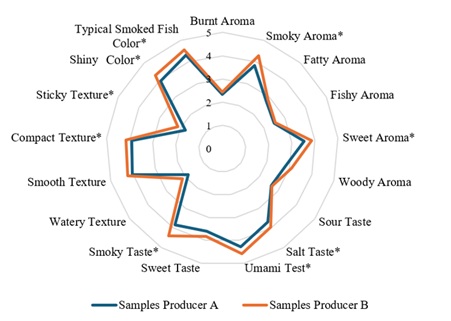
Smoked catfish is one of the popular fishery products in Indonesian society. Its soft meat and easy cultivation are the reasons why catfish is chosen as the raw material for making smoked fish. This research uses a case study of one of the smoked catfish producers (producer A) in Prawoto Village, Pati Regency, Central Java. The smoking process still uses traditional smoking. The research aims to determine the quality level of smoked catfish products from producer A and compare it to the quality level of benchmark product and the SNI standards. Quality analysis is carried out by chemical (protein, fat, moisture, and ash content), Total Plate Count (TPC) test, and organoleptic quality (the Rate-All-That-Apply (RATA) and hedonic tests). The results of the quality evaluation of producer A product: protein content 25.21%, moisture content 55.57%, fat content 8.62%, ash content 1.39%, and for TPC was 3.7×10³ CFU/g. Meanwhile, organoleptic tests on untrained consumer panelists showed that only a few parameters did not produce significantly different results. The quality parameters of product from producer A which have higher values compared to that from producer B are protein, moisture content, and TPC. When compared to the SNI standards, producer A, which is the main focus, has quality parameters that meet the requirements. Producer B, as a comparison, also meets the SNI standards. Recommendations to improve product quality include using a closed smoking process, and adding salt and liquid smoke for fresh catfish.
References
H. Herawati, S. D. W. Prajanti, and K. Kardoyo, “Predicted purchasing decisions from lifestyle, product quality and price through purchase motivation,” Journal of Economic Education, vol. 8, no. 1, pp. 1–11, 2019, https://doi.org/10.15294/JEEC.V8I1.29636.
A. Tidwell and J. S. Sutterfield, “Supplier selection using QFD: A consumer products case study,” International Journal of Quality & Reliability Management, vol. 29, no. 3, pp. 284–294, 2012, https://doi.org/10.1108/02656711211216144.
D. Yu, L. Wu, J. M. Regenstein, Q. Jiang, F. Yang, Y. Xu, and W. Xia, “Recent advances in quality retention of non-frozen fish and fishery products: A review,” Crit. Rev. Food Sci. Nutr., vol. 60, no. 10, pp. 1747–1759, 2020, https://doi.org/10.1080/10408398.2019.1596067.
C. O. Odoli, P. Oduor-Odote, and S. Arason, “The influence of lipid content and pretreatment methods on protein conformation in fish (capelin, Mallotus villosus) during smoking and drying,” Food Sci. Nutr., vol. 7, no. 4, pp. 1446–1454, 2019, https://doi.org/10.1002/fsn3.980.
I. S. Arvanitoyannis and K. V. Kotsanopoulos, “Smoking of fish and seafood: History, methods and effects on physical, nutritional and microbiological properties,” Food Bioproc. Tech., vol. 5, no. 3, pp. 831–853, 2012, https://doi.org/10.1007/s11947-011-0690-8.
M. A. Adepoju, B. O. Omitoyin, E. K. Ajani, and K. Asha, “Effect of smoking time and temperature on the proximate composition and quality of milkfish steaks,” Journal of Aquatic Food Product Technology, vol. 27, no. 3, pp. 369–378, 2018, https://doi.org/10.1080/10498850.2018.1437494.
Y. Fu, S. Cao, L. Yang, and Z. Li, “Flavor formation based on lipid in meat and meat products: A review,” J. Food Biochem., vol. 46, no. 12, p. e14439, 2022, https://doi.org/10.1111/jfbc.14439.
E. Nizio, K. Czwartkowski, and G. Niedbała, “Impact of smoking technology on the quality of food products: Absorption of polycyclic aromatic hydrocarbons (PAHs) by food products during smoking,” Sustainability, vol. 15, no. 24, 2023, https://doi.org/10.3390/su152416890.
T. Nishimura, C. Yamaguchi, K. Miyazaki, and R. Chikaraishi, “The role of lipids in enhancing the koku perception of pork sausage,” J. Oleo Sci., vol. 73, no. 4, pp. 503–508, 2024, https://doi.org/10.5650/jos.ess23220.
F. Rafiq, D. Rahmawati, D. Untari, D. P. Susilo, R. Nilamsari, and S. S. Lesari, “Monitoring of animal products entering east kalimantan with total plate count test,” Journal of Applied Veterinary Science and Technology, vol. 5, no. 2, pp. 115–121, 2024, https://doi.org/10.20473/javest.v5.i2.2024.115-121.
M. A. Okusanya, S. D. Oluwagbayide, and C. B. Ogunlade, “Impact of improved smoking kiln design on hygiene and timeliness of drying of smoked fish,” Turkish Journal of Agricultural Engineering Research, vol. 2, no. 1, pp. 133–155, 2021, https://doi.org/10.46592/turkager.2021.v02i01.010.
B. Krishnamoorthy and C. D’Lima, “Benchmarking as a measure of competitiveness,” International Journal of Process Management and Benchmarking, vol. 4, no. 3, pp. 342–359, 2014, https://doi.org/10.1504/IJPMB.2014.063240.
P. K. Prabhakar, S. Vatsa, P. P. Srivastav, and S. S. Pathak, “A comprehensive review on freshness of fish and assessment: Analytical methods and recent innovations,” Food Research International, vol. 133, p. 109157, 2020, https://doi.org/10.1016/j.foodres.2020.109157.
A. Hassoun and R. Karoui, “Quality evaluation of fish and other seafood by traditional and nondestructive instrumental methods: Advantages and limitations,” Crit. Rev. Food Sci. Nutr., vol. 57, no. 9, pp. 1976–1998, 2017, https://doi.org/10.1080/10408398.2015.1047926.
S. Al Sanjee and M. E. Karim, “Microbiological quality assessment of frozen fish and fish processing materials from bangladesh,” Int. J. Food Sci., 2016, https://doi.org/10.1155/2016/8605689.
M. C. Likongwe, W. Kasapila, M. Katundu, and P. Mpeketula, “Microbiological quality of traditional and improved kiln smoked catfish (Clarias gariepinus; Pisces; Clariidae) in lake chilwa basin,” Food Sci. Nutr., vol. 7, no. 1, pp. 281–286, 2019, https://doi.org/10.1002/fsn3.885.
M. Meyners, S. R. Jaeger, and G. Ares, “On the analysis of rate-all-that-apply (RATA) data,” Food Qual. Prefer., vol. 49, pp. 1–10, 2016, https://doi.org/10.1016/j.foodqual.2015.11.003.
C. O. Odoli, P. Oduor-Odote, and S. Arason, “The influence of lipid content and pretreatment methods on protein conformation in fish (capelin, Mallotus villosus) during smoking and drying,” Food Sci. Nutr., vol. 7, no. 4, pp. 1446–1454, 2019, https://doi.org/10.1002/fsn3.980.
S. A. O. Adeyeye, O. B. Oyewole, O. A. Obadina, A. M. Omemu, O. E. Adeniran, H. A. Oyedele, A. Olugbile, and S. A. Omoniyi, “Effect of smoking methods on quality and safety of traditional smoked fish from lagos state, nigeria,” Journal of Culinary Science & Technology, vol. 15, no. 1, pp. 17–35, 2017, https://doi.org/10.1080/15428052.2016.1185072.
S. L. Akintola, “Effects of smoking and sun-drying on proximate, fatty and amino acids compositions of southern pink shrimp (Penaeus notialis),” J. Food Sci. Technol., vol. 52, no. 5, pp. 2646–2656, 2015, https://doi.org/10.1007/s13197-014-1303-0.
S. A. O. Adeyeye, “Smoking of fish: a critical review,” Journal of Culinary Science & Technology, vol. 17, no. 6, pp. 559–575, 2019, https://doi.org/10.1080/15428052.2018.1495590.
S. Sumartini, F. Swastawati, and T. W. Agustini, “Analisis asam lemak Omega 3, 6, 9 dan kadar fenol ikan bandeng (Chanos chanos Forsk) asap dengan kombinasi jarak tungku dan lama pengasapan,” Jurnal Pengolahan dan Bioteknologi Hasil Perikanan, vol. 3, no. 1, pp. 157–166, 2014, https://ejournal3.undip.ac.id/index.php/jpbhp/article/view/4832/4664.
O. T. Bolaji, S. A. O. Adeyeye, and A. Araoye, “Effect of smoking and storage conditions on the quality and acceptability of smoked catfish (Clarias gariepinus),” Asian Journal of Dairy and Food Research, vol. 1, pp. 1–5, 2022, https://doi.org/10.18805/ajdfr.dr-1933.
S. Royer and M. Simon, “Small but powerful—local value chains and sustainability-oriented approaches in the agri-food sector,” Business and Society Review, vol. 128, no. 2, pp. 331–366, 2023, https://doi.org/10.1111/basr.12315.
A. Bulkini, A. Satria, and H. Mulyati, “Analysis of the catfish (Clarias sp.) value chain and its problems in Bogor, Indonesia,” Independent Journal of Management & Production, vol. 9, no. 1, pp. 262–273, 2018, https://doi.org/10.14807/ijmp.v9i1.628.
G. Bienkiewicz, G. Tokarczyk, and P. Biernacka, “Influence of storage time and method of smoking on the content of EPA and DHA acids and lipid quality of atlantic salmon (Salmo salar) meat,” Int. J. Food Sci., vol. 2022, no. 1, p. 1218347, 2022, https://doi.org/10.1155/2022/1218347.
M. T. Megawati and F. Swastawati, “Pengaruh pengasapan dengan variasi konsentrasi liquid smoke tempurung kelapa yang berbeda terhadap kualitas ikan bandeng (Chanos chanos forsk) asap,” Jurnal Pengolahan dan Bioteknologi Hasil Perikanan, vol. 3, no. 4, pp. 127–132, 2014, https://ejournal3.undip.ac.id/index.php/jpbhp/article/view/7789.
F. Swastawati, T. Surti, T. W. Agustini, and P. H. Riyadi, “Karakteristik kualitas ikan asap yang diproses menggunakan metode dan jenis ikan berbeda,” Jurnal aplikasi teknologi pangan, vol. 2, no. 3, 2013, https://doi.org/10.17728/jatp.142.
S. S. Nielsen and B. P. Ismail, “Ash content determination,” Food Analysis Laboratory Manual, pp. 117–119, 2017.
I. Ahmed, K. Jan, S. Fatma, and M. A. O. Dawood, “Muscle proximate composition of various food fish species and their nutritional significance: A review,” J. Anim. Physiol. Anim. Nutr. (Berl)., vol. 106, no. 3, pp. 690–719, 2022, https://doi.org/10.1111/jpn.13711.
S. K. Saha, M. N. Haider, and S. C. Chakraborty, “Assessment of quality and shelf-life of salt-smoked cured products from Pangasius catfish at various temperatures,” Journal of Advanced Biotechnology and Experimental Therapeutics, vol. 6, no. 1, pp. 184–197, 2023, https://doi.org/10.5455/jabet.2023.d117.
J. M. Lingbeck, P. Cordero, C. A. O’Bryan, M. G. Johnson, S. C. Ricke, and P. G. Crandall, “Functionality of liquid smoke as an all-natural antimicrobial in food preservation,” Meat Sci., vol. 97, no. 2, pp. 197–206, 2014, https://doi.org/10.1016/j.meatsci.2014.02.003.
D. G. H. Anihouvi, Y. E. Kpoclou, M. A. Massih, O. H. I. Afé, M. F. Assogba, M. Covo, M‐L. Scippo, D. J. Hounhouigan, V. Anihouvi, J. Mahillon, “Microbiological characteristics of smoked and smoked–dried fish processed in Benin,” Food Sci. Nutr., vol. 7, no. 5, pp. 1821–1827, 2019, https://doi.org/10.1002/fsn3.1030.
J. Guo, Q. Wang, C. Chen, H. Yu, and B. Xu, “Effects of different smoking methods on sensory properties, free amino acids and volatile compounds in bacon,” J. Sci. Food Agric., vol. 101, no. 7, pp. 2984–2993, 2021, https://doi.org/10.1002/jsfa.10931.
R. Azis and I. R. Akolo, “Analisis mutu organoleptik dan kadar air ikan roa (Hemiramphus sp.) asap dengan metode pengasapan berbeda,” Jurnal Ilmu Pertanian Indonesia, vol. 25, no. 4, pp. 487–492, 2020, https://doi.org/10.18343/jipi.25.4.487.
I. S. Erdiman, R. Wijayanti, and A. Kasim, “Pengaruh penambahan konsentrasi asap cair pada perendaman ikan bada (Rasbora argyrotaenia) terhadap karakteristik ikan asap,” Jurnal Pangan Dan Agroindustri, vol. 10, no. 3, 2022, https://doi.org/10.21776/ub.jpa.2022.010.03.5.
L. A. A. S. Alves, J. M. Lorenzo, C. A. A. Gonçalves, B. A. Santos, R. T. Heck, A. J. Cichoski, P. C. B. Campagnol, “Impact of lysine and liquid smoke as flavor enhancers on the quality of low-fat bologna-type sausages with 50% replacement of NaCl by KCl,” Meat Sci., vol. 123, pp. 50–56, 2017, https://doi.org/10.1016/j.meatsci.2016.09.001.
M. K. Nashiruddin, F. Swastawati, and E. Susanto, “Analisis kadar kolesterol dan kualitas ikan lele dumbo (Clarias gariepinus) asap menggunakan asap cair berbeda,” Jurnal Pengolahan dan Bioteknologi Hasil Perikanan, vol. 5, no. 1, pp. 28–35, 2016. https://ejournal3.undip.ac.id/index.php/jpbhp/article/view/10815/0.
S. De Pelsmaeker, X. Gellynck, C. Delbaere, N. Declercq, and K. Dewettinck, “Consumer-driven product development and improvement combined with sensory analysis: A case-study for European filled chocolates,” Food Qual. Prefer., vol. 41, pp. 20–29, 2015, https://doi.org/10.1016/j.foodqual.2014.10.009.
D. P. Suleman, M. M. Sari, A. N. Rochmah, and F. Zulfa, “Sensory acceptability and characteristics of cinnamon roll bread with pineapple puree (Ananas comosus L.) substituted with taro flour,” Journal of Agri-Food Science and Technology, vol. 6, no. 1, pp. 1–10, 2025, https://doi.org/10.12928/jafost.v6i1.11004.
S. A. O. Adeyeye, O. B. Oyewole, O. Obadina, O. E. Adeniran, H. A. Oyedele, A. Olugbile, and A. M. Omemu, “Effect of smoking methods on microbial safety, polycyclic aromatic hydrocarbon, and heavy metal concentrations of traditional smoked fish from lagos state, nigeria,” Journal of Culinary Science & Technology, vol. 14, no. 2, pp. 91–106, 2016. https://doi.org/10.1080/15428052.2015.1080644.
H. Sakti, S. Lestari, and A. Supriadi, “Perubahan mutu ikan gabus (Channa striata) asap selama penyimpanan,” Jurnal FishtecH, vol. 5, no. 1, pp. 11–18, 2016, https://doi.org/10.36706/fishtech.v5i1.3514.
Downloads
Published
Issue
Section
License
Copyright (c) 2026 Tian Nur Ma'rifat, Erik Musafi'in, Hefti Salis Yufidasari, Bayu Kusuma, Angga Wira Perdana, Ahmad Syihab Fahmi Q.R.M., Arief Rahmawan, Savaminee Teerawut

This work is licensed under a Creative Commons Attribution-ShareAlike 4.0 International License.
Authors who publish with the Journal of Agri-food Science and Technology (JAFOST) agree to the following terms:
- Authors retain copyright and grant the journal right of first publication with the work simultaneously licensed under a Creative Commons Attribution License (CC BY-SA 4.0) that allows others to share the work with an acknowledgment of the work's authorship and initial publication in this journal.
- Authors are able to enter into separate, additional contractual arrangements for the non-exclusive distribution of the journal's published version of the work (e.g., post it to an institutional repository or publish it in a book), with an acknowledgment of its initial publication in this journal.
- Authors are permitted and encouraged to post their work online (e.g., in institutional repositories or on their website) prior to and during the submission process, as it can lead to productive exchanges, as well as earlier and greater citation of published work.