The Impact of Drying Temperature and Duration on the Physicochemical and Sensory Properties of Cascara Powder Enriched with Emprit Ginger (Zingiber officinale var. amarum)
DOI:
https://doi.org/10.12928/jafost.v6i4.12287Keywords:
Antioxidant activity, Cascara powder, Drying temperature, Drying time, Emprit gingerAbstract
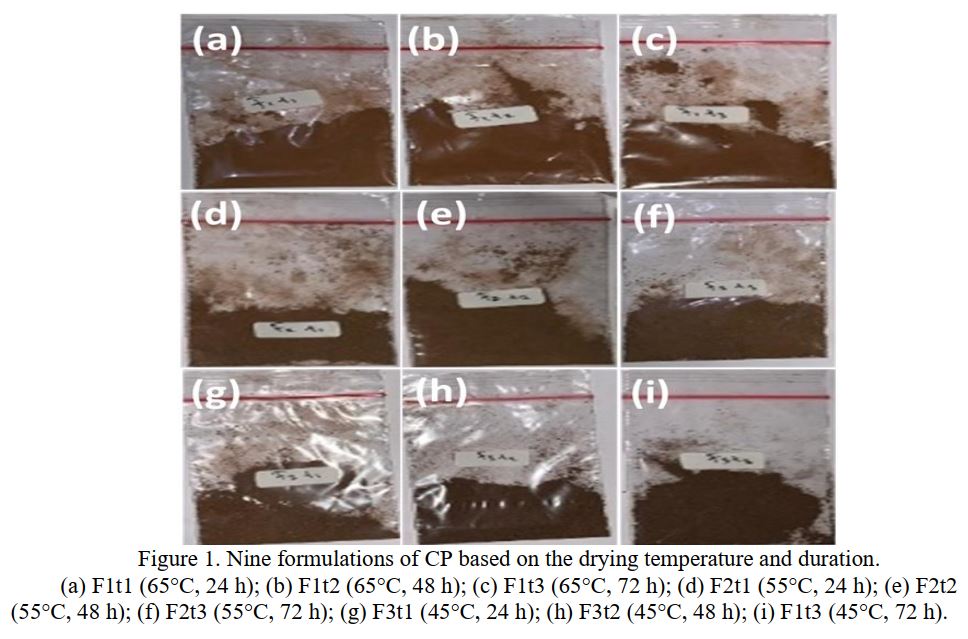
Cascara, derived from dried coffee pulp, is abundant in polyphenols such as catechin and epicatechin, offering substantial potential for diverse uses. Enriching cascara powder (CP) with emprit ginger (EG) is an ideal innovation, as both are rich in antioxidants, enhancing sensory attributes and health benefits. This study contributed to the effect of different drying temperatures and durations on the physicochemical and sensory properties of CP with and without EG. This study utilized a completely randomized design (CRD) with two factors: drying temperature (45°C, 55°C, and 65 °C) and duration (24, 48, and 72 h). The physicochemical analysis included moisture content, ash content, pH, reducing sugars, total phenolic content, and antioxidant activity of RSA. Sensory evaluation assessed color, taste, and aroma. The results indicated that moisture, ash, pH, reducing sugar, and total phenol contents ranged from 3.82–7.45%, 3.59–10.79%, 4.26–6.51, 14.78–58.51%, and 10.34–50.37 mg GAE/g, respectively. The antioxidant activity of RSA ranged from 45.59% to 87.73%. The sensory tests showed that all formulations were liked by the panelists. Based on physicochemical and sensory properties, the F3t1 formulation with EG was of the best quality. The optimal drying temperature and duration were 45°C and 24 h, with 75% CP and 25% EG (F3t1+J1). This work significantly contributes to the field of food technology by offering valuable insights into the utilization of coffee by-products and the incorporation of bioactive-rich compounds to create innovative, health-focused functional beverages.
References
V. S. Reddy, S. Shiva, S. Manikantan, and S. Ramakrishna, "Pharmacology of caffeine and its effects on the human body," Eur. J. Med. Chem. Reports, vol. 10, p. 100138, 2024, https://doi.org/10.1016/j.ejmcr.2024.100138.
A. Santanatoglia, S. Angeloni, M. Fiorito, L. Fioretti, M. Ricciutelli, G. Sagratini, S. Vittori, and G. Caprioli, "Development of new analytical methods for the quantification of organic acids, chlorogenic acids and caffeine in espresso coffee by using solid-phase extraction (SPE) and high-performance liquid chromatography-diode array detector (HPLC-DAD)," J. Food Compos. Anal., vol. 125, p. 105732, 2024, https://doi.org/10.1016/j.jfca.2023.105732.
M. F. Mendoza, R. M. Sulague, T. Posas-Mendoza, and C. J. Lavie, "Impact of coffee consumption on cardiovascular health," Ochsner J., vol. 23, no. 2, pp. 152–158, 2023, https://doi.org/10.31486/toj.22.0073.
G. A. Kahsay, N. Turreira-García, D. Ortiz-Gonzalo, F. Georget, and A. S. Bosselmann, "New coffee varieties as a climate adaptation strategy: Empirical evidence from Costa Rica," World Dev. Sustain., vol. 2, p. 100046, 2023, https://doi.org/10.1016/j.wds.2023.100046.
A. P. Riandani, E. Prangdimurti, and D. Herawati, "Profiling the chemical and sensory properties of cascara beverages from different locations in Indonesia," Food Res., vol. 6, no. 4, pp. 388–398, 2022, https://doi.org/10.26656/fr.2017.6(4).520.
E. D. Martauli, "Analysis Of Coffee Production In Indonesia," JASc (Journal Agribus. Sci., vol. 1, no. 2, pp. 112–120, 2018, https://doi.org/10.30596/jasc.v1i2.1962.
S. Qin, F. Hu, N. Yang, L. Li, H. Yang, Y. Suo, and F. He, "Influence of native coffee yeast fermentation on phenolic content, organic acids, and volatile compounds in cascara," LWT, vol. 210, p. 116860, 2024, https://doi.org/10.1016/j.lwt.2024.116860.
S. Eckhardt, H. Franke, S. Schwarz, and D. W. Lachenmeier, "Risk Assessment of coffee cherry (Cascara) fruit products for flour replacement and other alternative food uses," Molecules, vol. 27, no. 23, p. 8435, 2022, https://doi.org/10.3390/molecules27238435.
A. Heeger, A. Kosińska-Cagnazzo, E. Cantergiani, and W. Andlauer, "Bioactives of coffee cherry pulp and its utilisation for production of Cascara beverage," Food Chem., vol. 221, pp. 969–975, 2017, https://doi.org/10.1016/j.foodchem.2016.11.067.
N. Arpi, M. Muzaifa, M. I. Sulaiman, R. Andini, and S. I. Kesuma, "Chemical characteristics of cascara, coffee cherry tea, made of various coffee pulp treatments," IOP Conf. Ser. Earth Environ. Sci., vol. 709, no. 1, p. 012030, 2021, https://doi.org/10.1088/1755-1315/709/1/012030.
A. Rahmawati, M. A. Nurdiansyah, I. Taufik, M. Rosmiati, R. F. Ramadhaini, and M. Y. Abduh, "Effects of coffee pulp fermentation on bioactive compounds and antioxidant activity of coffee pulp extract: a systematic review and meta-analysis," Food Biosci., vol. 74, p. 107964, 2025, https://doi.org/10.1016/j.fbio.2025.107964.
I. Mustafa and N. L. Chin, "Antioxidant properties of dried ginger (Zingiber officinale Roscoe) var. Bentong," Foods, vol. 12, no. 1, p. 178, 2023, https://doi.org/10.3390/foods12010178.
M. Y. Abduh, D. Nofitasari, A. Rahmawati, A. Y. Eryanti, and M. Rosmiati, "Effects of brewing conditions on total phenolic content, antioxidant activity and sensory properties of cascara," Food Chem. Adv., vol. 2, p. 100183, 2023, https://doi.org/10.1016/j.focha.2023.100183.
S. Agustin, A. Wiliana, A. J. Kumalaputri, and M. Y. Abduh, "Production and characterization of cascara powder from coffee pulp," Chem. Nat. Resour. Eng. J., vol. 6, no. 1, 2022, https://doi.org/10.31436/cnrej.v6i1.66.
S. K. Putri and A. Setiyoko, "Proximate and texture profile analysis of gluten-free cookies made from black glutinous rice and mung bean flour," J. Agri-Food Sci. Technol., vol. 6, no. 2, pp. 107–116, 2025, https://doi.org/10.12928/jafost.v6i2.12717.
S. Rohaya, S. H. Anwar, A. B. Amhar, A. Sutriana, and M. Muzaifa, "Antioxidant activity and physicochemical composition of coffee pulp obtained from three coffee varieties in Aceh, Indonesia," IOP Conf. Ser. Earth Environ. Sci., vol. 1182, no. 1, p. 012063, 2023, https://doi.org/10.1088/1755-1315/1182/1/012063.
E. Zielińska, B. Baraniak, and M. Karaś, "Antioxidant and anti-inflammatory activities of hydrolysates and peptide fractions obtained by enzymatic hydrolysis of selected heat-treated edible insects," Nutrients, vol. 9, no. 9, p. 970, 2017, https://doi.org/10.3390/nu9090970.
I. A. T. Wahyuniari, I. G. A. M. Putra, M. D. D. Devani, P. W. D. Wiguna, and D. P. Kartika, "Sensory evaluation and antioxidant activity of functional ice cream with the ratio of cardamom powder and dragon fruit peel puree," J. Agri-Food Sci. Technol., vol. 6, no. 2, pp. 117–128, 2025, https://doi.org/10.12928/jafost.v6i2.12896.
N. Arpi, M. Muzaifa, R. Andini, H. P. Widayat, C. Nilda, and F. Nisa, "Physicochemical and sensory characteristics of cascara syrup with the addition of lemon (Citrus limon) extract," IOP Conf. Ser. Earth Environ. Sci., vol. 1177, no. 1, p. 012028, 2023, https://doi.org/10.1088/1755-1315/1177/1/012028.
S. Maharani, I. Mustikawati, L. Nailufhar, and S. Istiqomah, "The effect of brewing time on pH values, polyphenols content, and antioxidant activities of coffee husk tea (cascara tea)," J. Phys. Conf. Ser., vol. 1869, no. 1, p. 012050, 2021, https://doi.org/10.1088/1742-6596/1869/1/012050.
M. N. Azkia and S. B. Wahjuningsih, "Sensory characteristics of mocaf-substituted noodles enriched with latoh (Caulerpa lentillifera)," J. Agri-food Sci. Technol., vol. 6, no. 3, pp. 141–151, 2025, https://doi.org/10.12928/jafost.v6i3.14145.
D. P. Suleman, M. M. Sari, A. N. Rochmah, and F. Zulfa, "Sensory acceptability and characteristics of cinnamon roll bread with pineapple puree (Ananas comosus L.) substituted with taro flour," J. Agri-Food Sci. Technol., vol. 6, no. 1, pp. 1–10, 2025, https://doi.org/10.12928/jafost.v6i1.11004.
E. Murlida, S. Noviasari, C. Nilda, S. Rohaya, F. Rahmi, and M. Muzaifa, "Chemical characteristics of cascara tea from several varieties of coffee in Aceh Province," IOP Conf. Ser. Earth Environ. Sci., vol. 667, no. 1, p. 012078, 2021, https://doi.org/10.1088/1755-1315/667/1/012078.
A. Rahmawati, D. Nofitasari, M. Rosmiati, I. Taufik, and M. Y. Abduh, "Evaluation of phenolic compounds, antioxidant activity, and sensory analysis of commercial cascara from different locations in Indonesia," Food Humanit., vol. 5, p. 100791, 2025, https://doi.org/10.1016/j.foohum.2025.100791.
R. A. Utomo and S. N. Rahmadhia, "Effect of variations in drying temperature of papaya seeds (Carica papaya L.) on the physiochemical characteristics of jelly candy," Adv. Food Sci. Sustain. Agric. Agroindustrial Eng., vol. 7, no. 4, pp. 338–348, 2024, https://doi.org/10.21776/ub.afssaae.2024.007.04.6.
H. Giles, D. Zannidi, M. E. Clegg, J. V. Woodside, G. McKenna, C. G. Forde, S. P. Bull, S. Lignou, J. Gallagher, M. Faka, and L. Methven, "A systematic review of the factors affecting textural perception by older adults and their association with food choice and intake," Appetite, vol. 214, p. 108202, 2025, https://doi.org/10.1016/j.appet.2025.108202.
F. S. Latumahina, S. Susilawati, A. Antonius, and W. Tewoloipaky, "Mangrove diversity as an indicator of ecosystem health on Ambon Island, Indonesia," Agro Bali Agric. J., vol. 7, no. 2, pp. 295–306, 2024, https://doi.org/10.37637/ab.v7i2.1637.
J. An, H. Xie, J. Yan, H. Wei, Y. Wu, and X. Liao, "A review of applications of energy analysis: Grain, fruit and vegetable drying technology," Energy Reports, vol. 12, pp. 5482–5506, 2024, https://doi.org/10.1016/j.egyr.2024.11.037.
M. Vera Zambrano, B. Dutta, D. G. Mercer, H. L. MacLean, and M. F. Touchie, "Assessment of moisture content measurement methods of dried food products in small-scale operations in developing countries: A review," Trends Food Sci. Technol., vol. 88, pp. 484–496, 2019, https://doi.org/10.1016/j.tifs.2019.04.006.
S. Głowacki, W. Tulej, M. Sojak, A. Bryś, and K. Pietrzyk, "Analysis of thermal properties of coffee grounds left over from coffee percolation," E3S Web Conf., vol. 154, p. 03004, 2020, https://doi.org/10.1051/e3sconf/202015403004.
Ł. Łopusiewicz, E. Drozłowska, P. Trocer, P. Kwiatkowski, A. Bartkowiak, A. Gefrom, and M. Sienkiewicz, "The effect of fermentation with kefir grains on the physicochemical and antioxidant properties of beverages from blue lupin (Lupinus angustifolius L.) Seeds," Molecules, vol. 25, no. 24, p. 5791, 2020, https://doi.org/10.3390/molecules25245791.
S.-H. Chiang, M.-F. Tsou, C.-Y. Chang, and C.-W. Chen, "Physicochemical characteristics, sensory quality, and antioxidant properties of Paochung tea infusion brewed in cold water," Int. J. Food Prop., vol. 23, no. 1, pp. 1611–1623, 2020, https://doi.org/10.1080/10942912.2020.1820519.
M. M. Delorme, B. S. Machado, F. dos Santos Ferreira, R. N. Alves, D. C. Ferreira, J. P. de Lima Moreira, V. N. Castelo-Branco, T. M. Uekane, F. F. Fernandes, and A. R. Lima, "Harnessing arabica and canephora coffee cascara as substrates for kombucha: Comparative study of chemical, antioxidant, antibacterial and antifungal properties," Biocatal. Agric. Biotechnol., vol. 66, p. 103570, 2025, https://doi.org/10.1016/j.bcab.2025.103570.
R. Begum, S. Howlader, A. N. M. Mamun-Or-Rashid, S. M. Rafiquzzaman, G. M. Ashraf, G. M. Albadrani, A. A. Sayed, I. Peluso, M. M. Abdel-Daim, and M. S. Uddin, "Antioxidant and signal‐modulating effects of brown seaweed‐derived compounds against oxidative stress‐associated pathology," Oxid. Med. Cell. Longev., vol. 2021, no. 1, 2021, https://doi.org/10.1155/2021/9974890.
M. Suzery, B. Nudin, D. Nurwahyu Bima, and B. Cahyono, "Effects of temperature and heating time on degradation and antioxidant activity of anthocyanin from roselle petals (Hibiscus sabdariffa L.)," Int. J. Sci. Technol. Manag., vol. 1, no. 4, pp. 288–238, 2020, https://doi.org/10.46729/ijstm.v1i4.78.
D. S. Amanda and S. N. Rahmadhia, "The effect of drying duration on the physicochemical characteristics of beetroot (Beta vulgaris L.) sheet jam," JST (Jurnal Sains dan Teknol., vol. 13, no. 3, pp. 445–454, 2024, https://doi.org/10.23887/jstundiksha.v13i3.85165.
T. Chomphoosee, P. Seesuriyachan, W. Wattanutchariya, C. Tipbunjong, P. Therdtatha, C. Techapun, C. Insomphun, N. Panti, and C. Moukamnerd, "A novel beverage of coffee cherry (cascara) water kefir rich in antioxidants, bioactive compounds, and exhibiting promising antibacterial and sensory qualities," LWT, vol. 219, p. 117539, 2025, https://doi.org/10.1016/j.lwt.2025.117539.
A. Hernández-López, D. A. Sánchez Félix, Z. Zuñiga Sierra, I. García Bravo, T. D. Dinkova, and A. X. Avila-Alejandre, "Quantification of reducing sugars based on the qualitative technique of benedict," ACS Omega, vol. 5, no. 50, pp. 32403–32410, 2020, https://doi.org/10.1021/acsomega.0c04467.
M. Kurzyna-Szklarek, J. Cybulska, and A. Zdunek, "Analysis of the chemical composition of natural carbohydrates – An overview of methods," Food Chem., vol. 394, p. 133466, 2022, https://doi.org/10.1016/j.foodchem.2022.133466.
M. B. Rios, A. Iriondo-DeHond, M. Iriondo-DeHond, T. Herrera, D. Velasco, S. Gómez-Alonso, M. J. Callejo, and M. D. del Castillo, "Effect of coffee cascara dietary fiber on the physicochemical, nutritional and sensory properties of a gluten-free bread formulation," Molecules, vol. 25, no. 6, p. 1358, 2020, https://doi.org/10.3390/molecules25061358.
A. J. Alemayehu, Z. T. Adimas, and B. D. Abera, "The effect of sugar concentration and storage time on the physicochemical, microbial and sensory properties of ginger drink," Appl. Food Res., vol. 5, no. 2, p. 101278, 2025, https://doi.org/10.1016/j.afres.2025.101278.
P. Mathatheeranan, T. Wongprasert, M. Fang, T.-J. Lu, and I. Suppavorasatit, "Effect of drying techniques on the stability of volatile compounds and antioxidative activities of dried Thai fermented black soybean (thua nao)," J. Agric. Food Res., vol. 18, p. 101305, 2024, https://doi.org/10.1016/j.jafr.2024.101305.
Y.-L. Mao, J.-Q. Wang, F. Wang, Q.-Q. Cao, J.-F. Yin, and Y.-Q. Xu, "Effect of different drying temperature settings on the color characteristics of Tencha," Food Chem. X, vol. 24, p. 101963, 2024, https://doi.org/10.1016/j.fochx.2024.101963.
H. Yang, R. Pu, Y. Yang, T. Dong, Y. Hua, and L. Guo, "Impact of drying method on sensory, physicochemical properties and biology activity evaluation of Boletus edulis soup and their changes in volatile compounds," LWT, vol. 222, p. 117676, 2025, https://doi.org/10.1016/j.lwt.2025.117676.
S. Baliyan, R. Mukherjee, A. Priyadarshini, A. Vibhuti, A. Gupta, R. P. Pandey, and C.-M. Chang, "Determination of antioxidants by DPPH radical scavenging activity and quantitative phytochemical analysis of Ficus religiosa," Molecules, vol. 27, no. 4, p. 1326, 2022, https://doi.org/10.3390/molecules27041326.
Downloads
Published
Issue
Section
License
Copyright (c) 2025 Ibdal Satar, Adinda Yuniarti, Nurhayati Yusof, Waled Abdo Ahmed

This work is licensed under a Creative Commons Attribution-ShareAlike 4.0 International License.
Authors who publish with the Journal of Agri-food Science and Technology (JAFOST) agree to the following terms:
- Authors retain copyright and grant the journal right of first publication with the work simultaneously licensed under a Creative Commons Attribution License (CC BY-SA 4.0) that allows others to share the work with an acknowledgment of the work's authorship and initial publication in this journal.
- Authors are able to enter into separate, additional contractual arrangements for the non-exclusive distribution of the journal's published version of the work (e.g., post it to an institutional repository or publish it in a book), with an acknowledgment of its initial publication in this journal.
- Authors are permitted and encouraged to post their work online (e.g., in institutional repositories or on their website) prior to and during the submission process, as it can lead to productive exchanges, as well as earlier and greater citation of published work.