The Application of Potato Starch-Based (Amylum solani) Edible Coating on Tomatoes (Solanum lycopersicum L.)
DOI:
https://doi.org/10.12928/jafost.v6i2.12123Keywords:
Edible coating, Potato starch, Shelf life, Tomato, Vitamin CAbstract
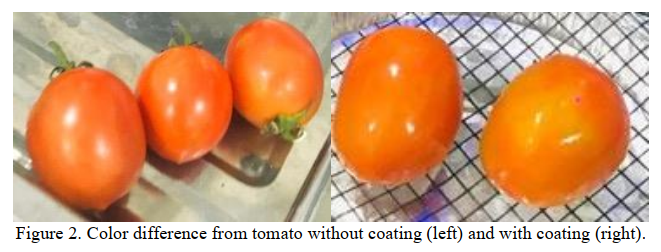
This study investigates the potential of potato starch-based edible coatings (Amylum solani) to extend the shelf life and preserve the quality of tomatoes (Solanum lycopersicum L.) during storage. The experiment contributed to evaluating the effect of the coating on critical quality parameters, including weight loss, firmness, color stability, moisture content, vitamin C retention, and sensory characteristics. Tomatoes with edible coatings exhibited a slower rate of weight loss compared to uncoated samples, which is attributed to the coating's ability to form a protective barrier that minimizes water evaporation and respiration rates. Coated tomatoes also retained firmness more effectively, delaying the softening process caused by metabolic and enzymatic activity. The study revealed that the edible coating reduced the rate of color degradation by slowing the loss of chlorophyll and the formation of lycopene, preserving the tomatoes' visual appeal. Moreover, the coating significantly delayed the decline in vitamin C content by inhibiting oxidation and maintaining structural integrity, which was further reflected in the higher sensory scores for coated tomatoes. Organoleptic tests indicated that panelists preferred coated tomatoes due to their glossy appearance, firmer texture, and sweeter taste, although these preferences gradually decreased over time. Analysis showed that the coating extended the shelf life of tomatoes to 13.64 days, compared to 9.76 days for uncoated samples. These results highlight the efficacy of potato starch-based edible coatings as an environmentally friendly and cost-effective solution for reducing postharvest losses, meeting consumer demand for fresh produce, and improving food security. This study provides valuable insights into the practical application of edible coatings for preserving climacteric fruits such as tomatoes, with implications for sustainable agricultural practices.
References
G. Abera, A. M. Ibrahim, S. F. Forsido, and C. G. Kuyu, “Assessment on postharvest losses of tomato (Lycopersicon esculentem Mill.) in selected districts of East Shewa Zone of Ethiopia using a commodity system analysis methodology,” Heliyon, vol. 6, no. 4, p. e03749, 2020, https://doi.org/10.1016/j.heliyon.2020.e03749.
S. S. Shanta, T. Ahmed, M. F. Jubayer, M. Sharma, K. Sridhar, M. M. Hoque, M. R. Rana, and B. S. Inbaraj, “Effect of taro corm mucilage and black seed oil as edible coatings on the shelf-life and quality of fresh guava,” Agronomy, vol. 13, no. 2, p. 538, 2023, https://doi.org/10.3390/agronomy13020538.
N. Kumar, N. Neeraj, P. Pratibha, and A. T. Petkoska, “Improved shelf life and quality of tomato (Solanum lycopersicum L.) by using chitosan-pullulan composite edible coating enriched with pomegranate peel extract,” ACS Food Sci. Technol., vol. 1, no. 4, pp. 500–510, 2021, https://doi.org/10.1021/acsfoodscitech.0c00076.
I. F. Islami and S. N. Rahmadhia, “The effect of sago starch (Metroxylon sp.) and chitosan as edible coating on physical and chemical characteristics of red chili (Capsicum annuum L.),” Adv. Food Sci. Sustain. Agric. Agroindustrial Eng., vol. 7, no. 3, pp. 265–273, 2024, https://doi.org/10.21776/ub.afssaae.2024.007.03.7.
M. A. Khalid, B. Niaz, F. Saeed, M. Afzaal, F. Islam, M. Hussain, M. Mahwish, H. M. S. Khalid, A. Siddeeg, and A. Al-Farga, “Edible coatings for enhancing safety and quality attributes of fresh produce: A comprehensive review,” Int. J. Food Prop., vol. 25, no. 1, pp. 1817–1847, 2022, https://doi.org/10.1080/10942912.2022.2107005.
P. Itkor, A. Boonsiriwit, C. Rodwihok, U. Siripatrawan, and Y. S. Lee, “Active bio-foam packaging based on sodium alginate incorporated with vanillin for extending the shelf life of cherry tomatoes,” Int. J. Biol. Macromol., vol. 306, p. 141610, 2025, https://doi.org/10.1016/j.ijbiomac.2025.141610.
Y. A. Shah, S. Bhatia, A. Al-Harrasi, and T. S. Khan, “Advancements in the biopolymer films for food packaging applications: a short review,” Biotechnol. Sustain. Mater., vol. 1, no. 1, p. 2, 2024, https://doi.org/10.1186/s44316-024-00002-1.
H. Wu, J. Wang, T. Li, Y. Lei, L. Peng, J. Chang, S. Li, X. Yuan, M. Zhou, and Z. Zhang, “Effects of cinnamon essential oil-loaded Pickering emulsion on the structure, properties and application of chayote tuber starch-based composite films,” Int. J. Biol. Macromol., vol. 240, p. 124444, 2023, https://doi.org/10.1016/j.ijbiomac.2023.124444.
S. N. Rahmadhia, A. A. Sidqi, and Y. A. Saputra, “Physical properties of tapioca starch-based film indicators with anthocyanin extract from purple sweet potato (Ipomea batatas L.) and response to pH changes,” Sains Malaysiana, vol. 52, no. 6, pp. 1685–1697, 2023, https://doi.org/10.17576/jsm-2023-5206-06.
D. Dutta and N. Sit, “Preparation and characterization of potato starch-based composite films reinforced by modified banana fibers and its application in packaging of grapes,” Int. J. Biol. Macromol., vol. 254, p. 127791, 2024, https://doi.org/10.1016/j.ijbiomac.2023.127791.
F. Momotaz, N. Hasan, and A. Sarkar, “A Details study on: Developing biodegradable plastics from potato starch with enhanced physico-mechanical properties,” Feb. 01, 2022. https://doi.org/10.21203/rs.3.rs-1240157/v1.
D. Ahmad, Y. Ying, and J. Bao, “Understanding starch biosynthesis in potatoes for metabolic engineering to improve starch quality: A detailed review,” Carbohydr. Polym., vol. 346, p. 122592, 2024, https://doi.org/10.1016/j.carbpol.2024.122592.
T. R. Putri, A. Adhitasari, V. Paramita, M. E. Yulianto, and H. D. Ariyanto, “Effect of different starch on the characteristics of edible film as functional packaging in fresh meat or meat products: A review,” Mater. Today Proc., vol. 87, pp. 192–199, 2023, https://doi.org/10.1016/j.matpr.2023.02.396.
N. Kumar, Pratibha, J. Prasad, A. Yadav, A. Upadhyay, Neeraj, S. Shukla, A. T. Petkoska, Heena, S. Suri, M. Gniewosz, and M. Kieliszek, “Recent trends in edible packaging for food applications — Perspective for the future,” Food Eng. Rev., vol. 15, no. 4, pp. 718–747, 2023, https://doi.org/10.1007/s12393-023-09358-y.
T. Majeed, A. H. Dar, V. K. Pandey, K. K. Dash, S. Srivastava, R. Shams, G. Jeevarathinam, P. Singh, N. Echegaray, and R. Pandiselvam, “Role of additives in starch-based edible films and coating: A review with current knowledge,” Prog. Org. Coatings, vol. 181, p. 107597, 2023, https://doi.org/10.1016/j.porgcoat.2023.107597.
P. F. Muñoz-Gimena, V. Oliver-Cuenca, L. Peponi, and D. López, “A review on reinforcements and additives in starch-based composites for food packaging,” Polymers (Basel)., vol. 15, no. 13, p. 2972, 2023, https://doi.org/10.3390/polym15132972.
E. N. Arifani and R. R. Tamalea, “Edible Film Based on Arrowroot Starch and Glycerol,” J. Agri-Food Sci. Technol., vol. 5, no. 1, pp. 33–43, 2024, https://doi.org/10.12928/jafost.v5i1.9494.
T. A. Ermawati and S. N. Rahmadhia, “Physico-chemical characteristics of edible film from breadfruit starch (Artocarpus altilis) and beeswax,” Adv. Food Sci. Sustain. Agric. Agroindustrial Eng., vol. 6, no. 4, pp. 325–337, 2023, https://doi.org/10.21776/ub.afssaae.2023.006.04.1.
T. M. Bimrew, S. Yihune, and I. Nyambayo, “Optimization of temperature and time for high-quality roasted barley (Kolo),” J. Agri-Food Sci. Technol., vol. 6, no. 1, pp. 49–62, 2025, https://doi.org/10.12928/jafost.v6i1.12666.
D. N. Zebua, E. C. Prima, Yelliantty, and Y. Garnida, “Effect of a pectin edible coating with lemon peel extract to maintain strawberry fruit’s quality during cold storage,” Food Humanit., vol. 4, p. 100541, 2025, https://doi.org/10.1016/j.foohum.2025.100541.
A. M. Fallah, R. M. Putri, W. Yuliani, W. Wagiman, and M. A. F. Falah, “Characterization of freeze-dried strawberries (Fragaria x ananassa var. Mencir): quality on physical information,” J. Agri-Food Sci. Technol., vol. 5, no. 2, pp. 85–93, 2024, https://doi.org/10.12928/jafost.v5i2.9468.
W. A. Coyotl-Pérez, E. Rubio-Rosas, Q. N. Morales-Rabanales, S. A. Ramírez-García, Y. Pacheco-Hernández, V. H. Pérez-España, O. Romero-Arenas, and N. Villa-Ruano, “Improving the shelf life of avocado fruit against clonostachys rosea with chitosan hybrid films containing thyme essential oil,” Polymers (Basel)., vol. 14, no. 10, p. 2050, 2022, https://doi.org/10.3390/polym14102050.
AOAC, Official Methode of Analysis Association of Official Analytical Chemists. 2005.
D. P. Suleman, M. M. Sari, A. N. Rochmah, and F. Zulfa, “Sensory acceptability and characteristics of cinnamon roll bread with pineapple puree (Ananas comosus L.) substituted with taro flour,” J. Agri-Food Sci. Technol., vol. 6, no. 1, pp. 1–10, 2025, https://doi.org/10.12928/jafost.v6i1.11004.
L. Kapoor, A. J. Simkin, C. George Priya Doss, and R. Siva, “Fruit ripening: dynamics and integrated analysis of carotenoids and anthocyanins,” BMC Plant Biol., vol. 22, no. 1, p. 27, 2022, https://doi.org/10.1186/s12870-021-03411-w.
J. E. de J. Dávila-Aviña, J. Villa-Rodríguez, R. Cruz-Valenzuela, M. Rodríguez-Armenta, M. Espino-Díaz, J. F. Ayala-Zavala, G. I. Olivas-Orozco, B. Heredia, and G. González-Aguilar, “Effect of edible coatings, storage time and maturity stage on overall quality of tomato fruits,” Am. J. Agric. Biol. Sci., vol. 6, no. 1, pp. 162–171, 2011, https://doi.org/10.3844/ajabssp.2011.162.171.
K. Chen, R. Tian, J. Jiang, M. Xiao, K. Wu, Y. Kuang, P. Deng, X. Zhao, and F. Jiang, “Moisture loss inhibition with biopolymer films for preservation of fruits and vegetables: A review,” Int. J. Biol. Macromol., vol. 263, p. 130337, 2024, https://doi.org/10.1016/j.ijbiomac.2024.130337.
N. D. Lakshan, C. M. Senanayake, T. Liyanage, and A. Lankanayaka, “Clove essential oil emulsions-loaded arrowroot starch-beeswax-based edible coating extends the shelf life and preserves the postharvest quality of fresh tomatoes ( Solanum lycopersicum L.) stored at room temperature,” Sustain. Food Technol., vol. 2, no. 4, pp. 1052–1068, 2024, https://doi.org/10.1039/D4FB00033A.
M. Sultan, O. M. Hafez, M. A. Saleh, and A. M. Youssef, “Smart edible coating films based on chitosan and beeswax–pollen grains for the postharvest preservation of Le Conte pear,” RSC Adv., vol. 11, no. 16, pp. 9572–9585, 2021, https://doi.org/10.1039/D0RA10671B.
H. Nybom, M. Ahmadi-Afzadi, K. Rumpunen, and I. Tahir, “Review of the impact of apple fruit ripening, texture and chemical contents on genetically determined susceptibility to storage rots,” Plants, vol. 9, no. 7, p. 831, 2020, https://doi.org/10.3390/plants9070831.
P. Zhao, J. P. Ndayambaje, X. Liu, and X. Xia, “Microbial spoilage of fruits: A review on causes and prevention methods,” Food Rev. Int., vol. 38, no. sup1, pp. 225–246, 2022, https://doi.org/10.1080/87559129.2020.1858859.
M. Hossain, M. Karim, and S. Juthee, “Postharvest physiological and biochemical alterations in fruits: a review,” Fundam. Appl. Agric., vol. 5, no. 4, pp. 453–469, 2020, https://doi.org/10.5455/faa.22077.
A. R. Ahmed, S. M. Aleid, and M. Mohammed, “Impact of modified atmosphere packaging conditions on quality of dates: Experimental study and predictive analysis using artificial neural networks,” Foods, vol. 12, no. 20, p. 3811, 2023, https://doi.org/10.3390/foods12203811.
U. E. Umeohia and A. A. Olapade, “Quality attributes, physiology, and postharvest technologies of tomatoes (Lycopersicum esculentum) – A review,” Am. J. Food Sci. Technol., vol. 12, no. 2, pp. 42–64, 2024, https://doi.org/10.12691/ajfst-12-2-1.
S. Paidari, N. Zamindar, R. Tahergorabi, M. Kargar, S. Ezzati, N. Shirani, and S. H. Musavi, “Edible coating and films as promising packaging: a mini review,” J. Food Meas. Charact., vol. 15, no. 5, pp. 4205–4214, 2021, https://doi.org/10.1007/s11694-021-00979-7.
S. Basak, L. Shaik, and S. Chakraborty, “Effect of ultraviolet and pulsed light treatments on ascorbic acid content in fruit juices-A review of the degradation mechanism,” Food Chem. Adv., vol. 2, p. 100333, 2023, https://doi.org/10.1016/j.focha.2023.100333.
Downloads
Published
Issue
Section
License
Copyright (c) 2025 Mohammad Prasanto Bimantio, Astri Wulandari, Ida Bagus Banyuro Partha

This work is licensed under a Creative Commons Attribution-ShareAlike 4.0 International License.
Authors who publish with the Journal of Agri-food Science and Technology (JAFOST) agree to the following terms:
- Authors retain copyright and grant the journal right of first publication with the work simultaneously licensed under a Creative Commons Attribution License (CC BY-SA 4.0) that allows others to share the work with an acknowledgment of the work's authorship and initial publication in this journal.
- Authors are able to enter into separate, additional contractual arrangements for the non-exclusive distribution of the journal's published version of the work (e.g., post it to an institutional repository or publish it in a book), with an acknowledgment of its initial publication in this journal.
- Authors are permitted and encouraged to post their work online (e.g., in institutional repositories or on their website) prior to and during the submission process, as it can lead to productive exchanges, as well as earlier and greater citation of published work.