TPOT AutoML-Guided Optimization of a Heterogeneous Stacking Ensemble for P2P Lending Default Prediction
DOI:
https://doi.org/10.12928/biste.v8i5.17316Keywords:
P2P Lending, TPOT AutoML, Heterogeneous Stacking, Credit Risk Prediction, ROC-AUCAbstract
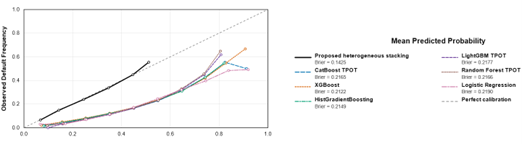
Default risk in peer-to-peer (P2P) lending can cause substantial losses for investors and platforms, requiring classification models with reliable discrimination and probability estimates. However, conventional credit-risk pipelines often use manually configured models and provide limited exploration of complementary algorithm families. The research contribution is a reproducible TPOT AutoML-guided heterogeneous stacking framework that integrates family-constrained pipeline search, leakage-free nested evaluation, calibration, significance testing, and ablation analysis. TPOT was selected because its exportable scikit-learn-compatible pipelines and customizable operator spaces permit explicit control of learner families and feature selection. The experiments used 27 pre-loan attributes from 200,000 unique Lending Club records covering 2007–Q3 2020, divided into 20,000 discovery records and 180,000 locked evaluation records. TPOT optimized Random Forest, CatBoost, and LightGBM pipelines, whose out-of-fold probabilities were combined with a prespecified Hist Gradient Boosting learner using a CatBoost meta-learner and sigmoid calibration. Final performance was estimated using stratified nested cross-validation with 10 outer and three inner folds, while the classification threshold was fixed from the discovery partition. The proposed model achieved a ROC-AUC of 0.7123 (95% CI: 0.7094–0.7152), accuracy of 0.6694, recall of 0.6266, F1-score of 0.4249, and Brier score of 0.1425. Its ROC-AUC gains over Hist Gradient Boosting, LightGBM, Random Forest, and Logistic Regression remained significant after Holm correction, whereas differences from CatBoost and XGBoost were not significant. The framework therefore provides competitive discrimination and reliable calibration, although its gains over the strongest boosting baselines were marginal and external validation beyond a single Lending Club sample remains necessary.
References
G. Kou and Y. Lu, “FinTech: a literature review of emerging financial technologies and applications,” Financial Innovation, vol. 11, no. 1, p. 1, 2025, https://doi.org/10.1186/s40854-024-00668-6.
D. Ha, P. Le, and D. K. Nguyen, “Financial inclusion and fintech: a state-of-the-art systematic literature review: DHT Thieu et al,” Financial Innovation, vol. 11, no. 1, p. 69, 2025, https://doi.org/10.1186/s40854-024-00741-0.
B. Setiawan et al., “Why do people use P2P lending services? The role of AI literacy and green self identity,” Journal of Financial Services Marketing, vol. 31, no. 2, Jun. 2026, https://doi.org/10.1057/s41264-026-00357-8.
F. M. J. Teichmann, S. R. Boticiu, and B. S. Sergi, “Compliance concerns in sustainable finance: an analysis of peer-to-peer (P2P) lending platforms and sustainability,” J. Financ. Crime, vol. 31, no. 4, pp. 993–1001, Jun. 2024, https://doi.org/10.1108/JFC-11-2022-0281.
S. Chung, K. Kim, C. H. Lee, and W. Oh, “Interdependence between online peer‐to‐peer lending and cryptocurrency markets and its effects on financial inclusion,” Prod. Oper. Manag., vol. 32, no. 6, pp. 1939–1957, Jun. 2023, https://doi.org/10.1111/poms.13950.
G. Klein, Z. Shtudiner, and M. Zwilling, “Why do peer-to-peer (P2P) lending platforms fail? The gap between P2P lenders’ preferences and the platforms’ intentions,” Electronic Commerce Research, vol. 23, no. 2, pp. 709–738, Jun. 2023, https://doi.org/10.1007/s10660-021-09489-6.
A. A. Taleizadeh, A. Z. Safaei, A. Bhattacharya, and A. Amjadian, “Online peer-to-peer lending platform and supply chain finance decisions and strategies,” Ann. Oper. Res., vol. 315, no. 1, pp. 397–427, Aug. 2022, https://doi.org/10.1007/s10479-022-04648-w.
N. Eid, J. Yang, and M. Duygun, “Bridging the credit gap: The influence of regional bank structure on the expansion of peer-to-peer lending,” British Accounting Review, vol. 56, no. 6, Nov. 2024, https://doi.org/10.1016/j.bar.2024.101448.
M. A. Muslim, Y. Dasril, M. Sam’an, and Y. N. Ifriza, “An improved light gradient boosting machine algorithm based on swarm algorithms for predicting loan default of peer-to-peer lending,” Indonesian Journal of Electrical Engineering and Computer Science, vol. 28, no. 2, p. 1002, Nov. 2022, https://doi.org/10.11591/ijeecs.v28.i2.pp1002-1011.
Z. Zhang, Y. Gu, L. Jiang, W. Yu, and J. Dai, “Internet of Things and Blockchain-Based Smart Contracts: Enabling Continuous Risk Monitoring and Assessment in Peer-to-Peer Lending,” Journal of Emerging Technologies in Accounting, vol. 20, no. 2, pp. 181–194, Oct. 2023, https://doi.org/10.2308/JETA-2022-003.
T. Bao, Y. Ding, R. Gopal, and M. Möhlmann, “Throwing Good Money After Bad: Risk Mitigation Strategies in the P2P Lending Platforms,” Information Systems Frontiers, vol. 26, no. 4, pp. 1453–1473, Aug. 2024, https://doi.org/10.1007/s10796-023-10423-4.
B. Prasetiyo, Alamsyah, M. A. Muslim, Subhan, and N. Baroroh, “Artificial neural network model for banckrupty prediction,” J. Phys. Conf. Ser., vol. 1567, no. 3, p. 032022, Jun. 2020, https://doi.org/10.1088/1742-6596/1567/3/032022.
P. C. Ko, P. C. Lin, H. T. Do, and Y. F. Huang, “P2P Lending Default Prediction Based on AI and Statistical Models,” Entropy, vol. 24, no. 6, Jun. 2022, https://doi.org/10.3390/e24060801.
A. Alonso Robisco and J. M. Carbó Martínez, “Measuring the model risk-adjusted performance of machine learning algorithms in credit default prediction,” Financial Innovation, vol. 8, no. 1, p. 70, Dec. 2022, https://doi.org/10.1186/s40854-022-00366-1.
A. Akinjole, O. Shobayo, J. Popoola, O. Okoyeigbo, and B. Ogunleye, “Ensemble-Based Machine Learning Algorithm for Loan Default Risk Prediction,” Mathematics, vol. 12, no. 21, p. 3423, Oct. 2024, https://doi.org/10.3390/math12213423.
A.-H. Chang, L.-K. Yang, R.-H. Tsaih, and S.-K. Lin, “Machine learning and artificial neural networks to construct P2P lending credit-scoring model: A case using Lending Club data,” Quantitative Finance and Economics, vol. 6, no. 2, pp. 303–325, 2022, https://doi.org/10.3934/qfe.2022013.
Y. Dasril, M. A. Muslim, M. F. Al Hakim, J. Jumanto, and B. Prasetiyo, “Credit Risk Assessment in P2P Lending Using LightGBM and Particle Swarm Optimization,” Register: Jurnal Ilmiah Teknologi Sistem Informasi, vol. 9, no. 1, pp. 18–28, Feb. 2023, https://doi.org/10.26594/register.v9i1.3060.
I. H. Sugozu, C. Verberi, and S. Yasar, “Machine learning approaches to credit risk: Evaluating Turkish participation and conventional banks,” Borsa Istanbul Review, vol. 25, no. 3, pp. 497–512, May 2025, https://doi.org/10.1016/j.bir.2025.02.001.
A. M. Vincent and P. Jidesh, “An improved hyperparameter optimization framework for AutoML systems using evolutionary algorithms,” Sci. Rep., vol. 13, no. 1, Dec. 2023, https://doi.org/10.1038/s41598-023-32027-3.
X. He, K. Zhao, and X. Chu, “AutoML: A survey of the state-of-the-art,” Knowl. Based. Syst., vol. 212, Jan. 2021, https://doi.org/10.1016/j.knosys.2020.106622.
M. M. Taye, “Understanding of Machine Learning with Deep Learning: Architectures, Workflow, Applications and Future Directions,” Computers, vol. 12, no. 5, p. 91, Apr. 2023, https://doi.org/10.3390/computers12050091.
M. Baratchi et al., “Automated machine learning: past, present and future,” Artif. Intell. Rev., vol. 57, no. 5, May 2024, https://doi.org/10.1007/s10462-024-10726-1.
M. Sabzevari, G. Martínez-Muñoz, and A. Suárez, “Building heterogeneous ensembles by pooling homogeneous ensembles,” International Journal of Machine Learning and Cybernetics, vol. 13, no. 2, pp. 551–558, Feb. 2022, https://doi.org/10.1007/s13042-021-01442-1.
S. Shi, R. Tse, W. Luo, S. D’Addona, and G. Pau, “Machine learning-driven credit risk: a systemic review,” Springer Science and Business Media Deutschland GmbH, Sep. 01, 2022, https://doi.org/10.1007/s00521-022-07472-2.
Y. Chen, R. Calabrese, and B. Martin-Barragan, “Interpretable machine learning for imbalanced credit scoring datasets,” Eur. J. Oper. Res., vol. 312, no. 1, pp. 357–372, Jan. 2024, https://doi.org/10.1016/j.ejor.2023.06.036.
V. La Gatta, M. Postiglione, and G. Sperlì, “A novel augmentation strategy for credit scoring modeling,” Neural Comput. Appl., vol. 37, no. 9, pp. 6663–6675, Mar. 2025, https://doi.org/10.1007/s00521-024-10452-3.
N. Suhadolnik, J. Ueyama, and S. Da Silva, “Machine Learning for Enhanced Credit Risk Assessment: An Empirical Approach,” Journal of Risk and Financial Management, vol. 16, no. 12, Dec. 2023, https://doi.org/10.3390/jrfm16120496.
U. Soni and G. Jethava, “Enhancing credit risk prediction via voting classifier and meta-dynamic ensemble selection on imbalanced data,” Discover Artificial Intelligence, vol. 6, no. 1, p. 138, Jan. 2026, https://doi.org/10.1007/s44163-026-00849-5.
V. Moscato, A. Picariello, and G. Sperlí, “A benchmark of machine learning approaches for credit score prediction,” Expert Syst. Appl., vol. 165, Mar. 2021, https://doi.org/10.1016/j.eswa.2020.113986.
E. Richardson, R. Trevizani, J. A. Greenbaum, H. Carter, M. Nielsen, and B. Peters, “The receiver operating characteristic curve accurately assesses imbalanced datasets,” Patterns, vol. 5, no. 6, p. 100994, Jun. 2024, https://doi.org/10.1016/j.patter.2024.100994.
W. Chen, K. Yang, Z. Yu, Y. Shi, and C. L. P. Chen, “A survey on imbalanced learning: latest research, applications and future directions,” Artif. Intell. Rev., vol. 57, no. 6, Jun. 2024, https://doi.org/10.1007/s10462-024-10759-6.
D. Tymoshchuk, I. Didych, O. Yasniy, A. Mykytyshyn, and V. Kovtun, “AutoML TPOT with XAI analysis: optimization and interpretation of a machine learning model for the classification of epoxy composites,” In ITTAP, pp. 286-295, 2025, https://doi.org/10.3390/modelling6040118.
J. G. Hernandez, A. K. Saini, A. Ghosh, and J. H. Moore, “The tree-based pipeline optimization tool: Tackling biomedical research problems with genetic programming and automated machine learning,” Patterns, vol. 6, no. 7, Jul. 2025, https://doi.org/10.1016/j.patter.2025.101314.
C. Serrano-Cinca, B. Gutiérrez-Nieto, and L. López-Palacios, “Determinants of default in P2P lending,” PLoS One, vol. 10, no. 10, Oct. 2015, https://doi.org/10.1371/journal.pone.0139427.
H. Ayari, P. R. Guetari, and P. N. Kraïem, “Machine learning powered financial credit scoring: a systematic literature review,” Artif. Intell. Rev., vol. 59, no. 1, Jan. 2026, https://doi.org/10.1007/s10462-025-11416-2.
Y. Xia, C. Liu, Y. Y. Li, and N. Liu, “A boosted decision tree approach using Bayesian hyper-parameter optimization for credit scoring,” Expert Syst. Appl., vol. 78, pp. 225–241, Jul. 2017, https://doi.org/10.1016/j.eswa.2017.02.017.
I. Emmanuel, Y. Sun, and Z. Wang, “A machine learning-based credit risk prediction engine system using a stacked classifier and a filter-based feature selection method,” J. Big Data, vol. 11, no. 1, Dec. 2024, https://doi.org/10.1186/s40537-024-00882-0.
V. Chang, Q. A. Xu, S. H. Akinloye, V. Benson, and K. Hall, “Prediction of bank credit worthiness through credit risk analysis: an explainable machine learning study,” Ann. Oper. Res., vol. 354, no. 1, pp. 247–271, Nov. 2025, https://doi.org/10.1007/s10479-024-06134-x.
Y. Yang, H. Lv, and N. Chen, “A Survey on ensemble learning under the era of deep learning,” Artif. Intell. Rev., vol. 56, no. 6, pp. 5545–5589, Jun. 2023, https://doi.org/10.1007/s10462-022-10283-5.
A. A. Khan, O. Chaudhari, and R. Chandra, “A review of ensemble learning and data augmentation models for class imbalanced problems: Combination, implementation and evaluation,” Elsevier Ltd, Jun. 15, 2024, https://doi.org/10.1016/j.eswa.2023.122778.
M. A. Muslim et al., “New model combination meta-learner to improve accuracy prediction P2P lending with stacking ensemble learning,” Intelligent Systems with Applications, vol. 18, May 2023, https://doi.org/10.1016/j.iswa.2023.200204.
W. F. Abror, A. Alamsyah, and M. Aziz, “Bankruptcy Prediction Using Genetic Algorithm-Support Vector Machine (GA-SVM) Feature Selection and Stacking,” Journal of Information System Exploration and Research, vol. 1, no. 2, Jul. 2023, https://doi.org/10.52465/joiser.v1i2.180.
T. Emmanuel, T. Maupong, D. Mpoeleng, T. Semong, B. Mphago, and O. Tabona, “A survey on missing data in machine learning,” J. Big Data, vol. 8, no. 1, Dec. 2021, https://doi.org/10.1186/s40537-021-00516-9.
S. Alam, M. S. Ayub, S. Arora, and M. A. Khan, “An investigation of the imputation techniques for missing values in ordinal data enhancing clustering and classification analysis validity,” Decision Analytics Journal, vol. 9, Dec. 2023, https://doi.org/10.1016/j.dajour.2023.100341.
H. L. Smith, P. J. Biggs, N. P. French, A. N. H. Smith, and J. C. Marshall, “Lost in the Forest: Encoding categorical variables and the absent levels problem,” Data Min. Knowl. Discov., vol. 38, no. 4, pp. 1889–1908, Jul. 2024, https://doi.org/10.1007/s10618-024-01019-w.
M. Madaan, A. Kumar, C. Keshri, R. Jain, and P. Nagrath, “Loan default prediction using decision trees and random forest: A comparative study,” in IOP Conference Series: Materials Science and Engineering, IOP Publishing Ltd, Jan. 2021, https://doi.org/10.1088/1757-899X/1022/1/012042.
M. J. Lewis, A. Spiliopoulou, K. Goldmann, C. Pitzalis, P. McKeigue, and M. R. Barnes, “Nestedcv: An R package for fast implementation of nested cross-validation with embedded feature selection designed for transcriptomics and high-dimensional data,” Bioinformatics Advances, vol. 3, no. 1, 2023, https://doi.org/10.1093/bioadv/vbad048.
S. Zian, S. A. Kareem, and K. D. Varathan, “An Empirical Evaluation of Stacked Ensembles With Different Meta-Learners in Imbalanced Classification,” IEEE Access, vol. 9, pp. 87434–87452, 2021, https://doi.org/10.1109/ACCESS.2021.3088414.
M. R. Mathibela and D. Maposa, “Predictive Modelling of Credit Default Risk Using Machine Learning and Ensemble Techniques,” Mathematical and Computational Applications, vol. 31, no. 2, p. 45, Mar. 2026, https://doi.org/10.3390/mca31020045.
K. M. Sujon, R. Hassan, K. Choi, and M. A. Samad, “Accuracy, precision, recall, f1-score, or MCC? empirical evidence from advanced statistics, ML, and XAI for evaluating business predictive models,” J. Big Data, vol. 12, no. 1, Dec. 2025, https://doi.org/10.1186/s40537-025-01313-4.
G. Mulugeta, T. Zewotir, A. S. Tegegne, L. H. Juhar, and M. B. Muleta, “Classification of imbalanced data using machine learning algorithms to predict the risk of renal graft failures in Ethiopia,” BMC Med. Inform. Decis. Mak., vol. 23, no. 1, Dec. 2023, https://doi.org/10.1186/s12911-023-02185-5.
H. M. Daryani, A. A. Taleizadeh, and M. Afsharian, “A general profit evaluation metric for optimizing profitability of machine learning classifiers in credit risk management,” Inf. Sci. (N. Y.)., vol. 741, p. 123183, Jun. 2026, https://doi.org/10.1016/j.ins.2026.123183.
P. Cho, W. Chang, and J. W. Song, “Application of Instance-Based Entropy Fuzzy Support Vector Machine in Peer-To-Peer Lending Investment Decision,” IEEE Access, vol. 7, pp. 16925–16939, 2019, https://doi.org/10.1109/ACCESS.2019.2896474.
L. I. Souadda, A. R.alitim, B. Benilles, J. M. Oliveira, and P. Ramos, “Optimizing Credit Risk Prediction for Peer-to-Peer Lending Using Machine Learning,” Forecasting, vol. 7, no. 3, Sep. 2025, https://doi.org/10.3390/forecast7030035.
Published
How to Cite
Issue
Section
License
Copyright (c) 2026 Much Aziz Muslim, Dwika Ananda Agustina Pertiwi, Jumanto Jumanto, Ari Nugroho Putro, Sidiq Noor Kharisma, Pramudya Kamal Jumblat, Shahrul Nizam Salahudin, Yosza Dasril

This work is licensed under a Creative Commons Attribution-ShareAlike 4.0 International License.
Authors who publish with this journal agree to the following terms:
- Authors retain copyright and grant the journal right of first publication with the work simultaneously licensed under a Creative Commons Attribution License that allows others to share the work with an acknowledgment of the work's authorship and initial publication in this journal.
- Authors are able to enter into separate, additional contractual arrangements for the non-exclusive distribution of the journal's published version of the work (e.g., post it to an institutional repository or publish it in a book), with an acknowledgment of its initial publication in this journal.
- Authors are permitted and encouraged to post their work online (e.g., in institutional repositories or on their website) prior to and during the submission process, as it can lead to productive exchanges, as well as earlier and greater citation of published work (See The Effect of Open Access).

This journal is licensed under a Creative Commons Attribution-ShareAlike 4.0 International License.