A Robust Model Predictive Direct Speed Control Framework for PMSM Drives with Superior Speed and Torque Error Compensation
DOI:
https://doi.org/10.12928/biste.v8i4.16737Keywords:
PMSM, MPDSC, Sliding-Mode Observer, Parameter Disturbance, Predictive ControlAbstract
High-performance industrial drive systems utilize Permanent Magnet
Synchronous Motors (PMSMs) due to their high power density, quick
dynamic reaction, and outstanding efficiency. However, the dynamic and
steady-state performance of the drive system is impacted by conventional
Model Predictive Direct Speed control (MPDSC) schemes, which are very
susceptible to parameter mismatch, load disturbance, and model uncertainty.
This work proposes a new MPDSC technique with an adaptive Sliding-Mode
Observer (SMO) for the position and speed management of a PMSM in order
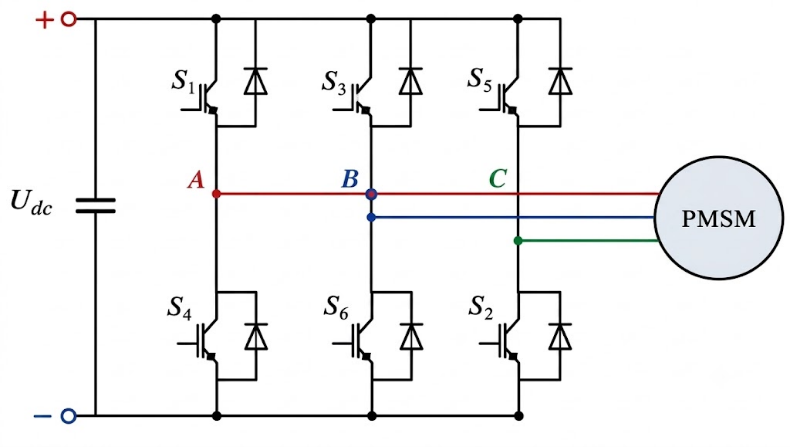
to address the aforementioned issues. After deriving a mathematical model of
the PMSM in the synchronous (d)-(q) coordinate frame, an MPDSC approach
centered on the finite control set predictive control principle is put forward.
The suggested observer minimizes chattering while ensuring resilience and
accurate disturbance assessment by adjusting the sliding mode coefficients
using an adaptive approach. In MATLAB/Simulink, the efficacy of the
suggested approach is confirmed under various operating situations, including
fluctuating load torque and speed. The simulation findings display that the
enhanced MPDSC method outperforms the conventional MPDSC strategy in
terms of dynamic response, including reduced overshooting, quicker settling
reaction, reduced speed error, and superior current quality performance. For
instance, at the operating conditions utilized in the testing, the settling time
was reduced from around 40ms to 38ms, and the total harmonic distortion
(THD) of the stator current was diminished from 13.95% to 2.41%.
Furthermore, the suggested observer-based compensation technique may
enhance the robustness of the PMSM and efficiently suppress factor
disturbances. The obtained findings confirm that the suggested adaptive
observer-assisted MPDSC method is a practical and computationally
economical way to improve PMSM's dynamic performance and disturbance
rejection capabilities.
References
L. Wogi, M. Morawiec, and T. Ayana, “Sensorless Control of Induction Motor Based on Super-Twisting Sliding Mode Observer With Speed Convergence Improvement,” IEEE Access, vol. 12, no. May, pp. 74239–74250, 2024, https://doi.org/10.1109/ACCESS.2024.3404040.
Y. Yang, S. C. Tan, and S. Y. R. Hui, “Adaptive Reference Model Predictive Control with Improved Performance for Voltage-Source Inverters,” IEEE Trans. Control Syst. Technol., vol. 26, no. 2, pp. 724–731, 2018, https://doi.org/10.1109/TCST.2017.2670529.
M. K. Ismael, S. T. Bahar, and A. A. Abdullah, “Harmonic Elimination Method for Permanent Magnet Synchronous Motor Utilizing Active Disturbance Rejection Control,” Proc. Eng. Technol. Innov., vol. 30, pp. 11–23, 2025, https://doi.org/10.46604/peti.2024.14386.
S. Abood, A. Annamalai, I. Khalid, M. Chouikha, and H. A. Al-Zuhairi, “AI-Based Hybrid Control for Optimizing Doubly-Fed Induction Generators in Wind Turbines,” Int. J. Intell. Eng. Syst., vol. 18, no. 6, pp. 439–459, 2025, https://doi.org/10.22266/ijies2025.0731.28.
Y. Zhang, S., Wang, Y., Hu, and Y. Zhang, “Model Predictive Control with Parameter Robustness for Surface-mounted Permanent Magnet Synchronous Motor Drives,” in 2021 IEEE International Conference on Predictive Control of Electrical Drives and Power Electronics (PRECEDE), pp. 322–327, 2021, https://doi.org/10.1109/precede51386.2021.9680908.
H. Wang, S. Zhang, W. Liu, Q. Geng, and Z. Zhou, “Finite control‐set model predictive direct speed control of a PMSM drive based on the Taylor series model,” IET Electric Power Applications, vol. 15, no. 11, pp. 1452–1465, July 2021, https://doi.org/10.1049/elp2.12112.
S. T. Bahar and H. Qiu, “Amelioration of Traditional PI Boost Converter Utilizing Linear Active Disturbance Rejection Controller-Mode Predictive Control Strategy,” Int. J. Robot. Control Syst., vol. 6, no. 1, pp. 305–323, 2026, https://doi.org/10.31763/ijrcs.v6i1.2364.
S. T. Bahar, W. Wang, and H. Qiu, “AI-Enhanced Model Predictive and Active Disturbance Rejection Control for High-Performance Permanent Magnet Synchronous Motor Drives,” Energies, vol. 19, no. 11, p. 2574, May 2026, https://doi.org/10.3390/en19112574.
Z. Chen, L., Chen, J., Qiu, L., Shi, D., and Qi, D., “Current Sampling Scheme for Finite-Control-Set Model Predictive Control of PMSM Drives with Two Shunt Resistors,” in 2023 IEEE International Conference on Predictive Control of Electrical Drives and Power Electronics (PRECEDE), pp. 1–6, 2023, https://doi.org/10.1109/precede57319.2023.10174466.
B. R. Park, G. C. Lim, J. Choi, C. Hwang, and J.-I. Ha, “Torque Ripple Minimization of PMSM Drive with Speed Ripple Feedback Considering Non-linearities of PMSM,” in 2021 IEEE Energy Conversion Congress and Exposition (ECCE), 2021, https://doi.org/10.1109/ecce47101.2021.9595926.
S. T. Bahar and Raed A. Abd-Alhmeed, “Reduce-Complexity of Predictive Current 479 Control for a 3-Phase Voltage Source Inverter,” Journal of Techniques, vol. 7, no. 3, pp. 480 16–25, Sep. 2025, https://doi.org/10.51173/jt.v7i3.2621.
S. Zhuo, A. Gaillard, L. Guo, L. Xu, D. Paire, and F. Gao, “Active Disturbance Rejection Voltage Control of a Floating Interleaved DC-DC Boost Converter with Switch Fault Consideration,” IEEE Trans. Power Electron., vol. 34, no. 12, pp. 12396–12406, 2019, https://doi.org/10.1109/TPEL.2019.2905897.
S. Masoudi and H. Mehrjerdi, "A Multilayer Perception Trained Method in Speed Control of a Linear Switched Reluctance Motor," IEEE Transactions on Power Electronics, vol. 37, no. 4, pp. 4475-4483, 2022, https://doi.org/10.1109/TPEL.2021.3125606.
R. K. Chillab and H. A. Hasan, “Adaptive Hybrid Fuzzy–Neural PID Control of Speed Regulation and Torque Ripple Reduction of BLDC Motors”, Buletin Ilmiah Sarjana Teknik Elektro, vol. 8, no. 3, pp. 792–810, Jun. 2026, https://doi.org/10.12928/biste.v8i3.16182.
Y. Zhao, L. Ren, Z. Liao, and G. Lin, “A Novel Model Predictive Direct Torque Control Method for Improving Steady-State Performance of the Synchronous Reluctance Motor,” Energies, vol. 14, no. 8, p. 2256, 2021, https://doi.org/10.3390/en14082256.
X. Li, Y. Cui, and X. Wu, “Sensorless Control of Surface-Mounted Permanent Magnet Synchronous Motor in a Wide-Speed Range,” Electron., vol. 13, no. 6, 2024, https://doi.org/10.3390/electronics13061131.
N. K. Quang and Q. P. Ha, “FPGA-based Sensorless PMSM Drive with Sliding Mode Observer for Velocity Tracking,” IEEE Access, vol. 14, no. March, pp. 39687–39701, 2026, https://doi.org/10.1109/ACCESS.2026.3673003.
N. V. Laksmi B., M. S. Mubarok, W. Aribowo, D. Purwanto, J. R. Isaac, and V. H. Abdullayev, “Indirect Matrix Converter Based Synchronous Reluctance Motor Drive Systems using Model Predictive Control”, Buletin Ilmiah Sarjana Teknik Elektro, vol. 8, no. 2, pp. 331–343, Mar. 2026, https://doi.org/10.12928/biste.v8i2.15222.
K. Wang, R. D. Lorenz, and N. A. Baloch, “Enhanced Methodology for Injection-Based Real-Time Parameter Estimation to Improve Back EMF Self-Sensing in Induction Machine Deadbeat-Direct Torque and Flux Control Drives,” IEEE Trans. Ind. Appl., vol. 54, no. 6, pp. 6071–6080, 2018, https://doi.org/10.1109/TIA.2018.2855162.
Q. H. Le and N. T. Pham, “Predefined-Time Super-Twisting Disturbance-Observer-Based Speed Control for PI-Based FOC Induction Motor Drives”, Buletin Ilmiah Sarjana Teknik Elektro, vol. 8, no. 2, pp. 451–462, Apr. 2026, https://doi.org/10.12928/biste.v8i2.15761.
Z. Hao et al., “Linear/Nonlinear Active Disturbance Rejection Switching Control for Permanent Magnet Synchronous Motors,” IEEE Trans. Power Electron., vol. 36, no. 8, pp. 9334–9347, 2021, https://doi.org/10.1109/TPEL.2021.3055143.
C. LIU, G. LUO, Z. CHEN, W. TU, and C. QIU, “A linear ADRC-based robust high-dynamic double-loop servo system for aircraft electro-mechanical actuators,” Chinese J. Aeronaut., vol. 32, no. 9, pp. 2174–2187, 2019, https://doi.org/10.1016/j.cja.2019.03.036.
M. Tian, B. Wang, Y. Yu, Q. Dong, and D. Xu, “Discrete-Time Repetitive Control-Based ADRC for Current Loop Disturbances Suppression of PMSM Drives,” IEEE Trans. Ind. Informatics, vol. 18, no. 5, pp. 3138–3149, 2022, https://doi.org/10.1109/TII.2021.3107635.
Q. Zhang, Y. Fan, and C. Mao, “A Gain Design Method for a Linear Extended State Observers to Improve Robustness of Deadbeat Control,” IEEE Trans. Energy Convers., vol. 35, no. 4, pp. 2231–2239, 2020, https://doi.org/10.1109/TEC.2020.3009119.
S. Ye and X. Yao, “A Modified Flux Sliding-Mode Observer for the Sensorless Control of PMSMs with Online Stator Resistance and Inductance Estimation,” IEEE Trans. Power Electron., vol. 35, no. 8, pp. 8652–8662, 2020, https://doi.org/10.1109/TPEL.2019.2963112.
A. B. Badri, I. K. A. Razzaqe, and O. A. Kadhim, “AI-Driven Predictive Maintenance for Rare-Earth-Free Synchronous Motors in Smart Grid Applications,” Mathematical Modelling of Engineering Problems, vol. 13, no. 1, pp. 99–110, Feb. 2026, https://doi.org/10.18280/mmep.130110.
Z. Wu, D. Li, Y. Liu, and Y. Q. Chen, “Performance Analysis of Improved ADRCs for a Class of High-Order Processes With Verification on Main Steam Pressure Control,” IEEE Trans. Ind. Electron., vol. 70, no. 6, pp. 6180–6190, 2023, https://doi.org/10.1109/TIE.2022.3192687.
J. She, M. Xie, D. Y. Li, M. Wu, Z. T. Liu, and W. N. Zhang, “A VFF-RLS Method of Inertia Identification for PMSM,” CCTA 2019 - 3rd IEEE Conf. Control Technol. Appl., no. 10, pp. 942–943, 2019, https://doi.org/10.1109/CCTA.2019.8920489.
H. Dan, W. Yue, W. Xiong, Y. Liu, M. Su and Y. Sun, "Open-Switch and Current Sensor Fault Diagnosis Strategy for Matrix Converter-Based PMSM Drive System," IEEE Transactions on Transportation Electrification, vol. 8, no. 1, pp. 875-885, 2022, https://doi.org/10.1109/TTE.2021.3109093.
X. Wang et al., "Well-Conditioned Identifiability Criteria With Observability Degree for Parameter Estimation of Permanent Magnet Synchronous Motors," IEEE Transactions on Transportation Electrification, vol. 11, no. 3, pp. 7195-7206, 2025, https://doi.org/10.1109/TTE.2024.3524783.
W. Lu, B. Tang, K. Ji, K. Lu, D. Wang, and Z. Yu, “A New Load Adaptive Identification Method Based on an Improved Sliding Mode Observer for PMSM Position Servo System,” IEEE Trans. Power Electron., vol. 36, no. 3, pp. 3211–3223, 2021, https://doi.org/10.1109/TPEL.2020.3016713.
S. T. Bahar and R. G. Omar, “Permanent Magnet Synchronous Motor Torque Ripple Reduction Using Predictive Torque Control,” J. Eng. Sustain. Dev., vol. 27, no. 3, pp. 394–406, 2023, https://doi.org/10.31272/jeasd.
W. Zhang, W. Wang, H. Liu, and D. Xu, “A Disturbance Rejection Control Strategy for Droop-Controlled Inverter Based on Super-Twisting Algorithm,” IEEE Access, vol. 7, no. c, pp. 27037–27046, 2019, https://doi.org/10.1109/ACCESS.2019.2900501.
Z. H. Liu, H. L. Wei, X. H. Li, K. Liu, and Q. C. Zhong, “Global Identification of Electrical and Mechanical Parameters in PMSM Drive Based on Dynamic Self-Learning PSO,” IEEE Trans. Power Electron., vol. 33, no. 12, pp. 10858–10871, 2018, https://doi.org/10.1109/TPEL.2018.2801331.
X. Zhang, B. Hou, and Y. Mei, “Deadbeat Predictive Current Control of Permanent-Magnet Synchronous Motors with Stator Current and Disturbance Observer,” IEEE Trans. Power Electron., vol. 32, no. 5, pp. 3818–3834, 2017, https://doi.org/10.1109/TPEL.2016.2592534.
J. M. Tabora et al., “Exploring the Effects of Voltage Variation and Load on the Electrical and Thermal Performance of Permanent-Magnet Synchronous Motors,” Energies, vol. 17, no. 1, p. 8, 2023, https://doi.org/10.3390/en17010008.
Y. Zhao, W. Qiao, and L. Wu, “Improved Rotor Position and Speed Estimators for Sensorless Control of Interior Permanent-Magnet Synchronous Machines,” IEEE Journal of Emerging and Selected Topics in Power Electronics, vol. 2, no. 3, pp. 627–639, 2014, https://doi.org/10.1109/JESTPE.2014.2298433.
T. T. Pham and N. T. Pham, “A Hybrid PI–SOSM Control Strategy with Disturbance Observer for Enhanced Dynamic Response of IM Drives”, Buletin Ilmiah Sarjana Teknik Elektro, vol. 7, no. 4, pp. 702–714, Oct. 2025, https://doi.org/10.12928/biste.v7i4.14458.
F. Xie et al., “The Optimal Speed-Torque Control of Asynchronous Motors for Electric Cars in the Field-Weakening Region Based on the RFR,” IEEE Trans. Ind. Electron., vol. 67, no. 11, pp. 9601–9612, 2020, https://doi.org/10.1109/TIE.2019.2956379.
B. Guo, S. Bacha, M. Alamir, A. Hably, and C. Boudinet, “Generalized Integrator-Extended State Observer with Applications to Grid-Connected Converters in the Presence of Disturbances,” IEEE Trans. Control Syst. Technol., vol. 29, no. 2, pp. 744–755, 2021, https://doi.org/10.1109/TCST.2020.2981571.
A. Najem, A. Moutabir, A. Ouchatti, and M. E. Haissouf, “Experimental Validation of the Generation of Direct and Quadratic Reference Currents by Combining the Ant Colony Optimization Algorithm and Sliding Mode Control in PMSM using the Process PIL,” International Journal of Robotics and Control Systems, vol. 4, no. 1, pp. 188–216, Mar. 2024, https://doi.org/10.31763/ijrcs.v4i1.1286.
X. Zhang, Z. Zhao, Y. Cheng, Y. Wang, “Robust Model Predictive Current Control Based on Inductance and Flux Linkage Extraction Algorithm,” IEEE Transactions on Vehicular Technology, vol. 69, no. 12, pp. 14893-14902, 2020, https://doi.org/10.1109/TVT.2020.3043474.
Z. Guoqing et al., “Research on Position Sensorless Control of PMSM Based on Improved SMO,” IOP Conf. Ser. Mater. Sci. Eng., vol. 533, no. 1, 2019, https://doi.org/10.1088/1757-899X/533/1/012019.
M. Nicola, C. I. Nicola, D. Selişteanu, and D. Şendrescu, “PMSM Sensorless Control System Based on Super Twisting-Terminal SMC and SMO-PLL Observer,” 2024 28th Int. Conf. Syst. Theory, Control Comput. ICSTCC 2024 - Proc., no. 1, pp. 483–490, 2024, https://doi.org/10.1109/ICSTCC62912.2024.10744709.
E. J. Fuentes, C. A. Silva, and J. I. Yuz, “Predictive speed control of a two-mass system driven by a permanent magnet synchronous motor,” IEEE Trans. Ind. Electron., vol. 59, no. 7, pp. 2840–2848, 2012, https://doi.org/10.1109/TIE.2011.2158767.
P. G. Carlet, A. Favato, S. Bolognani, F. Dorfler, “Data-Driven Continuous-Set Predictive Current Control for Synchronous Motor Drives,” IEEE Transactions on Power Electronics, vol. 37, no. 6, pp. 6637–6646, 2022, https://doi.org/10.1109/TPEL.2022.3142244.
H. H. Lee, P. Q. Dzung, L. D. Khoa, and L. M. Phuong, “The optimized adaptive space vector pulse width modulation for four switch three phase inverter under DC - Link voltage ripple condition,” IEEE Reg. 10 Annu. Int. Conf. Proceedings/TENCON, no. 2, pp. 1–6, 2009, https://doi.org/10.1109/TENCON.2009.5396098.
J. Liu and H. Yu, “Active Disturbance Rejection Control of SEA Based on Reduced Order Extended State Observer,” Lect. Notes Electr. Eng., vol. 885 LNEE, no. 2, pp. 121–129, 2022, https://doi.org/10.1007/978-981-19-1309-9_12.
M. S. Rafaq and J. W. Jung, “A Comprehensive Review of State-of-the-Art Parameter Estimation Techniques for Permanent Magnet Synchronous Motors in Wide Speed Range,” IEEE Trans. Ind. Informatics, vol. 16, no. 7, pp. 4747–4758, 2020, https://doi.org/10.1109/TII.2019.2944413.
Z. H. Liu, H. L. Wei, Q. C. Zhong, K. Liu, X. S. Xiao, and L. H. Wu, “Parameter estimation for VSI-Fed PMSM based on a dynamic PSO with learning strategies,” IEEE Trans. Power Electron., vol. 32, no. 4, pp. 3154–3165, 2017, https://doi.org/10.1109/TPEL.2016.2572186.
Published
How to Cite
Issue
Section
License
Copyright (c) 2026 Islam Khalid, Othman J. Alhayali, Sameh Aljanabi

This work is licensed under a Creative Commons Attribution-ShareAlike 4.0 International License.
Authors who publish with this journal agree to the following terms:
- Authors retain copyright and grant the journal right of first publication with the work simultaneously licensed under a Creative Commons Attribution License that allows others to share the work with an acknowledgment of the work's authorship and initial publication in this journal.
- Authors are able to enter into separate, additional contractual arrangements for the non-exclusive distribution of the journal's published version of the work (e.g., post it to an institutional repository or publish it in a book), with an acknowledgment of its initial publication in this journal.
- Authors are permitted and encouraged to post their work online (e.g., in institutional repositories or on their website) prior to and during the submission process, as it can lead to productive exchanges, as well as earlier and greater citation of published work (See The Effect of Open Access).

This journal is licensed under a Creative Commons Attribution-ShareAlike 4.0 International License.