Static-Slope Dynamics and Uncertainty of a Compact-Excavator Manipulator for Near-Ground Sensing
DOI:
https://doi.org/10.12928/biste.v8i4.16278Keywords:
Hydraulic Excavator Dynamics, Uncertainty Propagation, Static Slope Compensation, Computed-Torque Control, Chassis Attitude EstimationAbstract
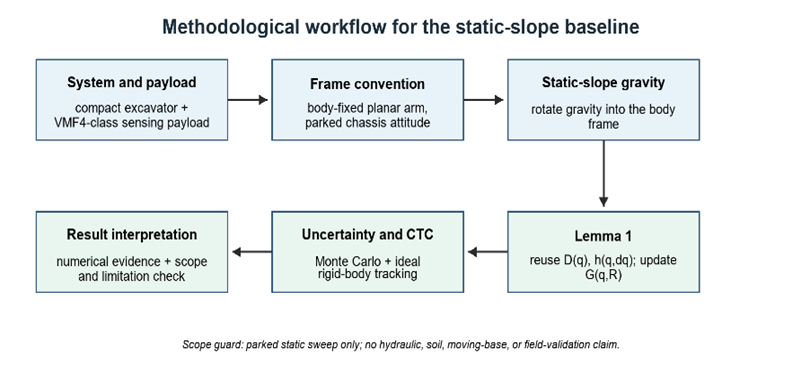
Near-ground unexploded ordnance (UXO) sensing requires a mobile carrier that maintains a controlled detector air gap over uneven terrain. This paper develops a static-slope rigid-body baseline for a Bobcat E20-class mini excavator carrying a 15 kg VMF4-class payload on a self-leveling gimbal. The research contribution is a body-frame, parked-base formulation that separates arm-level Cartesian positioning from payload-level attitude stabilization and identifies which rigid-body terms change on a static slope. The four-DOF attachment is reduced to a planar three-DOF boom-stick-tool subsystem for line sweeping. A kinetic-energy argument and potential-energy differentiation show that, with parked chassis and body-fixed coordinates, the inertia and Coriolis/centrifugal terms retain their level-ground form, while only the gravity torque is recomputed from the rotated gravity vector and center-of-mass Jacobians. Evaluation combines static torque analysis, Monte Carlo propagation, computed-torque tracking, and runtime timing. At 10° pitch, the 95th-percentile end-effector uncertainty is 2.63-3.65 cm; at 15° pitch, the tested gravity-torque change reaches 322.66 Nm. In the Python reproducibility environment, gravity-only update takes 24.0 microseconds per sample, compared with 38.9 microseconds for full rigid-body term recomputation. The 5.7°-6.3° trigger is a heuristic gravity-bias indicator, not a stability or clearance guarantee. Results support lightweight slope-aware gravity recomputation, while hydraulic dynamics, friction, soil interaction, moving-base effects, embedded timing, and hardware validation remain future work.
References
O. M. U. Eraliev, K.-H. Lee, D.-Y. Shin, and C.-H. Lee, "Sensing, perception, decision, planning and action of autonomous excavators," Automation in Construction, vol. 141, p. 104428, 2022, https://doi.org/10.1016/j.autcon.2022.104428.
D. Jud, S. Kerscher, M. Wermelinger, E. Jelavic, P. Egli, P. Leemann, G. Hottiger, and M. Hutter, "HEAP - The autonomous walking excavator," Automation in Construction, vol. 129, p. 103783, 2021, https://doi.org/10.1016/j.autcon.2021.103783.
T. Zhang, T. Fu, T. Ni, H. Yue, Y. Wang, and X. Song, "Data-driven excavation trajectory planning for unmanned mining excavator," Automation in Construction, vol. 162, p. 105395, 2024, https://doi.org/10.1016/j.autcon.2024.105395.
A. Jomartov, A. Tuleshov, A. Kamal, and A. Abduraimov, "Design of a cable-driven parallel robot for landmine detection," SN Applied Sciences, vol. 5, p. 299, 2023, https://doi.org/10.1007/s42452-023-05533-2.
Y. Cao and Y. Xie, "Dynamic modeling of the front structure of an excavator," Nonlinear Dynamics, vol. 91, no. 1, pp. 233-247, 2018, https://doi.org/10.1007/s11071-017-3865-7.
R. Mitrev, D. Janošević, and D. Marinković, "Dynamical modelling of hydraulic excavator considered as a multibody system," Tehnički vjesnik - Technical Gazette, vol. 24, Supplement 2, pp. 327-338, 2017, https://doi.org/10.17559/TV-20151215150306.
H. Ding, Z. Sang, Z. Li, J. Shi, Y. Wang, and D. Meng, "Trajectory planning and control of large robotic excavators based on inclination-displacement mapping," Automation in Construction, vol. 158, p. 105209, 2024, https://doi.org/10.1016/j.autcon.2023.105209.
S. Tafazoli, P. D. Lawrence, and S. E. Salcudean, "Identification of inertial and friction parameters for excavator arms," IEEE Transactions on Robotics and Automation, vol. 15, no. 5, pp. 966-971, 1999, https://doi.org/10.1109/70.795801.
Y. H. Zweiri, L. D. Seneviratne, and K. Althoefer, "Parameter estimation for excavator arm using generalized Newton method," IEEE Transactions on Robotics, vol. 20, no. 4, pp. 762-767, 2004, https://doi.org/10.1109/TRO.2004.829476.
Y. Feng, X. Tian, T. Li, and Y. Jiang, "Measurement of mobile manipulator chassis pose change caused by suspension deformation and end-effector accuracy improvement based on multi-sensor fusion," Robotics and Autonomous Systems, vol. 170, p. 104553, 2023, https://doi.org/10.1016/j.robot.2023.104553.
H. Q. Dong, N. T. Gam, H. M. Cuong, and L. A. Tuan, "Fractional-order fast terminal back-stepping sliding mode control of autonomous robotic excavators," Journal of the Franklin Institute, vol. 361, no. 6, p. 106686, 2024, https://doi.org/10.1016/j.jfranklin.2024.106686.
V. D. Le and N. M. Kha, "The dynamics of a wheel loader in motion considering random road surface irregularities," Journal of Science and Technique, vol. 20, no. 1, 2025, https://doi.org/10.56651/lqdtu.jst.v20.n01.898.
S. Kafashan and J. D. Saphores, “Building Sustainably: Annualized Cost of Ownership, Externalities, and the Electrification of Construction Machinery,” Sustainability, vol. 18, no. 12, p. 6343, 2026, https://doi.org/10.3390/su18126343.
W. Liu, X. Luo, J. Zhang, D. Niu, J. Deng, W. Sun, and J. Kang, "Review on control systems and control strategies for excavators," Journal of Physics: Conference Series, vol. 2301, no. 1, p. 012023, 2022, https://doi.org/10.1088/1742-6596/2301/1/012023.
T. Okada, T. Yamamoto, T. Doi, K. Koiwai, and K. Yamashita, "Database-driven model predictive control system for online adaptation of an autonomous excavator to environmental conditions," Control Engineering Practice, vol. 145, p. 105843, 2024, https://doi.org/10.1016/j.conengprac.2024.105843.
M. Lee, H. Choi, C. Kim, J. Moon, D. Kim, and D. Lee, "Precision motion control of robotized industrial hydraulic excavators via data-driven model inversion," IEEE Robotics and Automation Letters, vol. 7, no. 2, pp. 1912-1919, 2022, https://doi.org/10.1109/LRA.2022.3142389.
H. Feng, J. Jiang, X. Chang, C. Yin, D. Cao, H. Yu, C. Li, and J. Xie, "Adaptive sliding mode controller based on fuzzy rules for a typical excavator electro-hydraulic position control system," Engineering Applications of Artificial Intelligence, vol. 126, p. 107008, 2023, https://doi.org/10.1016/j.engappai.2023.107008.
X. Tao, K. Liu, J. Yang, Y. Chen, J. Chen, and H. Zhu, “Sliding mode backstepping control of excavator bucket trajectory synovial in particle swarm optimization algorithm and neural network disturbance observer,” Actuators, vol. 14, no. 1, p. 9, 2025, https://doi.org/10.3390/act14010009.
P. Egli, D. Gaschen, S. Kerscher, D. Jud, and M. Hutter, "Soil-adaptive excavation using reinforcement learning," IEEE Robotics and Automation Letters, vol. 7, no. 4, pp. 9778-9785, 2022, https://doi.org/10.1109/LRA.2022.3189834.
P. Egli and M. Hutter, "A general approach for the automation of hydraulic excavator arms using reinforcement learning," IEEE Robotics and Automation Letters, vol. 7, no. 2, pp. 5679-5686, 2022, https://doi.org/10.1109/LRA.2022.3152865.
W. Huang, Q. Wang, S. Yang, J. Zhang, and B. Xu, "Adaptive sliding mode and safety control for excavators using kinematic control barrier function and sliding mode disturbance observer," Automation in Construction, vol. 172, p. 106046, 2025, https://doi.org/10.1016/j.autcon.2025.106046.
K. Chen, L. Tao, J. Chen, C. Hua, and Q. Li, "Safe reinforcement learning for tracking control of uncertain hydraulic excavators," Nonlinear Dynamics, vol. 113, pp. 26269-26284, 2025, https://doi.org/10.1007/s11071-025-11500-w.
Z. Jin, M. Gong, D. Zhao, Y. Zhang, W. Liu, J. Zhu, and B. Su, "MPC motion control of boom descending of unmanned excavator based on regenerative valve," Heliyon, vol. 10, no. 9, p. e29915, 2024, https://doi.org/10.1016/j.heliyon.2024.e29915.
D. Mambetov, V. Jundibayev, U. Kasymov, A. Danyarova, and D. Murzabekov, “Ensuring quick changeability of the working bodies of technological machines in the construction and maintenance of the landscape, road-building, and agricultural industries,” Mechanics Based Design of Structures and Machines, vol. 52, no. 10, pp. 7692-7704, 2024, https://doi.org/10.1080/15397734.2024.2305783.
D. G. Atinafu, J. Y. Choi, Y. Choi, J. Nam, and S. Kim, “Eicosane-infused heterostructured nanocarbon hybrid aerogel composite for high-performance thermal transport and energy conversion,” Composites Part B: Engineering, vol. 304, p. 112658, 2025, https://doi.org/10.1016/j.compositesb.2025.112658.
K. Xu, J. Song, Z. Li, F. Guipeng, Z. Zha, and K. Wu, “Research and application of rock asphalt dry-modified fluid mastic asphalt mixture for reflective crack treatment in asphalt pavements,” Case Studies in Construction Materials, p. e05622, 2025, https://doi.org/10.1016/j.cscm.2025.e05622.
S. Echeandia and P. M. Wensing, "Numerical methods to compute the Coriolis matrix and Christoffel symbols for rigid-body systems," Journal of Computational and Nonlinear Dynamics, vol. 16, no. 9, p. 091004, 2021, https://doi.org/10.1115/1.4051169.
J. Paziewski, R. Sieradzki, J. Rapinski, D. Tomaszewski, K. Stepniak, J. Geng, and G. Li, “Integrating low-cost GNSS and MEMS accelerometer for precise dynamic displacement monitoring,” Measurement, vol. 242, p. 115798, 2025, https://doi.org/10.1016/j.measurement.2024.115798.
Y. Yamamoto, J. Qiu, T. Doi, T. Nanjo, K. Yamashita, and R. Kikuuwe, "A position controller for hydraulic excavators with deadtime and regenerative pipelines," IEEE Transactions on Automation Science and Engineering, vol. 22, pp. 855-871, 2025, https://doi.org/10.1109/TASE.2024.3354952.
G. Fabris, L. Scalera, P. Boscariol, and A. Gasparetto, “Static and dynamic friction models for robotic manipulators: state of the art and experimental comparison,” Journal of Intelligent & Robotic Systems, vol. 112, article 41, 2026, https://doi.org/10.1007/s10846-026-02390-0.
X. Zhang, R. Shi, Z. Zhu, and Y. Quan, “Adaptive nonsingular fixed-time sliding mode control for manipulator systems’ trajectory tracking,” Complex & Intelligent Systems, vol. 9, pp. 1605–1616, 2023, https://doi.org/10.1007/s40747-022-00864-w.
S. Hu, Y. Wan, and X. Liang, “Adaptive fast terminal sliding mode control of robotic manipulators based on joint torque estimation and friction compensation,” International Journal of Robust and Nonlinear Control, vol. 34, no. 18, pp. 12223–12238, 2024, https://doi.org/10.1002/rnc.7624.
G. R. Petrovic and J. Mattila, "Mathematical modelling and virtual decomposition control of heavy-duty parallel-serial hydraulic manipulators," Mechanism and Machine Theory, vol. 170, p. 104680, 2022, https://doi.org/10.1016/j.mechmachtheory.2021.104680.
D. Guan, N. Yang, J. Lai, M.-F. F. Siu, X. Jing, and C.-K. Lau, "Kinematic modeling and constraint analysis for robotic excavator operations in piling construction," Automation in Construction, vol. 126, p. 103666, 2021, https://doi.org/10.1016/j.autcon.2021.103666.
J. T. Jose, J. Das, and S. K. Mishra, "Dynamic improvement of hydraulic excavator using pressure feedback and gain scheduled model predictive control," IEEE Sensors Journal, vol. 21, no. 17, pp. 18526-18534, 2021, https://doi.org/10.1109/JSEN.2021.3083677.
V. L. Nguyen, C.-H. Kuo, and P.-T. Lin, "Reliability-based analysis and optimization of the gravity balancing performance of spring-articulated serial robots with uncertainties," Journal of Mechanisms and Robotics, vol. 14, no. 3, p. 031016, 2022, https://doi.org/10.1115/1.4053048.
M. Busch, F. Schnoes, A. Elsharkawy, and M. F. Zaeh, "Methodology for model-based uncertainty quantification of the vibrational properties of machining robots," Robotics and Computer-Integrated Manufacturing, vol. 73, p. 102243, 2022, https://doi.org/10.1016/j.rcim.2021.102243.
T. Yaren and S. Kizir, "Efficiency assessment of SOA-based computed torque control: A comparative analysis with NE-based approach," Proceedings of the Institution of Mechanical Engineers, Part I: Journal of Systems and Control Engineering, vol. 238, no. 8, pp. 1410-1424, 2024, https://doi.org/10.1177/09596518241238414.
G. Simonini, M. Baracca, T. V. Cavaliere, A. Bicchi, and P. Salaris, "A novel formulation for adaptive computed torque control enabling low feedback gains in highly dynamical tasks," IEEE Access, vol. 13, pp. 69898-69909, 2025, https://doi.org/10.1109/ACCESS.2025.3561635.
A. Srour, A. Franchi, P. R. Giordano, and M. Cognetti, “Experimental validation of sensitivity-aware trajectory planning for a redundant robotic manipulator under payload uncertainty,” IEEE Robotics and Automation Letters, vol. 10, no. 2, pp. 1561–1568, 2025, https://doi.org/10.1109/LRA.2024.3519857.
Z. Yao, S. Zhao, X. Tan, W. Wei, and Y. Wang, "Real-time task-oriented continuous digging trajectory planning for excavator arms," Automation in Construction, vol. 152, p. 104916, 2023, https://doi.org/10.1016/j.autcon.2023.104916.
Y. Shen, J. Wang, C. Feng, and Q. Wang, "Hybrid-driven autonomous excavator trajectory generation combining empirical driver skills and optimization," Automation in Construction, vol. 165, p. 105523, 2024, https://doi.org/10.1016/j.autcon.2024.105523.
J. Gong, J. Chen, D. Cai, W. Wei, and Y. Long, "Disturbance observer-based passivity and impedance control for trajectory tracking in autonomous hydraulic excavators," Automation in Construction, vol. 170, p. 105898, 2025, https://doi.org/10.1016/j.autcon.2024.105898.
H. Feng, Y. Zhong, C. Zhou, S. Ji, C. Yin, and D. Cao, “Collaborative high-precision trajectory control for heavy excavators based on an improved particle swarm optimization algorithm,” Automation in Construction, vol. 180, article 106546, 2025, https://doi.org/10.1016/j.autcon.2025.106546.
C. Hua, J. Zhou, B. Zhang, Y. Zhang, and J. Zhang, "Low-complexity tracking control of hydraulic excavator systems with asymmetric full-state constraints," Journal of the Franklin Institute, vol. 362, p. 107345, 2025, https://doi.org/10.1016/j.jfranklin.2024.107345.
T. Fu, Z. Hu, T. Zhang, Q. Bi, and X. Song, "Physics-Informed Neural Networks-Based Online Excavation Trajectory Planning for Unmanned Excavator," Chinese Journal of Mechanical Engineering, vol. 37, p. 131, 2024, https://doi.org/10.1186/s10033-024-01109-2.
T. Wang, X. He, Y. Zhou, and F. Shao, "Optimization of Unmanned Excavator Operation Trajectory Based on Improved Particle Swarm Optimization," Actuators, vol. 14, no. 5, p. 226, 2025, https://doi.org/10.3390/act14050226.
P. Egli, L. Terenzi, and M. Hutter, "Reinforcement Learning-Based Bucket Filling for Autonomous Excavation," IEEE Transactions on Field Robotics, vol. 1, pp. 170-191, 2024, https://doi.org/10.1109/TFR.2024.3432508.
T. Zhang, Z. Zhou, C. Yan, J. Yao, X. Song, and K. Li, "Digital twin-driven excavation trajectory planning of unmanned excavator based on multidisciplinary co-simulation," Automation in Construction, vol. 178, p. 106404, 2025, https://doi.org/10.1016/j.autcon.2025.106404.
C. Wang, “Integrated electronic control of electro-hydraulic excavators,” Journal of Engineering and Applied Science, vol. 73, article 157, 2026, https://doi.org/10.1186/s44147-026-01023-5.
X. Wei, S. Fan, Y. Zhang, W. Gao, F. Shen, X. Ming, and J. Yang, “A robust adaptive error state Kalman filter for MEMS IMU attitude estimation under dynamic acceleration,” Measurement, vol. 242, Part D, article 116097, 2025, https://doi.org/10.1016/j.measurement.2024.116097.
S. B. Farahan, J. J. M. Machado, F. G. de Almeida, and J. M. R. S. Tavares, “9-DOF IMU-based attitude and heading estimation using an extended Kalman filter with bias consideration,” Sensors, vol. 22, no. 9, p. 3416, 2022, https://doi.org/10.3390/s22093416.
M. Liu, Y. Cai, L. Zhang, and Y. Wang, “Attitude estimation algorithm of portable mobile robot based on complementary filter,” Micromachines, vol. 12, no. 11, p. 1373, 2021, https://doi.org/10.3390/mi12111373.
H. Kallel and K. Iqbal, “Online estimation of manipulator dynamics for computed torque control of robotic systems,” Sensors, vol. 25, no. 22, p. 6831, 2025, https://doi.org/10.3390/s25226831.
P. Galarce-Acevedo and M. Torres-Torriti, “Discrete-time computed torque control with PSO-based tuning for energy-efficient mobile manipulator trajectory tracking,” Robotics, vol. 15, no. 1, p. 19, 2026, https://doi.org/10.3390/robotics15010019.
Z. He, S. Piao, X. Leng, and Y. Wu, “Uneven terrain walking with linear and angular momentum allocation,” Sensors, vol. 23, no. 4, p. 2027, 2023, https://doi.org/10.3390/s23042027.
P. Li, B. Yin, L. Zhang, and Y. Zhao, “Adaptive control algorithm for quadruped robots in unknown high-slope terrain,” Journal of Engineering Research, vol. 13, no. 3, pp. 1771–1784, 2025, https://doi.org/10.1016/j.jer.2024.05.018.
R. Kang, H. Ning, F. Meng, and Z. He, “Whole-body synergy-based balance control for quadruped robots with manipulators on sloped terrains,” Cyborg and Bionic Systems, vol. 5, p. 0201, 2024, https://doi.org/10.34133/cbsystems.0201.
V. D. Phan, C. P. Vo, and K. K. Ahn, “Adaptive neural tracking control for flexible joint robot including hydraulic actuator dynamics with disturbance observer,” International Journal of Robust and Nonlinear Control, vol. 34, no. 13, pp. 8744–8767, 2024, https://doi.org/10.1002/rnc.7412.
K. Liu, H. Zhong, M. Chen, J. Yang, H. Qiang, and S. Kang, “Analysis of vibration characteristics of hydraulic excavator device under flat ground conditions,” Modelling and Simulation in Engineering, vol. 2024, p. 4390530, 2024, https://doi.org/10.1155/2024/4390530.
S. Wang, B. Zhang, J. Zhou, B. Yang, and Y. He, “Time-jerk optimal trajectory planning for industrial robots with coupled interpolation function selection,” Journal of Field Robotics, vol. 41, no. 4, pp. 917–941, 2024, https://doi.org/10.1002/rob.22298.
F. Lozer, L. Scalera, P. Boscariol, and A. Gasparetto, “Planning optimal minimum-jerk trajectories for redundant robots,” Robotics and Autonomous Systems, vol. 192, p. 105049, 2025, https://doi.org/10.1016/j.robot.2025.105049.
Published
How to Cite
Issue
Section
License
Copyright (c) 2026 Pham Chi Thanh, Tran Ngoc Binh, Nguyen Xuan Chiem

This work is licensed under a Creative Commons Attribution-ShareAlike 4.0 International License.
Authors who publish with this journal agree to the following terms:
- Authors retain copyright and grant the journal right of first publication with the work simultaneously licensed under a Creative Commons Attribution License that allows others to share the work with an acknowledgment of the work's authorship and initial publication in this journal.
- Authors are able to enter into separate, additional contractual arrangements for the non-exclusive distribution of the journal's published version of the work (e.g., post it to an institutional repository or publish it in a book), with an acknowledgment of its initial publication in this journal.
- Authors are permitted and encouraged to post their work online (e.g., in institutional repositories or on their website) prior to and during the submission process, as it can lead to productive exchanges, as well as earlier and greater citation of published work (See The Effect of Open Access).

This journal is licensed under a Creative Commons Attribution-ShareAlike 4.0 International License.