Kinematic Modeling of 6-DOF Articulated Robot Arm Denso VS 6577
DOI:
https://doi.org/10.12928/biste.v8i4.16049Keywords:
6-DOF Robot Manipulator, Forward Kinematics, Inverse KinematicsAbstract
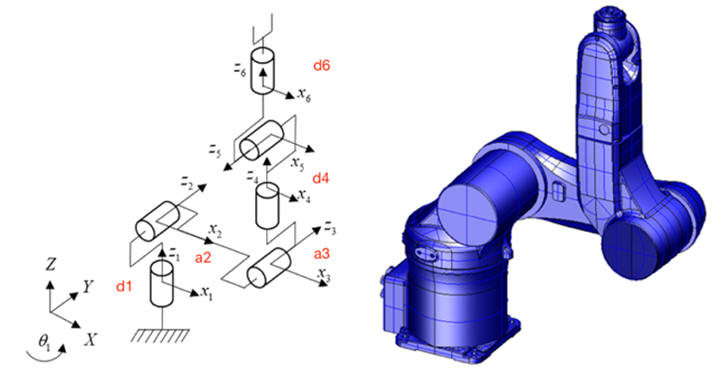
This paper presents a virtual-to-real validation framework for the kinematic modeling of a 6-DOF articulated industrial manipulator, Denso VS-6577. The proposed framework integrates analytical forward and inverse kinematics with a virtual simulation environment and physical robot experiments to evaluate trajectory consistency between simulated and real-world robotic environments. Closed-form inverse kinematic solutions based on the Denavit–Hartenberg (DH) convention are derived to enable computationally efficient real-time joint computation and continuous and smooth joint trajectory generation. A graphical simulation environment developed using MATLAB and V-Realm is employed to visualize and analyze robot motion under multiple joint configurations, including elbow-up posture selection and continuity-aware joint configuration management to maintain continuous manipulator motion throughout trajectory execution. To validate the proposed framework, identical circular trajectories are executed in both simulation and physical robot environments using the built-in closed-loop servo control system of the industrial manipulator. Trajectory tracking performance is evaluated by comparing Cartesian position errors along the x, y, and z axes using root-mean-square error (RMSE) analysis. Experimental results show simulation RMSE values of 1.85 mm, 0.49 mm, and 0.054 mm along the x, y, and z axes, respectively, while the physical robot experiments produce RMSE values of 3.125 mm, 1.318 mm, and 0.089 mm. The computational cost of the analytical inverse kinematic solution is less than 5 ms, demonstrating suitability for real-time robotic implementation. The results demonstrate satisfactory agreement between simulation and physical robot trajectories during continuous circular motion, while larger deviations are observed during transitional point-to-point movements. These discrepancies are primarily attributed to actuator dynamics, servo response delay, joint compliance, and mechanical backlash that are not represented in the analytical kinematic model. The proposed framework provides a unified approach for analytical kinematic validation, trajectory evaluation, and virtual-to-real robotic verification. The proposed framework can support future development of digital twin systems, advanced motion planning, and industrial robotic trajectory optimization.
References
M. Y. Alwardat and H. M. Alwan, “Forward and inverse kinematics of a 6-DOF robotic manipulator with a prismatic joint using MATLAB robotics toolbox,” International Journal of Advanced Technology and Engineering Exploration, vol. 11, no. 117, pp. 1096–1110, 2024, https://doi.org/10.19101/IJATEE.2024.111100210.
H. D. Salman, M. N. Hamzah, and S. H. Bakhy, “Kinematics analysis and implementation of three degrees of freedom robotic arm by using MATLAB,” The Iraqi Journal for Mechanical and Materials Engineering, vol. 21, no. 2, pp. 118–129, 2021, https://doi.org/10.32852/iqjfmme.v21i2.547.
X. Zhou, Y. Xian, Y. Chen, T. Chen, L. Yang, S. Chen, and J. Huang, “An improved inverse kinematics solution for 6-DOF robot manipulators with offset wrists,” Robotica, vol. 40, no. 7, pp. 2275–2294, 2022, https://doi.org/10.1017/S0263574721001648.
Y. Wen and P. Pagilla, “Path-constrained and collision-free optimal trajectory planning for robot manipulators,” IEEE Transactions on Automation Science and Engineering, vol. 20, no. 2, pp. 763–774, 2022, https://doi.org/10.1109/TASE.2022.3169989.
H. Wang, Z. Zhou, X. Zhong, and Q. Chen, “Singular configuration analysis and singularity avoidance with application in an intelligent robotic manipulator,” Sensors, vol. 22, no. 3, p. 1239, 2022, https://doi.org/10.3390/s22031239.
N. G. Adar, “Real time control application of the robotic arm using neural network based inverse kinematics solution,” Sakarya University Journal of Science, vol. 25, no. 3, pp. 849–857, 2021, https://doi.org/10.16984/saufenbilder.907312.
M. Li and L. Qiao, “A review and comparative study of differential evolution algorithms in solving inverse kinematics of mobile manipulator,” Symmetry, vol. 15, no. 5, p. 1080, 2023, https://doi.org/10.3390/sym15051080.
B. Wu, X. Wu, N. Hui, and X. Han, “Trajectory planning and singularity avoidance algorithm for robotic arm obstacle avoidance based on an improved fast marching tree,” Applied Sciences, vol. 14, no. 8, p. 3241, 2024, https://doi.org/10.3390/app14083241.
J. Villalobos, I. Y. Sanchez, and F. Martell, “Singularity analysis and complete methods to compute the inverse kinematics for a 6-DOF UR/TM-type robot,” Robotics, vol. 11, no. 6, p. 137, 2022, https://doi.org/10.3390/robotics11060137.
Q. Fan, Z. Gong, S. Zhang, B. Tao, Z. Yin, and H. Ding, “A vision-based fast base frame calibration method for coordinated mobile manipulators,” Robotics and Computer-Integrated Manufacturing, vol. 68, p. 102078, 2021, https://doi.org/10.1016/j.rcim.2020.102078.
V. Lakshmi Narayanan, J. Narayan, H. Gritli, and S. K. Dwivedy, “A decade of inverse kinematics methods for serial manipulators: A systematic review,” Journal of Field Robotics, vol. 43, no. 1, pp. 184–229, 2026, https://doi.org/10.1002/rob.70014.
W. He, P. Zhang, K. Guo, J. Sun, V. Sivalingam, and X. Huang, “Kinematic calibration and compensation of industrial robots based on extended joint space,” IEEE Access, vol. 11, pp. 109331–109340, 2023, https://doi.org/10.1109/ACCESS.2023.3322569.
T. Chen, W. Yang, S. Li, and X. Luo, “An adaptive p-norms-based kinematic calibration model for industrial robot positioning accuracy promotion,” IEEE Transactions on Systems, Man, and Cybernetics: Systems, vol. 55, no. 5, pp. 2937–2949, 2025, https://doi.org/10.1109/TSMC.2025.3535783.
A. R. Firdaus, C. R. Soru, and H. Soebhakti, “Dynamic modeling and PID control of a 6-DOF robotic arm using ROS and Gazebo,” Journal of Applied Electrical Engineering, vol. 9, no. 2, pp. 141–147, 2025, https://doi.org/10.30871/jaee.v9i2.11027.
D. Ionescu, A. Filipescu, G. Simion, and A. Filipescu, “Internet of Things-cloud control of a robotic cell based on inverse kinematics, hardware-in-the-loop, digital twin, and Industry 4.0/5.0,” Sensors, vol. 25, no. 6, p. 1821, 2025, https://doi.org/10.3390/s25061821.
M. Elsisi, K. Mahmoud, M. Lehtonen, and M. M. Darwish, “An improved neural network algorithm to efficiently track various trajectories of robot manipulator arms,” IEEE Access, vol. 9, pp. 11911–11920, 2021, https://doi.org/10.1109/ACCESS.2021.3051807.
C. Li, P. Zheng, S. Li, Y. Pang, and C. K. Lee, “AR-assisted digital twin-enabled robot collaborative manufacturing system with human-in-the-loop,” Robotics and Computer-Integrated Manufacturing, vol. 76, p. 102321, 2022, https://doi.org/10.1016/j.rcim.2022.102321.
A. Bonci, F. Gaudeni, M. C. Giannini, and S. Longhi, “Robot operating system 2 (ROS2)-based frameworks for increasing robot autonomy: A survey,” Applied Sciences, vol. 13, no. 23, p. 12796, 2023, https://doi.org/10.3390/app132312796.
S. Bratchikov, A. Abdullin, G. L. Demidova, and D. V. Lukichev, “Development of digital twin for robotic arm,” in Proceedings of the 2021 IEEE 19th International Power Electronics and Motion Control Conference (PEMC), pp. 717–723, 2021, https://doi.org/10.1109/PEMC48073.2021.9432535.
H. Li, X. He, Y. Wu, G. Liu, H. Wang, X. Wen, and L. Li, “Digital twin and AI-driven robotic embodied control system: A novel adaptive learning and decision optimization method,” Robotics and Computer-Integrated Manufacturing, vol. 98, p. 103138, 2026, https://doi.org/10.1016/j.rcim.2025.103138.
G. Singh and V. K. Banga, “Kinematics and trajectory planning analysis based on hybrid optimization algorithms for industrial robotic manipulators,” Soft Computing, vol. 26, pp. 11339–11372, 2022, https://doi.org/10.1007/s00500-022-07423-y.
Z. Liang, P. Quan, S. Di, and Z. Huang, “Inverse kinematics optimization for redundant manipulators using motion-level factor,” Mathematics, vol. 13, no. 4, p. 624, 2025, https://doi.org/10.3390/math13040624.
N. Singh, V. K. Tewari, P. K. Biswas, L. K. Dhruw, R. Ranjan, and A. Ranjan, “Optimizing cotton-picking robotic manipulator and inverse kinematics modeling using evolutionary algorithm-assisted artificial neural network,” Journal of Field Robotics, vol. 41, no. 7, pp. 2322–2342, 2024, https://doi.org/10.1002/rob.22247.
A. Calzada-Garcia, J. G. Victores, F. J. Naranjo-Campos, and C. Balaguer, “A review on inverse kinematics, control and planning for robotic manipulators with and without obstacles via deep neural networks,” Algorithms, vol. 18, no. 1, p. 23, 2025, https://doi.org/10.3390/a18010023.
S. Zhang, Q. Xia, M. Chen, and S. Cheng, “Multi-objective optimal trajectory planning for robotic arms using deep reinforcement learning,” Sensors, vol. 23, no. 13, p. 5974, 2023, https://doi.org/10.3390/s23135974.
S. Li, D. Chen, and J. Wang, “An optimal singularity-free motion planning method for a 6-DOF parallel manipulator,” Industrial Robot: The International Journal of Robotics Research and Application, vol. 48, no. 2, pp. 290–299, 2021, https://doi.org/10.1108/IR-04-2020-0079.
A. Sharkawy and S. Khairullah, “Forward and inverse kinematics solution of a 3-DOF articulated robotic manipulator using artificial neural network,” International Journal of Robotics and Control Systems, vol. 3, no. 2, pp. 330–353, 2023, https://doi.org/10.31763/ijrcs.v3i2.1017.
M. Makulavičius, J. J. Petronienė, E. Šutinys, V. Bučinskas, and A. Dzedzickis, “Industrial robotic setups: Tools and technologies for tracking and analysis in industrial processes,” Applied Sciences, vol. 15, no. 18, p. 10249, 2025, https://doi.org/10.3390/app151810249.
C. Zhao, Y. Wei, J. Xiao et al., “Inverse kinematics solution and control method of 6-degree-of-freedom manipulator based on deep reinforcement learning,” Scientific Reports, vol. 14, Art. no. 12467, 2024, https://doi.org/10.1038/s41598-024-62948-6.
Published
How to Cite
Issue
Section
License
Copyright (c) 2026 Wiroj Khawlaor, Anuchart Srisiriwat

This work is licensed under a Creative Commons Attribution-ShareAlike 4.0 International License.
Authors who publish with this journal agree to the following terms:
- Authors retain copyright and grant the journal right of first publication with the work simultaneously licensed under a Creative Commons Attribution License that allows others to share the work with an acknowledgment of the work's authorship and initial publication in this journal.
- Authors are able to enter into separate, additional contractual arrangements for the non-exclusive distribution of the journal's published version of the work (e.g., post it to an institutional repository or publish it in a book), with an acknowledgment of its initial publication in this journal.
- Authors are permitted and encouraged to post their work online (e.g., in institutional repositories or on their website) prior to and during the submission process, as it can lead to productive exchanges, as well as earlier and greater citation of published work (See The Effect of Open Access).

This journal is licensed under a Creative Commons Attribution-ShareAlike 4.0 International License.