Utilizing Two Maximum Power Point Tracking Techniques with an Integrated DC-DC Boost Converter for Controlling a Grid-Connected Photovoltaic System
DOI:
https://doi.org/10.12928/biste.v8i2.15933Keywords:
Boost Converter, MPPT, P&O, INC, Comparative AnalysisAbstract
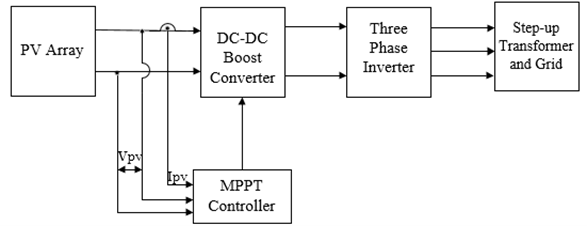
This paper focuses on the comparison of maximum power point tracking (MPPT) techniques for photovoltaic (PV) system that is interfaced with the utility grid via a three-phase voltage source inverter (VSI). Two algorithms for MPPT are presented: the Perturb and Observe (P&O) technique and the Incremental Conductance (INC) algorithm, which employ a DC-DC boost converter. The algorithms are designed to optimize the capture of power produced by the PV system by measuring the PV output power and adjust the converter’s duty cycle. The VSI in the system handles the conversion from DC to AC. It employs both an internal control loop and an external control loop to maintain the stability of the DC-link voltage and to ensure synchronization with the grid. The grid synchronization of system involves the use of Phase-Locked Loops (PLL) to achieve high accuracy in dynamic conditions. The MPPT algorithms are implemented purely in a simulated environment using the Matlab/Simulink package to illustrate the advantages of the presented MPPT methods in comparison to operating without MPPT under different meteorological conditions. The PV array simulation generally employs monocrystalline modules. The electrical parameters of the system comprise the maximum power point voltage (Vmpp), maximum power point current (Impp), open-circuit voltage (Voc), and short-circuit current (Isc). The system initiates operations under standard test conditions (STC) of 25°C and 1000 W/m² during the simulation, followed by variations in irradiance (G) and temperature (T) over time. The findings indicate that the P&O technique effectively tracks the maximum power point (MPP) and facilitates the extraction of further power throughout fluctuations under various meteorological conditions. Furthermore, the INC algorithm is determined to be more effective for achieving MPPT in relation to both the P&O method and the absence of MPPT under dynamic as well as steady-state conditions. The INC algorithm is shown to increase the PV output power at STC by 5.24% without utilizing MPPT, whereas the P&O algorithm achieves an enhancement of 3.24%. The results also reveal that the INC technique exhibits the highest performance, achieving approximately 99.72% efficiency, whereas P&O reaches nearly 97.62% efficiency at STC.
References
A. Ghilani, A. Terki, A. M. Ghodbane, Z. Alili, and O. Belaroussi, "Optimal Conversion Topologies for Grid-Connected PV Systems: A Comparative Study of Single-Stage and Two-Stage Configurations," ITEGAM-JETIA, vol. 12, pp. 408-415, 2026, https://doi.org/10.5935/jetia.v12i57.3027.
W. Jahnavi and C. S. JN, "A comprehensive review on application of ai algorithms for GRID connected Solar Photovoltaic Systems," ITEGAM-JETIA, vol. 10, pp. 87-95, 2024, https://doi.org/10.5935/jetia.v10i49.1248.
A. A. Z. Diab, I. Y. Fawzy, A. M. Elsawy, M. A. Tolba, and A. G. A. El–Magd, "Enhancing Voltage Stability in PV/Wind Power Systems with STATCOM Utilizing Fuzzy Controller," in 2025 7th International Youth Conference on Radio Electronics, Electrical and Power Engineering (REEPE), pp. 1-8, 2025, https://doi.org/10.1109/REEPE63962.2025.10971104.
M. Aslan, B. Afif, M. Salmi, B. Merabet, M. Berka, and S. Masoud, "Performance enhancement of microgrid systems using backstepping control for grid side converter and MPPT optimization," Solar Energy and Sustainable Development Journal, vol. 14, pp. 19-41, 2025, https://doi.org/10.51646/jsesd.v14i1.367.
A. Kaab, H. Ghasemi-Mobtaker, and M. Sharifi, "Photovoltaic integration for sustainable electricity in the agro-industrial sector: A techno-economic analysis," Energy Conversion and Management: X, p. 101773, 2026, https://doi.org/10.1016/j.ecmx.2026.101773.
M. Laimon and T. Yusaf, "Towards energy freedom: Exploring sustainable solutions for energy independence and self-sufficiency using integrated renewable energy-driven hydrogen system," Renewable Energy, vol. 222, p. 119948, 2024, https://doi.org/10.1016/j.renene.2024.119948.
H. Ghasemi-Mobtaker, F. S. Ataiee, A. Akram, and A. Kaab, "Feasibility study of using photovoltaic cells for a commercial hydroponic greenhouse: Energy analysis and life cycle assessment," E-Prime-Advances in Electrical Engineering, Electronics and Energy, vol. 8, p. 100597, 2024, https://doi.org/10.3390/engproc2025112025.
Z. Mohammed, T. Kaoutar, E. O. Abdelghani, and T. Belkacem, "Enhancing Grid-Connected Photovoltaic Power System Performance Using Fuzzy P&O Approach," Engineering Proceedings, vol. 112, p. 25, 2025, https://doi.org/10.3390/engproc2025112025.
M. S. Endiz, G. Gökkuş, A. E. Coşgun, and H. Demir, "A review of traditional and advanced MPPT approaches for PV systems under uniformly insolation and partially shaded conditions," Applied Sciences, vol. 15, p. 1031, 2025, https://doi.org/10.3390/app15031031.
M. H. Ali, M. Zakaria, and S. El-Tawab, "A comprehensive study of recent maximum power point tracking techniques for photovoltaic systems," Scientific Reports, vol. 15, p. 14269, 2025, https://doi.org/10.1038/s41598-025-96247-5.
G. N. Al Shabaan and I. S. Altarawneh, "Decoding Climatic Drivers of Solar Photovoltaic Output in Arid Climates: Integrating Sensitivity, Lag Dynamics, and Principal Component Analysis for Forecasting Accuracy," Sustainable Energy Technologies and Assessments, vol. 86, p. 104851, 2026, https://doi.org/10.1016/j.seta.2026.104851.
L. Yang and X. Fu, "A Review of Photovoltaic Uncertainty Modeling Based on Statistical Relational AI," Energies, vol. 19, p. 1509, 2026, https://doi.org/10.3390/en19061509.
A. A. AlZubaidi, L. A. Khaliq, H. S. Hamad, W. K. Al-Azzawi, M. S. Jabbar, and T. A. Shihab, "MPPT implementation and simulation using developed P&O algorithm for photovoltaic system concerning efficiency," Bulletin of Electrical Engineering and Informatics, vol. 11, pp. 2460-2470, 2022, https://doi.org/10.11591/eei.v11i5.3949.
M. W. Lotfy and A. I. Hussein, "Power extraction in photovoltaic systems using P&O-based MPPT with DC-DC buck converter integration," WSEAS Transactions on Electronics, vol. 16, pp. 51-59, 2025, https://doi.org/10.37394/232017.2025.16.6.
M. A. B. Siddique, D. Zhao, K. Ouahada, A. U. Rehman, and H. Hamam, "Performance validation of global MPPT for efficient power extraction through PV system under complex partial shading effects," Scientific reports, vol. 15, p. 17061, 2025, https://doi.org/10.1038/s41598-025-01816-3.
N. A. Ahmed, S. Abdul Rahman, and B. N. Alajmi, “Optimal controller tuning for P&O maximum power point tracking of PV systems using genetic and cuckoo search algorithms,” International Transactions on Electrical Energy Systems, vol. 31, no. 10, p. e12624, 2021, https://doi.org/10.1002/2050-7038.12624.
H. Shahid, M. Kamran, Z. Mehmood, M. Y. Saleem, M. Mudassar, and K. Haider, "Implementation of the novel temperature controller and incremental conductance MPPT algorithm for indoor photovoltaic system," Solar Energy, vol. 163, pp. 235-242, 2018, https://doi.org/10.1016/j.solener.2018.02.018.
A. Lemmassi, A. Derouich, A. Hanafi, A. Byou, M. Benmessaoud, and N. El Ouanjli, "Low-cost MPPT for triple-junction solar cells used in nanosatellites: A comparative study between P&O and INC algorithms," e-Prime-Advances in Electrical Engineering, Electronics and Energy, vol. 7, p. 100426, 2024, https://doi.org/10.1016/j.prime.2024.100426.
M. Ahmad, A. Numan, and D. Mahmood, "A comparative study of perturb and observe (P&O) and incremental conductance (INC) PV MPPT techniques at different radiation and temperature conditions," Engineering and Technology Journal, vol. 40, pp. 376-385, 2022, https://doi.org/10.30684/etj.v40i2.2189.
A. Rashid, "A Comprehensive Study on the Effectiveness of Perturb and Observe and Incremental Conductance MPPT Algorithms for Photovoltaic Systems in Dynamic Environments," in 2025 International Conference on Green Energy, Computing and Sustainable Technology (GECOST), pp. 1-5, 2025, https://doi.org/10.1109/GECOST66002.2025.11324634.
N. B. Malla and V. Parajuli, "Comparison of Incremental Conductance and Perturb and Observe Techniques of Maximum Power Point Tracking for PV Systems," International Journal of Research In Science & Engineering (IJRISE), 2023, https://doi.org/10.55529/ijrise.41.13.21.
B. Shuriya, S. Sivaraju, T. Anuradha, S. Srithar, and J. Chitra, "Renewable Energy Solutions for Virtual Environments," in Green Metaverse: Fuzzy Logic Approaches to Sustainable Virtual Worlds, pp. 135-152, 2026, https://doi.org/10.1007/978-3-032-08183-4_8.
I. Y. Fawzy, Y. Mohamad, E. Shehata, and M. Abd El Sattar, "A modified perturb and observe technique for MPPt of intgrated PV system using DC-DC boost converter," Journal of Advanced Engineering Trends, vol. 40, pp. 63-77, 2021, https://doi.org/10.21608/jaet.2021.82231.
A. Belaid, M. Guermoui, R. Khelifi, T. Arrif, T. Chekifi, A. Rabehi, et al., "Assessing suitable areas for PV power installation in remote agricultural regions," Energies, vol. 17, p. 5792, 2024, https://doi.org/10.3390/en17225792.
X. Zhong et al., "The Water Lifting Performance of a Photovoltaic Sprinkler Irrigation System Regulated by Solar-Coupled Compressed-Air Energy Storage," Agriculture, vol. 16, p. 154, 2026, https://doi.org/10.3390/agriculture16020154.
A. A. Aboukra and K. A. H. Lekhmaisi, "A Comparative Study Between Conventional Power Generation Plants and Renewable Energy Generation Technologies Using Solar (PV) Panels and Wind Energy in Libya," Libyan Open University Journal of Applied Sciences (LOUJAS), pp. 71-79, 2026, https://doi.org/10.65422/loujas.v2i1.171.
T. M. Abed, S. S. Eskander, M. A. Elsayes, and M. Zaki, "Design and Economic Assessment of a Sustainable Standalone Photovoltaic System for Hospital Lift Applications," Mansoura Engineering Journal, vol. 51, p. 11, 2026, https://doi.org/10.58491/2735-4202.3404.
R. K. Kumar and P. Samuel, "Efficient solar hydrogen generation using PEM electrolysis in a grid-connected system," International Journal of Hydrogen Energy, vol. 197, p. 152584, 2026, https://doi.org/10.1016/j.ijhydene.2025.152584.
J. A. Pinto et al., "A comparative analysis of thermosolar and photovoltaic systems for meeting residential hot water demands," Renewable Energy, vol. 244, p. 122652, 2025, https://doi.org/10.1016/j.renene.2025.122652.
J. F. Ardashir, M. Hasannezhad, H. V. Ghadim, and M. Sarhangzadeh, "Integration of energy storage systems with multilevel inverters for microgrids," in Distributed Energy Storage Systems for Digital Power Systems, pp. 293-318, 2025, https://doi.org/10.1016/B978-0-443-22013-5.00012-5.
S. Afonaa-Mensah, I. B. Majeed, and F. Odoi-Yorke, "Advancing the Adoption of Net Metering: An Economic Assessment of Grid‐Tied Solar Photovoltaic Systems in Urban Homes in Ghana," International Journal of Energy Research, vol. 2024, p. 9919076, 2024, https://doi.org/10.1155/2024/9919076.
F. Yang, K. Pan, C. Yan, X. Ji, and W. Xu, "Systematic Security Analysis of Sensors and Controls in PV Inverters: Threat Validation and Countermeasures," Sensors, vol. 25, p. 1493, 2025, https://doi.org/10.3390/s25051493.
H. Al Mahdi, P. G. Leahy, M. Alghoul, and A. P. Morrison, "A review of photovoltaic module failure and degradation mechanisms: Causes and detection techniques," in Solar, pp. 43-82, 2024, https://doi.org/10.3390/solar4010003.
P. B. Joshi and B. Bagde, "Comparative analysis between the Reference voltage P&O and the Reference voltage IC Method for MPPT," in 2026 International Conference on Electric Power and Renewable Energy (EPREC), pp. 1-5, 2026, https://doi.org/10.1109/EPREC66546.2026.11412329.
M. B. S. Bechekir¹, M. Brahami¹, H. Bendaho, and A. Brahimi, "Comparative Analysis of MPPT Algorithms: P&O and Inc for Optimizing PV Systems," Smart Computing and Control Renewable Energy Systems: Advanced Computational Techniques for Wireless Network Optimization, vol. 1238, p. 60, 2025, https://doi.org/10.1007/978-3-031-80301-7_8.
S. Bharti, R. Kumar, Monika, and U. Sinha, "Analysis and Comparison of the P&O and INC MPPT Techniques for Solar Energy Systems When Compared to Various Atmospheric Temperatures," in International Conference on Electric Power and Renewable Energy, pp. 311-325, 2023, https://doi.org/10.1007/978-981-99-9054-2_23.
D. Routray, P. K. Rout, and B. K. Sahu, "A brief review and comparative analysis of two classical MPPT techniques," in 2021 International Conference in Advances in Power, Signal, and Information Technology (APSIT), pp. 1-6, 2021, https://doi.org/10.1109/APSIT52773.2021.9641301.
L. Assiya, D. Aziz, and H. Ahmed, "Comparative study of P&O and INC MPPT algorithms for DC-DC Converter Based PV System on MATLAB/SIMULINK," in 2020 IEEE 2nd International Conference on Electronics, Control, Optimization and Computer Science (ICECOCS), pp. 1-5, 2020, https://doi.org/10.1109/ICECOCS50124.2020.9314498.
M. Shafiullah, S. D. Ahmed, and F. A. Al-Sulaiman, "Grid integration challenges and solution strategies for solar PV systems: A review," IEEE access, vol. 10, pp. 52233-52257, 2022, https://doi.org/10.1109/ACCESS.2022.3174555.
M. Killi and S. Samanta, "Modified perturb and observe MPPT algorithm for drift avoidance in photovoltaic systems," IEEE transactions on Industrial Electronics, vol. 62, pp. 5549-5559, 2015, https://doi.org/10.1109/TIE.2015.2407854.
M. Bošnjaković, R. Santa, Z. Crnac, and T. Bošnjaković, "Environmental impact of PV power systems," Sustainability, vol. 15, p. 11888, 2023, https://doi.org/10.3390/su151511888.
J. Zhao, Z. Xu, M.-K. Law, H. Heidari, S. O. Abdellatif, M. A. Imran, et al., "Simulation of crystalline silicon photovoltaic cells for wearable applications," IEEE Access, vol. 9, pp. 20868-20877, 2021, https://doi.org/10.1109/ACCESS.2021.3050431.
M. Dada and P. Popoola, "Recent advances in solar photovoltaic materials and systems for energy storage applications: a review," Beni-Suef University Journal of Basic and Applied Sciences, vol. 12, p. 66, 2023, https://doi.org/10.1186/s43088-023-00405-5.
A. Elsafi, A. A. Almohammedi, M. Balfaqih, Z. Balfagih, and S. Sabri, "Comparative analysis of maximum power point tracking methods for power optimization in grid tied photovoltaic solar systems," Discover Applied Sciences, vol. 7, p. 976, 2025, https://doi.org/10.1007/s42452-025-07606-w.
A. S. Al-Ezzi and M. N. M. Ansari, "Photovoltaic solar cells: a review," Applied System Innovation, vol. 5, p. 67, 2022, https://doi.org/10.3390/asi5040067.
A. K. Abdulrazzaq, G. Bognár, and B. Plesz, "Enhanced single-diode model parameter extraction method for photovoltaic cells and modules based on integrating genetic algorithm, particle swarm optimization, and comparative objective functions," Journal of Computational Electronics, vol. 24, p. 44, 2025, https://doi.org/10.1007/s10825-025-02282-w.
U. Younas, B. Akdemir, and A. A. Kulaksiz, "Modeling and simulation of a grid-connected PV system under varying environmental conditions," International Journal of Energy Applications and Technologies, vol. 6, pp. 17-23, 2019, https://doi.org/10.31593/ijeat.526377.
S. M. Belhadj, B. Meliani, H. Benbouhenni, I. Colak, Z. Elbarbary, and S. F. Al-Gahtani, "Control of three-level quadratic DC-DC boost converters for energy systems using various technique-based MPPT methods," Scientific Reports, vol. 15, p. 14631, 2025, https://doi.org/10.1038/s41598-025-99551-2.
S. Muthubalaji, G. Devadasu, S. Srinivasan, and N. Soundiraraj, "Development and validation of enhanced fuzzy logic controller and boost converter topologies for a single phase grid system," Electrical Engineering & Electromechanics, pp. 60-66, 2022, https://doi.org/10.20998/2074-272X.2022.5.10.
D. Lakshmi, S. Sathishkumar, R. Sreedhar, G. Vasumathi, M. M. Irfan, and M. Balasubramanian, "Enhanced solar PV system with battery storage and grid integration using cascaded ANFIS-based MPPT and self-lift Luo converter," in 2025 3rd International Conference on Device Intelligence, Computing and Communication Technologies (DICCT), pp. 361-366, 2025, https://doi.org/10.1109/DICCT64131.2025.10986645.
A. S. Jaber, M. Ismael, T. Rashid, M. A. Sarhan, M. Rasheed, and I. M. Sala, "Comparesion the electrical parameters of photovoltaic cell using numerical methods," Eureka: Physics and Engineering, pp. 29-39, 2023, https://doi.org/10.21303/2461-4262.2023.002770.
N. M. Kumar, M. P. Subathra, and J. E. Moses, "On-Grid Solar Photovoltaic System: Components, Design Considerations, and Case Study," in 2018 4th International Conference on Electrical Energy Systems (ICEES), pp. 616-619, 2018, https://doi.org/10.1109/ICEES.2018.8442403.
A. A. El Halim and E. H. Bayoumi, "Using a New Combination of P&O and ICM Methods for the Experimental Validation of MPPT Efficacy," Journal Européen des Systèmes Automatisés, vol. 54, 2021, https://doi.org/10.18280/jesa.540601.
A. Cordeiro et al., “Automated solar PV simulation system supported by DC–DC power converters,” Designs, voll 7, no. 2, p. 36, 2023, https://doi.org/10.3390/designs7020036.
B. Adel, M. Tarek, and K. Samia, "Evaluation of pulse width modulation techniques to reduce total harmonic distortion in grid-connected PV systems," International Journal of Power Electronics and Drive Systems(IJPEDS), vol. 16, p. 564, 2025, https://doi.org/10.11591/ijpeds.v16.i1.pp564-574.
M. S. Endiz, "Comparative analysis of P&O and IC MPPT techniques under different atmospheric conditions," El-Cezeri, vol. 10, pp. 27-35, 2023, https://doi.org/10.31202/ecjse.1101526.
S. Kart, "Power Ripple Reduction in Cascade Boost Converters Using PI-Based MPPT Control for Solar Cells," Tehnički vjesnik, vol. 33, pp. 451-457, 2026, https://doi.org/10.17559/TV-20241121002148.
S. Xu, Y. Gao, G. Zhou, and G. Mao, "A global maximum power point tracking algorithm for photovoltaic systems under partially shaded conditions using modified maximum power trapezium method," IEEE Transactions on industrial electronics, vol. 68, pp. 370-380, 2020, https://doi.org/10.1109/TIE.2020.2965498.
A. Sadick, "Maximum power point tracking simulation for photovoltaic systems using perturb and observe algorithm," in Solar Radiation-Enabling Technologies, Recent Innovations, and Advancements for Energy Transition, 2023, https://doi.org/10.5772/intechopen.111632.
M. Algarbalje and A. Gün, "A Novel Framework for Power Extraction Enhancement in PV Systems Based on Hybrid ACO-ANN Optimization," Electronics, vol. 15, p. 649, 2026, https://doi.org/10.3390/electronics15030649.
F. A. Pamuji et al., “Design and Implementation of Boost Converter for Maximum Power Point Tracking Based on Fuzzy Logic Controller in Photovoltaic System,” In 2025 International Seminar on Intelligent Technology and Its Applications (ISITIA), pp. 708-713, 2025, https://doi.org/10.1109/ISITIA66279.2025.11137530.
N. Dasgupta, A. Pandey, and A. K. Mukerjee, "Voltage-sensing-based photovoltaic MPPT with improved tracking and drift avoidance capabilities," Solar Energy Materials and Solar Cells, vol. 92, pp. 1552-1558, 2008/12/01/ 2008, https://doi.org/10.1016/j.solmat.2008.06.020.
M. L. Katche, A. B. Makokha, S. O. Zachary, and M. S. Adaramola, “A comprehensive review of maximum power point tracking (mppt) techniques used in solar pv systems,” Energies, vol. 16, no. 5, p. 2206, 2023, https://doi.org/10.3390/en16052206.
M. Değermenci, Y. Yalman, and K. Olcay, "MPPT algorithms for grid-connected solar systems including deep learning approaches," Scientific Reports, 2026, https://doi.org/10.1038/s41598-026-36321-8.
A. Pallavee Bhatnagar and B. Nema, "Conventional and global maximum power point tracking techniques in photovoltaic applications: A review," Journal of Renewable and Sustainable Energy, vol. 5, p. 032701, 2013, https://doi.org/10.1063/1.4803524.
M. Bouksaim, M. Mekhfioui, and M. N. Srifi, "A Comprehensive Decade-Long Review of Advanced MPPT Algorithms for Enhanced Photovoltaic Efficiency," in Solar, p. 44, 2025, https://doi.org/10.3390/solar5030044.
S. Y. Prasad, B. B. Chhetri, B. Adhikary, and D. Bista, "Microcontroller based intelligent DC/DC converter to track Maximum Power Point for solar photovoltaic module," in 2010 IEEE Conference on Innovative Technologies for an Efficient and Reliable Electricity Supply, pp. 94-101, 2010, https://doi.org/10.1109/CITRES.2010.5619859.
F. Tahiri, A. Harrouz, G. E. Bostanci, M. A. Hartani, A. Badoud, S. Zemitte, et al., "Comparative analysis of the MPPT methods employed in the PV system, involving incremental conductance control and sliding mode control," in 2023 Second International Conference on Energy Transition and Security (ICETS), pp. 1-5, 2023, https://doi.org/10.1109/ICETS60996.2023.10410778.
L. Guanghua, A. M. Soomar, S. H. H. Shah, S. Shaikh, and P. Musznicki, "Maximum power point tracking strategies for solar PV systems: A review of current methods and future innovations," Results in Engineering, vol. 28, p. 107227, 2025, https://doi.org/10.1016/j.rineng.2025.107227.
K. Bouguerra, S. Latreche, M. Khemliche, and H. Khemliche, "PV system MPPT control: a comparative analysis of P&O, IncCond, SMC and FLC algorithms," Informatyka, Automatyka, Pomiary W Gospodarce I Ochronie Środowiska, vol. 14, pp. 52-62, 2024, https://doi.org/10.35784/iapgos.6152.
A. Boubakir, S.-A. Touil, S. Labiod, and N. Boudjerda, "A robust model-free controller for a three-phase grid-connected photovoltaic system based on ultra-local model," Protection and Control of Modern Power Systems, vol. 6, p. 43, 2021, https://doi.org/10.1186/s41601-021-00218-7.
D. C. Martins, "Analysis of a Three‐Phase Grid‐Connected PV Power System Using a Modified Dual‐Stage Inverter," International Scholarly Research Notices, vol. 2013, p. 406312, 2013, https://doi.org/10.1155/2013/406312.
M. H. Mohamed Hariri, M. Salem, M. K. Mohd Jamil, M. N. Abdullah, and M. K. Mat Desa, "Modeling and analysis of 100 kW two-stage three-phase grid-connected PV generation system under absurd atmospheric and grid disturbances," Plos one, vol. 20, p. e0323269, 2025, https://doi.org/10.1371/journal.pone.0323269.
Published
How to Cite
Issue
Section
License
Copyright (c) 2026 Haitham Ibrahim Elbahat, Ibram Y. Fawzy, Ahmed A. Zaki Diab, Hamdy Sultan, Ahmed Kassem, Alfian Maarif, Mahmoud A. Mossa

This work is licensed under a Creative Commons Attribution-ShareAlike 4.0 International License.
Authors who publish with this journal agree to the following terms:
- Authors retain copyright and grant the journal right of first publication with the work simultaneously licensed under a Creative Commons Attribution License that allows others to share the work with an acknowledgment of the work's authorship and initial publication in this journal.
- Authors are able to enter into separate, additional contractual arrangements for the non-exclusive distribution of the journal's published version of the work (e.g., post it to an institutional repository or publish it in a book), with an acknowledgment of its initial publication in this journal.
- Authors are permitted and encouraged to post their work online (e.g., in institutional repositories or on their website) prior to and during the submission process, as it can lead to productive exchanges, as well as earlier and greater citation of published work (See The Effect of Open Access).

This journal is licensed under a Creative Commons Attribution-ShareAlike 4.0 International License.