A Compact Wideband Microstrip-Fed Planar Slot Antenna with Partial Defected Ground Structure for 2.7–12 GHz Wireless Applications
DOI:
https://doi.org/10.12928/biste.v8i3.15913Keywords:
Wideband Antenna, Wireless Communications, Defected Ground Structure, Planar Slot Antenna, Sub-6 GHz 4G/5GAbstract
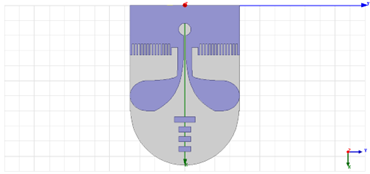
This paper presents the design and numerical investigation of a compact wideband microstrip-fed planar slot antenna for broadband wireless communication applications. The antenna is designed on a low-cost FR-4 substrate with a compact planar configuration, making it suitable for space-constrained and economical wireless devices. In the initial design stage, a reference microstrip-fed antenna is developed and shown to operate from 3.25 to 11.6 GHz under the −10 dB impedance bandwidth criterion. The antenna is then optimized through a systematic trial-and-error parametric refinement process involving modifications of the radiator profile, feed-line geometry, slot configuration, and partial defected ground structure. To further enhance radiation performance, three compact rectangular parasitic directors are arranged in front of the main radiating structure with optimized spacing to improve forward radiation and gain. Full-wave electromagnetic simulations are carried out using Ansys High Frequency Structure Simulator (HFSS). The final optimized antenna achieves a continuous −10 dB impedance bandwidth from 2.7 to 12 GHz, covering the ultra-wideband (UWB) spectrum as well as several sub-6 GHz fourth-generation/fifth-generation (4G/5G) communication bands. The optimized antenna exhibits simulated gains of approximately 5.53 dB, 6.97 dB, and 6.19 dB at 6.7 GHz, 8.7 GHz, and 10.7 GHz, respectively, showing an overall improvement compared with the reference design. The radiation patterns remain reasonably stable across the investigated lower, middle, and upper frequency regions of the operating band, with quasi-omnidirectional characteristics and improved forward radiation due to the director elements. Compared with several reported wideband microstrip antenna designs, the proposed antenna offers a favorable combination of wide impedance bandwidth, compact structure, low-cost substrate realization, and enhanced gain. Therefore, the proposed antenna is a promising candidate for modern broadband wireless systems, including UWB and sub-6 GHz 4G/5G applications.
References
A. Hassan et al., “Design strategies and performance of IoT antennas: A comprehensive review,” Discover Computing, vol. 28, no. 1, p. 39, 2025, https://doi.org/10.1007/s10791-025-09536-y.
M. S. Khan, A. Iftikhar, R. M. Shubair, A.-D. Capobianco, B. D. Braaten, and D. E. Anagnostou, “Eight-element compact UWB-MIMO/diversity antenna with WLAN band rejection for 3G/4G/5G communications,” IEEE Open Journal of Antennas and Propagation, vol. 1, pp. 196–206, 2020, https://doi.org/10.1109/OJAP.2020.2991522.
S. Singh, M. Kumar, and R. Kumar, “Powering the future: A survey of ambient RF-based communication systems for next-gen wireless networks,” IET Wireless Sensor Systems, vol. 14, no. 6, pp. 265–292, 2024, https://doi.org/10.1049/wss2.12094.
T. S. Rappaport, T. E. Humphreys, and S. Nie, “Spectrum opportunities for the wireless future: From direct-to-device satellite applications to 6G cellular,” npj Wireless Technologies, vol. 1, no. 1, p. 8, 2025, https://doi.org/10.1038/s44459-025-00008-9.
Y. O. Imam-Fulani et al., “5G frequency standardization, technologies, channel models, and network deployment: Advances, challenges, and future directions,” Sustainability, vol. 15, no. 6, p. 5173, 2023, https://doi.org/10.3390/su15065173.
D. M. John, S. Vincent, S. Pathan, P. Kumar, and T. Ali, “Flexible antennas for a sub-6 GHz 5G band: A comprehensive review,” Sensors, vol. 22, no. 19, p. 7615, 2022, https://doi.org/10.3390/s22197615.
M. M. Ismail, B. B. Q. Elias, B. S. Bashar, T. A. Elwi, Z. A. Rhazali, and H. Misran, “Frequency reconfigurable using CLRH for 5G sub-6 GHz wireless application,” Iraqi Journal of Information and Communication Technology, vol. 8, no. 3, pp. 62–72, 2025, https://doi.org/10.31987/ijict.8.3.330.
N. Qasem, H. M. Marhoon, and N. F. Abdul Malek, “A graphene-based rectangular-notched UWB antenna with reconfigurable notch,” International Journal on Engineering Applications, vol. 13, no. 3, 2025, https://doi.org/10.15866/irea.v13i3.24249.
D. Bepari et al., “Fluid antennas: Pioneering a new era in next-generation wireless communications,” IEEE Communications Surveys & Tutorials, vol. 28, pp. 5596–5631, 2026, https://doi.org/10.1109/COMST.2026.3678505.
A. Sivasangari et al., “Design and electromagnetic analysis of photonic crystal based microstrip patch antenna for next generation wireless systems,” Scientific Reports, 2026, https://doi.org/10.1038/s41598-026-48569-1.
A. Hassan et al., “Designs strategies and performance of IoT antennas: A comprehensive review,” Discover Computing, vol. 28, no. 39, 2025, https://doi.org/10.1007/s10791-025-09536-y.
M. Marzouk, Y. Rhazi, I. H. Nejdi, F.-E. Zerrad, M. Saih, S. Ahmad, A. Ghaffar, and M. Hussein, “Ultra-wideband compact fractal antenna for WiMAX, WLAN, C and X band applications,” Sensors, vol. 23, no. 9, p. 4254, 2023, https://doi.org/10.3390/s23094254.
Y. Albaihani, R. Akram, E. A. Hajlaoui, A. M. Almohaimeed, Z. M. Almohaimeed, and A. Albaihani, “5.8 GHz microstrip patch antennas for wireless power transfer: A comprehensive review of design, optimization, applications, and future trends,” Electronics, vol. 15, no. 2, p. 311, 2026, https://doi.org/10.3390/electronics15020311.
M. Edries et al., “Compact and low mutual coupling 4 × 4 wideband MIMO antenna design for 5G millimeter-wave applications,” Scientific Reports, vol. 16, p. 9804, 2026, https://doi.org/10.1038/s41598-026-39770-3.
M. V. Yadav, C. Kumar R, S. V. Yadav, T. Ali, and J. Anguera, “A miniaturized antenna for millimeter-wave 5G-II band communication,” Technologies, vol. 12, no. 1, p. 10, 2024, https://doi.org/10.3390/technologies12010010.
K. PriethamjeVithya, L. M. Varalakshmi, S. S., P. K., and S. L. V., “4 port MIMO antenna for 5G and Wi-Fi integration in smart device applications,” in Proc. 2026 6th International Conference on Expert Clouds and Applications (ICOECA), pp. 17–22, 2026, https://doi.org/10.1109/ICOECA68095.2026.11485592.
J. P. Siyara, M. N. Jivani, S. P. Lavadiya, and S. K. Patel, “Design and diversity parameter analysis of metamaterial-inspired quad-port MIMO antenna structure for sub-6 GHz 5G wireless communication application,” Journal of Electromagnetic Waves and Applications, vol. 40, no. 6, pp. 876–906, 2026, https://doi.org/10.1080/09205071.2025.2611285.
H. M. Marhoon, H. Al-Rammahi, N. Basil, N. Qasem, and B. M. Tarik, “Towards intelligent control architectures: A systematic review of Internet of Things applications in control systems,” Iraqi Journal of Information and Communication Technology, vol. 9, no. 1, pp. 1–29, 2026, https://doi.org/10.31987/ijict.9.1.373.
F. A. Salman and B. M. Sabbar, “DOA estimation exploiting moving platform of unfolded coprime array,” International Journal of Intelligent Engineering and Systems, vol. 15, no. 2, pp. 532–542, 2022, https://doi.org/10.22266/ijies2022.0430.47.
J. MP, T. P. Surekha, and S. Kumar AJ, “Innovative designs and performance evaluation of super wideband MIMO antennas: A survey,” Nondestructive Testing and Evaluation, vol. 41, no. 2, pp. 635–666, 2026, https://doi.org/10.1080/10589759.2024.2447387.
L. F. Guerrero-Vásquez, N. A. Chacón-Reino, S. D. Tenezaca-Angamarca, P. A. Chasi-Pesantez, and J. O. Ordoñez-Ordoñez, “Advancements in antenna and rectifier systems for RF energy harvesting: A systematic review and meta-analysis,” Applied Sciences, vol. 15, no. 14, p. 7773, 2025, https://doi.org/10.3390/app15147773.
M. S. Yahya, S. Soeung, S. K. A. Rahim, U. Musa, S. S. B. Hashwan, Z. Yunusa, and S. A. Hamzah, “LoRa microstrip patch antenna: A comprehensive review,” Alexandria Engineering Journal, vol. 103, pp. 197–221, 2024, https://doi.org/10.1016/j.aej.2024.06.017.
Y. S. Gurbet and S. Doğu, “Comprehensive review of Ku, K, and Ka band antenna designs: Applications in CubeSats,” International Journal of Aeronautical and Space Sciences, vol. 27, pp. 447–496, 2026, https://doi.org/10.1007/s42405-025-00989-5.
B. Mishra, A. K. Singh, T. Y. Satheesha, R. K. Verma, and V. Singh, “From past to present: A comprehensive review of antenna technology in modern wireless communication,” Journal of Engineering Science & Technology Review, vol. 17, no. 3, 2024, https://doi.org/10.25103/jestr.173.20.
C. Singh et al., “A comprehensive survey on millimeter wave antennas at 30/60/120 GHz: Design, challenges and applications,” Wireless Personal Communications, vol. 133, pp. 1547–1584, 2023, https://doi.org/10.1007/s11277-023-10828-z.
A. Alsudani and H. M. Marhoon, “Design and enhancement of microstrip patch antenna utilizing mushroom-like EBG for 5G communications,” Journal of Communications, vol. 18, no. 3, pp. 156–163, 2023, https://doi.org/10.12720/jcm.18.3.156-163.
B. S. Taha and H. M. Marhoon, “Simulation and manufacturing of modified circular monopole microstrip antenna for UWB applications,” International Journal of Advanced and Applied Sciences, vol. 10, no. 1, pp. 70–78, 2021, https://doi.org/10.11591/ijaas.v10.i1.
T. Doloi, G. S. Das, P. P. Kalita, Y. Beria, R. Devi, and A. Buragohain, “Compact MIMO antenna employing inductive–capacitive coupling and honeycomb defected ground structure,” AEU – International Journal of Electronics and Communications, p. 156208, 2026, https://doi.org/10.1016/j.aeue.2026.156208.
H. Ahmadi et al., “Ultra-wideband unidirectional pseudospin-polarized waveguide with dual boundary conditions,” Scientific Reports, vol. 15, p. 6717, 2025, https://doi.org/10.1038/s41598-025-91489-9.
A. Azzouz, R. Bouhmidi, M. E. Munir, M. Sheraz, T. C. Chuah, and I. E. Lee, “Dual-band terahertz MIMO antenna using DGS for UWB applications,” Results in Optics, p. 100968, 2026, https://doi.org/10.1016/j.rio.2026.100968.
H. M. Marhoon, N. Qasem, N. Basil, and A. R. Ibrahim, “Design and simulation of a compact metal–graphene frequency reconfigurable microstrip patch antenna with FSS superstrate for 5G applications,” International Journal on Engineering Applications, vol. 10, no. 3, pp. 193–201, 2022, https://doi.org/10.15866/irea.v10i3.21752.
A. S. Kamel and A. S. Jalal, “Reconfigurable monopole antenna design based on fractal structure for 5G applications,” Iraqi Journal of Information and Communication Technology, vol. 1, no. 1, pp. 177–186, 2021, https://doi.org/10.31987/ijict.1.1.159.
A. Alsudani and H. M. Marhoon, “Performance enhancement of microstrip patch antenna based on frequency selective surface substrate for 5G communication applications,” Journal of Communications, vol. 17, no. 10, pp. 851–856, Oct. 2022, https://doi.org/10.12720/jcm.17.10.851-856.
L. C. Paul, S. C. Das, T. Rani, S. M. Muyeen, S. A. Shezan, and M. F. Ishraque, “A slotted plus-shaped antenna with a DGS for 5G Sub-6 GHz/WiMAX applications,” Heliyon, vol. 8, no. 12, p. e12040, 2022, https://doi.org/10.1016/j.heliyon.2022.e12040.
D. S. First, N. Kashyap, and A. Thakur, “Design and optimization of a hexagonal-slotted wideband microstrip antenna for 5G networks RF energy harvesting,” Franklin Open, p. 100409, 2025, https://doi.org/10.1016/j.fraope.2025.100409.
M. L. El Issawi, D. Konditi, and A. D. Usman, “Design of enhanced wide band microstrip patch antenna based on defected ground structures (DGS) for sub-6 GHz applications,” Int. J. Electrical and Electronics Research, vol. 12, no. 1, pp. 315–321, 2024, https://doi.org/10.37391/IJEER.120143.
N. O. Parchin, H. J. Basherlou, and R. A. Abd-Alhameed, “UWB microstrip-fed slot antenna with improved bandwidth and dual notched bands using protruded parasitic strips,” Progress in Electromagnetics Research C, vol. 101, pp. 261–273, 2020, https://doi.org/10.2528/PIERC20040701.
I. U. Din, W. Ullah, N. A. Abbasi, S. Ullah, W. Shihzad, B. Khan, and D. N. K. Jayakody, “A novel compact ultra-wideband frequency-selective surface-based antenna for gain enhancement applications,” J. Electromagnetic Engineering and Science, vol. 23, no. 2, pp. 188–201, 2023, https://doi.org/10.26866/jees.2023.2.r.159.
T. O. Olawoye and P. Kumar, “A high gain antenna with DGS for sub-6 GHz 5G communications,” Advanced Electromagnetics, vol. 11, no. 1, pp. 41–50, 2022, https://doi.org/10.7716/aem.v11i1.1670.
A. Singh and S. Joshi, “Design of Y-shaped tri-band rectangular slot DGS patch antenna at sub-6 GHz frequency range for 5G communication,” Journal of Engineering and Applied Science, vol. 71, p. 144, 2024, https://doi.org/10.1186/s44147-024-00476-w.
M. F. Ahmed and M. H. Kabir, “An analysis of methods for enhancing gain and bandwidth in ultra-wideband microstrip patch antennas,” Cureus Journals, vol. 2, no. 1, 2025, https://doi.org/10.7759/s44388-025-03326-4.
W. Sun and Y. Li, “Gain stabilization method for wideband slot-coupled microstrip antenna,” IEEE Transactions on Antennas and Propagation, vol. 69, no. 12, pp. 8932–8936, 2021, https://doi.org/10.1109/TAP.2021.3097441.
J. Yeo and J.-I. Lee, “Gain enhancement of microstrip patch array antennas using two metallic plates for 24 GHz radar applications,” Electronics, vol. 12, no. 7, Art. 1512, 2023, https://doi.org/10.3390/electronics12071512.
H. M. Marhoon, H. A. Abdulnabi, and Y. Y. Al-Aboosi, “Designing and analysing of a modified rectangular microstrip patch antenna for microwave applications,” Journal of Communications, vol. 17, no. 8, pp. 668–674, 2022, https://doi.org/10.12720/jcm.17.8.668-674.
N. Qasem and H. M. Marhoon, “Simulation and optimization of a tuneable rectangular microstrip patch antenna based on hybrid metal–graphene and FSS superstrate for fifth-generation applications,” TELKOMNIKA (Telecommunication Computing Electronics and Control), vol. 18, no. 4, pp. 1719–1730, 2020, https://doi.org/10.12928/telkomnika.v18i4.14988.
T. Nahar and S. Rawat, “Efficiency enhancement techniques of microwave and millimeter‐wave antennas for 5G communication: A survey,” Transactions on Emerging Telecommunications Technologies, vol. 33, no. 9, p. e4530, 2022, https://doi.org/10.1002/ett.4530.
A. Tiwari, A. A. Khurshid, and K. Sharma, “Compact wearable microstrip antenna design using hybrid quasi-Newton and Taguchi optimization,” Scientific Reports, vol. 15, p. 116, 2025, https://doi.org/10.1038/s41598-024-83864-9.
E. D. Hussein, N. Qasem, M. S. Jameel, M. Ilyas and O. Bayat, "Performance Optimization of Microstrip Patch Antenna Using Frequency Selective Surfaces for 60 GHz," 2020 28th Signal Processing and Communications Applications Conference (SIU), pp. 1-4, 2020, https://doi.org/10.1109/SIU49456.2020.9302486.
H. Wei, W. Chen, J. Lv, G. Shen, and X. Xu, “Compact N-shaped metasurface microstrip antenna designed for the 5G/B5G communications,” International Journal of Communication Systems, vol. 39, no. 1, p. e70309, 2026, https://doi.org/10.1002/dac.70309.
H. M. Marhoon and N. Qasem, “Simulation and optimization of tuneable microstrip patch antenna for fifth-generation applications based on graphene,” International Journal of Electrical and Computer Engineering, vol. 10, no. 5, pp. 5546–5558, 2020, https://doi.org/10.11591/ijece.v10i5.
Published
How to Cite
Issue
Section
License
Copyright (c) 2026 Rami Abduimawjood Mohammed, Uttam Laxman Bombale

This work is licensed under a Creative Commons Attribution-ShareAlike 4.0 International License.
Authors who publish with this journal agree to the following terms:
- Authors retain copyright and grant the journal right of first publication with the work simultaneously licensed under a Creative Commons Attribution License that allows others to share the work with an acknowledgment of the work's authorship and initial publication in this journal.
- Authors are able to enter into separate, additional contractual arrangements for the non-exclusive distribution of the journal's published version of the work (e.g., post it to an institutional repository or publish it in a book), with an acknowledgment of its initial publication in this journal.
- Authors are permitted and encouraged to post their work online (e.g., in institutional repositories or on their website) prior to and during the submission process, as it can lead to productive exchanges, as well as earlier and greater citation of published work (See The Effect of Open Access).

This journal is licensed under a Creative Commons Attribution-ShareAlike 4.0 International License.